Dark Living Room Ideas: Moody Living Rooms That Feel Cozy
A dark living room works when walls sit at an LRV of 5–15, lighting runs on three low-level circuits at 2700K and 30–40 percent of surfaces stay light. Here are the colors, lighting specs and layouts that keep a moody living room cozy.
Part of our guide: Home Interior Design Ideas: House Styles, Rooms & Layouts
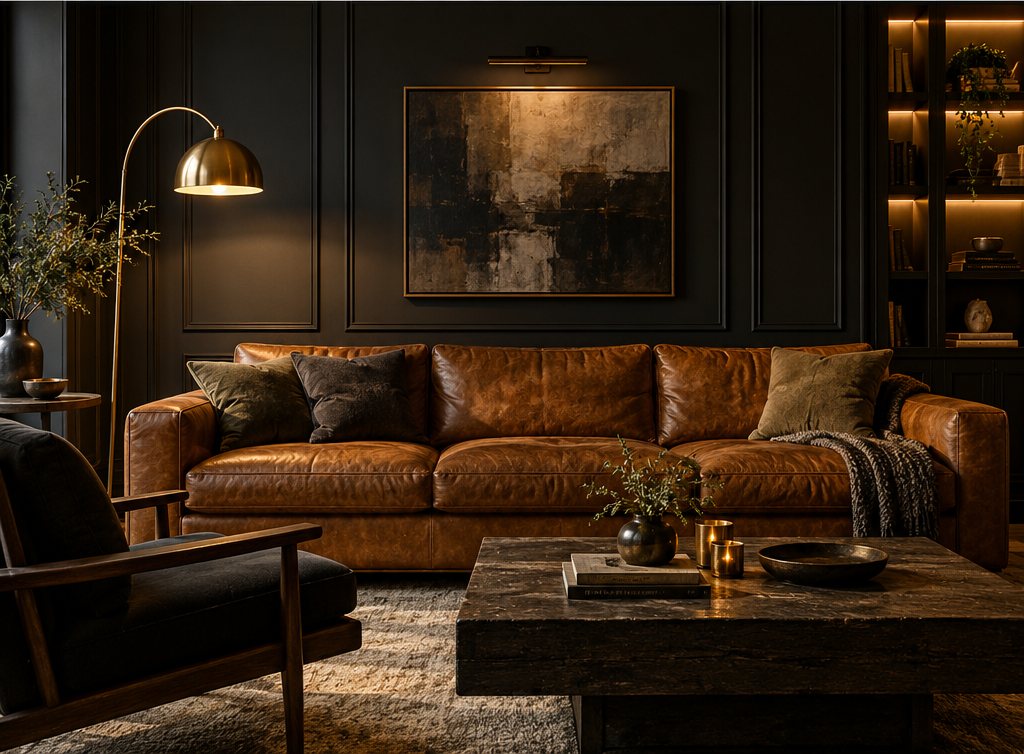
Key takeaways
- Dark living room walls should sit at an LRV of 5–15; paint the trim and ceiling the same color to remove the hard edges that make a room feel small
- Light a moody living room with 3 circuits of low-level light at 2700K and 4–8 lamps, never one bright ceiling fixture
- Keep 30–40 percent of the room light or reflective: a pale rug, oat upholstery, brass, mirror or a stone table
- Matte and limewash finishes hide imperfections on dark walls; eggshell and satin show every roller mark
- Dark colors work in any size of living room, including small ones, as long as the floor stays lighter than the walls
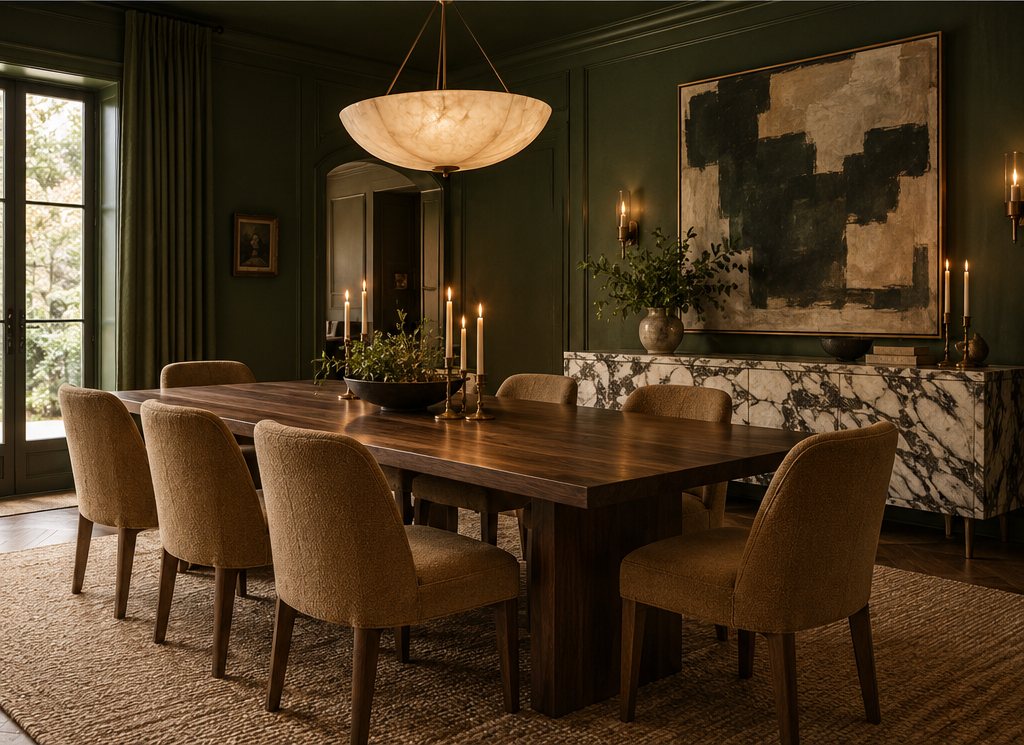
A dark living room is painted or paneled in colors with a light reflectance value (LRV) of 5–15, such as charcoal, ink, forest green, aubergine or chocolate, then balanced with warm low-level lighting at 2700K and 30–40 percent lighter surfaces. Done right, a dark moody living room feels enveloping and expensive; done wrong, it feels like a cave. The difference comes down to finish, lighting and contrast.
Dark walls in the living room went from a bold move to a mainstream one over the last few years, and in 2027 they are among the strongest directions in our living room trends report. The technique is called color drenching when walls, trim and ceiling all get the same shade, and our color drenching guide explains that method. Here we focus on dark living room ideas specifically: which colors, which finishes, how to light them and how to furnish them.
- Wall LRV: 5–15 for a genuinely dark room; 15–25 for a deep but mid-toned "moody" room.
- Finish: matte, flat or limewash; avoid eggshell and satin on large dark walls.
- Lighting: 3 circuits, 2700K, CRI 90+, 4–8 lamps and sconces, all dimmable.
- Contrast ratio: 60–70 percent dark, 30–40 percent light or textured surfaces.
- Floor: keep it lighter than the walls, or cover it with a pale rug that runs under the seating.
Does a dark living room make the room feel smaller?
No. A dark living room makes the walls recede and the corners disappear, which usually makes the room feel larger and deeper, not smaller; what makes a dark room feel small is contrast at the edges. When a charcoal wall meets white trim and a white ceiling, the eye reads every corner and the box shrinks. When the trim, ceiling, radiators and doors all take the same dark color, the boundaries blur and the room becomes a space rather than a container. That is why the first rule of dark walls in a living room is to paint everything, including the ceiling, the picture rail and the back of the door.
Dark colors also absorb light rather than bounce it, so a north-facing room painted ink blue at an LRV of 8 will feel different at noon than a south-facing room in the same color. Neither is wrong. The north-facing room becomes a den; the south-facing room keeps a glow on the walls through the day. Small cozy dark living rooms, under 150 sq ft (14 m²), work best when the floor is light, the ceiling is painted the same color as the walls and the window has no heavy curtain blocking the daylight.
Which colors work best for dark moody living room walls?
The colors that work best are warm or green-leaning darks with some gray in them, because pure blacks and cold navies turn flat under artificial light. Aim for an LRV between 5 and 15, and test each one on all four walls for two days before committing. These are the families we specify most for moody living room ideas:
| Color family | Typical LRV | Reads as | Pairs with | Best light |
|---|---|---|---|---|
| Charcoal / soft black | 5–9 | Modern, gallery-like | Oat, camel, brass, pale oak | South or west |
| Ink / midnight blue | 6–10 | Classic, elegant | Rust, cognac leather, cream, walnut | Any; warms under lamps |
| Forest / bottle green | 7–12 | Cozy, English-library | Mustard, terracotta, brass, cherry | North or east |
| Aubergine / plum | 6–11 | Luxurious, theatrical | Blush, olive, gold, black marble | Evening rooms |
| Chocolate / espresso | 5–10 | Warm, 1970s-modern | Cream, caramel, tan leather, travertine | Any |
| Oxblood / deep burgundy | 6–10 | Rich, traditional | Sage, bone, antique brass | North |
| Slate / deep teal | 8–14 | Calm, coastal-moody | Sand, white oak, chrome | South |
| Olive / deep khaki | 10–16 | Earthy, soft | Clay, ivory, black, rattan | Any |
#2B2D2F#1F2A3C#2E3F32#3A2A33#3B2A22#4A2B2B#5B5B46Dark modern living rooms tend to use charcoal, espresso or slate; dark eclectic interior design leans on green, aubergine and oxblood, where pattern and collected objects stand out against the depth. For a complete set of coordinated schemes, see our 2027 color palettes and the palette library.
What paint finish should you use on dark walls?
Use a matte or flat finish, or a limewash, for dark living room walls; the lower the sheen, the more the color reads as pigment and the less the surface shows roller marks, patching and glare from lamps. Dark paint shows every flaw that a pale paint hides, because any sheen reflects light at a different angle wherever the surface changes. A dark eggshell wall under a floor lamp looks striped. The paint sheen guide explains the full ladder; for dark colors the practical rules are:
- Walls: flat or matte, in a scrubbable formula if the room gets heavy use.
- Trim, doors and radiators: same color, one step up in sheen (eggshell or satin) for wipeability; or matte everywhere for the fully drenched look.
- Ceiling: flat, same color or 10–15 percent lighter in the same hue.
- Coverage: dark colors need a tinted primer and two to three top coats; budget 25–35 percent more paint than the paint calculator suggests for a pale color.
Limewash and mineral paints deserve a mention. A limewashed charcoal or deep green wall has cloudy variation that reads as plaster and gives the moody room an aged, textured depth that flat paint cannot. It costs roughly double a standard paint job, at $3–6 per sq ft applied, and works best on smooth walls.
How do you light a moody living room so it stays cozy?
Light a dark living room with many low sources rather than one bright one: three circuits, 4–8 lamps and sconces, all at 2700K or warmer, all on dimmers, and no downlight in the center of the ceiling. This is the step that separates a cozy moody living room from a gloomy one. Dark walls absorb 85–95 percent of the light that hits them, so a single ceiling fixture bright enough to light the room will glare while the corners stay black. Pools of lamp light, by contrast, make the darkness feel intentional.
The three circuits
- Ambient: a cove, an uplighter or two or three wall washers aimed at the ceiling, 2700K, delivering 3–6 lumens per sq ft, which is half what you would use in a white room. Keep this on a dimmer and run it at 30–50 percent most evenings.
- Task and pools: table lamps at either end of the sofa, a floor lamp by the reading chair and a lamp on a console, each 400–800 lumens with a fabric or linen shade. Wire them to one switched circuit so they come on together.
- Accent: picture lights over art, a sconce pair flanking the fireplace or a bookcase, and 2–3 small LED spots grazing a textured wall, at 2200–2700K. Our wall sconces guide covers mounting heights, and the lighting layering guide goes deeper on all three.
Shade choice matters in a dark room. Opaque shades throw light up and down and leave the walls dark; linen or paper shades glow and warm the wall behind them. Use mostly glowing shades, with one or two opaque ones for drama. Size the total output with the lighting calculator and then plan to run it at a third of its capacity.
How do you keep a dark living room from feeling gloomy?
Keep 30–40 percent of the visible surfaces light, warm or reflective, and keep the texture count high; darkness without contrast is gloom, darkness with contrast is atmosphere. The pieces that do the work:
- A pale rug: oat, cream or sand wool, sized to run under the front legs of every seat. The rug size calculator gives the number; the wool rug guide gives the material.
- Light upholstery on the main sofa: bouclé, linen or wool in oat or stone, with the darker colors on the smaller chairs.
- Warm metal: aged brass or bronze on lamps, frames, hardware and the coffee table base. Brass against charcoal or green is the signature pairing of dark and moody decor.
- Stone or glass: a travertine, marble or glass coffee table reflects lamp light back into the room; our travertine coffee table guide covers sizes.
- Mirror: one large antique or bronze-tinted mirror opposite a window doubles the daylight without looking like a trick.
- Timber: mid-tone oak or walnut on a console, shelves or the floor, which stops the room from reading as all-synthetic.
- Plants: two or three large-leafed plants; green reads brighter against dark walls than against white.
Elegant dark living room ideas rely on this ratio more than on any single object. A luxury dark living room is typically 60 percent dark envelope, 25 percent pale textiles and 15 percent metal, stone and glass.
Can you have a moody living room with white walls?
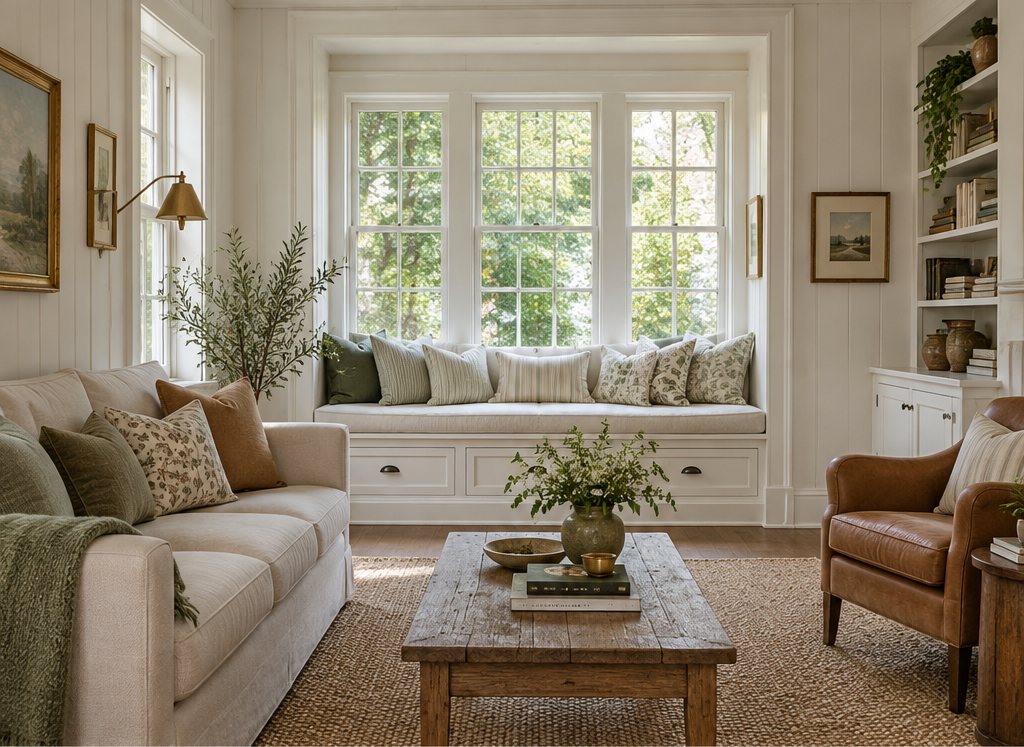
Yes. A moody living room with white walls keeps the envelope pale and puts the darkness into furniture, textiles, floor and lighting, which suits renters, small rooms and anyone who is not ready to paint. The room reads as moody because the lighting is low and warm and the big pieces are dark, not because the walls are. To get there:
- Choose a warm off-white or stone white rather than a bright white; see warm white paint colors.
- Go dark on the floor with a charcoal or deep rust rug covering 70 percent of the room.
- Pick a sofa in ink, forest or chocolate velvet or wool, with a dark timber or black metal coffee table.
- Hang full-height curtains in a heavy dark linen or velvet, pooling 1 in (2.5 cm) on the floor; our living room curtain ideas covers fabrics.
- Light at 2700K or warmer, at the same low levels as a fully dark room, with lamps rather than downlights.
- Add one dark painted element, the fireplace surround, a bookcase back or a single wall behind the sofa, to anchor the scheme.
Moody modern living rooms are often built this way, with pale plaster walls and a black, bronze and chocolate furniture palette.
How do you furnish a dark modern living room?
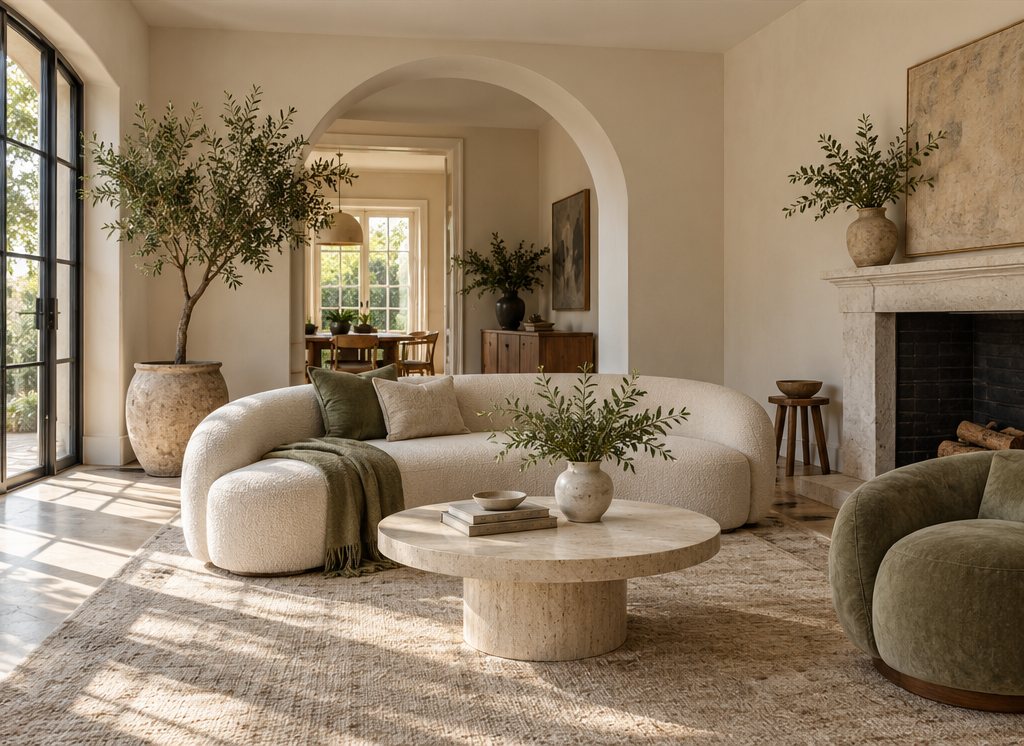
Furnish a dark modern living room with fewer, larger, lower pieces in natural materials, floated away from the walls, so the dark envelope reads as architecture rather than as backdrop to clutter. Modern dark moody living rooms tend to use a curved or deep modular sofa, a stone or timber coffee table, one sculptural chair and a long low media unit, with the walls kept almost bare apart from one large artwork.
| Piece | Dark modern | Dark eclectic | Dark traditional |
|---|---|---|---|
| Sofa | Low curved or modular, oat bouclé or stone wool | Velvet in a jewel tone, mixed cushions | Rolled-arm, tufted leather or linen |
| Coffee table | Travertine, marble or blackened oak, 48 in (122 cm) | Vintage brass or glass, often two nested | Ottoman with tray, or dark mahogany |
| Chairs | One sculptural lounge chair in leather | Mismatched pair, cane or rattan | Wing or club chair in a pattern |
| Rug | Pale wool, flatweave or low pile | Antique or vintage pattern, red or rust | Bordered wool, soft pattern |
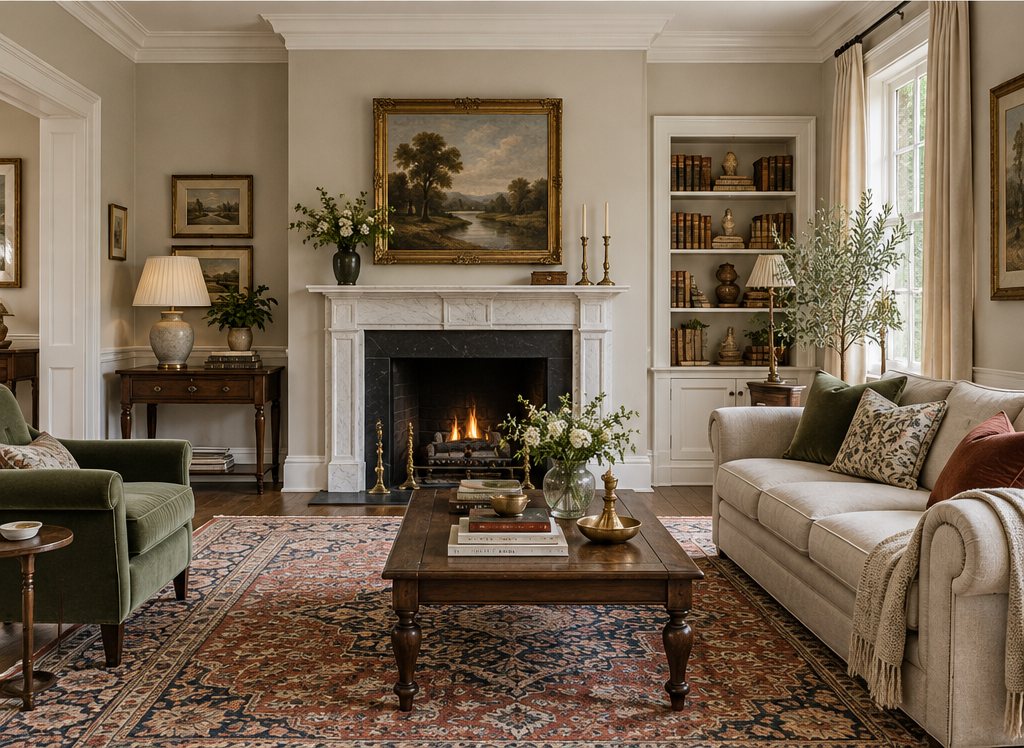
| Lighting | Linen pendant, arc floor lamp, cove | Mixed vintage lamps, picture lights | Chandelier plus 4–6 lamps |
| Wall | One large abstract, nothing else | Gallery wall, mirrors, shelves | Portraits, picture rail, paneling |
Whichever version you build, layout rules stay the same: float the sofa with 30–36 in (76–91 cm) of circulation behind it where the room allows, keep 14–18 in (36–46 cm) between the sofa and the coffee table, and give every seat a lamp within arm's reach. The living room layout ideas article shows ten arrangements that work.
What dark sitting room ideas work in a small room?
Small cozy dark living rooms work when the dark color covers the walls and ceiling completely, the floor stays light, the furniture is low and the lighting is at seated eye level or below. The common fear, that a small room cannot take a dark color, is backward: a small room with pale walls shows every corner, while the same room drenched in a dark green loses its edges and reads as a den. Practical moves for a room under 180 sq ft (17 m²):
- Paint the ceiling, trim and door the wall color; an LRV around 10–15 is easier to live with than 5.
- Use one sofa, 72–84 in (183–213 cm), and one chair, rather than a three-piece suite.
- Choose a glass or stone coffee table so the floor shows through.
- Mount sconces or plug-in wall lights instead of using floor lamps that eat floor space; see plug-in wall sconces.
- Hang one large mirror opposite the window.
- Keep the rug pale and as large as the room allows, leaving 8–12 in (20–30 cm) of floor at the edges.
More on planning tight rooms in our small living room ideas guide.
How do you paint a living room dark, step by step?
Painting a living room dark takes a weekend, a tinted primer and two or three top coats, and the preparation matters more than it does with pale colors because every flaw shows.
- Sample on all four walls. Paint 24 × 24 in (61 × 61 cm) patches of two or three candidate colors and live with them for 48 hours, watching them at noon and under lamplight.
- Prepare the surface. Fill and sand every dent; dark matte paint shows texture changes. Wash the walls, then sand lightly with 180-grit to give the primer a key.
- Prime with a tinted primer. Ask for the primer tinted to a gray or a shade close to the top coat; this saves a full coat and evens the coverage.
- Cut in and roll the ceiling first, then the walls, then the trim, in that order, using a 3/8 in (10 mm) nap roller for smooth walls and a 1/2 in (13 mm) for textured.
- Apply two top coats minimum, three for blacks, reds and deep blues, allowing the full recoat time between each. Keep a wet edge and roll in one direction on the final coat.
- Paint the trim and doors the same color one sheen step up, or the same matte for a fully drenched room.
- Let it cure for 7–14 days before hanging art or pushing furniture against the walls.
Expect to use 25–35 percent more paint than for a pale color. A 15 × 18 ft (4.6 × 5.5 m) living room with 9 ft (2.7 m) ceilings, walls plus ceiling, needs roughly 3–4 gallons (11–15 liters) of top coat across two coats, plus primer.
Free toolCurtain Size CalculatorRod length, panel size, ready-made match and yardage.Frequently asked questions
Does a dark living room make it look smaller?
No. Dark walls make corners and edges recede, which usually makes a living room feel deeper rather than smaller. The room only feels small when dark walls meet bright white trim and ceiling, which outlines the box. Paint the ceiling, trim and doors the same color, keep the floor light and the room reads as larger.
What colors make a moody living room?
Warm or green-leaning darks with an LRV of 5–15: soft charcoal, ink blue, bottle green, aubergine, espresso brown, oxblood and deep olive. Pair them with oat or cream upholstery, a pale wool rug, aged brass and mid-tone timber so that 30–40 percent of the room stays light or reflective.
How do you light a dark living room?
Use three dimmable circuits at 2700K: a soft ambient layer from a cove or uplighters, a pool layer of four to eight table and floor lamps with linen shades, and an accent layer of picture lights and sconces. Avoid a single bright central ceiling fixture, which glares against walls that absorb 85–95 percent of light.
What finish is best for dark walls?
Matte or flat paint, or a limewash. Low sheen makes dark colors read as pigment and hides roller marks, patching and glare from lamps. Use eggshell or satin only on trim and doors for wipeability, or keep everything matte for a fully drenched room. Expect two to three top coats over a tinted primer.
Can a small living room be dark?
Yes, and often it works better than a pale scheme. Drench the walls, ceiling and trim in one color at an LRV of 10–15, keep the floor and rug light, choose a glass or stone coffee table, use wall-mounted lights instead of floor lamps and hang one large mirror opposite the window. The room loses its edges and reads as a den.
How do you make a moody living room with white walls?
Keep the walls a warm off-white and put the darkness into the big pieces: a charcoal or rust rug covering 70 percent of the floor, an ink or forest velvet sofa, dark timber or black metal tables, heavy dark curtains and low 2700K lamp lighting. One dark painted element, such as a fireplace surround or bookcase, anchors it.
Is a dark living room still in style for 2027?
Yes. Deep, drenched living rooms in green, ink, espresso and oxblood are one of the strongest directions in 2027, driven by the shift toward warm, enveloping interiors and away from all-white rooms. The current version is matte or limewashed, lit with lamps, and balanced with pale bouclé or wool seating and travertine or brass accents.
Some links may be affiliate links. Regulations and specifications change — always confirm with suppliers and qualified professionals.