Plaster Walls: Types, Decorative Finishes & Cost per Sq Ft
Plaster walls are either traditional three-coat plaster over lath (pre-1950s homes) or modern decorative plaster finishes troweled over drywall. The four plaster types are lime, gypsum, clay and acrylic; decorative finishes cost $3–25 per sq ft installed and last 30–100 years.
Part of our guide: Wall Treatments Guide: 14 Wall Finishes & Covering Ideas
Key takeaways
- Plaster walls are either traditional 3-coat plaster over lath (pre-1950) or a 2–5 mm decorative plaster finish over drywall
- The four plaster types are lime, gypsum, clay and acrylic; lime is the most breathable and beautiful, gypsum the hardest and fastest
- Decorative plaster finishes cost $3–8 per sq ft for lime wash, roman clay and clay plaster, and $8–30 for marmorino, venetian plaster and tadelakt
- A thumbtack that will not sink in means plaster; keep sound old plaster, re-adhere loose areas and skim rather than replace
- Use lime finishes in wet rooms, clay and lime wash in bedrooms, and keep modern plaster walls matte, monochrome and continuous
Plaster walls come in two forms: the solid three-coat lime or gypsum plaster over lath found in homes built before about 1950, and the decorative plaster finishes, 2–5 mm thick, troweled over modern drywall. The four plaster wall types by binder are lime, gypsum, clay and acrylic. Decorative plaster finishes cost $3–25 per sq ft ($30–270 per sq m) installed, and a lime or gypsum plaster wall lasts 50–100 years.
Interest in plaster walls interior has surged because they offer what paint cannot: a surface with depth, variation and the mark of a hand. This guide explains the types of plaster, every common decorative plaster finish with its cost and best use, how to recognize and care for old plaster, and when modern plaster walls make sense over drywall. It is part of our wall treatments guide.
- Traditional plaster: 3 coats (scratch, brown, finish) totaling 3/4–1 in (19–25 mm) over lath.
- Decorative plaster: 2–3 thin coats totaling 2–5 mm over primed drywall or old plaster.
- Cost: $3–8 per sq ft for lime wash, clay and gypsum veneer; $8–25 for marmorino, tadelakt and venetian plaster.
- Breathability: lime and clay are vapor-open; gypsum is moderately so; acrylic forms a film.
- Repair: lime and gypsum plasters are patchable and re-skimmable; a well-kept plaster wall outlives several generations of drywall.
What are plaster walls?
A plaster wall is a wall whose finished surface is a mineral paste, applied wet and hardened in place, rather than a factory-made gypsum board with a paper face. Before drywall took over in the 1950s, almost every interior wall was plaster: a scratch coat pushed through wood lath to form keys, a brown coat to level, and a thin, hard finish coat of lime or gypsum, troweled smooth. The result is a dense, 3/4–1 in (19–25 mm) monolithic skin that is quieter, harder and more fire-resistant than drywall, and whose slight undulations are a large part of the charm of older houses.
Modern plaster walls are mostly a different animal. Drywall provides the flat substrate, and a decorative plaster is applied as a finish layer 2–5 mm thick. The phrase "plaster walls" in a 2027 renovation brief almost always means this: a troweled lime, clay or acrylic finish that gives drywall the look and feel of the real thing. Both routes are covered here.
What are the types of plaster used on interior walls?
The four types of plaster for interior walls, by binder, are lime plaster, gypsum plaster, clay (earthen) plaster and acrylic or synthetic plaster. Cement plaster exists too but belongs on exteriors and wet rooms rather than living spaces.
| Plaster type | Binder | Set and cure | Breathability | Hardness | Best use | Installed cost per sq ft |
|---|---|---|---|---|---|---|
| Lime plaster | Slaked lime (and marble dust for fine finishes) | Slow; carbonates over 28+ days | High | Hard, flexible | Historic walls, bathrooms, decorative finishes | $6–25 |
| Gypsum plaster | Calcium sulfate | Fast; sets in 30–90 min | Moderate | Very hard, brittle | Veneer plaster over blueboard, repairs | $3–6 |
| Clay plaster | Clay, sand, fiber | Dries by evaporation | Very high; regulates humidity | Soft | Bedrooms, living rooms, eco builds | $5–12 |
| Acrylic / synthetic plaster | Polymer resin with fillers | Dries by evaporation | Low | Medium | Budget decorative finishes, commercial | $3–10 |
| Cement plaster (render) | Portland cement, sand | Hydrates over 7–28 days | Low | Very hard | Exteriors, wet rooms, garages | $4–10 |
Lime is the aristocrat of the group: breathable, self-healing in micro-cracks, naturally mold-resistant and beautiful, but slow and skill-intensive. Gypsum is the workhorse, setting fast and hard, and is the base of veneer plaster, a 1/16–1/8 in (2–3 mm) coat over special blueboard that gives a true plaster wall in new construction for only $1–3 per sq ft more than level-5 drywall. Clay plaster is the softest and most ecological, absorbing and releasing humidity. Acrylic plasters are the easy route to a decorative look at low cost, with the compromises on breathability and depth that we set out in the venetian plaster guide.
What are the decorative plaster finishes?
Decorative plaster finishes are the textured or polished surface treatments made with lime, clay or acrylic plaster, and the nine that matter for interior walls are lime wash, roman clay, clay plaster, marmorino, venetian plaster (stucco veneziano), tadelakt, tinted gypsum veneer, textured plaster (skip trowel or sgraffito) and ornamental plasterwork such as cornices and medallions.
| Finish | Material | Surface | Installed cost per sq ft | Difficulty | Best rooms |
|---|---|---|---|---|---|
| Lime wash | Lime and pigment, brushed | Chalky, cloudy, no relief | $3–6 | Easy | Bedrooms, living rooms, exteriors |
| Roman clay | Acrylic-bound clay compound, troweled | Suede-like, matte | $4–8 | Moderate | Bedrooms, living rooms, offices |
| Clay plaster | Clay, sand, fiber, troweled | Soft, sandy, matte | $5–12 | Moderate | Bedrooms, living rooms |
| Gypsum veneer plaster | Gypsum over blueboard | Smooth or lightly textured | $3–6 | Pro | Whole-house smooth walls |
| Marmorino | Lime and coarse marble dust | Stony, matte to satin | $8–16 | Pro | Living rooms, kitchens, baths |
| Venetian plaster | Lime and fine marble dust | Polished, marble-like | $12–25 | Expert | Feature walls, entries |
| Tadelakt | Lime, polished with stone and sealed with soap | Waterproof, waxy | $15–30 | Expert | Showers, sinks, tubs |
| Textured plaster (skip, sgraffito) | Lime or acrylic, troweled with relief | Raised, hand-made | $5–12 | Moderate | Feature walls, fireplaces |
| Ornamental plasterwork | Cast or run gypsum | Cornices, medallions, panels | $8–40 per linear ft | Pro | Ceilings, period rooms |
Lime wash and roman clay
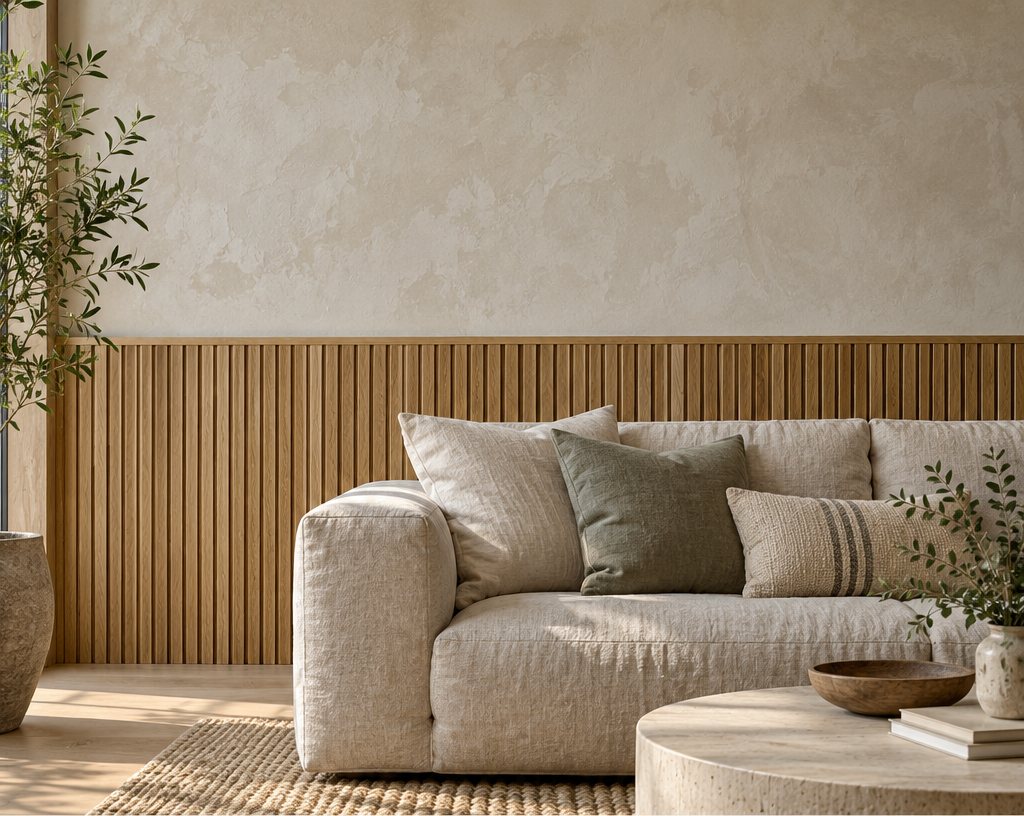
Lime wash is the gateway decorative plaster: slaked lime and pigment brushed on in two thin coats with a wide block brush, drying to a soft, mottled, chalky surface with no physical relief. It costs little, can be done by a careful amateur and suits almost any style. Roman clay is its troweled cousin, an acrylic-bound compound applied in two coats and burnished slightly, with a suede-like finish that photographs beautifully behind a bed, one of the moves in bedroom trends 2027.
Marmorino, venetian plaster and tadelakt
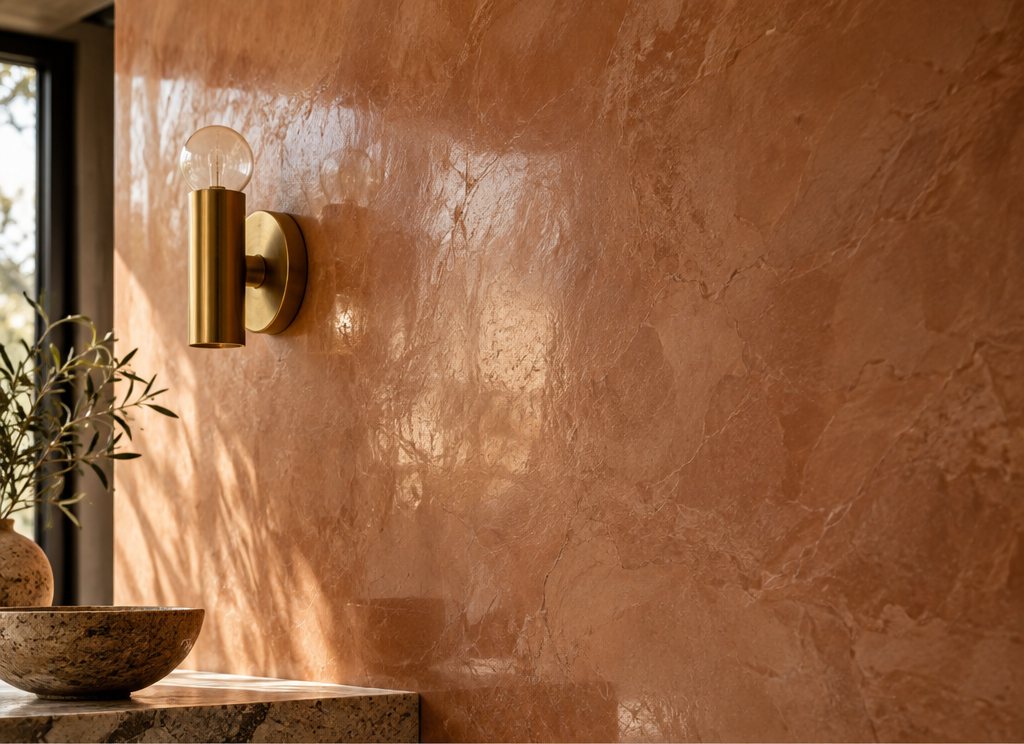
The lime-and-marble finishes are the premium tier. Marmorino is matte or satin with a stone-like grain; venetian plaster is burnished to a polish; tadelakt is a Moroccan lime plaster compressed with a river stone and sealed with olive soap until it is waterproof enough to line a shower. They cost $8–30 per sq ft because of the layers and the skill, and they are the finishes that make a room feel built rather than decorated, which is why they anchor quiet luxury interiors.
Textured plaster and ornamental plasterwork
A textured plaster finish uses the same materials with deliberate relief: skip-troweled islands, dragged combs, or sgraffito, where a top coat is scratched through to reveal a contrasting layer. Textured plaster interior walls work best on one wall and in low-saturation colors. Ornamental decorative plasterwork, the cornices, ceiling roses and panel moldings of period houses, is a separate craft: pieces are cast in molds or run in place with a profiled template, and restoration or new installation runs $8–40 per linear ft depending on depth and complexity.
How can you tell if your walls are plaster or drywall?
Push a thumbtack into the wall: it sinks easily into drywall and will not penetrate hard plaster. Other signs of plaster walls are a house built before 1950, walls that feel cold and dense, a hollow "thud" rather than a papery sound when knocked, slight waviness, hairline cracks that follow the lath lines, and, where you can see an edge at an outlet, a layered gray or white cross-section with wood strips or wire mesh behind instead of a paper-faced board 1/2 in (12 mm) thick.
The distinction matters for every job that follows. Hanging anything heavy on plaster means finding the lath or stud, pre-drilling, and using toggle or screw-in anchors, because plaster crumbles around a nail; our guide to hanging art and gallery walls covers the hardware. Painting old plaster needs a breathable, alkali-tolerant primer. And smoothing or repairing it follows different rules from drywall.
How do you repair cracked or damaged plaster walls?
Repair plaster walls by first fixing the cause of the damage, then re-securing any plaster that has pulled away from the lath, then filling with a compatible plaster or setting-type compound, feathering and sanding. Hairline cracks are cosmetic; cracks wider than 1/8 in (3 mm), bulges and hollow-sounding areas mean the keys have broken and the plaster has lost its grip.
- Diagnose. Map the cracks. Diagonal cracks from door and window corners are normal settlement; horizontal cracks, stair-step cracks and bulges suggest movement or water. Press the wall: a soft, springy feel means detached plaster.
- Re-adhere loose plaster. Drill 3/16 in (5 mm) holes through the plaster to the lath every 3–4 in (8–10 cm) across the loose area, vacuum the dust, inject a conditioner and then an acrylic plaster adhesive, and clamp with plaster washers and screws until it cures. Fill the holes afterward.
- Open hairline cracks into a V. Use a utility knife or a crack opener so the filler has a key, then vacuum.
- Fill with setting-type compound or lime plaster. Setting-type joint compound (the powdered kind, 45- or 90-minute) is strong and shrinks little; for historic lime walls, a lime putty filler stays compatible. Wipe a bonding agent into the crack first. Fill in two lifts, the second slightly proud.
- Bridge recurring cracks with mesh. Embed fiberglass mesh tape in the first fill over any crack that has reopened before, then skim over it 6–8 in (15–20 cm) each side.
- Patch holes with a matching build-up. For holes, screw a drywall patch to the lath or attach new metal lath, build a base coat of setting compound or base plaster, let it set, then finish with a skim coat.
- Skim, sand and prime. Feather a thin skim coat over the repair, sand with 150–220 grit, and prime with an alkali-resistant or breathable primer before paint or a decorative finish.
A badly cracked but sound plaster wall is often best treated with a whole-wall skim coat, which erases the map of repairs at once; the method is the same one used for smoothing drywall texture in how to smooth textured walls.
Is plaster better than drywall?
Plaster is better than drywall for durability, sound insulation, fire resistance, surface quality and longevity; drywall is better for cost, speed, ease of repair and ease of running services. A traditional plaster wall costs $8–15 per sq ft new against $2–4 for finished drywall, which is why almost no one builds full three-coat plaster today, and why veneer plaster over blueboard, at $3–6 per sq ft, is the compromise most plaster-loving architects specify.
For an existing home, the question is rarely either-or. Keep sound old plaster; it is quieter and more solid than anything you would replace it with, and a skilled plasterer can skim it to the finish you want. Replace it only where it is water-damaged or has lost its key over a large area. On new drywall, the sensible upgrade is a decorative plaster finish on the walls that matter: the living room, the entry, the main bedroom, the bathroom. That gets most of the beauty for a fraction of the cost.
What do modern plaster walls look like and where do they work?
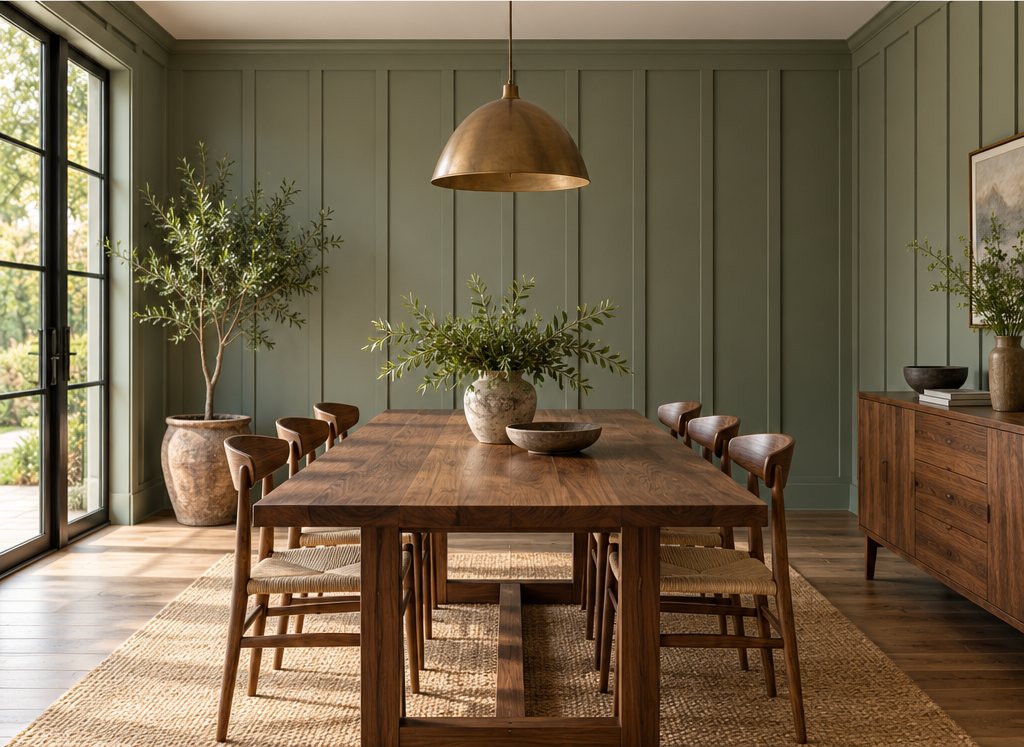
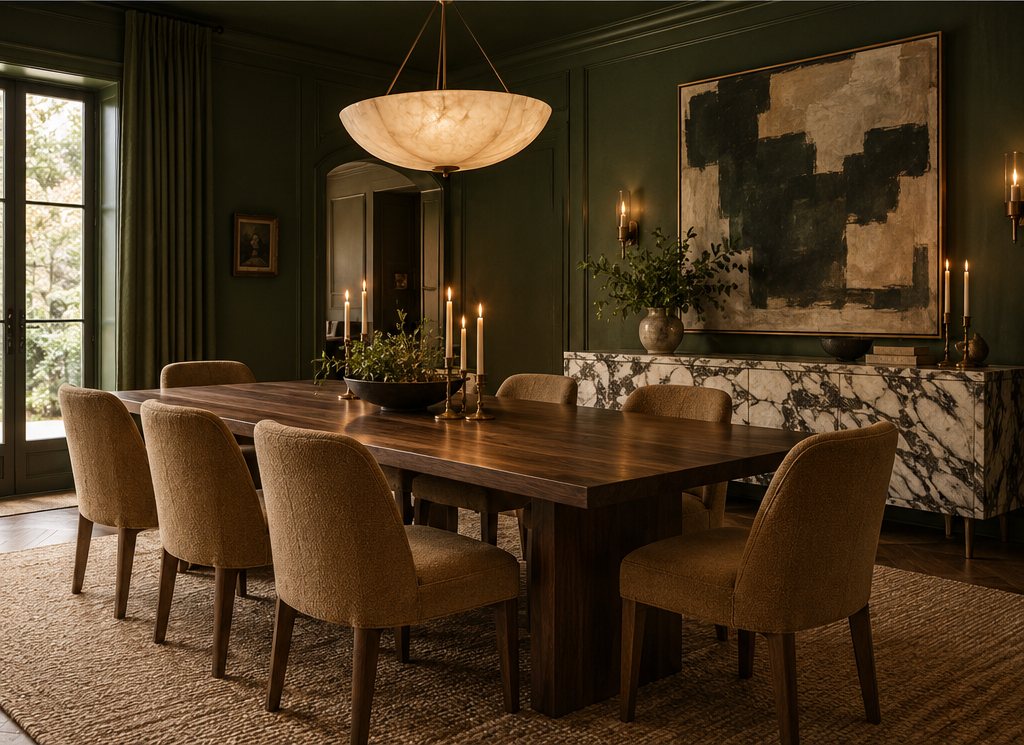
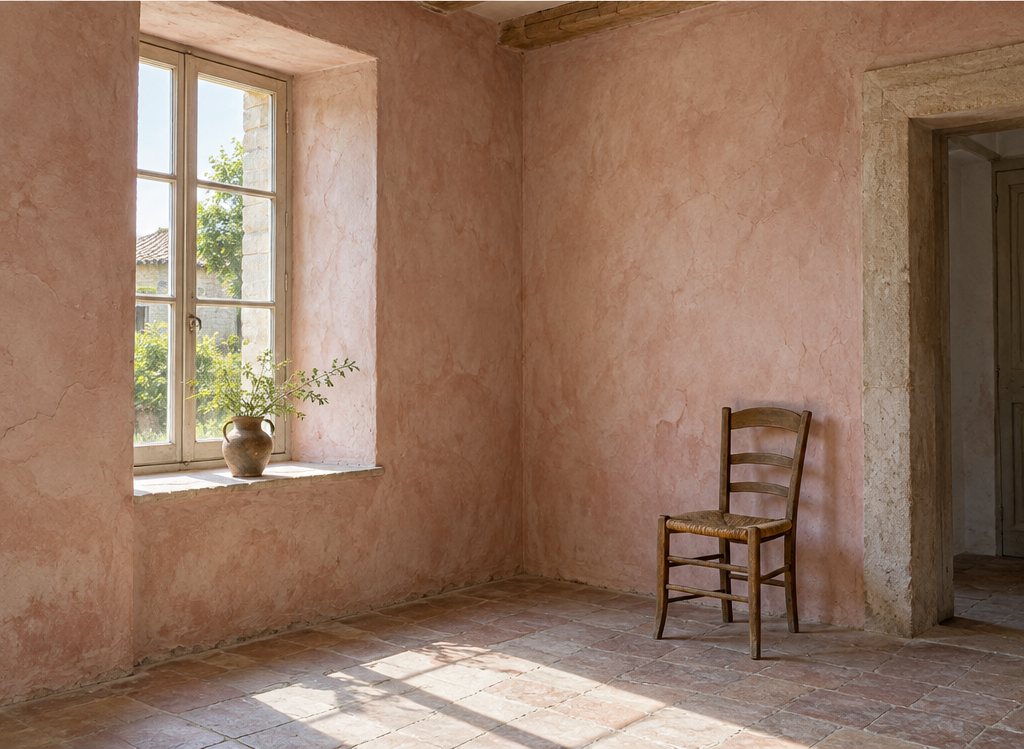
Modern plaster walls are matte, monochrome and continuous: a single warm mineral tone running across walls, fireplace, built-ins and sometimes the ceiling, with no visible edges, trowel marks softened to a cloudy movement rather than a pattern, and no glossy or veined effects. The palette is white, bone, sand, clay, mushroom and soft green, the family in our neutral color guide, with the occasional deep smoke or oxblood room for contrast.
#F1ECE3#E0D5C4#C7B29C#A89F8E#7F8B78#5B4E48Plaster interior finishes work in every room, with the material matched to the use. Lime wash and roman clay in bedrooms and living rooms, where their softness is the point. Marmorino in kitchens, where it is sealed and wipeable, and on the range hood, one of the signatures of kitchen trends 2027. Tadelakt or sealed marmorino in bathrooms, including inside the shower. Clay plaster in bedrooms and nurseries for humidity control. Plaster also pairs naturally with the material family it comes from: travertine, oak, linen, unlacquered brass and microcement floors, a close cousin that can run from floor to wall in one continuous surface.
How do you choose a plaster wall finish?
Choose a plaster wall finish by matching the material to the room's moisture, the budget to the number of walls, and the surface to how much movement you want to see. Three questions settle most decisions.
Is the room wet? Bathrooms, kitchens and laundry rooms need lime (marmorino, tadelakt, sealed venetian plaster); dry rooms can take lime wash, roman clay or clay plaster. How much are you covering? At $3–8 per sq ft, lime wash and roman clay can run through a whole floor; at $12–30, venetian plaster and tadelakt are feature-wall and bathroom finishes. How much texture do you want? Lime wash and roman clay give movement with no relief; marmorino gives stony grain; textured plaster gives raised, visible hand-work. If you want relief without plaster at all, the wall texture types guide covers the joint-compound alternatives, and a wood accent wall is the warm, dry-room alternative that needs no trowel.
Free toolPaint CalculatorWork out exactly how much paint to buy.Frequently asked questions
What are the different types of plaster finishes?
The common decorative plaster finishes are lime wash, roman clay, clay plaster, gypsum veneer plaster, marmorino, venetian plaster, tadelakt, textured plaster (skip trowel and sgraffito) and ornamental plasterwork such as cornices. They differ in binder (lime, clay, gypsum or acrylic), surface (chalky, suede-like, stony or polished) and cost, from $3 per sq ft for lime wash to $30 for tadelakt.
How much do plaster walls cost?
Decorative plaster finishes over existing drywall cost $3–8 per sq ft for lime wash, roman clay and clay plaster, $8–16 for marmorino, $12–25 for venetian plaster and $15–30 for tadelakt, all installed. Veneer plaster over blueboard in new construction runs $3–6 per sq ft. Full traditional three-coat plaster is $8–15 per sq ft and is rarely done outside restoration.
Are plaster walls better than drywall?
For quality, yes: plaster is denser, quieter, more fire-resistant, harder to dent and lasts 50–100 years, and its surface has a depth paint on drywall cannot match. Drywall wins on cost, speed and ease of repair. The practical compromise is drywall with a decorative plaster finish on key walls, or veneer plaster over blueboard for a whole house.
Can you plaster over drywall?
Yes. Decorative plasters such as lime wash, roman clay, marmorino and venetian plaster are designed to go over primed drywall, and most modern plaster walls are exactly that. The drywall must be smooth, with joints finished to level 4 or 5, and primed with a sanded or bonding primer so the plaster keys in. Gypsum veneer plaster needs blueboard, a special drywall with an absorbent face.
Are plaster walls still popular in 2027?
Very. Plaster and plaster-look finishes are among the strongest wall treatment trends for 2027, driven by warm minimalism, quiet luxury and the appetite for hand-made, imperfect surfaces. The modern expression is matte, single-tone and continuous across walls, hoods and fireplaces, rather than the glossy, veined faux finishes of twenty years ago.
Do plaster walls crack easily?
Old three-coat plaster develops hairline cracks as a house settles, which are cosmetic and easily filled; serious cracking or bulging means the plaster has detached from the lath and should be re-adhered with plaster washers and adhesive. Modern decorative plasters applied thinly over a stable substrate rarely crack; when they do, the usual causes are coats that were too thick, drywall joints that moved, or drying forced by heat.
Some links may be affiliate links. Regulations and specifications change — always confirm with suppliers and qualified professionals.