Sectional Sofa Sizes: L-Shaped, U-Shaped and Modular Dimensions
Sectional sofa sizes run from 72 in (183 cm) small sectionals to 144 in (366 cm) U-shaped couches. Here are the standard L-shaped, U-shaped, chaise and modular dimensions, plus how big a sectional your room can take.
Part of our guide: How to Choose a Sofa Size: Dimensions, Fit and 2027 Sofa Trends
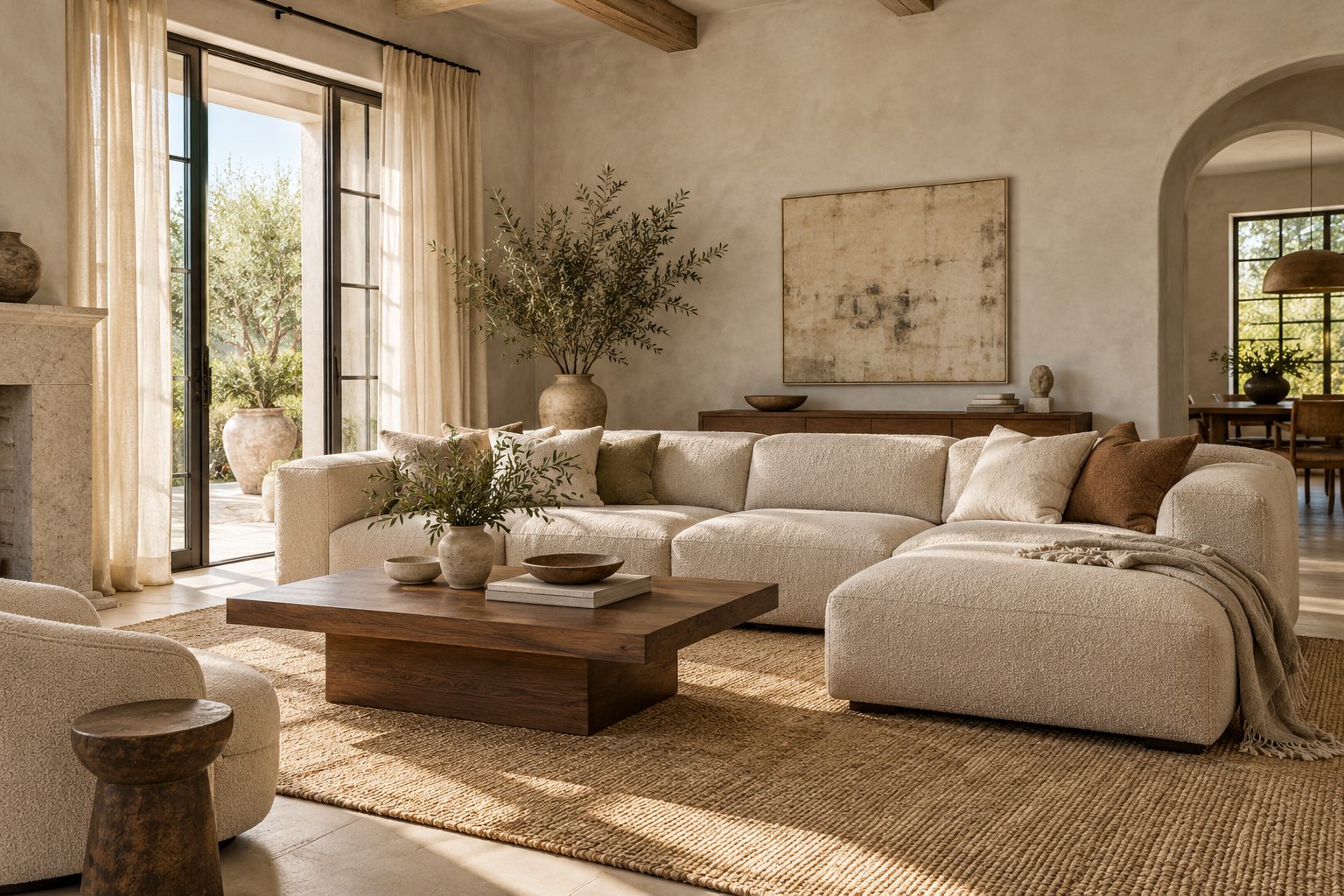
Key takeaways
- A standard L-shaped sectional measures 94–120 in (239–305 cm) on its long side, 72–100 in (183–254 cm) on its short side and 34–40 in (86–102 cm) deep
- Leave 30–36 in (76–91 cm) of walkway around a sectional and 16–18 in (41–46 cm) to the coffee table; the sofa should fill no more than two-thirds of its wall
- Modular sectionals use 28–40 in (71–102 cm) seat units, so you can size them to the inch and get them through narrow doors
- Measure doors, stairs and lifts before you buy: most sectional pieces need at least 32 in (81 cm) of clear opening
Standard sectional sofa sizes are 94–120 in (239–305 cm) on the long side and 72–100 in (183–254 cm) on the short side for an L-shaped sectional, 110–144 in (279–366 cm) wide for a U-shaped sectional, and 72–90 in (183–229 cm) for a small sectional. Depth runs 34–40 in (86–102 cm). Size it so you keep 30–36 in (76–91 cm) of walkway.
- Seat depth: 21–24 in (53–61 cm) on most sectionals; 25–30 in (64–76 cm) on deep lounge models.
- Seat height: 16–19 in (41–48 cm); arm and back heights 24–36 in (61–91 cm).
- Chaise length: 60–70 in (152–178 cm) from back to front edge.
- Room rule: the longest side fills no more than two-thirds of the wall it sits on.
- Delivery: each piece usually needs a 32 in (81 cm) door or larger.
This page goes deep on sectionals only. For sofas, loveseats and room ratios in general, start with our guide on how to choose sofa size, then come back here to pick the right sectional couch configuration and measurements.
What are standard sectional sofa sizes?
Most sectional sofas fall into four size families: small sectionals under 90 in (229 cm), standard L-shaped sectionals around 100–112 in (254–284 cm), large L-shapes up to 120 in (305 cm) and U-shaped sectionals from 110 in (279 cm) upward. The chart below gives typical ranges; any single model can sit a few inches outside them.
| Configuration | Long side | Short side / return | Depth | Seats | Typical US price (2026) |
|---|---|---|---|---|---|
| Small sectional (apartment) | 72–90 in (183–229 cm) | 55–72 in (140–183 cm) | 32–36 in (81–91 cm) | 3–4 | $700–2,500 |
| Sectional sofa with chaise | 84–110 in (213–279 cm) | 60–70 in (152–178 cm) chaise | 34–38 in (86–97 cm) | 3–5 | $900–4,500 |
| Standard L-shaped sectional | 94–112 in (239–284 cm) | 72–94 in (183–239 cm) | 34–40 in (86–102 cm) | 4–6 | $1,200–6,000 |
| Large L-shaped sectional | 112–130 in (284–330 cm) | 94–120 in (239–305 cm) | 36–42 in (91–107 cm) | 6–7 | $2,000–9,000 |
| U-shaped sectional | 110–144 in (279–366 cm) | 70–100 in (178–254 cm) each return | 34–42 in (86–107 cm) | 6–9 | $2,500–12,000 |
| Modular sectional | Any, in 28–40 in (71–102 cm) units | Any | 36–44 in (91–112 cm) | Per module | $400–1,500 per module |
Treat these sectional sofa sizes as starting points, then confirm the exact numbers on the spec sheet of the model you like. Prices are typical US retail and trade ranges for 2026, from budget flat-pack to mid-market custom upholstery; designer and fully bespoke pieces go well beyond them. The seat count assumes 24–30 in (61–76 cm) of cushion per adult, and a corner seat is only comfortable when its cushion is at least 32 in (81 cm) square.
How big is an L-shaped couch?
An L-shaped couch is typically 94–120 in (239–305 cm) long on one side and 72–100 in (183–254 cm) on the return, with a depth of 34–40 in (86–102 cm). Sellers list it as overall width by overall length, so a "112 × 86" L shaped sectional covers a footprint of roughly 9 ft 4 in by 7 ft 2 in (284 × 218 cm).
L-shaped sectional dimensions to check
- Overall width and length: the two outside measurements, arm to arm and arm to return end.
- Inside seat width: usable cushion length on each side, usually 10–14 in (25–36 cm) less than the outside because of arms and the corner.
- Seat depth: front edge to back cushion. Under 21 in (53 cm) feels upright; over 25 in (64 cm) needs pillows behind you unless you lounge.
- Arm width: 4–6 in (10–15 cm) for track arms, 8–12 in (20–30 cm) for rolled or padded arms, which quietly steal seat space.
- Left-arm or right-arm facing: named as you face the sofa. A right-arm-facing loveseat has its arm on your right when you stand in front of it.
An L shape sofa works best tucked into a corner or floated to divide an open plan, with the long side facing the TV or fireplace. If the return blocks a doorway or path, choose a sectional sofa with chaise instead: the open end keeps the room flowing. Our chaise sofa guide compares chaise lengths and when a chaise beats a full return.
How big is a U-shaped sectional?
A U-shaped sectional usually measures 110–144 in (279–366 cm) across the back and 70–100 in (178–254 cm) along each return, so it needs a room of at least 14 × 14 ft (4.3 × 4.3 m) to keep clear walkways. A U-shaped couch seats six to nine and builds a natural conversation pit around a coffee table.
The weak point of a U shaped sofa is the inside distance between the two returns. Keep at least 48–60 in (122–152 cm) between them so a coffee table fits with 16–18 in (41–46 cm) of legroom on each side. Below about 42 in (107 cm) the knees of people sitting opposite each other collide. A U-shaped sectional also has two corner seats, which many people avoid, so count real seats, not cushions. In family rooms we often specify one chaise end and one standard return instead: you get lounging and seating without the closed-in feel of a full U.
What size sectional for a 16x16 room?
A 16 × 16 ft (4.9 × 4.9 m) room takes an L-shaped sectional of about 100–112 in (254–284 cm) by 84–100 in (213–254 cm), or a compact U-shaped sectional around 120 × 84 in (305 × 213 cm) if nothing else needs the floor. That leaves 30–36 in (76–91 cm) walkways and space for a coffee table, a chair and a media unit.
The math is simple. A 16 ft wall is 192 in (488 cm). Two-thirds of that is 128 in (325 cm), the upper limit for the long side. Subtract a 36 in (91 cm) path and a 16 in (41 cm) gap to the TV unit, and the remaining depth tells you how long the return can be. Use these rough starting points for other square and rectangular rooms:
| Room size | Recommended sectional | Notes |
|---|---|---|
| 10 × 12 ft (3.0 × 3.7 m) | Small sectional, 72–86 in (183–218 cm), or apartment chaise sofa | Skip the full return; use a chaise or ottoman |
| 12 × 14 ft (3.7 × 4.3 m) | L-shape 90–100 × 72–84 in (229–254 × 183–213 cm) | Corner placement, one path only |
| 14 × 16 ft (4.3 × 4.9 m) | L-shape 100–112 × 84–94 in (254–284 × 213–239 cm) | Can float the sofa 12–18 in off one wall |
| 16 × 16 ft (4.9 × 4.9 m) | L-shape 100–112 × 84–100 in or compact U 120 × 84 in | Room for a lounge chair opposite |
| 16 × 20 ft (4.9 × 6.1 m) and up | Large L-shape to 130 in (330 cm) or U-shape to 144 in (366 cm) | Pair with a 9 × 12 ft or 10 × 14 ft rug |
Before you order, tape the footprint on the floor with painter's tape and live with it for two days. It catches the problems a floor plan hides, such as a return that clips a door swing or a radiator behind the back cushions. Our living room layout ideas show how to place a sectional around a TV, a fireplace or both.
What size is a small sectional sofa?
A small sectional sofa is usually 72–90 in (183–229 cm) on the long side with a 55–72 in (140–183 cm) return or chaise, and 32–36 in (81–91 cm) deep, which fits rooms from about 10 × 12 ft (3.0 × 3.7 m). It seats three comfortably and four at a squeeze.
When you shop for a small sectional, look for three things: track or slim arms of 6 in (15 cm) or less, a reversible chaise you can switch to either side when you move, and raised legs of 4–6 in (10–15 cm) that show floor underneath and make the piece read lighter. Avoid deep lounge cushions in a small room; at 38–40 in (97–102 cm) overall depth, the sofa will eat the walkway. A small sectional with an apartment-size chaise of 58–62 in (147–157 cm) long gives you a place to put your feet up without a full L. Of all sectional sofa sizes, this is the one where an inch of arm or cushion matters most.
Modular sofa or fixed sectional: which should you buy?
Buy a modular sofa if you move often, have tight access or want to reconfigure; buy a fixed sectional if you want the tidiest look and the firmest corner joint. A modular sectional sofa is a set of freestanding units, typically armless seats of 28–40 in (71–102 cm), corner units of 36–44 in (91–112 cm) square, arm units and ottomans, that clip or bolt together.
Modular sectional couch pros and cons
- Sizing: modular sectionals let you build to within one module width, so you can hit 104 in (264 cm) exactly instead of choosing 98 or 112.
- Delivery: single modules pass through 30 in (76 cm) doors and tight stair turns that a two-piece sectional cannot.
- Flexibility: today's L-shape becomes two loveseats or a U-shape later; the best modular furniture sells extra units for years.
- Weak points: modules can creep apart on hard floors; insist on metal connectors under every joint and rubber feet.
- Cost: per seat, a modular couch costs 10–30 percent more than an equivalent fixed sectional.
Is a couch in a box any good?
A couch in a box ships compressed or flat in cartons small enough for one person to carry, then assembles in 20–60 minutes. The best versions use solid wood or plywood frames, zipped washable covers and foam of 1.8 lb/ft³ (29 kg/m³) or denser; the worst use particleboard and thin foam that flattens within a year. They are a sensible, affordable sectional couch for walk-up apartments, but test the return policy, because sending boxes back is harder than receiving them.
How do you measure for a sectional couch?
Measure the room, the delivery path and the people who will sit on it, in that order, because a sectional couch that fits the floor plan but not the stairwell is the most common return we see.
- Measure the wall and floor. Record each wall length and mark doors, windows, vents and outlets. The long side should stay under two-thirds of its wall.
- Plan the walkways. Keep 30–36 in (76–91 cm) for main paths and 16–18 in (41–46 cm) between seat front and coffee table.
- Choose the configuration. L-shape for a corner, chaise for an open end, U-shape for rooms of 14 ft (4.3 m) or more on both sides.
- Pick seat depth by body. 21–23 in (53–58 cm) if most users are under 5 ft 6 in (168 cm) or sit upright; 24–28 in (61–71 cm) for tall people and loungers.
- Check the delivery path. Measure door width, door height and the diagonal of each piece; a piece will pass if its depth or height is under the door width.
- Tape it out. Mark the full footprint on the floor and walk the room for a day or two.
- Size the rug last. The rug should hold at least the front legs of every section; most sectionals need 9 × 12 ft (274 × 366 cm) or larger.
Our free rug size calculator gives the rug size once your sectional footprint is fixed.
How do you choose the best sectional sofa?
The best sectional sofa for most homes has a kiln-dried hardwood or plywood frame, sinuous or eight-way hand-tied springs, high-resilience foam at 1.8 lb/ft³ (29 kg/m³) or more and a fabric rated at 30,000 Martindale or 30,000 double rubs Wyzenbeek and above. Shape and size come next; construction decides whether it lasts five years or fifteen.
- Frame: corner-blocked, glued and screwed; avoid particleboard in the frame or seat deck.
- Cushions: foam wrapped in fiber or feather; tight backs or semi-attached backs slump less than loose pillow backs.
- Fabric: performance weaves, wool blends and tight chenille for daily family use; leather for pets that do not scratch.
- Connectors: metal brackets between sections, not plastic clips.
- Covers: removable and zipped, ideally with a spare cushion cover set for light colors.
Affordable sectional couches in the $700–1,500 range can be fine if you accept a shorter life and check the frame and foam specs above. If people sit deep and long, read our deep seat sofa guide before choosing cushion depth.
Mistakes we see with sectional sizes
The mistake we see most often is buying for the showroom instead of the room: a sectional that looks modest under a 20 ft (6 m) warehouse ceiling becomes a wall of upholstery at home. Close behind are these:
- Ignoring the corner seat. A corner of less than 32 in (81 cm) square is a place for cushions, not people.
- Too-deep seats in small rooms. A 42 in (107 cm) deep lounge model in a 12 ft (3.7 m) room leaves no path.
- Wrong orientation. Left-arm versus right-arm facing is the most expensive typo in furniture ordering.
- Undersized rugs. A 5 × 8 ft rug floating in front of a 110 in sectional makes both look smaller and cheaper.
- Blocking light. A tall back of 34–36 in (86–91 cm) in front of a low window sill cuts daylight; choose a 28–30 in (71–76 cm) back there.
Our verdict: of all the sectional sofa sizes on the market, one covers most homes. For living rooms between 12 and 16 ft (3.7–4.9 m) wide, it is a modular L-shaped sectional of about 100–110 in (254–279 cm) with 22–23 in (56–58 cm) seats is the safest buy. It fits, it moves house with you and it can grow later. Pair it with a properly sized dining table if your living and dining areas share one open room, so both zones keep their walkways.
Specifying sectionals for a rental portfolio, a hotel or a whole house? Send your room plans and quantities to our furniture sourcing desk and we will come back with factory options, typical MOQs and lead times.
Free toolRug Size CalculatorFind the right rug size for your room and furniture.Shop & source the look
Buy it today — or have it made
Retail links are affiliate links: we may earn a commission at no extra cost to you (disclosure). “Get it made” sends the item to our sourcing desk for factory quotes in custom sizes and finishes.
In this guide
Frequently asked questions
What are standard sectional sofa sizes?
Standard sectional sofa sizes are 94–120 in (239–305 cm) on the long side and 72–100 in (183–254 cm) on the return for an L-shape, 110–144 in (279–366 cm) wide for a U-shape and 72–90 in (183–229 cm) for a small sectional. Depth is usually 34–40 in (86–102 cm), with seat depths of 21–24 in (53–61 cm) on most models.
What size sectional for a 16x16 room?
A 16 × 16 ft room suits an L-shaped sectional of about 100–112 in by 84–100 in (254–284 by 213–254 cm), or a compact U-shape around 120 × 84 in if the room has no other furniture needs. Keep the long side under 128 in (325 cm), two-thirds of the wall, and leave 30–36 in walkways.
How much space do you need around a sectional?
Leave 30–36 in (76–91 cm) for main walkways around a sectional and 16–18 in (41–46 cm) between the seat front and the coffee table. Allow 8–12 in (20–30 cm) behind a sofa floated off the wall for cords and cleaning, and at least 48 in (122 cm) between the two returns of a U-shaped sectional.
Is a modular sofa better than a sectional?
A modular sofa is better if you move often, have narrow doors or stairs, or want to reconfigure the layout later. A fixed sectional is better for a tighter, more tailored look and firmer joints. Modular sectionals cost roughly 10–30 percent more per seat but can be sized to within one module, usually 28–40 in (71–102 cm).
How deep should a sectional be?
Most sectionals are 34–40 in (86–102 cm) deep overall with 21–24 in (53–61 cm) seat depth, which suits upright sitting and average heights. Deep lounge sectionals run 40–44 in (102–112 cm) overall with 25–30 in (64–76 cm) seats; they are comfortable for tall people and loungers but need a room at least 14 ft (4.3 m) wide.
Some links may be affiliate links. Regulations and specifications change — always confirm with suppliers and qualified professionals.