Custom Upholstery: How Custom Sofas & Chairs Are Made (and Priced)
Custom upholstery explained from the inside: what you can change on a sofa or chair, frame and foam grades, how COM fabric works, realistic lead times, what drives the factory price, and the checklist before you approve a sample.
Key takeaways
- Custom usually means adjusting a proven frame in size, fabric, fill, legs and details; a new frame adds a $300–1,500 prototype fee and 3–5 weeks
- Specify kiln-dried hardwood or 18 mm plywood frames, doweled joints and HR foam at 35–45 kg/m³; the invisible parts decide the lifespan
- COM needs 12–16 yd for a sofa and 6–8 yd for a chair plus 15–25 percent for pattern repeat; send a cutting for suitability first
- Expect 12–20 weeks door to door and $350–1,200 FOB for a custom sofa; approve one sample against a written spec to avoid revision rounds
Custom upholstery means a factory builds a sofa or chair to your dimensions, in your fabric, on a frame and foam you specify, and it typically costs 20–60 percent more than a comparable stock piece and takes 8–16 weeks. You can change size, fabric, fill, legs, arm and back style and stitching; you cannot cheaply change the frame's engineering. Here is what is inside the piece, how COM works and what moves the price.
Two quotes for the same drawing can be a factor of three apart; this guide explains why, and how to make the first sample the last one.
- What changes: width in 1–2 in (2.5–5 cm) steps, depth, seat height, fabric, foam firmness, legs, arm and back style.
- What does not: the frame's structural design, suspension type on a stock model, and the factory's tooling.
- Lead time: 2–4 weeks sample, 6–10 weeks production, 4–6 weeks sea freight.
- Price band: $350–1,200 FOB for a custom 84 in (213 cm) sofa; $120–450 for a custom accent chair.
What "custom" can actually change: size, fabric, fill, legs
On most upholstery factory programs, custom means five adjustable variables on a proven frame: overall size, fabric, fill firmness, leg style and finish, and the details of arms, back and stitching. Fully bespoke, a new frame from a sketch, costs a prototype fee of $300–1,500 and adds 3–5 weeks.
| Element | Typical custom range | Cost impact | Notes |
|---|---|---|---|
| Overall width | Stock ±12 in (30 cm) in 1–2 in steps | Low to medium | Frame is cut to length; over 108 in (274 cm) usually needs a two-piece frame |
| Seat depth | 20–28 in (51–71 cm) | Low | Changes the seat cushion mold; deeper seats need lower backs to look right |
| Seat height | 16–20 in (41–51 cm) | Low | Adjusted via leg height or seat deck; hospitality asks for 18 in (46 cm)+ |
| Fabric | Factory range or COM | Low to very high | The single largest variable; 12–25 yd (11–23 m) for a sofa |
| Seat fill | HR foam, foam-and-feather wrap, pocket spring, down blend | Medium | Firmness tuned by foam density and ILD |
| Legs | Turned, tapered, block, metal plinth, casters | Low | Timber finish or metal plating; 3–8 in (8–20 cm) height |
| Arm and back style | Track, rolled, sloped, tight vs loose back | Medium | Changes frame templates; loose cushions add fabric |
| Stitching and trim | Piping, topstitch, channel, button tufting, skirt | Medium to high | Tufting adds 2–4 hours of labor per piece |
| Frame engineering | Not usually changed | High if it is | New frame = prototype fee and 3–5 weeks |
Think of custom upholstered furniture as a stock frame with a menu, and ask for the factory's base model list before you send a sketch; a piece reached by adjusting a base model quotes lower and samples right first time. Custom made chairs follow the same logic, with more cost in the frame template than in the fabric.
Frame and fill quality: what's underneath the fabric matters more
The frame and foam decide whether a custom sofa is still square and comfortable in ten years; the fabric decides whether it looks good in three. A low quote saves its money in the invisible parts.
- Frame timber: kiln-dried beech, birch, poplar or oak at 6–8 percent moisture, rails at least 1 × 2 in (25 × 50 mm); 18 mm plywood for curved frames; no particleboard or MDF anywhere structural.
- Joinery: dowel and glue with corner blocks at every stress point, or mortise-and-tenon; screws and staples alone are a residential-only construction. Contract frames should pass a 100,000-cycle load test.
- Suspension: sinuous springs at 3–4 in (8–10 cm) centers for firm support; elastic webbing for a softer, thinner deck; eight-way hand-tied coils at the top of the range.
- Seat foam: high-resilience polyurethane at 2.2–2.8 lb/ft³ (35–45 kg/m³) density and a firmness (ILD) of 30–40 for seating; 1.8–2.2 lb/ft³ (29–35 kg/m³) is a compromise; under 1.8 lb/ft³ (29 kg/m³) sags within two years. CMHR foam is required for UK and Gulf contract work under BS 5852.
- Back foam and wraps: 1.5–1.8 lb/ft³ (24–29 kg/m³) for backs, a 1–2 in (2.5–5 cm) fiber or feather wrap over the seat core.
For restaurant and hotel pieces the commercial grades are set out in our Restaurant Furniture Buying Guide. Whatever the use, ask for a photo of a bare frame from current production and the foam supplier's density sheet.
COM (customer's own material) explained
COM stands for customer's own material: you buy the fabric from a mill or showroom, ship it to the factory, and the factory charges a labor-only upholstery price plus a COM handling fee of $25–80 per piece. It is how a hotel matches curtains, banquettes and lounge chairs from one bolt.
The process runs in six steps; the first two are where mistakes happen.
- Get the yardage. Factories quote per piece in 54 in (137 cm) wide plain fabric: 12–16 yd (11–15 m) for an 84 in (213 cm) sofa, 6–8 yd (5.5–7.3 m) for an armchair, 4–6 yd (3.7–5.5 m) for an upholstered dining chair, 2–3 yd (1.8–2.7 m) per linear meter of banquette. Add 15–25 percent for pattern repeats and directional pile, and 10 percent for attic stock.
- Check suitability. Send the factory a 12 × 12 in (30 × 30 cm) cutting first. They will confirm whether it is stable enough for a tight back, whether it needs a knit backing, and whether it needs a fire-retardant interliner to meet CAL 117 or crib 5.
- Inspect the bolt before shipping. Check for flaws and shade variation between bolts; fabric shipped uninspected is fabric the factory is not responsible for.
- Label and ship. Mark each bolt with order number, piece and face side, and declare it as fabric for processing so duty is not paid twice.
- Confirm the cut plan. Ask for a diagram of pattern placement and nap direction before cutting; matched stripes and railroaded banquette fabric are decisions, not defaults.
- Keep the remnants over 1 yd (0.9 m) as your repair kit.
Custom couch upholstery in COM is rarely cheaper than a factory fabric of equal grade once freight and handling are added; it is worth it when the fabric is the point.
Lead times: what's realistic for a custom piece
A single custom piece from an overseas factory takes 12–20 weeks door to door; a domestic workroom 6–12 weeks; a contract order of 50–200 pieces 14–22 weeks. Most of it is not the sewing.
| Stage | Typical duration | What decides it |
|---|---|---|
| Spec, drawing and quotation | 1–2 weeks | How complete your brief is |
| Fabric strike-off and COM shipping | 1–3 weeks | Mill stock; air vs sea for fabric |
| Pre-production sample | 2–4 weeks (3–5 for a new frame) | Frame templates, fabric arrival |
| Sample review and revisions | 1–3 weeks | One round if the brief was clear; each extra round adds 2–3 weeks |
| Production | 4–6 weeks (1–20 pieces); 6–10 weeks (50–200) | Factory schedule, peak season before major trade fairs and holidays |
| Inspection and packing | 1 week | Third-party inspection booking |
| Sea freight and customs | 4–6 weeks to US West Coast or Europe; 2–3 weeks to the Gulf | Route, port congestion |
| Domestic delivery | 1–2 weeks | White-glove vs curbside |
Factory holidays in late January to February and early October add 2–4 weeks. These are common ranges, not promises; the factory's written schedule against your purchase order is the number that counts.
What drives the price of custom upholstery
Fabric, frame, labor and quantity set the price, in that order for a single piece and the reverse for a contract order. A custom 84 in (213 cm) three-seater sofa runs about $350–1,200 FOB from a factory and $1,800–6,000 from a domestic workroom; a custom accent chair $120–450 FOB or $700–2,500 domestically. Here is where the money goes.
- Fabric: 15–40 percent of the piece. A 14 yd (13 m) sofa carries $210 of fabric at $15/yd and $1,260 at $90/yd; the labor is the same.
- Frame and suspension: 20–30 percent. A kiln-dried hardwood frame with sinuous springs costs the factory $60–120 for a sofa; eight-way hand-tied coils add $150–300; a new frame design adds a prototype fee.
- Fill: 10–15 percent. HR foam at 35–45 kg/m³ adds $30–60 over standard foam on a sofa; feather-wrapped cushions add $40–90; pocket-sprung seats $80–150.
- Labor: 20–35 percent. A plain track-arm sofa takes 8–12 hours to upholster; rolled arms with piping and a skirt 14–20; deep tufting 20–30.
- Quantity: factory MOQ for a custom design is usually 5–10 pieces per model and fabric; single pieces carry a 20–40 percent premium, and unit price falls 10–15 percent at 20 pieces and 20–30 percent at 100.
- Compliance and packaging: CMHR foam and crib 5 or CAL 117 treatments add $20–60 per piece; export cartons or a single-piece crate add $30–120.
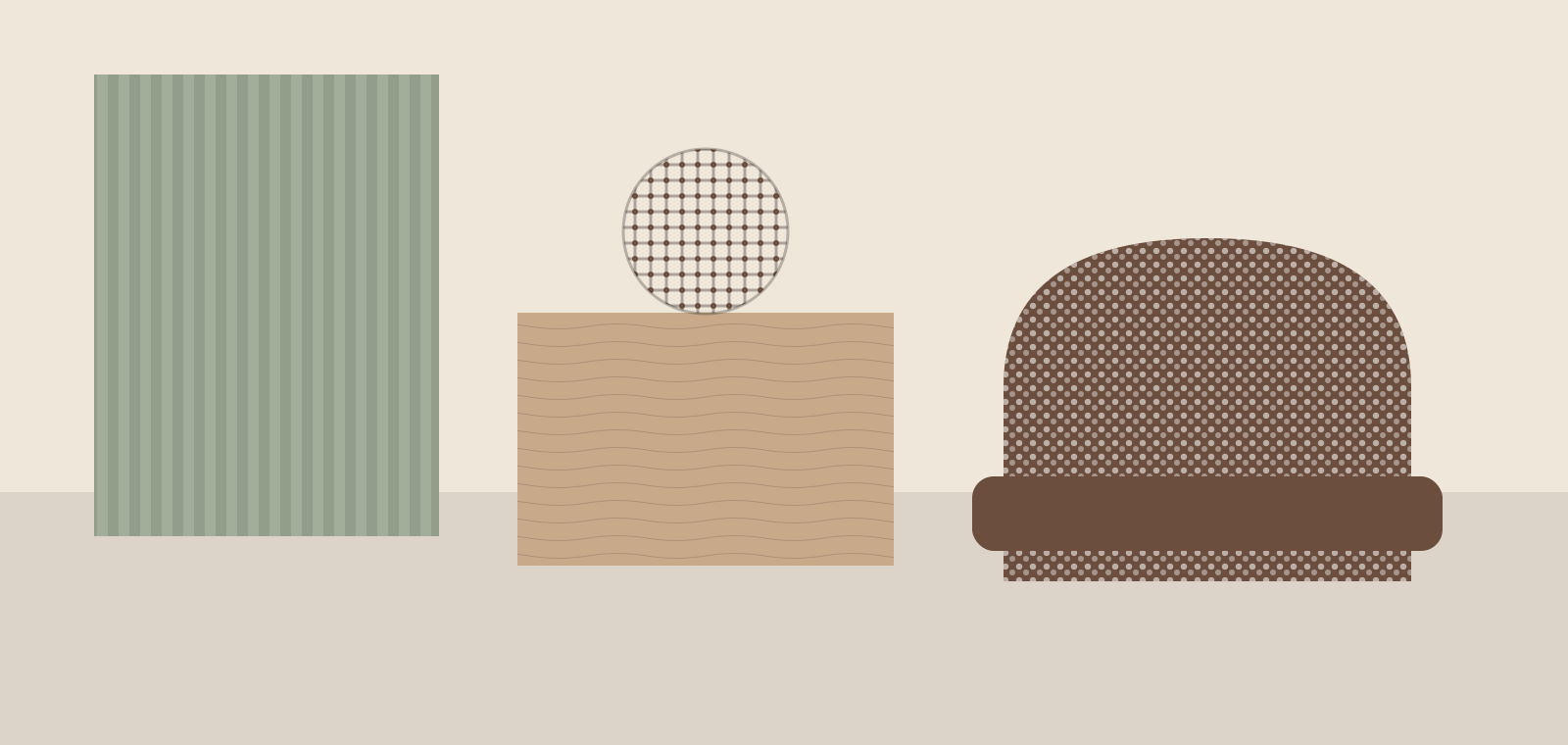
#C8A98A#EFE7DA#A3AE9A#6B4E3D#2E2A26Textured neutrals in camel, ivory and sage hide wear and sit inside the warm palette running through 2027. Saturated velvets are where custom design upholstery earns its keep; hold them for accent chairs where 6–8 yd (5.5–7.3 m) keeps the fabric line under control.
Working with a factory: samples, revisions and approvals
The rule that saves the most money in custom upholstery: put every decision in the brief before the sample, and approve or reject the sample against that brief in writing. Each revision round costs 2–3 weeks and $100–400.
Send a one-page spec sheet per piece: a dimensioned drawing, frame timber and joinery, suspension, foam density and firmness, fabric with Martindale count and fire standard, cut plan, stitching details, leg finish with a reference color, and packaging. Add marked-up reference photos; "like this but firmer" without a number is a revision waiting to happen.
Review the sample physically or by live video against the spec sheet, approve it with signed photos, and state that production must match it within plus or minus 0.4 in (1 cm) and one shade band. For more than 20 pieces, book a third-party inspection at $250–400 per day and pay 70 percent against its report. Our guide on how to source furniture from China covers supplier vetting, contracts and what to do when the inspection fails.
Custom accent chairs and swivel chairs vs custom sofas
Custom chairs are faster and cheaper to sample and are where a new frame design is worth trying; sofas are where you adjust a proven frame and spend the budget on fabric and fill.
A custom accent chair uses 6–8 yd (5.5–7.3 m) of fabric, a frame that one person can build in a day, and a sample that costs $150–400 and ships by air in a week. A failed chair sample is a $300 lesson, a failed sofa sample a $900 one. Custom swivel chairs add a mechanism: specify a steel plate rated to 300 lb (136 kg) with a memory return, a 22–26 in (56–66 cm) base, and a seat height that stays at 17–18 in (43–46 cm) after the 2–3 in (5–8 cm) the mechanism adds. Tub shapes need a curved plywood frame, a template cost the factory spreads over your MOQ; the same curved back and build-up appear as Banquette Seating in restaurants, where only the base changes.
A custom sofa is a logistics problem as much as a craft one: over 96 in (244 cm) build the frame in two bolted sections so it fits a container and a stairwell. The seat deck should be sprung rather than a foam slab, which is where cheap custom sofas fail. Ask for the sample as a single 36–42 in (91–107 cm) end section, which shows arm, seat, back and leg at a third of the cost.
A quick checklist before you commission a custom piece
- Decide the level: adjusted stock frame, or fully bespoke with a prototype fee and 3–5 extra weeks.
- Fix the dimensions against the room and the delivery route; anything over 96 in (244 cm) in two sections.
- Specify the invisible parts: kiln-dried hardwood or 18 mm plywood frame, doweled joints with corner blocks, suspension type, HR foam at 35–45 kg/m³, CMHR where crib 5 applies.
- Specify the fabric by number: Martindale count, fire standard (CAL 117, BS 5852 crib 5 or EN 1021), cleaning code, yardage with repeat allowance, cut plan.
- Confirm the commercial terms: MOQ, unit FOB price and port, sample fee and credit, 30/70 payment, inspection, packaging, warranty.
- Agree the schedule in writing: sample date, production start, inspection date, shipping window.
- Approve the sample against the spec sheet with signed photos, and state the production tolerance.
- Keep the records: fabric remnants, foam sheet, approved photos and the spec, for repairs and reorders.
Have a fabric you love or a chair you have sketched? Bring your fabrics and finishes to our sourcing desk: we match the piece to a factory that builds it well, handle the COM shipping, sample approval and inspection, and quote it landed at your door.
Free toolCurtain Size CalculatorRod length, panel size, ready-made match and yardage.Shop & source the look
Buy it today — or have it made
Retail links are affiliate links: we may earn a commission at no extra cost to you (disclosure). “Get it made” sends the item to our sourcing desk for factory quotes in custom sizes and finishes.
Frequently asked questions
What does "COM" mean in custom upholstery?
COM means customer's own material: you supply the fabric and the factory charges labor plus a handling fee of $25–80 per piece. Get the factory's yardage per piece first, add 15–25 percent for pattern repeats and nap, send a cutting to confirm the fabric is suitable, and inspect every bolt before it ships.
How long does custom upholstery usually take?
Plan on 12–20 weeks door to door from an overseas factory and 6–12 weeks from a domestic workroom. A pre-production sample takes 2–4 weeks, production 4–10 weeks depending on quantity, and sea freight 4–6 weeks. Each extra sample round adds 2–3 weeks, and the factory's written schedule is the figure to rely on.
Is custom upholstery more expensive than buying off the shelf?
Usually by 20–60 percent for a single piece, because sampling, custom cutting and single-unit freight are not spread across a production run. At contract quantities of 20 or more the gap narrows to 0–15 percent, and if the fabric is a factory range rather than COM, a custom size can cost the same as stock.
Can you use your own fabric on a custom sofa?
Yes; that is COM. Confirm the yardage, which is about 12–16 yd (11–15 m) for an 84 in sofa plus 15–25 percent for pattern repeat, and send a cutting so the factory can check stretch, backing and fire treatment. Thin or loosely woven fabrics may need a knit backing or a fire-retardant interliner.
What should you check before approving a custom upholstery sample?
Check dimensions against the drawing, seat firmness and recovery after sitting, frame rigidity by rocking and lifting, straight and even stitching with matched piping, fabric nap and pattern running the same direction on every panel, cushion fill and crown, leg finish against the reference, and that the fabric label and fire test match your spec.
Some links may be affiliate links. Regulations and specifications change — always confirm with suppliers and qualified professionals.