Upholstery Fabric Guide: Types, Rub Counts, Yardage and Cost
The best upholstery fabric for daily use is a tightly woven blend rated 30,000+ Martindale. Compare 8 upholstery fabrics by durability and cost, learn yardage per piece and how custom fabric printing works.
Part of our guide: Custom Upholstery: How Custom Sofas & Chairs Are Made (and Priced)
Key takeaways
- Choose upholstery fabric by rub count first: 15,000 Martindale for occasional chairs, 25,000–30,000 for family sofas, 50,000+ for commercial seating
- Tight weaves in wool, linen-cotton, performance polyester and solution-dyed acrylic outlast loose bouclé and slub textures
- A three-seat sofa takes 14–18 yd (12.8–16.5 m) of plain 54 in (137 cm) fabric; add 10–25% for pattern repeats
- Custom fabric printing suits accent chairs and cushions; ask for printed performance bases rated 25,000+ rubs
The best upholstery fabric for everyday furniture is a tightly woven fabric rated at least 25,000–30,000 Martindale (about 15,000 Wyzenbeek double rubs), in wool, a linen-cotton blend, performance polyester or solution-dyed acrylic. Expect to pay roughly $20–150 per yard for quality upholstery fabrics, and plan 14–18 yards for a three-seat sofa.
Fabric choice decides how long a sofa looks new far more than frame or cushion fill. This guide covers fiber, weave, durability ratings, yardage and custom fabric, and pairs with our custom upholstery guide on frames, springs and workrooms.
- Durability: 15,000 Martindale minimum for light use, 25,000–30,000 for daily sofas, 50,000+ for commercial use.
- Weight: 300–600 gsm for most upholstery, heavier than drapery or apparel cloth.
- Width: 54–56 in (137–142 cm) is standard; some railroaded fabrics run 110 in (280 cm).
- Cleaning codes: W (water), S (solvent), W/S (either), X (vacuum only).
What is upholstery fabric?
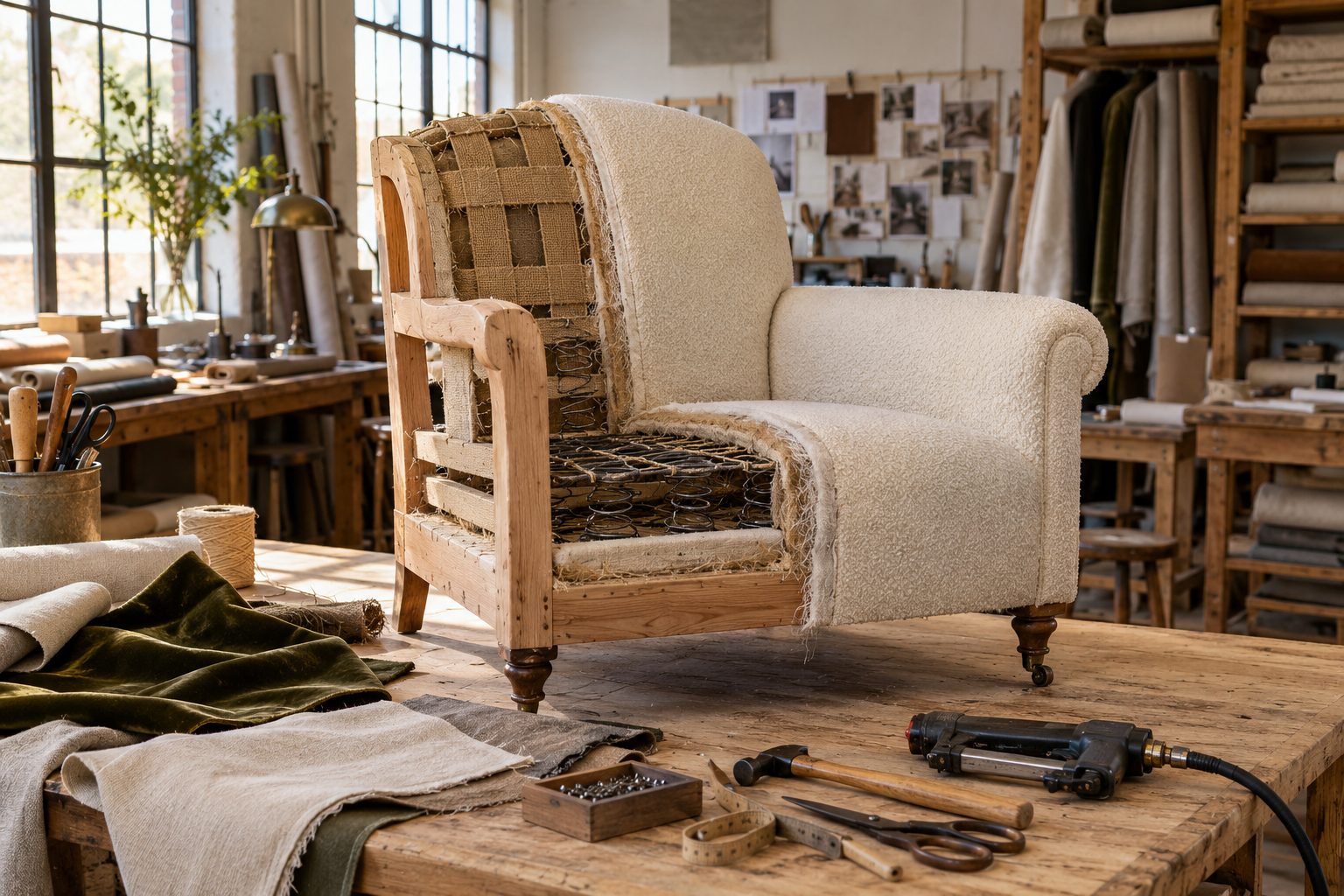
Upholstery fabric is heavy, tightly constructed textile made to be stretched over furniture, with higher abrasion, seam-slippage and pilling resistance than fabric for curtains or clothing. Upholstery material is usually backed with acrylic latex or knit backing so it holds its shape on a frame and resists fraying at seams.
What separates furniture fabric from decorative cloth is testing. A good upholstery cloth lists its abrasion rating (Martindale or Wyzenbeek), pilling grade (1–5, with 4 or higher the target), lightfastness (grade 5+ on a 1–8 scale for sunny rooms), fiber content and a fire standard such as CAL 117 in the US or BS 5852 in the UK. If a supplier cannot give you those numbers, treat it as decorative fabric.
What are the main types of upholstery fabrics?
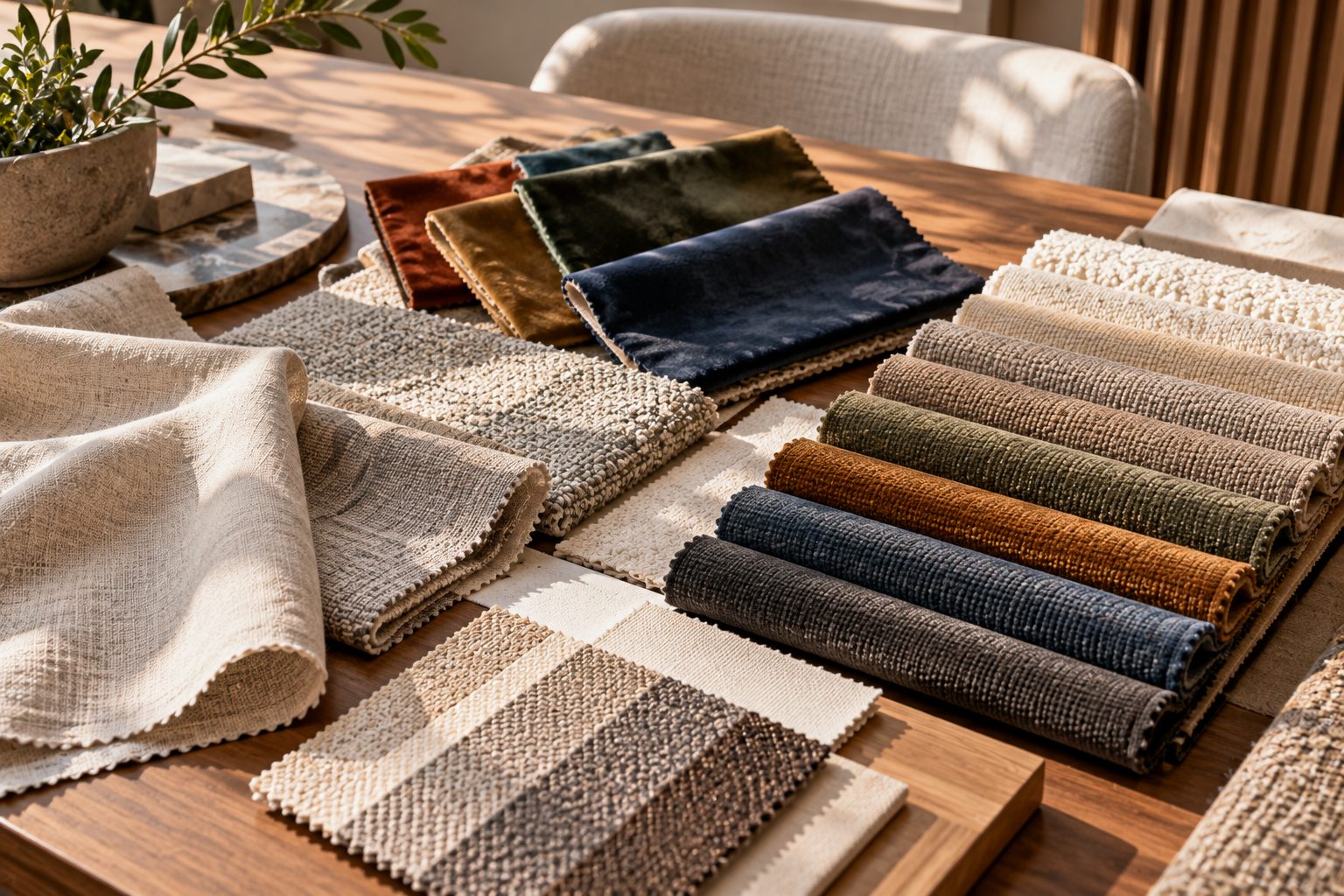
The main upholstery fabrics are natural fibers (wool, linen, cotton, leather), synthetics (polyester, nylon, olefin, acrylic) and blends, and blends usually perform best for the price. The table compares the types we specify most often.
| Fabric | Typical Martindale | Strengths | Weaknesses | Typical price per yard (US 2026) |
|---|---|---|---|---|
| Wool and wool blends | 40,000–100,000 | Resilient, naturally flame-resistant, hides soil | Can feel scratchy; costly | $50–150 |
| Linen | 15,000–30,000 | Cool, matte, ages well | Wrinkles, stains, can sag | $35–110 |
| Linen-cotton blend | 20,000–35,000 | Linen look with more stability | Fades in strong sun | $30–90 |
| Cotton canvas and twill | 15,000–30,000 | Soft, washable as slipcovers | Stains, wrinkles, fades | $20–60 |
| Performance polyester (incl. velvet) | 50,000–100,000+ | Stain-resistant, cleanable, colorfast | Can feel synthetic; check finish chemistry | $25–90 |
| Solution-dyed acrylic | 30,000–60,000 | Fade- and bleach-cleanable, indoor-outdoor | Slightly crisp hand | $30–80 |
| Chenille | 20,000–50,000 | Soft, warm, plush | Pile can crush or snag | $25–80 |
| Bouclé | 10,000–40,000 | Texture, trend appeal | Loops snag on claws; pills | $40–140 |
Rub counts and prices are typical trade ranges, not guarantees for any single fabric; always read the test sheet for the exact cloth.
How do weave and backing change how upholstery fabric wears?
Weave matters as much as fiber: a tight, flat weave in an average fiber will outlast a loose, textured weave in a premium one. Before reading any test sheet, hold the cloth up to a window; if you can see light through it easily, it will stretch, snag and wear thin on a seat.
- Plain and twill weaves: the most durable constructions; twills hide soiling well thanks to their diagonal line.
- Jacquards and damasks: pattern woven in rather than printed, so it never wears off; long floats on the surface can snag.
- Velvets and chenilles: a cut pile over a base cloth; density of pile decides how fast it crushes.
- Bouclé and slub textures: loops and thick-thin yarns look rich but catch on jewelry, zips and claws.
- Knits: stretch well over curved shells but need a stabilizing backing for flat cushions.
Backing is the quiet spec that separates furniture fabric from pretty cloth. An acrylic latex or knit backing improves seam strength and stops a loose weave from shifting on the frame; many workrooms will back a decorative fabric for $5–12 per yard (typical) so it can be used on upholstery. Ask also for seam slippage results, ideally 6 mm or less at the test load, because fabrics that pass abrasion still fail when seams pull open on a tight seat.
How durable should upholstery fabric be?
Upholstery fabric for a daily-use home sofa should be 25,000–30,000 Martindale or higher, and anything for commercial seating should reach 50,000–100,000. Martindale (used in Europe and much of Asia) rubs fabric in a figure-eight with wool abradant until threads break; Wyzenbeek (used in the US) rubs back and forth with cotton duck, and its double-rub numbers are lower.
- Decorative (cushions, headboards): 10,000+ Martindale, about 6,000 Wyzenbeek.
- Light domestic (occasional chairs): 15,000+ Martindale, about 9,000 Wyzenbeek.
- General domestic (family sofa): 25,000–30,000 Martindale, about 15,000 Wyzenbeek.
- Heavy-duty and contract: 50,000–100,000+ Martindale, 30,000+ Wyzenbeek.
The two tests do not convert precisely; use the conversions as rough guides. Above about 100,000 rubs, extra numbers say little about real-world life, and pilling, seam slippage and fading become the deciding factors.
What is the best sofa upholstery fabric?
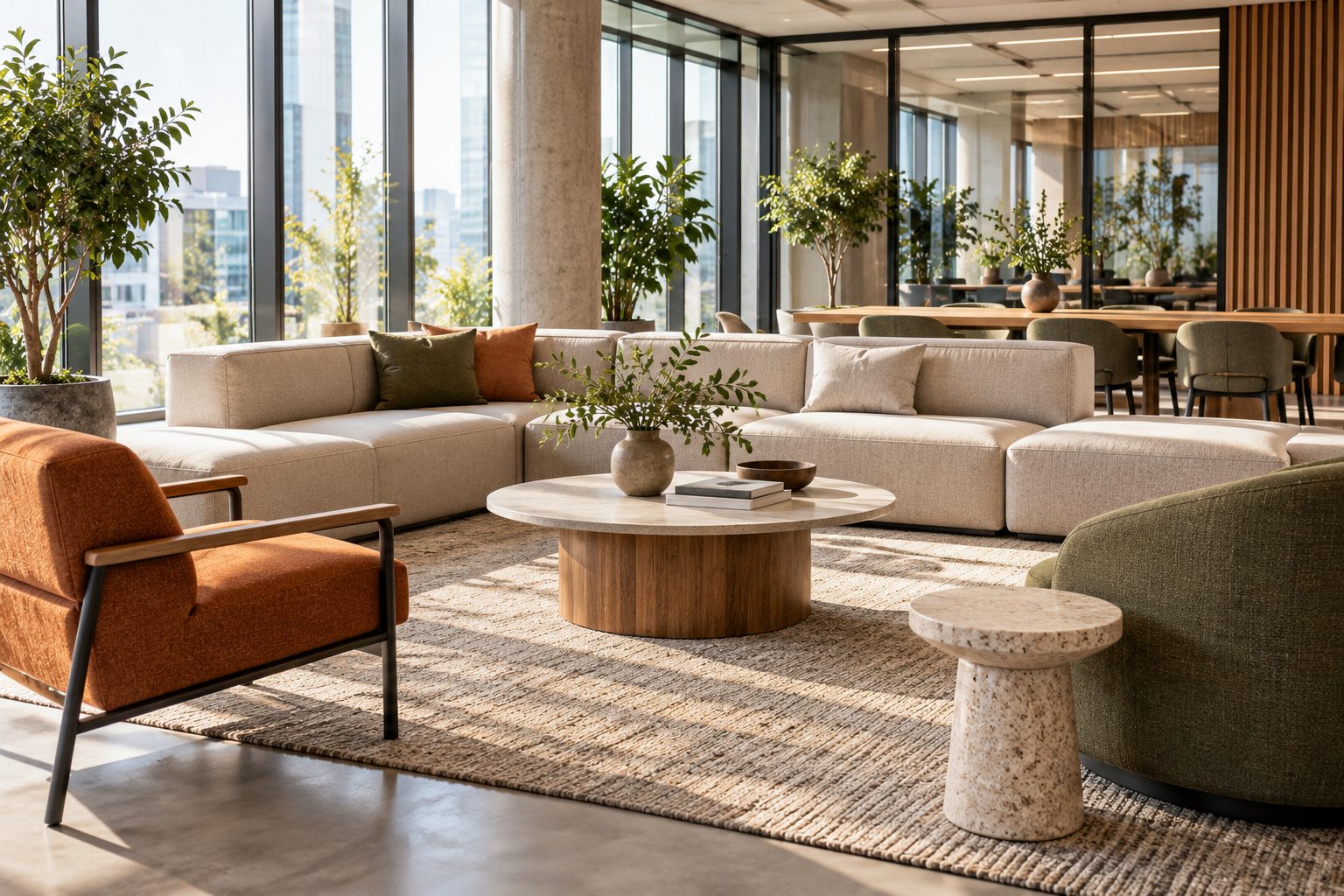
The best sofa upholstery fabric for most homes is a tight-weave wool blend or performance polyester, because both resist abrasion, pilling and staining while still looking natural. For fabric sofas used by children or pets, choose a flat or tight weave with no loops, a W or W/S cleaning code and a mid-tone, slightly heathered color that hides lint.
Linen and cotton sofa upholstery cloth works best as removable slipcovers you can wash. Velvet is more durable than its reputation suggests: a polyester or cotton-blend velvet at 50,000+ rubs handles daily use, though it shows pressure marks. Leather is a separate category and a strong choice for pets that do not scratch. Pair the fabric with a sensible size and shape using our sofa size guide, and see our washable couch guide if spills are a daily event.
#B7A68F#6F7A65#8A5A44#4A4F57#D8CFC0These mid-tones are the colors we reach for on family sofas: oatmeal, moss, rust and charcoal hide wear far better than bright white or flat black, which both show every crumb and hair. Hex values are approximate screen references; always order cuttings.
What upholstery fabric is best for chairs and dining chairs?
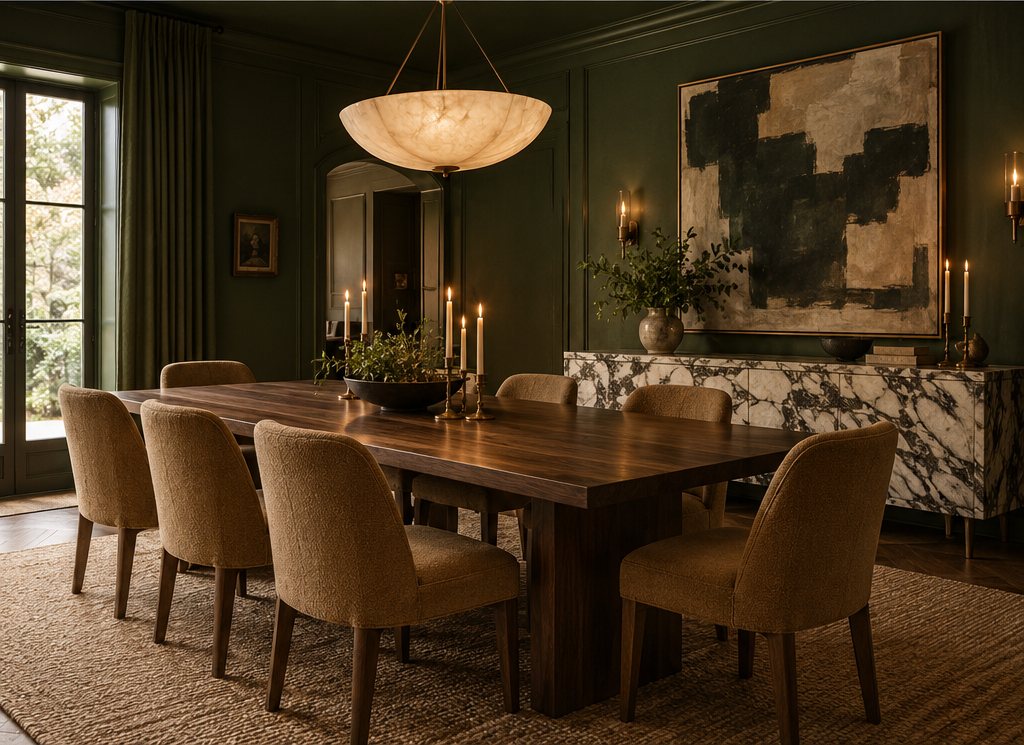
Upholstery fabric for dining chairs should be stain-resistant, water-cleanable and at least 30,000 Martindale, because seats take food, friction and frequent wiping. Performance polyester, solution-dyed acrylic, coated linen blends and leather are the safest dining room chairs upholstery material.
For accent and lounge chairs, chair upholstery fabric can be more decorative: a 15,000–25,000 rub linen, mohair or bouclé is fine on a chair used a few times a week. Upholstery fabric for chairs with tight seats and backs should have little stretch, or it will bag. Our upholstered dining chairs guide covers seat heights and frames.
A practical trick for dining rooms: upholster the seat in a cleanable performance fabric and use the more delicate fabric you love only on the outside back, where hands and food rarely reach. Drop-in seats that unscrew from below make re-covering a 20-minute job, so you can refresh a set of eight chairs for the cost of 4–6 yd of fabric.
How much upholstery fabric by the yard do you need?
A three-seat sofa needs about 14–18 yd (12.8–16.5 m) of plain 54 in (137 cm) fabric, an armchair 6–8 yd (5.5–7.3 m) and a dining chair seat 0.5–1 yd (0.5–0.9 m). Patterned fabric needs more, since each cushion must line up with the repeat.
| Piece | Plain fabric, 54 in (137 cm) wide | Large pattern repeat |
|---|---|---|
| Dining chair, seat only | 0.5–0.75 yd (0.5–0.7 m) | 0.75–1 yd (0.7–0.9 m) |
| Dining chair, seat and back | 1.25–1.75 yd (1.1–1.6 m) | 1.75–2.25 yd (1.6–2.1 m) |
| Accent or slipper chair | 4–6 yd (3.7–5.5 m) | 5–7 yd (4.6–6.4 m) |
| Armchair or club chair | 6–8 yd (5.5–7.3 m) | 7–10 yd (6.4–9.1 m) |
| Loveseat | 10–13 yd (9.1–11.9 m) | 12–15 yd (11–13.7 m) |
| Three-seat sofa | 14–18 yd (12.8–16.5 m) | 16–22 yd (14.6–20.1 m) |
| Sectional, L-shape | 20–28 yd (18.3–25.6 m) | 24–34 yd (21.9–31.1 m) |
Figures are typical workroom estimates; skirts, piping, tufting and loose back cushions each add 1–3 yd. When buying upholstery fabric by the yard, order everything from one dye lot plus 1–2 yd spare for repairs.
What does it cost to reupholster with new fabric?
Fabric is usually 30–50% of a reupholstery bill; labor is the rest. Typical US 2026 workroom labor runs about $250–600 for an armchair, $800–1,800 for a three-seat sofa and $60–150 per dining chair seat, before fabric. A sofa in 16 yd of $45 fabric therefore lands around $1,500–2,500 all in. Reupholstering makes sense when the frame is solid hardwood with eight-way hand-tied or good sinuous springs; on a stapled softwood frame, the money is better spent on a new piece.
How does custom fabric printing work?
Custom fabric printing applies your own artwork to a blank base cloth with digital inkjet or screen printing, and it is the simplest way to get custom fabric made in short runs. Digital printing has no screen costs and minimums as low as one yard; screen printing suits runs of a few hundred yards or more and gives richer, more lightfast color.
- Choose the base first. Pick a printable upholstery base at 300–450 gsm and 25,000+ Martindale; thin quilting cotton will not survive a seat.
- Prepare the file. A repeating tile at 150–300 dpi at full print size, with the repeat width set to fit 54 in (137 cm) cloth.
- Order a strike-off. A test print of 8–24 in (20–60 cm) checks color, scale and hand before you commit.
- Ask about finishes. Stain repellent and backing can usually be added after printing.
- Confirm fire compliance. Commercial jobs need the printed cloth, not just the blank base, tested to CAL 117, NFPA 260 or BS 5852.
- Plan lead time. Digital custom textile fabric printing takes about 1–3 weeks; screen-printed or custom-woven fabric 6–12 weeks.
Typical US prices for personalized printed fabric on upholstery-weight bases run roughly $30–70 per yard for digital short runs, falling with volume. Custom textile fabric woven to your design needs larger minimums, often 300–1,000 yd per colorway.
Mistakes we see when choosing upholstery fabric
The mistake we see most often is choosing upholstery fabric from a small swatch under showroom light and never testing it at home. Order a large cutting, at least 18 × 18 in (46 × 46 cm), drape it over the actual seat for a week and look at it morning and evening.
- Ignoring the cleaning code: an S-code fabric on a family sofa means solvent cleaning for every spill.
- Loose weaves near pets: loops and slubs snag on claws in weeks.
- Natural fibers in sunny rooms: silk, linen and cotton fade fast under a south-facing window.
- Buying short: a second dye lot rarely matches the first.
- Skipping fire certification on contract jobs: see our contract furniture guide for commercial standards.
Our verdict: for most homes, a wool blend or performance weave in a heathered mid-tone at 30,000+ Martindale is the fabric you will not regret. Specifying upholstery fabric for a hotel, restaurant or rental portfolio? Our FF&E procurement toolkit includes a fabric specification sheet, or send your yardage and test requirements to our textile sourcing desk for mill quotes.
Free toolTile CalculatorWork out tiles, boxes, grout and adhesive with the right wastage.Shop & source the look
Buy it today — or have it made
Retail links are affiliate links: we may earn a commission at no extra cost to you (disclosure). “Get it made” sends the item to our sourcing desk for factory quotes in custom sizes and finishes.
Frequently asked questions
What is the most durable upholstery fabric?
The most durable upholstery fabrics are performance polyester, nylon blends, wool blends and solution-dyed acrylic, many rated 50,000–100,000+ Martindale. Tight flat weaves outlast loose or looped textures at the same rub count. Leather is also very durable if it is not scratched. Check pilling grade 4 or higher alongside the rub count.
How many yards of fabric do I need to reupholster a sofa?
A typical three-seat sofa needs 14–18 yards (12.8–16.5 m) of plain 54 in (137 cm) upholstery fabric. Add 10–25% for large pattern repeats, and 1–3 yards more for skirts, piping or loose back cushions. Ask your workroom for an exact figure before ordering, and buy from one dye lot.
What is the best upholstery fabric for dining chairs?
The best upholstery fabric for dining chairs is a stain-resistant, water-cleanable weave rated 30,000 Martindale or more, such as performance polyester, solution-dyed acrylic or a coated linen blend. Leather and faux leather also wipe clean well. Avoid loose linens and light silks on seats that will meet food and frequent friction.
How do I get custom fabric made?
To get custom fabric made, send a repeating artwork file to a digital printer or mill, choose an upholstery-weight base of 300–450 gsm, and approve a strike-off before full production. Digital printing has low minimums and takes 1–3 weeks; custom weaving needs 300–1,000 yard minimums and 6–12 weeks.
Is upholstery fabric different from regular fabric?
Yes, upholstery fabric is heavier and more tightly constructed than apparel or drapery fabric, usually 300–600 gsm, and is tested for abrasion, pilling, seam slippage and fire resistance. Many upholstery fabrics also have a latex or knit backing. Regular cotton or quilting fabric wears through quickly on a seat.
Some links may be affiliate links. Regulations and specifications change — always confirm with suppliers and qualified professionals.