Persian Rugs Guide: Authenticity, Knot Counts, Prices and Care
Persian rugs are hand-knotted wool or silk rugs woven in Iran; a new 8 x 10 ft piece typically costs $2,500–15,000. Here is how to check authenticity, read knot counts, compare origins and care for one.
Part of our guide: Wool Rugs Guide: Weaves, Sizes & Wool Jute Rug Blends
Key takeaways
- A true Persian rug is hand-knotted in Iran; Persian-design rugs from India, Pakistan, Nepal, Turkey or Afghanistan can be just as well made but are not Persian
- Check the back: individual, slightly irregular knots and a fringe that is the warp itself mean hand-knotted; a glued canvas backing means hand-tufted
- Typical 2026 prices for an 8 x 10 ft rug run $300–1,200 machine-made, $1,500–6,000 hand-knotted outside Iran and $2,500–15,000+ for good Persian wool
- Knot density is one quality signal among several; wool quality, dyes, even tension and condition matter as much
Persian rugs are hand-knotted pile rugs woven in Iran, usually from wool on a cotton foundation, sometimes with silk. A genuine new 8 x 10 ft (244 x 305 cm) Persian rug typically costs $2,500–15,000 in the US in 2026, while machine-made Persian-style copies sell for $300–1,200. The back of the rug tells you which one you are looking at.
- Definition: "Persian" means made in Iran; "oriental rugs" is the broader trade term for hand-knotted rugs from Iran, Turkey, the Caucasus, Central Asia, India, Pakistan, Nepal and China.
- Construction: each knot is tied by hand around warp threads; 80–400+ knots per square inch (KPSI).
- Time: a fine 8 x 10 ft rug can take one weaver many months to more than a year.
- Lifespan: a well-kept hand-knotted wool rug lasts 50–100 years; tufted rugs last 5–15.
Persian rugs are the most famous branch of hand knotted wool rugs, and most of the fiber advice in our wool rug guide applies to them directly. What is different is the vocabulary: knots, origins, dyes and the long secondhand market that makes buying one feel opaque. This guide strips that back to what you can check yourself.
What makes a rug a Persian rug?
A rug is Persian when it is hand-knotted in Iran; the design alone does not make it Persian, and a rug woven in Iran on a power loom is a machine-made Iranian carpet, not a Persian rug in the collector's sense.
The terms overlap in everyday searches. Iranian rugs, iran persian rugs and iranian carpet all describe origin. Persian carpet and persian rug carpet are used interchangeably; in the trade, "carpet" often means a piece larger than about 6 x 9 ft (183 x 274 cm) and "rug" anything smaller. An oriental carpet is any hand-knotted pile carpet from the traditional weaving belt between Turkey and China. Asian carpet is a looser retail term that may include machine-made pieces.
Persian weavers typically tie the asymmetrical knot, sometimes called the Persian or Senneh knot, which allows fine curved lines. Turkish and many Caucasian weavers use the symmetrical knot. Both are hand knotted carpets of equal standing; the knot type helps experts attribute origin rather than judge quality.
A note on buying Iranian rugs in the US
US sanctions have restricted imports of new Iranian-made carpets since 2018, so most new rugs sold in the US as "Persian" are Persian-design rugs woven in India, Pakistan, Nepal, Afghanistan or Turkey, or older Iranian pieces that were already in the country. A reputable dealer will tell you the country of origin and roughly when the rug entered the US. Check current rules before importing one yourself.
How can you tell if a Persian rug is authentic?
Authentic persian rugs are hand-knotted, so the back shows the pattern clearly in individual knots with small irregularities, and the fringe is the warp itself rather than a strip sewn on. Those two checks separate hand-knotted from tufted and machine-made in under a minute.
- Flip a corner. On a hand-knotted rug, the design on the back is crisp and mirrors the front. Slight variation in knot size and line is normal. A perfectly uniform grid suggests a machine.
- Look for glue or canvas. A cloth or latex backing means the rug is hand-tufted: the pile was punched through a base with a tufting gun and glued. Hand tied rugs never have this.
- Check the fringe. On hand-knotted and hand woven rugs, the fringe is the ends of the warp threads running through the whole rug. A fringe stitched onto the edge is a sign of machine or tufted construction.
- Fold the pile. Bend the rug along a row. You should see the knots tied around the warps at the base of the pile.
- Read the sides. Overcast edges, wrapped by hand, are slightly uneven. Machine-serged sides are perfectly straight.
- Check the fiber. Wool should feel slightly oily from lanolin and resist a match flame test; shiny "art silk" is usually viscose, which crushes and stains with water.
Authenticity of construction does not tell you origin. A handmade knotted rug from Nepal and one from Iran pass all six checks. For origin you need a dealer's documentation, an appraiser or experience with specific weaving styles.
How much is a Persian rug?
A new or recent hand-knotted Persian rug in good wool typically costs $25–200 per sq ft in the US in 2026, which puts an 8 x 10 ft rug at roughly $2,500–15,000; fine silk or antique pieces can cost far more. Price rises with knot density, fiber, size, age, condition and the dealer's overheads.
| Rug type | Construction | Typical KPSI | Typical 8 x 10 ft price (US, 2026) | Expected lifespan |
|---|---|---|---|---|
| Machine-made Persian-style | Power loom, polypropylene or wool | Not applicable | $300–1,200 | 5–20 years |
| Hand-tufted Persian design | Tufting gun, glued backing | Not applicable | $600–2,000 | 5–15 years |
| Hand-knotted, India or Pakistan | Hand-knotted wool | 60–200 | $1,500–6,000 | 30–75 years |
| Hand-knotted village Persian | Handspun wool, geometric | 80–160 | $2,500–8,000 | 50–100 years |
| Fine city-weave Persian | Wool, often with silk | 200–400+ | $6,000–15,000+ | 75–100+ years |
| Pure silk Persian | Silk on silk | 400–1,000 | $15,000 and well beyond | Heirloom; low traffic only |
These bands are typical retail ranges, not appraisals. Estate sales and auctions can be much cheaper, and gallery prices for named antique types can be much higher. Vintage rugs from the mid-20th century, worn to a low pile, often sell below new prices and suit busy rooms because the wear is already done.
Is knot count the best measure of quality?
Knot count is a useful signal but a poor single measure. A 120 KPSI village rug in lustrous handspun wool with natural dyes can outlast and outvalue a 300 KPSI rug in dull, over-processed wool. Look at the wool's sheen and spring, whether the colors bleed, how flat the rug lies and whether the pile is even.
Which Persian rug styles suit modern rooms?
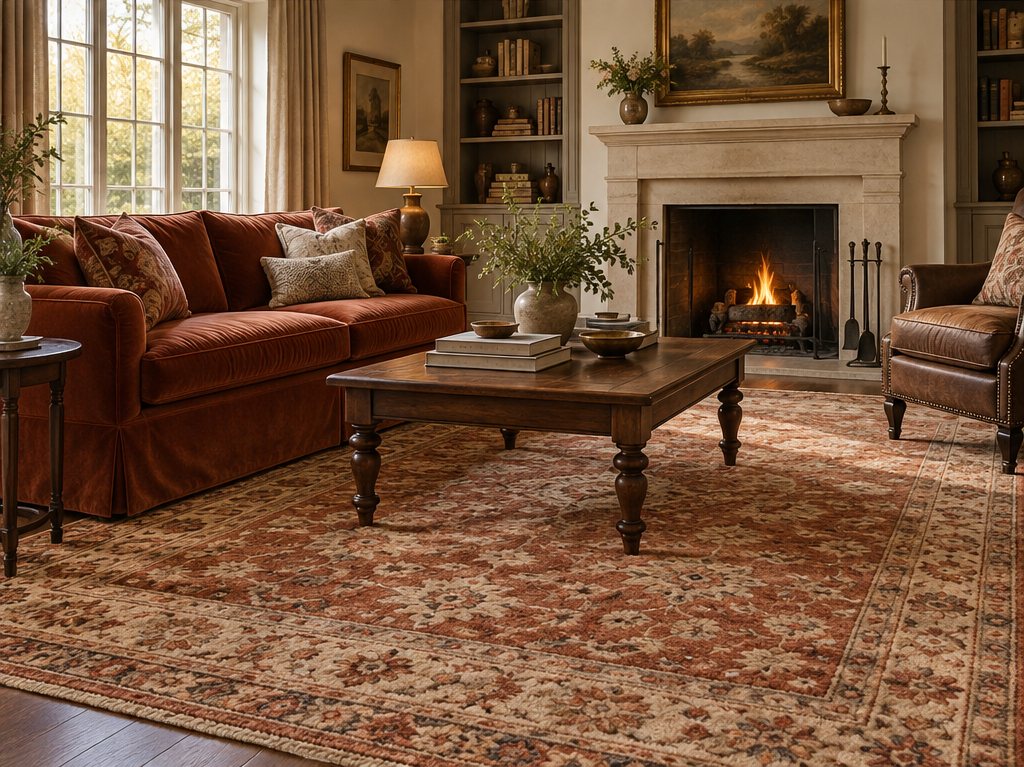
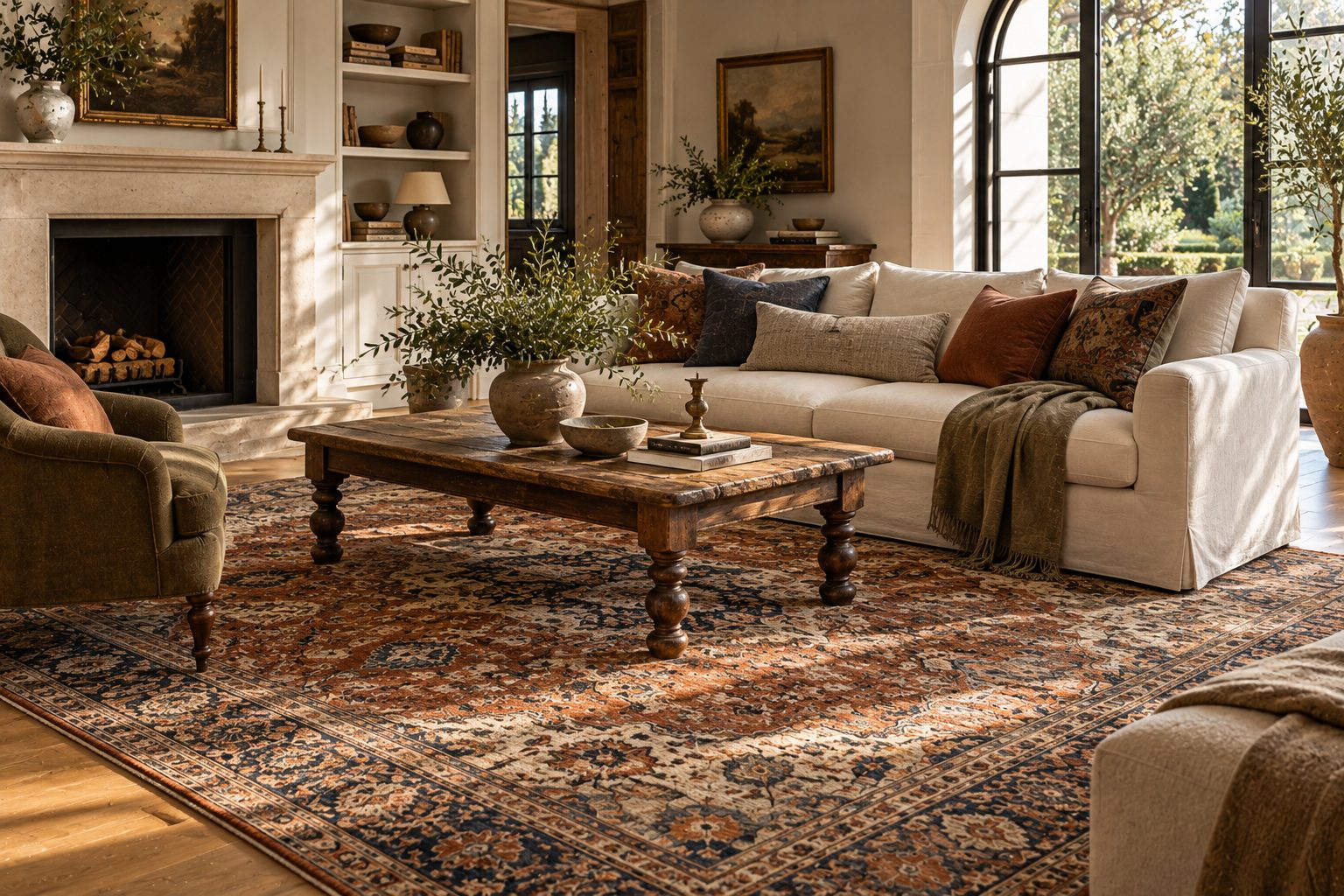
Geometric village and tribal Persian rugs suit modern and minimal rooms best, because their bold, simplified motifs and warm reds and blues read as graphic rather than formal. Curvilinear city rugs with dense floral fields suit traditional or deliberately eclectic schemes.
- Geometric village rugs: medallions and borders drawn in straight lines; thicker pile; ideal for living rooms with clean-lined furniture.
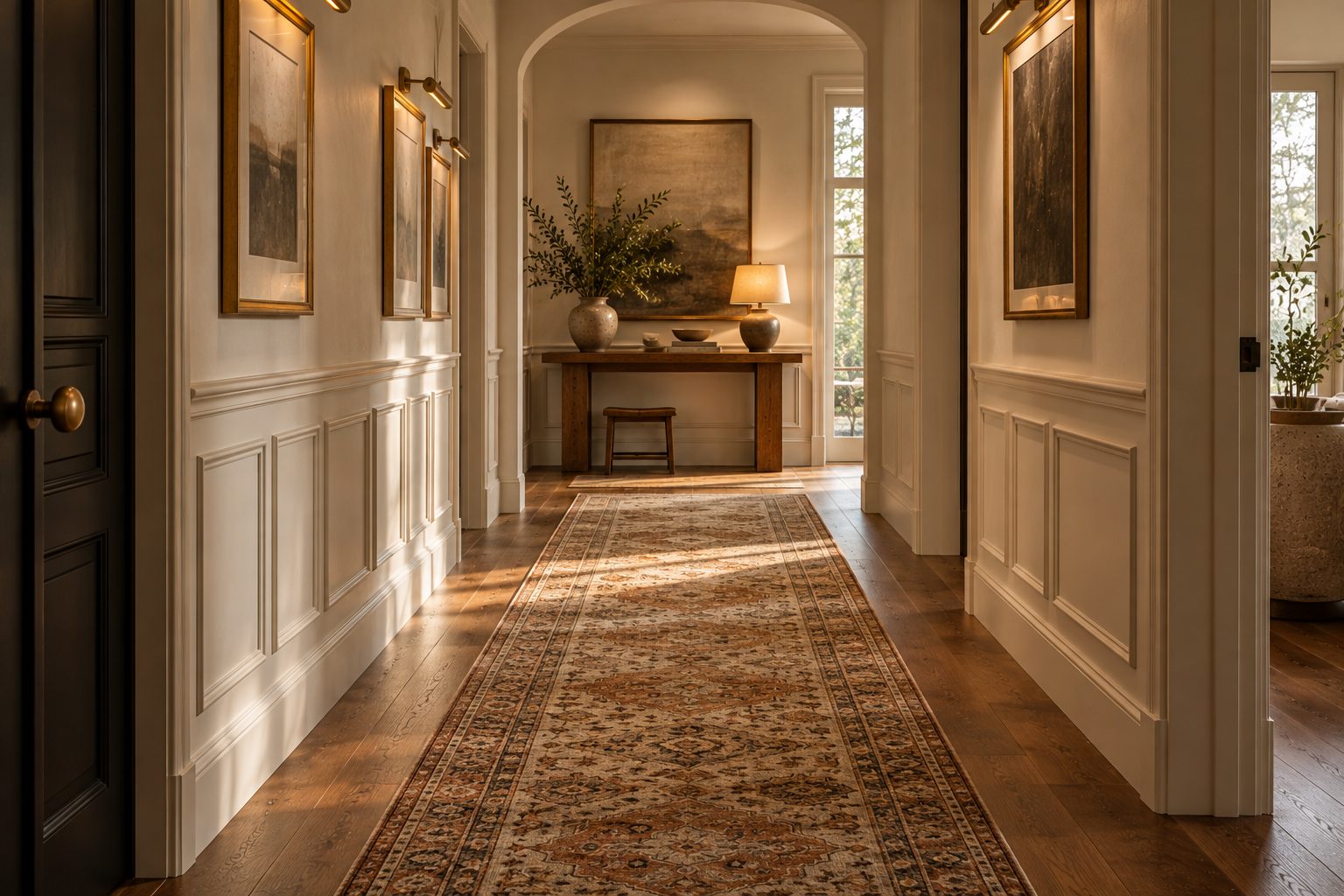
- Tribal rugs: nomadic, often small, with abstract animals and stepped motifs; great in hallways and as layered accents.
- City-weave florals: fine curvilinear vines and central medallions; formal dining rooms, libraries, bedrooms.
- Washed or overdyed rugs: older rugs faded or recolored in a single tone; a popular bridge between traditional pattern and modern palettes, though harsh chemical washing shortens life.
#8E2B23#1F3150#C79A4B#E9DEC9#4D5B3AThe traditional dye palette is narrow: madder red, indigo blue, weld yellow, walnut brown and undyed ivory, with green made by overdyeing. When you build a room around a Persian rug, pull one wall or upholstery color from the rug's minor tones rather than its dominant red. Our traditional interior design guide and living room rug ideas show how to pair pattern with plain upholstery.
What size Persian rug should you buy?
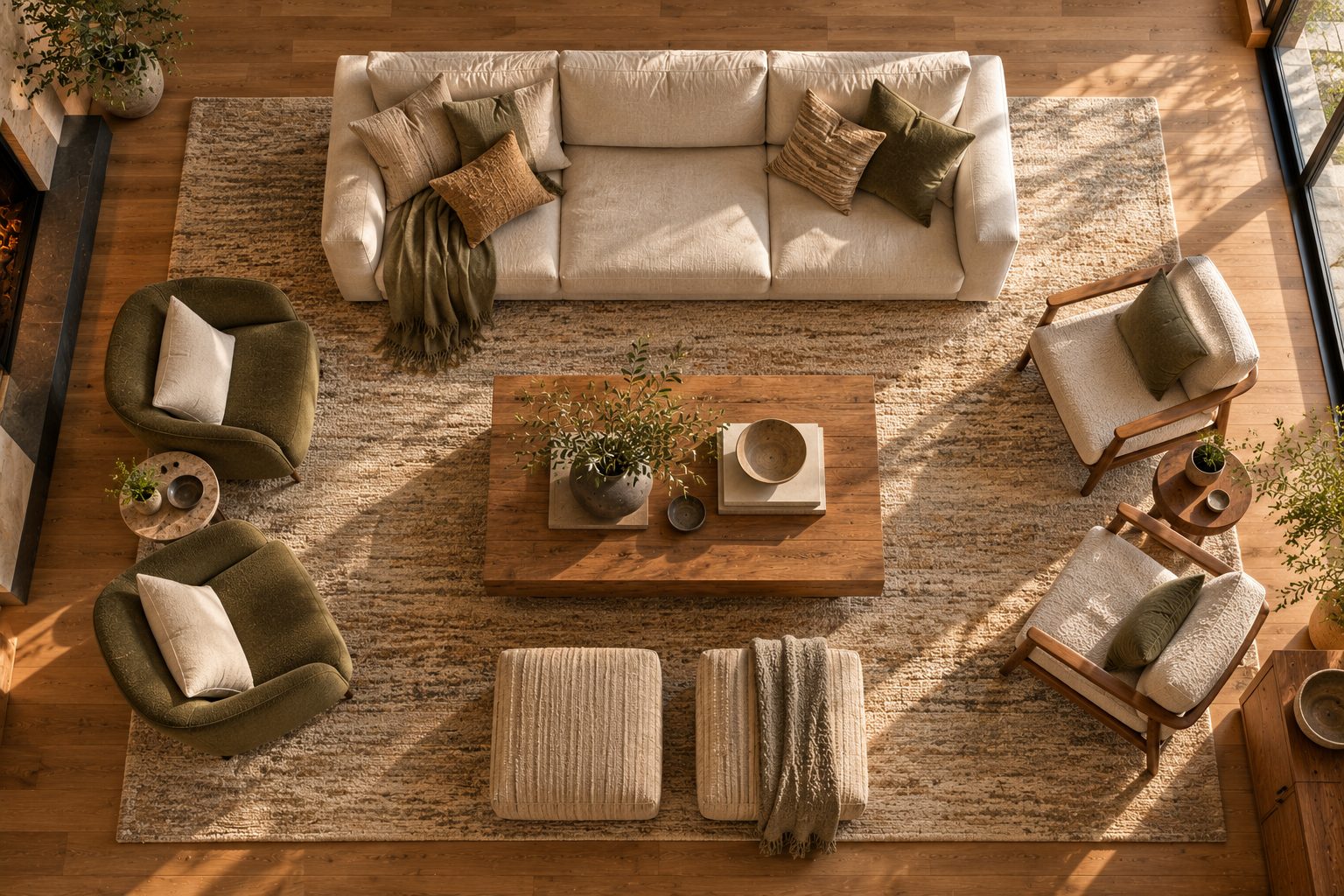
Buy a Persian rug large enough for the front legs of every seat to rest on it in a living room, and large enough for chairs to stay on it when pulled out in a dining room. Hand-knotted rugs come in traditional sizes that are not always the round US numbers.
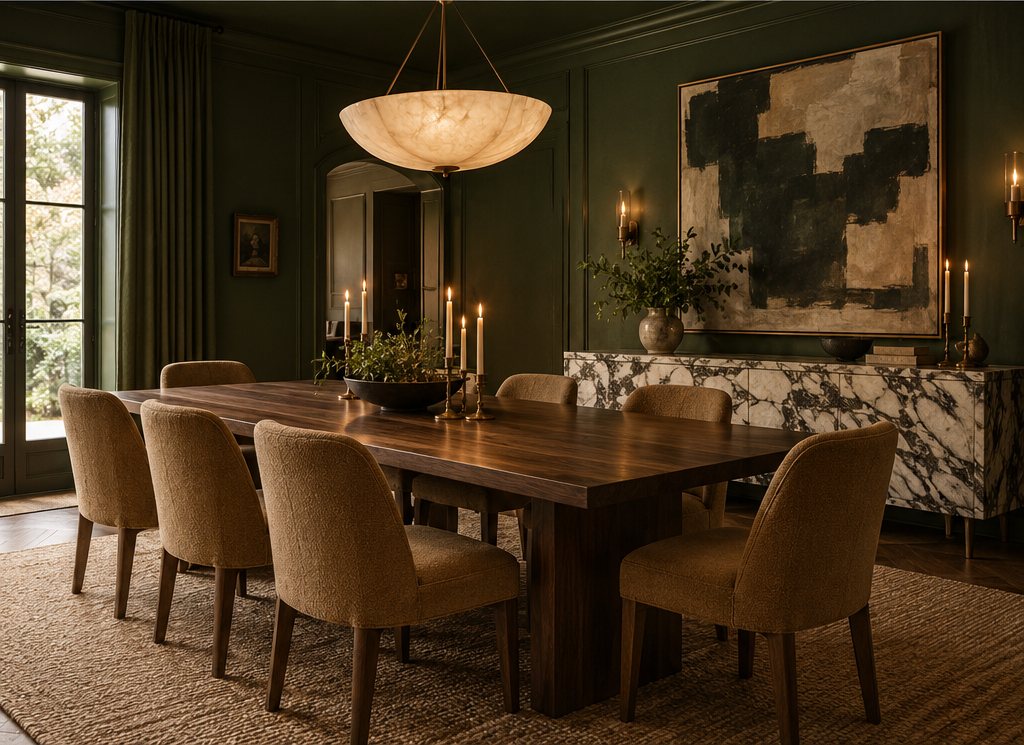
Common hand-knotted sizes run roughly 4 x 6 ft, 5 x 7 ft, 6 x 9 ft, 8 x 10 ft, 9 x 12 ft and 10 x 14 ft, with runners 2 ft 6 in to 3 ft wide and 8–16 ft long; expect a few inches either way because each rug is made by hand. For a dining table, add 24 in (61 cm) on every side; see our dining room rug guide for the full rule set, or run your room through the rug size calculator.
How do you care for hand knotted rugs?
Hand knotted rugs need regular vacuuming without a beater bar, rotation every six to twelve months, a felt or rubber-and-felt pad and professional immersion washing every three to five years. With that routine, a wool rug can outlive its owner.
- Vacuum weekly with suction only or the brush raised; never vacuum the fringe, which tears.
- Rotate 180 degrees every six to twelve months so sun fading and traffic wear even out.
- Use a pad. A dense felt or felt-and-rubber pad stops creeping and cushions the foundation; see our rug pad guide.
- Blot spills at once with cold water and a white cloth; avoid ammonia, oxygen bleach and steam cleaning.
- Watch for moths. Check under furniture and the back of the rug every few months; moths prefer dark, undisturbed wool.
- Repair early. Re-overcasting a fraying edge or securing a fringe typically costs $50–300; leaving it can cost thousands later.
What to check before buying handmade persian rugs
Before buying handmade persian rugs, lay the rug flat, inspect the back in daylight and ask for a written description of origin, age, fiber and any repairs. A dealer who will not put those in writing is a dealer to walk away from.
Check for dry rot by gently folding the rug back on itself; cracking sounds or stiff, brittle areas mean the cotton foundation has been damaged by moisture. Look for painted-in areas where worn pile has been colored with ink. Make sure the rug lies flat and roughly square, as some wavy edges are normal but a rug that buckles in the middle will always ripple. Ask about the return policy and whether you can try the rug at home for a few days, which most established dealers allow.
Our verdict on oriental rugs vs new hand-knotted rugs
For most homes, a good mid-century or vintage hand-knotted oriental rug offers more character per dollar than a new one, and a new hand-knotted rug from a reputable weaver outside Iran offers better value than a new machine-made Persian copy. Machine-made rugs look right at a glance but crush, fade and stay at the same value or lose it, while handmade rugs hold or gain.
Our own buying rule: put real money into one hand-knotted rug in the room you live in most, buy vintage if you want traditional pattern, and choose a geometric design if your furniture is modern. Persian rugs are among the few home purchases that improve with use, provided the wool is good and the foundation stays dry. If you want an overview of other constructions before deciding, our types of rugs guide compares them side by side.
Need a custom size, a color-matched design or a set of rugs for a hotel or multi-room project? Send sizes, palette and quantities to our textile sourcing desk for quotes from vetted hand-knotting workshops.
Free toolRug Size CalculatorFind the right rug size for your room and furniture.Shop & source the look
Buy it today — or have it made
Retail links are affiliate links: we may earn a commission at no extra cost to you (disclosure). “Get it made” sends the item to our sourcing desk for factory quotes in custom sizes and finishes.
Frequently asked questions
How much is a Persian rug?
A genuine hand-knotted Persian rug typically costs $25–200 per sq ft in the US in 2026, so an 8 x 10 ft rug runs about $2,500–15,000. Fine silk and rare antique pieces cost more. Machine-made Persian-style rugs sell for $300–1,200, and hand-knotted Persian-design rugs from India or Pakistan usually fall between $1,500 and $6,000.
How do I know if my Persian rug is real?
A real Persian rug is hand-knotted, so the pattern is clearly visible on the back in slightly irregular individual knots, and the fringe is the end of the warp threads rather than a sewn-on strip. A glued canvas back means hand-tufted. Construction proves handmade, not Iranian origin; for origin you need dealer documentation or an appraiser.
What is the difference between Persian and oriental rugs?
Persian rugs are hand-knotted in Iran, while oriental rugs is the broader term for hand-knotted rugs from the whole weaving belt, including Turkey, the Caucasus, Afghanistan, India, Pakistan, Nepal and China. Every Persian rug is an oriental rug, but not every oriental rug is Persian. Quality depends on wool, dyes and weaving, not on the label.
Are Persian rugs worth the money?
A well-made hand-knotted Persian rug is worth the money if you value longevity: good wool rugs last 50–100 years, can be washed and repaired, and often hold their value. They are not a good buy if you want a trend color for a few years. Vintage pieces frequently give the best value per dollar.
Can you put a Persian rug in a high-traffic area?
Yes, a hand-knotted wool Persian rug handles high traffic well, especially a geometric village rug with a medium pile of about 0.4–0.6 in (10–15 mm). Use a dense felt pad, rotate it every six to twelve months and vacuum weekly without a beater bar. Avoid silk or very fine city rugs in hallways and entries.
Some links may be affiliate links. Regulations and specifications change — always confirm with suppliers and qualified professionals.