Runner Rugs Guide: Sizes for Hallways, Kitchens, Stairs and Baths
Runner rugs are 2–3 ft wide and 6–14 ft long, and the right one leaves 4–6 in of floor on each side. Here are sizes for hallways, kitchens, stairs and baths, plus fibers, pads and typical prices.
Part of our guide: How to Choose a Rug Size: The Definitive Guide for Every Room
Key takeaways
- Standard runner rugs are 2–3 ft (61–91 cm) wide and 6–14 ft (183–427 cm) long; 2.5 × 8 ft (76 × 244 cm) is the most common
- Leave 4–6 in (10–15 cm) of floor each side of a runner and 6–18 in (15–46 cm) at each end
- Kitchens and entries need washable or solution-dyed synthetics; halls and stairs reward dense wool
- Cut-to-length carpet runners solve odd hallway lengths at typical $10–45 per linear foot
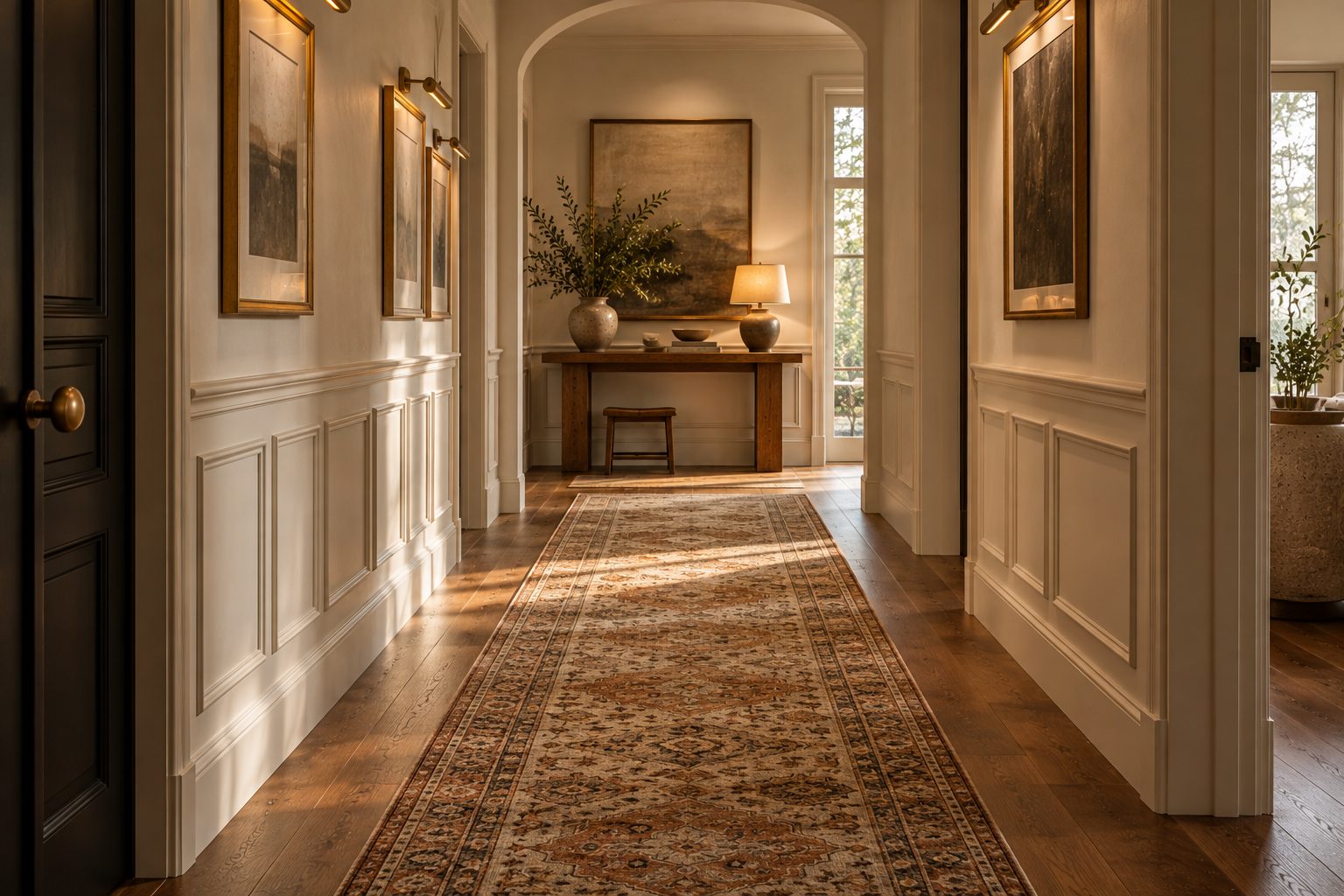
Runner rugs are long, narrow rugs 2–3 ft (61–91 cm) wide and 6–14 ft (183–427 cm) long, used in hallways, kitchens, entries, beside beds and on stairs. The most common size is 2.5 × 8 ft (76 × 244 cm). Choose a width that leaves 4–6 in (10–15 cm) of floor on each side and a length that stops 6–18 in (15–46 cm) short of each end.
That simple ratio is what makes a runner look made-to-measure. This page belongs to our how to choose rug size guide; for room-size rugs, see our rug sizes chart.
- Common widths: 2 ft, 2 ft 6 in, 2 ft 8 in and 3 ft (61, 76, 81 and 91 cm).
- Common lengths: 6, 8, 10, 12 and 14 ft (183, 244, 305, 366 and 427 cm).
- Thickness: under 0.5 in (13 mm) anywhere a door swings over it.
- Typical price: $40–200 machine-made, $200–900 wool, $10–45 per linear foot cut to length.
What are the dimensions of a runner rug?
The standard dimensions of a runner rug are 2.5 ft wide by 8, 10 or 12 ft long, with 2 ft and 3 ft widths and 6 ft and 14 ft lengths also widely made. Anything longer is usually cut to length from roll goods.
| Runner size | Metric (cm) | Hallway or space it fits | Best use |
|---|---|---|---|
| 2 × 6 ft | 61 × 183 | Up to 8 ft long, 30–36 in wide | Kitchen sink run, bathroom double vanity |
| 2.5 × 8 ft | 76 × 244 | 9–11 ft long, 36–42 in wide | Standard hallway runner rug, galley kitchen |
| 2.5 × 10 ft | 76 × 305 | 11–13 ft long, 36–42 in wide | Longer halls, beside a king bed |
| 2.5 × 12 ft | 76 × 366 | 13–15 ft long, 36–42 in wide | Long hallways, kitchen islands |
| 3 × 10 ft / 3 × 12 ft | 91 × 305 / 91 × 366 | Halls 44–48 in wide | Wide entries, gallery halls |
| 2.5 × 14 ft | 76 × 427 | 15–17 ft long | Very long corridors |
| Cut to length | Widths 24–36 in (61–91 cm) | Any length | Hallway runners over 17 ft, stairs, odd sizes |
The widths in the "fits" column are hallway widths. Most US hallways are 36–42 in (91–107 cm) wide, which is why the 2.5 ft width dominates.
What size hallway runner do you need?
A hallway runner should be 8–12 in (20–30 cm) narrower than the hall and 1–3 ft (30–91 cm) shorter than its length, so an even border of floor frames it. Measure wall to wall at the narrowest point, including baseboards, then subtract.
- Measure the width. Subtract 8–12 in: a 36 in hall takes a 24–28 in runner; a 42 in hall a 30–34 in runner.
- Measure the length. Run the tape from door threshold to door threshold or wall to wall.
- Subtract the ends. Take 6–18 in off each end, more if a door swings into the hall.
- Check door swings. Any door opening over the runner needs at least 0.5 in (13 mm) clearance above the pile and pad together.
- Map the junctions. Where a side hall branches off, stop the runner before the junction or use two runners rather than bending one.
- Round to a stock size or go custom. If the result is between stock lengths, choose the shorter one or order cut-to-length.
In an L-shaped hall, use two hallway rug runners of the same design, with 6–12 in (15–30 cm) of floor between them at the corner. Overlapping them creates a trip edge.
Which kitchen runner rugs work best?
The kitchen runner rugs that work best are flat or low-pile, washable or solution-dyed synthetic, 2–2.5 ft wide and long enough to cover the main work zone between sink and range. Kitchen rugs take water, oil and dropped food daily, so fiber and backing matter more than pattern.
In a galley, a kitchen runner should run the length of the aisle, leaving 6 in (15 cm) of floor on each side and 12 in (30 cm) at each end. For an island kitchen, center a 2.5 × 10 ft or 2.5 × 12 ft runner on the sink run, not the island. A working galley aisle is usually 42–48 in (107–122 cm) wide, so a 2–2.5 ft runner leaves the right border.
Washable runner rugs
Washable runner rugs have a thin polyester face bonded to a rubber or TPR backing and fit a standard washer; most 2.5 × 8 ft runners fold into a 4.5 cu ft drum. They are the practical choice for kitchens, entries and pets. Wash cold, air dry flat, and expect the backing to stiffen after 30–60 washes. Our washable rugs guide covers the trade-offs.
Kitchen floor mats
Kitchen floor mats differ from rugs: they are anti-fatigue foam or gel mats 0.5–0.75 in (13–19 mm) thick, typically 20 × 32 in (51 × 81 cm) or 20 × 72 in (51 × 183 cm), for standing at the sink or counter. They help on hard tile but look utilitarian, so keep them in working kitchens and use kitchen rugs and runners elsewhere.
What is the right entryway rug and indoor door mat?
The right entryway rug is a 3x5 or 4x6 low-pile rug that clears the door swing, paired with a coarse indoor door mat directly inside the threshold to catch grit. Most dirt comes in on the first four or five steps, so the mat does the cleaning and the rug does the looks.
- Indoor door mats: 2 × 3 ft (61 × 91 cm) or 3 × 4 ft (91 × 122 cm), rubber-backed, with a coir, polypropylene or nylon face that scrapes grit.
- Entryway rug: 3 × 5 ft (91 × 152 cm) in a narrow foyer, 4 × 6 ft (122 × 183 cm) or a 5–6 ft round in a square one.
- Hall beyond: a runner continuing the line of travel into the house.
- Clearance: at least 1 in (2.5 cm) between the rug and the door's bottom edge at full swing.
Our entryway design ideas show how to combine a mat, rug and bench in small spaces.
Which materials are best for rug runners?
Wool is the best material for rug runners in halls and on stairs, while polypropylene, nylon and washable polyester are best in kitchens, entries and bathrooms. A runner gets more footsteps per square foot than any other rug in the house, so fiber density matters more than softness.
| Fiber | Durability in traffic | Stain and water resistance | Typical 2.5 × 8 ft price | Best for |
|---|---|---|---|---|
| Wool (flatweave or dense loop) | Excellent; resilient, hides soil | Good on spills if blotted fast; not for wet areas | $200–700 | Hallways, stairs, bedrooms |
| Nylon | Excellent; most crush-resistant synthetic | Good with stain treatment | $80–300 | Stairs, busy halls, carpet runners |
| Polypropylene (olefin) | Good; can crush in high pile | Excellent; bleach-cleanable | $40–180 | Kitchens, entries, mudrooms |
| Polyester (often washable) | Fair to good | Very good; machine washable versions | $40–200 | Kitchens, baths, pets |
| Cotton flatweave | Fair | Fair; many are washable | $40–150 | Bathrooms, low-traffic halls |
| Jute and sisal | Good in dry areas | Poor; water stains and sheds | $70–300 | Dry halls and living spaces only |
Prices are typical 2026 US retail for machine-made runners; hand-knotted wool runners run $600–3,000+. For wool, ask for long-staple wool yarn and a dense, tightly woven face rather than a loose, fluffy pile.
What color runner rug hides dirt best?
A mid-tone, multicolor or patterned runner hides dirt best; plain cream and solid charcoal show the most. Traffic paths collect a gray-brown film, so mid-value colors with some variation disguise it for months between cleans.
#8C5A3C#A8956F#3F4A3C#6E6A60#2E3A4FHex values are approximate screen references; dyed yarns shift in different light. In the halls we design, a vintage-style pattern in rust, wheat and indigo outlasts a solid every time, and a small stripe or border helps visually lengthen a short corridor.
How do carpet runners and stair runners work?
Carpet runners are strips of broadloom or woven runner stock cut to any length and bound or serged on the edges, sold by the linear foot rather than as fixed sizes. Carpet hall runner rugs are the answer for corridors over 15 ft or with odd jogs, and for stairs.
A stair runner is normally 27 in (69 cm) wide on a 36 in (91 cm) stair, leaving about 4.5 in (11 cm) of tread exposed each side; wider stairs take 30–32 in (76–81 cm). Allow about 18 in (46 cm) of runner per step for a typical 10 in tread and 7.5 in riser, plus 6 in for each landing turn. Choose a dense, low loop or flatweave under 0.4 in (10 mm) thick; deep pile on stair noses is a slip risk. Carpet runners wool rugs stock with a cut or loop pile is the classic choice, and nylon is the tougher alternative.
Typical 2026 costs are $10–45 per linear foot for the runner material, plus $15–40 per step for professional installation with staples or rods.
Where else do runners work?
Runners also work beside beds, in bathrooms with double vanities and in front of kitchen islands, wherever a narrow strip of floor gets regular foot traffic. A bathroom runner rug of 2 × 5 ft (61 × 152 cm) or 2 × 6 ft (61 × 183 cm) suits a 60–72 in double vanity; choose cotton or washable polyester with a latex-free rubber backing that dries fast. Our bathroom rug guide covers absorbency in gsm.
Beside a bed, a 2.5 × 8 ft runner on each side is an alternative to one large rug in a small room. Behind a sofa that floats in an open plan, a runner can mark a walkway without adding another room-size rug.
How much should you pay for runner rugs?
Expect to pay $40–200 for a machine-made 2.5 × 8 ft runner, $200–900 for wool and $600 or more for hand-knotted, with cut-to-length carpet runners priced by the foot. Price tracks fiber, density and construction more than size, because runners are small.
- Under $80: printed polyester and thin polypropylene. Fine for kitchens and rentals; expect edges to curl and colors to dull within two or three years.
- $80–250: washable runners with bonded backings, dense power-loomed polypropylene and nylon, and cotton flatweaves. The sweet spot for kitchens, entries and baths.
- $250–900: wool flatweaves, wool-blend loop piles and hand-tufted wool. Worth it in a main hallway, where a good runner can last ten years or more.
- $600–3,000+: hand-knotted wool runners, new or vintage. The best long-term value in halls if you buy sound construction.
- By the foot: typically $10–45 per linear foot for carpet runners, plus binding at $1–4 per linear foot if it is not included.
Before paying more, check the back. A dense, even weave with tight knots or rows and a firm hand means the runner will hold its shape; a loose, glued back on a tufted runner tends to shed and smell when wet. Ask for the pile height, total thickness and fiber content in writing, especially on carpet hall runner rugs ordered to length, since cut goods are rarely returnable.
Mistakes we see with runner rugs
The mistake we see most often is a runner that is too narrow, a 2 ft strip in a 48 in hall, which looks like a forgotten bath mat. Close behind is skipping the pad: runners on hard floors slide every time someone turns, and that is how people fall.
- Wrong width: keep 4–6 in of floor visible each side; go wider than you think in broad halls.
- No pad: use a thin felt-rubber pad 0.125–0.25 in (3–6 mm), cut 1 in smaller than the runner; see our rug pad guide.
- Thick pile under doors: it catches and frays the runner end within weeks.
- Jute in the kitchen: one water spill leaves a permanent brown ring.
Our verdict on runner rugs: buy wool flatweave for halls, washable polyester or polypropylene for kitchens and entries, and order cut-to-length for anything longer than 14 ft. Size by the hall, not the catalog.
Sourcing runners for a hotel, rental portfolio or a long corridor? Send us widths, lengths and quantities through our textile sourcing desk and we will match you with mills that make bound runners and cut-to-length stock.
Free toolTile CalculatorWork out tiles, boxes, grout and adhesive with the right wastage.Shop & source the look
Buy it today — or have it made
Retail links are affiliate links: we may earn a commission at no extra cost to you (disclosure). “Get it made” sends the item to our sourcing desk for factory quotes in custom sizes and finishes.
Frequently asked questions
What are the dimensions of a runner rug?
Standard runner rugs are 2–3 ft (61–91 cm) wide and 6–14 ft (183–427 cm) long, with 2.5 × 8 ft (76 × 244 cm) the most common. Runners of 2.5 × 10 and 2.5 × 12 ft suit longer halls, and anything over 14 ft is usually cut to length from roll stock and bound on the edges.
What size runner for a hallway?
A hallway runner should be 8–12 in narrower than the hall and 1–3 ft shorter than its length, leaving 4–6 in of floor on each side and 6–18 in at each end. A typical 36–42 in hall takes a 2.5 ft wide runner; a 48 in hall suits a 3 ft width.
What is the best material for a kitchen runner?
The best kitchen runner material is polypropylene or washable polyester with a rubber backing, because both shrug off water, grease and frequent cleaning. Nylon is also strong. Avoid jute, sisal and high-pile wool in kitchens; they stain from water and trap crumbs.
How wide should a stair runner be?
A stair runner is usually 27 in (69 cm) wide on a standard 36 in stair, leaving about 4.5 in of tread showing on each side. Wider staircases take 30–32 in runners. Allow about 18 in of runner per step and choose a dense, low pile under 0.4 in thick for safe footing.
Do runner rugs need a rug pad?
Yes, runner rugs need a thin non-slip pad on hard floors, because their narrow shape makes them slide and bunch more than room-size rugs. Use a felt-and-natural-rubber pad 0.125–0.25 in thick, cut 1 in smaller than the runner on every side so the edges stay flat.
Some links may be affiliate links. Regulations and specifications change — always confirm with suppliers and qualified professionals.