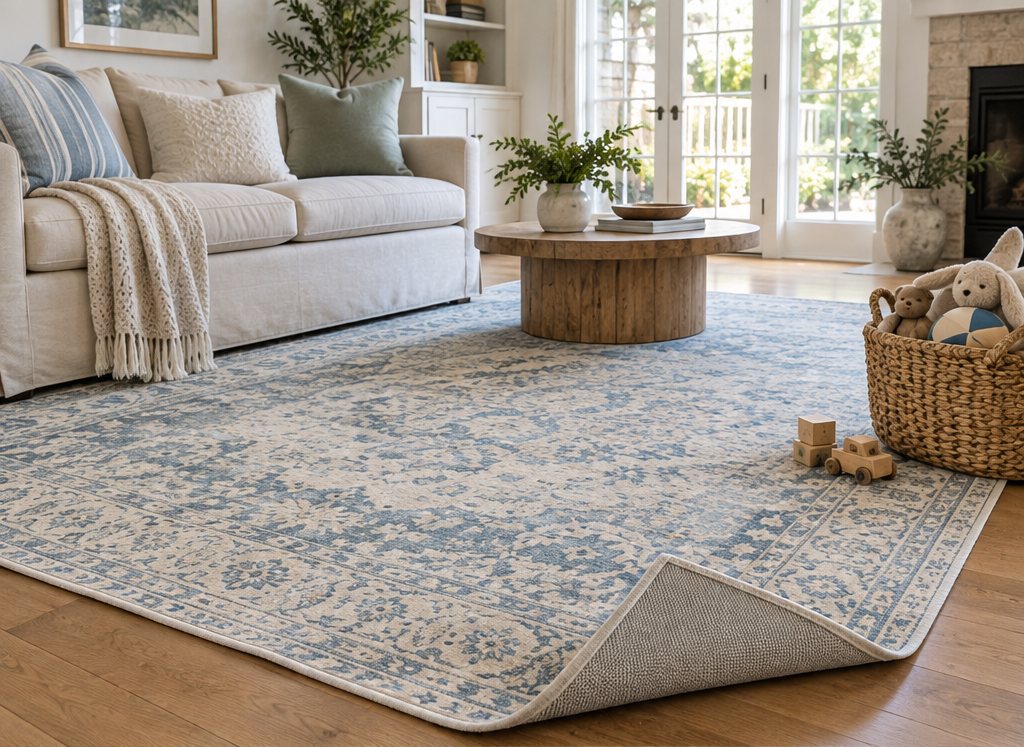
Bathroom Rugs: Sizes, Materials and Non-Slip Backings Explained
Bathroom rugs should be machine washable, 1,200 gsm or heavier for cotton, and sized to leave 3–6 in (8–15 cm) of floor showing. Here are sizes, materials, backings and wash rules that actually last.
Part of our guide: Washable Rugs: Are They Worth It? Kitchen, Runner & Living Room Picks
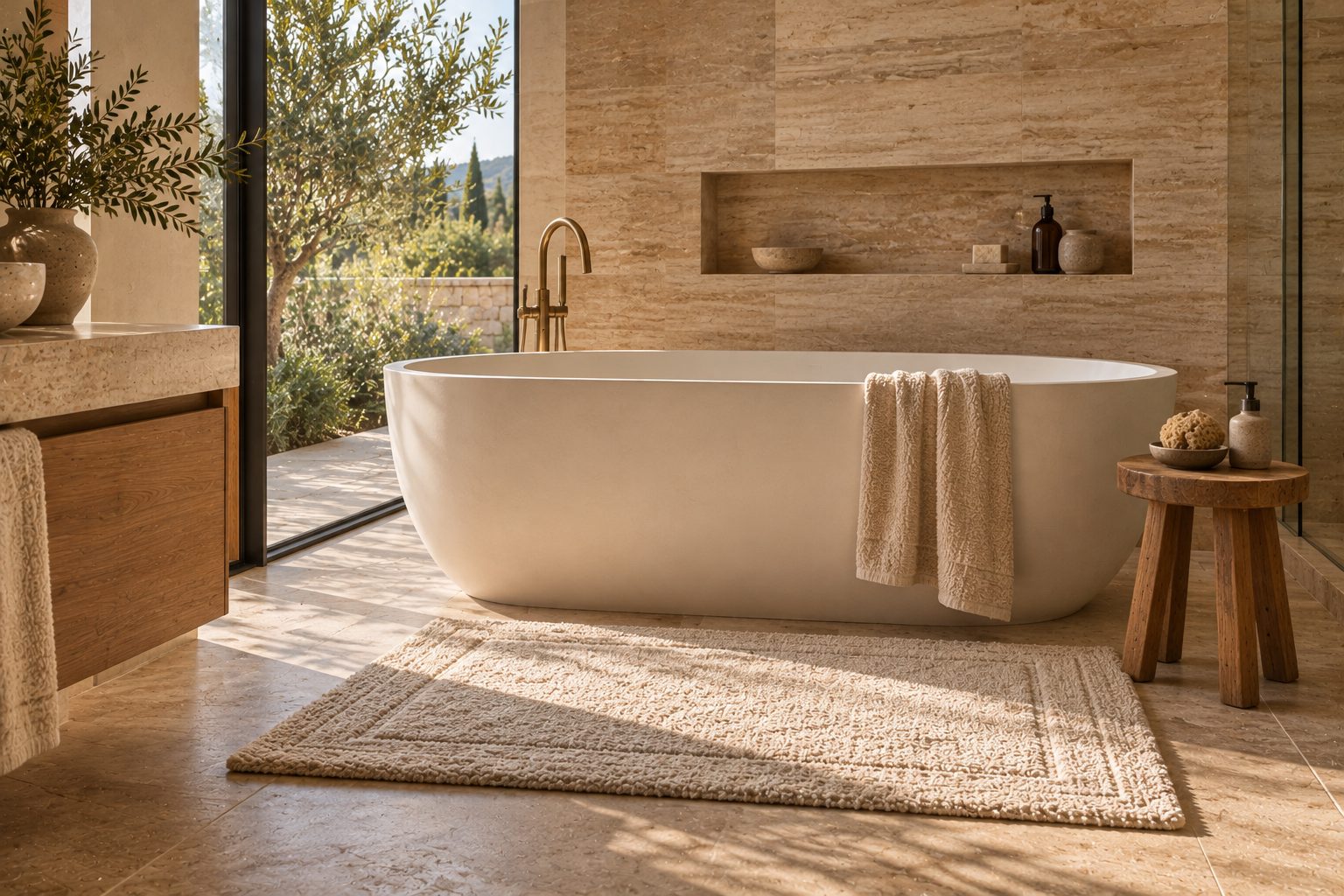
Key takeaways
- Buy bathroom rugs that go in the washing machine: cotton at 1,200–2,000 gsm, microfiber chenille or a washable flat-weave, never a dry-clean-only wool
- Size the rug to the fixture: 21 x 34 in (53 x 86 cm) for a single vanity or tub, a 24 x 60 in (61 x 152 cm) runner for a double vanity
- Rubber and latex backings grip but can stain vinyl and degrade in the dryer; a TPR or silicone dot backing is the safer non slip rug choice
- Wash bath mats every one to two weeks in a shared bathroom, warm not hot, and dry flat or on low heat to keep the backing intact
The best bathroom rugs are machine washable, quick to dry and gripped by a non-slip backing that survives the dryer. In practice that means tufted cotton at 1,200–2,000 gsm or microfiber chenille, sized 21 x 34 in (53 x 86 cm) for a single vanity or tub and leaving 3–6 in (8–15 cm) of tile showing around the edge.
- Standard sizes: 17 x 24 in, 20 x 32 in, 21 x 34 in, 24 x 40 in and runners of 24 x 60 in to 2 x 8 ft.
- Weight that lasts: 1,200 gsm and up for cotton; under 800 gsm flattens and feels thin within months.
- Backing: TPR or silicone dots grip on tile and vinyl; natural rubber grips hardest but dislikes heat.
- Typical 2026 prices: $15–35 for a small mat, $30–80 for a standard bath rug, $50–150 for a long runner.
- Washing: every 1–2 weeks, warm water, low heat or line dry.
A bath rug is a small textile with a hard life: wet feet, damp air, cleaning chemicals and weekly laundering. It belongs to the same family as the larger washable pieces in our washable rugs guide, but the spec priorities change once water is involved. Absorbency and drying time matter more than pile height, and the backing matters more than the pattern.
What are the best bathroom rugs made of?
The best bathroom rugs are made of long-staple cotton, microfiber chenille or a tightly woven cotton blend, because these absorb water, survive hot washing and dry within a day. Wool and jute, which work beautifully elsewhere in the house, either shrink, smell or rot in a wet room.
Fiber matters less than construction. A tufted cotton rug with a dense, low loop pile absorbs well and recovers after washing. A cut-pile "plush" rug feels luxurious in the store but mats down fast. Microfiber chenille, the noodle-like texture, pulls water off feet quickest and dries fastest, which makes it a good choice for a family bathroom with no window. Memory-foam bath mats feel soft underfoot but hold moisture in the core and rarely tolerate tumble drying.
| Material | Absorbency | Drying time (air) | Washability | Typical price, 21 x 34 in | Best for |
|---|---|---|---|---|---|
| Tufted cotton, 1,200–2,000 gsm | High | 8–16 hours | Machine, warm; tumble low | $30–70 | Main and primary bathrooms |
| Microfiber chenille | Very high | 2–6 hours | Machine, cool; tumble low | $20–45 | Family and windowless bathrooms |
| Memory foam with microfiber top | Medium | 12–24 hours | Machine, gentle; air dry | $15–40 | Comfort in a low-traffic bathroom |
| Cotton flat-weave or waffle | Medium | 4–8 hours | Machine, hot; tumble medium | $20–60 | Long runners, door clearance |
| Bamboo or teak slat mat | None (drains) | 1–2 hours | Wipe; oil wood yearly | $30–90 | Shower exits, wet rooms |
| Diatomaceous stone mat | Very high (surface) | Minutes | Sand lightly; never wash | $25–50 | Minimal bathrooms, single users |
Prices are typical US ranges for 2026 and assume mid-market quality; hotel-grade cotton at 2,000 gsm sits at the top of each band.
What size bathroom rug do you need?
A bathroom rug should be about two-thirds the width of the fixture it sits in front of, with 3–6 in (8–15 cm) of floor visible on each side and clear of the door swing. That one rule handles most layouts.
| Location | Recommended rug size | Metric | Notes |
|---|---|---|---|
| Toilet front or contour | 17 x 24 in or 20 x 20 in contour | 43 x 61 cm / 51 x 51 cm | Contour mats trap splash; many people skip them now |
| Single vanity, 24–36 in wide | 20 x 32 in or 21 x 34 in | 51 x 81 cm / 53 x 86 cm | The workhorse size |
| Bathtub, 60 in long | 21 x 34 in or 24 x 40 in | 53 x 86 cm / 61 x 102 cm | Center on the tub's open side |
| Double vanity, 60–72 in | 24 x 60 in or 2 x 6 ft runner | 61 x 152 cm / 61 x 183 cm | One long runner beats two mats |
| Large primary bath, open floor | 3 x 5 ft or 4 x 6 ft | 91 x 152 cm / 122 x 183 cm | Use a washable flat-weave, not a tufted bath rug |
| Galley or long narrow bathroom | 2 x 8 ft runner | 61 x 244 cm | Leave 6 in (15 cm) at each end |
Large bathroom rugs and long bathroom rugs
Large bathroom rugs, 3 x 5 ft and up, read more like room rugs than mats. They make a big primary bath feel warmer, but no domestic washer handles a 4 x 6 ft tufted cotton rug weighing 8–12 lb (4–5 kg) dry and three times that wet. Choose a machine-washable flat-weave or a low-pile polyester at this size, or accept a trip to a laundromat's large-capacity machine. Long bathroom rugs are easier: a 24 x 60 in runner fits a standard front-loader. Our runner rug guide covers lengths and placement in more detail, and the rug size calculator works for bathrooms as well as living rooms.
Small bathroom rugs
In a powder room or a 5 x 8 ft (1.5 x 2.4 m) bathroom, one small rug in front of the vanity is enough. Two or three bath mats and rugs in a compact room cut the floor into pieces and make it look smaller. Our small bathroom ideas page has more on keeping a tight room visually open.
Are rubber backed rugs safe for bathroom floors?
Rubber backed rugs grip well on tile and are safe on most stone and porcelain, but natural rubber and latex can permanently stain vinyl, linoleum and some sealed wood floors, and they crack after repeated hot drying. That is the trade-off with the stickiest non skid rugs.
The stain is a chemical reaction between plasticizers in vinyl and compounds in the rubber, and it shows up as yellow or brown marks that do not wash out. If your bathroom floor is luxury vinyl plank or sheet vinyl, look for backings labeled TPR (thermoplastic rubber), silicone dots or PVC-free. They grip slightly less but will not discolor the floor.
- Natural rubber or latex: strongest grip; avoid on vinyl; never tumble dry hot; expect cracking after 30–60 washes.
- TPR or silicone dot backing: good grip on dry tile, safe on vinyl, survives low-heat drying; the best all-round non slip backing rugs can have.
- No backing plus a separate pad: reversible cotton rugs over a thin non-slip mesh pad; the pad is washed less often and replaced every year or two.
- Bamboo or teak slats: rubber feet only; no slip risk from fabric, but cold underfoot.
A non slip rug only works on a dry floor. Water between the backing and the tile acts as a lubricant, so lift the rug and mop beneath it weekly. For pad choices under larger rugs, see our rug pad guide.
How do you wash bath mats and washable bathroom rugs?
Wash bath mats and washable bathroom rugs every one to two weeks in warm water at about 104 °F (40 °C), on a gentle cycle with ordinary detergent, then line dry or tumble on low. Hot water and high heat are what kill backings and shrink cotton.
- Shake the rug outdoors. Hair and grit abrade fibers in the drum.
- Wash it with towels, not alone. A single heavy rug unbalances the drum; two or three towels even the load.
- Skip fabric softener. Softener coats cotton and reduces absorbency by a noticeable margin after a few washes.
- Use oxygen bleach for mildew. Chlorine bleach yellows rubber and weakens cotton; oxygen bleach is gentler on both.
- Dry on low or air dry flat. Rubber and TPR backings should never see high heat. Microfiber dries on a rack in a few hours.
- Rotate two rugs. Owning two washable bath rugs per bathroom means one is always dry and in use while the other is in the wash.
A washable bath mat that smells musty right out of the dryer is usually overloaded or under-dried. Run a second low-heat cycle rather than putting it back damp.
Should you put bathroom carpet or a rug in the bathroom?
Choose a washable rug, not wall-to-wall bathroom carpet: fitted carpet traps moisture at the subfloor, cannot be laundered and tends to develop odor and mold within a few years. The search for "bathroom carpet" mostly comes from owners of older homes that already have it.
If you have inherited carpeted bathrooms, budget to replace them with porcelain tile, sheet vinyl or luxury vinyl plank, which typically costs $8–25 per sq ft installed for tile and $4–10 per sq ft for vinyl in 2026. Until then, use a large washable rug on top of the carpet in front of the tub or shower so the worst splashing lands on something you can wash. The same logic applies to so-called bathroom carpets rugs sold cut-to-fit: they are just low-pile washable rugs, and they work as long as they come out of the room for washing.
What colors and patterns work for bath rugs?
Bath rugs look best when they repeat a color already in the room, a towel, the vanity or the grout, rather than introducing a new one. Mid-tones hide water marks and hair better than white or black.
#F1ECE2#C9B79C#8F9E8B#3F5A6B#9E3B33White and ivory rugs look clean for exactly one day in a family bathroom; oat, sand and soft gray show less. Sage and slate blue tie in with the green and blue tile we see in many bathroom trends 2027 schemes. Bathroom red rugs, in brick or rust rather than fire-engine red, are a good way to warm a white, marble-look bathroom, and they hide the pink tinge that cotton picks up from some cleaning products. Stripes and simple geometric patterns hide wear; busy florals tend to fight with patterned tile. For more ideas on towels, accessories and textiles, see our bathroom decor ideas.
Mistakes we see with bathroom floor mats
The most common mistake we see with bathroom floor mats is buying for softness in the store instead of for washing and drying at home. A thick, cloud-like mat that takes two days to dry will smell within a month.
- Too thin a cotton. Under 800 gsm feels limp and soaks through. Check the weight on the label; if it is not listed, the rug is usually light.
- Too thick to clear the door. Bathroom doors often have 0.5–0.75 in (13–19 mm) of floor clearance. A 1 in (25 mm) plush rug will catch and bunch.
- Sets of three. Matching contour, tub and vanity mats were standard decades ago. One good rug per fixture zone is enough.
- Rubber on vinyl. The stain is permanent. Check the floor before you buy the backing.
- Dry-clean-only fabrics. Silk-look viscose and wool belong in a hallway, not next to a shower.
Our verdict on the best bath rugs
For most homes, the best bath rugs are a pair of 21 x 34 in tufted cotton rugs at 1,400–1,800 gsm with a TPR dot backing, rotated weekly, plus a 24 x 60 in washable flat-weave runner in front of a double vanity. That combination costs roughly $90–200 per bathroom at typical 2026 prices and should last two to four years of regular washing.
We would add a microfiber chenille mat in any windowless bathroom, because fast drying matters more than looks there, and we would only buy a large bathroom rug in a primary bath with a real floor area to fill. Bath rugs for bathroom use in households with dogs or toddlers follow the same rules, which overlap with our pet friendly rugs advice: low pile, washable, mid-tone. Bathroom rugs are cheap enough to replace, but the right spec means you replace them because you want a change, not because the backing has crumbled.
Fitting out several bathrooms, a rental portfolio or a hotel floor? Send sizes, colors and quantities through our textile sourcing desk and we will match you with vetted mills and realistic lead times.
Free toolTile CalculatorWork out tiles, boxes, grout and adhesive with the right wastage.Shop & source the look
Buy it today — or have it made
Retail links are affiliate links: we may earn a commission at no extra cost to you (disclosure). “Get it made” sends the item to our sourcing desk for factory quotes in custom sizes and finishes.
Frequently asked questions
What is the difference between a bath mat and a bath rug?
A bath mat is usually small, flat and highly absorbent, designed to stand on straight out of the shower, while a bath rug is larger, has a pile and doubles as decor. Many products are sold as both. For daily use, choose whichever is machine washable, has a non-slip backing and dries within a day.
How often should you wash bathroom rugs?
Wash bathroom rugs every one to two weeks in a shared or family bathroom and every two to three weeks in a guest bath. Use warm water around 104 °F (40 °C), skip fabric softener, and dry on low heat or flat. Damp rugs left on the floor grow mildew, so dry them fully before putting them back.
Do rubber backed bath mats ruin floors?
Rubber backed bath mats can permanently stain vinyl, linoleum and some finished wood floors, because the rubber reacts with plasticizers in the flooring. They are generally fine on glazed porcelain and sealed stone. On vinyl or luxury vinyl plank, choose a TPR or silicone dot backing, or a reversible rug over a thin non-slip pad.
What size should a bathroom rug be?
A bathroom rug should be about two-thirds the width of the vanity or tub it sits in front of, leaving 3–6 in (8–15 cm) of floor visible. For most single vanities and tubs that means 20 x 32 in or 21 x 34 in (51 x 81 cm or 53 x 86 cm); double vanities suit a 24 x 60 in (61 x 152 cm) runner.
Is it okay to put a rug in the bathroom?
Yes, a washable rug in the bathroom is fine and safer than bare wet tile, as long as it has a non-slip backing and is laundered regularly. Avoid fitted bathroom carpet, which cannot be washed and traps moisture at the subfloor. Lift rugs weekly to mop underneath so water and grit do not build up.
Some links may be affiliate links. Regulations and specifications change — always confirm with suppliers and qualified professionals.