Mid Century Modern Furniture: Pieces, Woods and How to Spot Quality
Mid century modern furniture is the clean-lined, tapered-leg style made from about 1945 to 1969 in walnut, teak and molded materials. Here are its 10 key pieces, sizes, prices and how to tell good vintage from new.
Part of our guide: Mid-Century Modern Decor & Interior Design: A Complete Guide
Key takeaways
- Mid century modern furniture means pieces designed roughly 1945–1969: low, light, tapered legs, organic curves and warm woods like walnut and teak
- A mid century modern sofa has a tight back, a 20–22 in (51–56 cm) seat depth and raised legs; it sits more upright than today's deep sofas
- Judge vintage by joinery, solid wood edges and drawer construction, not by the label; reproductions vary from excellent to flimsy
- Mix one or two vintage pieces with new upholstery and a modern rug so the room reads current, not like a period set
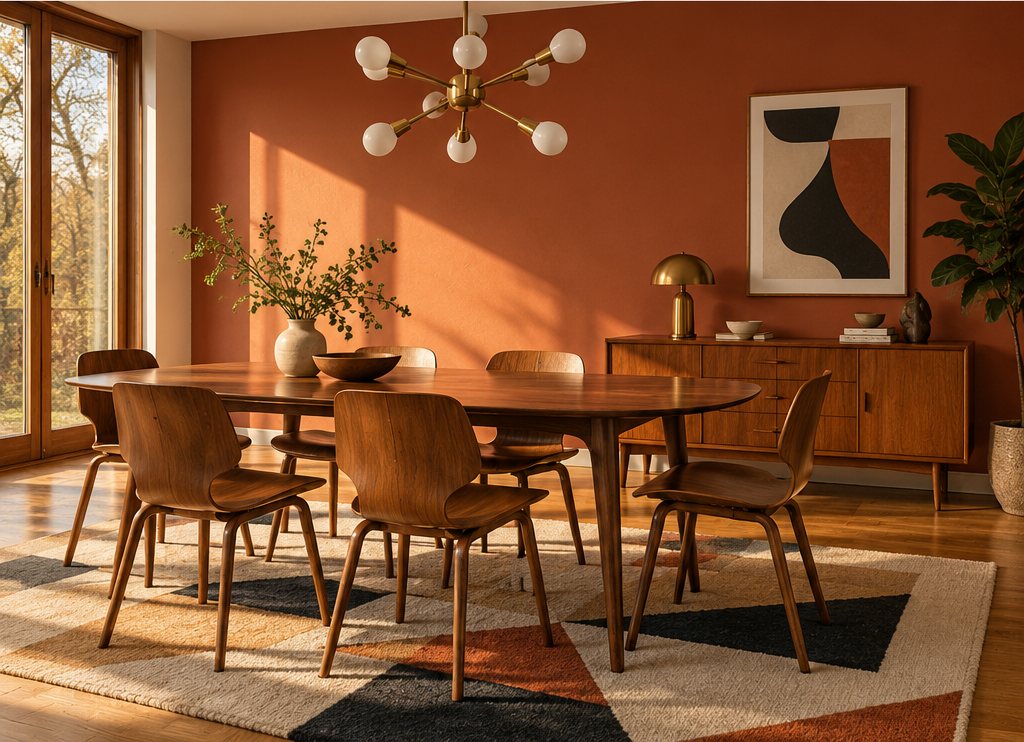
Mid century modern furniture is the style of furniture designed between roughly 1945 and 1969: low and light pieces on tapered legs, organic curves, minimal ornament, and warm woods such as walnut, teak and rosewood alongside molded plywood, fiberglass and steel. Good examples still work today because they are scaled for real rooms and built to last.
MCM furniture, as it is often abbreviated, grew out of postwar optimism, new manufacturing methods and smaller suburban homes. It is the furniture end of a broader design movement; for the architecture, color palettes and room-by-room styling, start with our pillar mid-century modern guide. This page covers the pieces themselves: what to buy, what to measure and how to tell quality.
- Era: about 1945–1969, peaking in the late 1950s.
- Woods: walnut, teak, rosewood, oak and birch plywood, usually oiled or satin lacquered.
- Signature details: tapered or splayed legs, floating case pieces, recessed pulls, tight upholstered backs.
- Typical price: new $1,200–3,500 for a sofa; restored vintage dressers $900–4,000 (US 2026 typical).
What is mid century modern furniture?
Mid century modern furniture is functional, clean-lined furniture from the postwar decades that lifts pieces off the floor on slim legs and lets material, not decoration, provide the interest. When people ask what mid century modern means, that is the short answer: modern design at mid-century, made for everyday homes.
The style mixed three traditions. Scandinavian makers brought solid teak and fine joinery. American designers pushed molded plywood, fiberglass shells and wire bases from wartime manufacturing. European modernists contributed steel frames and strict geometry. The result was furniture that was lighter, lower and more open than the heavy, skirted pieces before it. Among the types of decorating styles, mid century modern sits between the warmth of Scandinavian and the rigor of modernism; our interior design styles overview places it alongside its neighbors.
What is a mid century modern house?
A mid century modern house is a postwar home, typically single-story, with a low-pitched or flat roof, large windows and sliding glass doors, an open plan and a strong connection to the garden. Ceilings are often 8 ft (2.4 m) with exposed beams, and rooms are modest in size. That architecture explains the furniture: pieces stayed low so they would not block views to the outside, and they stayed light so a compact living room could hold a sofa, two chairs and a credenza without feeling crowded. If you live in a newer, taller house, choose slightly larger mid century pieces, a 90 in (229 cm) sofa rather than a 72 in one, so they do not look stranded.
Mid century vs retro furniture
Mid century modern and retro furniture overlap but are not the same. Retro usually means anything that looks like the 1950s–1970s, including bright laminate, chrome diner sets and shag-era pieces. Mid century modern is a narrower, more architectural style built on wood, clean lines and restraint.
10 key pieces of mid century furnishings
The ten mid century furnishings below cover most rooms, with the sizes and typical specs to look for whether you buy vintage or new.
| Piece | Typical size | Look for | Typical price (new / vintage) |
|---|---|---|---|
| Tight-back sofa | 72–90 in (183–229 cm) wide, 20–22 in (51–56 cm) seat | Hardwood frame, tapered legs, piped cushions | $1,200–3,500 / $800–3,000 |
| Lounge chair and ottoman | 32–34 in (81–86 cm) wide | Molded ply shell, leather, steel or wood base | $900–6,000 / $2,000–7,000 |
| Credenza or sideboard | 60–72 in (152–183 cm) wide, 30 in (76 cm) high | Sliding doors, dovetailed drawers, solid edges | $900–3,000 / $1,000–4,500 |
| Six- or nine-drawer dresser | 54–66 in (137–168 cm) wide | Recessed pulls, dust panels, solid drawer sides | $900–2,800 / $700–3,500 |
| Platform or low bed | Base 12–16 in (30–41 cm) high | Floating nightstands, cane or wood headboard | $800–2,500 / $600–2,500 |
| Surfboard or oval coffee table | 48–60 x 20–24 in (122–152 x 51–61 cm) | Solid edge, splayed legs | $300–1,200 / $250–1,500 |
| Tulip or pedestal dining table | 42–60 in (107–152 cm) round or oval | Single base, laminate or wood top | $600–3,000 / $800–4,000 |
| Shell or spindle dining chairs | 18 in (46 cm) seat height | Molded seat, dowel or wire base | $150–600 each / $200–900 each |
| Wall unit or shelving system | Modular bays 32–36 in (81–91 cm) | Adjustable shelves, wall-hung rails | $600–3,000 / $1,500–6,000 |
| Globe or cone lighting | 14–24 in (36–61 cm) | Opal glass, brass or enameled metal | $150–900 / $200–1,200 |
Vintage prices swing widely with condition, maker and region; a signed piece from a known studio can cost many times the ranges above, while an unattributed dresser at an estate sale may cost a fraction. The table reflects typical US 2026 asking prices for good, usable pieces.
How do you choose a mid century modern sofa?
Choose a mid century modern sofa with a tight or button-tufted back, a seat depth of 20–22 in (51–56 cm), a seat height of 17–18 in (43–46 cm) and raised tapered legs that show 5–7 in (13–18 cm) of floor. That geometry is what makes the shape read as mid century rather than generic modern.
A mid century modern couch sits more upright than the deep lounging sofas popular now. That suits reading, conversation and smaller rooms, but it disappoints anyone who wants to curl up. If you want both, look for a mid mod sofa with a slightly deeper 23 in (58 cm) seat and loose back cushions over a tight frame. Check these specs before buying a mid century sofa:
- Frame: kiln-dried hardwood, corner-blocked; never particleboard.
- Legs: solid wood bolted into a metal plate, not screwed straight into the rail.
- Fabric: 30,000+ Martindale wool blend, tweed or leather; tight weaves suit the crisp lines.
- Arms: track or slim slope arms 4–6 in (10–15 cm) wide keep the profile lean.
Size the sofa to the room before choosing a style; our sectional sofa sizes guide gives the ratios if you need an L-shape.
How do you furnish a mid century living room?
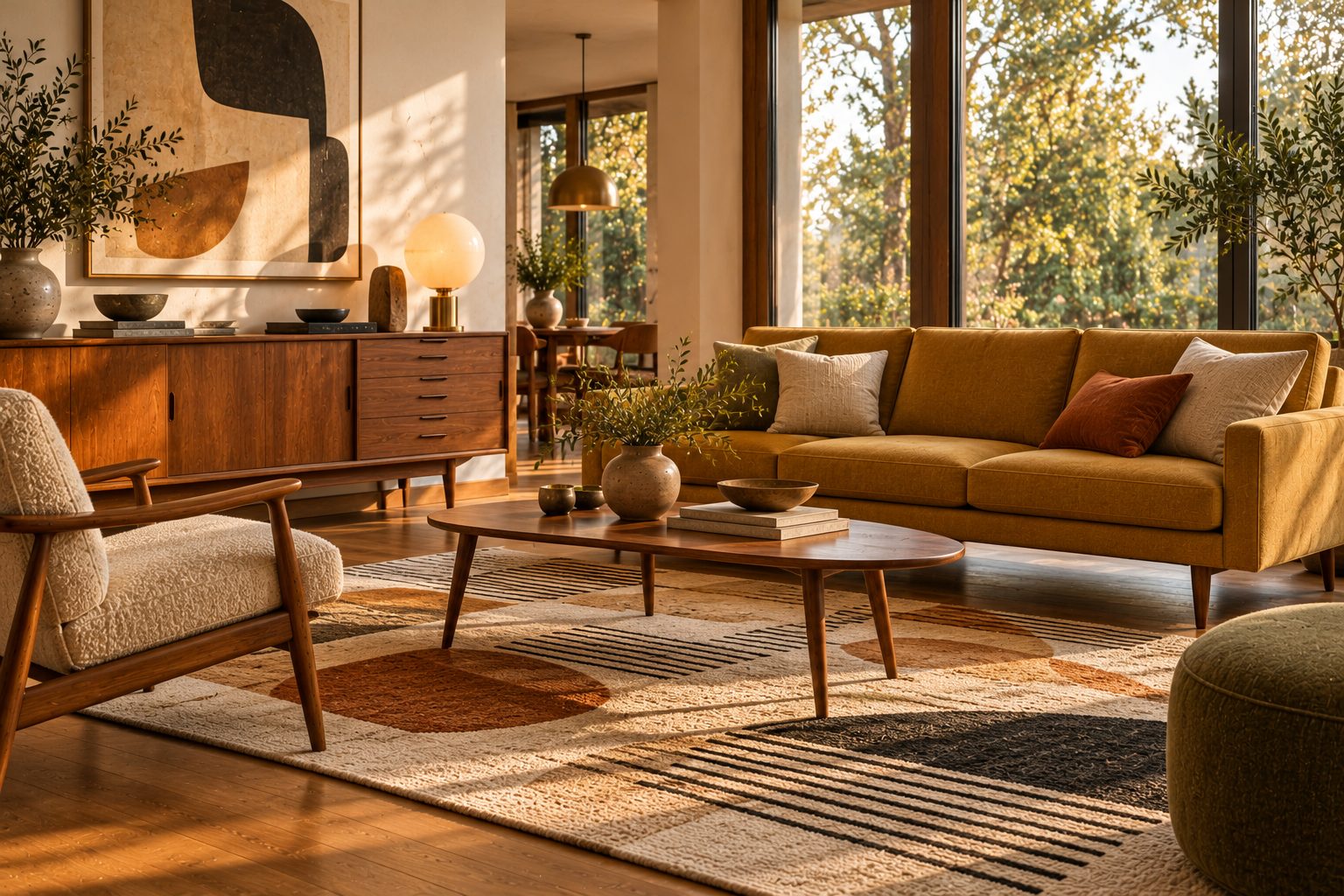
Furnish a mid century living room around one low sofa, one sculptural lounge chair, a long credenza and a low oval or surfboard coffee table, keeping the floor visible under every piece. Air between legs is the defining quality of mid century modern living room furniture.
Keep the sofa and credenza at similar low heights, 28–32 in (71–81 cm) for the back and top, so the room reads as one horizontal band. Add a globe pendant or an arc floor lamp, a flat-weave or low-pile wool rug, and one strong color in a cushion or chair. Warm wood dominates, so balance it with one cooler surface such as stone, white laminate or brushed steel.
#6B4A33#A8673A#C98A2B#4F6B5A#8C3B2E#E8E1D2These hex values are approximate references for typical mid-century woods and accents. In 2027 schemes we see mustard and avocado used in smaller doses than in the 1960s, with warm white walls doing most of the work.
What makes a good mid century modern bedroom?
A good mid century modern bedroom pairs a low platform bed with floating or leggy nightstands and a long, low dresser, all in one wood tone with recessed or integrated pulls. It should feel calm and horizontal, with no carved detail or tall canopy.
A matched mid century modern bedroom set, meaning bed, two nightstands and a dresser, is the quickest route, but it can look like a showroom. We prefer buying the bed and dresser in matching walnut and choosing nightstands in a contrasting material: a white lacquer, cane or a lighter oak. For a midcentury bedroom in a small room, wall-hung nightstands at 24–26 in (61–66 cm) high free up floor and keep the look light.
Mid century modern bedroom furniture often ran smaller than modern furniture. Vintage beds may be full rather than queen, and dressers can be 18 in (46 cm) deep rather than 20–22 in (51–56 cm), so measure drawers and mattress sizes before you buy. Our bedroom layout ideas show clearances for each bed size.
How do you tell quality vintage mid century furniture?
Tell quality vintage mid century furniture by its joinery, its drawers and its edges: look for dovetails, solid wood drawer sides, dust panels between drawers and solid wood banding where veneer meets the edge. Labels can be faked; construction cannot.
- Pull a drawer all the way out. Dovetailed corners and solid sides signal quality; stapled particleboard does not.
- Check the veneer. Small lifts can be reglued; large bubbles, missing chips and water rings need a restorer at $300–1,500.
- Look underneath. Original glue blocks, consistent aging and maker stamps support age; fresh screws suggest repairs.
- Sit on chairs and sofas. Wobbly joints are fixable; cracked shells or broken springs are expensive.
- Smell it. Smoke and mildew in old upholstery rarely leave without replacing foam and fabric.
- Price the restoration. Add refinishing and reupholstery costs before you decide a piece is a bargain.
Where to find vintage furniture is less important than knowing what to inspect: estate sales, auction houses, consignment stores and local listings all turn up good pieces. Antique vintage furniture dealers generally price higher but pre-inspect. Expect to pay more for teak and rosewood than for walnut-veneer pieces, and avoid any rosewood without clear provenance, since trade rules restrict some species.
Vintage mid century modern furniture or new?
Buy vintage mid century modern furniture for case goods and chairs, and buy new for upholstery, because wood ages well while 60-year-old foam and springs rarely do. That split gets you authenticity where it shows and comfort where it counts.
A restored teak dresser often costs the same as a new veneer one and will outlast it. A vintage sofa, by contrast, usually needs new foam, webbing and fabric at $1,500–3,500 in labor and materials, which can exceed the price of a well-made new mid century modern sofa. Our custom upholstery guide covers what reupholstery involves if you find a frame worth saving.
Our verdict on mid century modern furniture
Mid century modern furniture is still the most livable classic style for 2027 because its pieces are compact, light on their feet and built from honest materials. Our formula: one good vintage case piece, one new tight-back sofa, a lounge chair with a molded or bent-wood frame, and everything else simple and modern. Skip the full period recreation with starburst clocks and boomerang laminate; it reads as a set, not a home. Choose walnut or teak as the lead wood and add one other tone, not three. Vintage furniture rewards patience; new furniture rewards careful spec checking. Either way, mid century modern furniture should look lighter than the room around it.
Furnishing a hotel, rental or multi-room project in a mid century style? Send quantities and sizes to our furniture sourcing desk for factory quotes on tight-back sofas, walnut case goods and dining sets.
Free toolRug Size CalculatorFind the right rug size for your room and furniture.Shop & source the look
Buy it today — or have it made
Retail links are affiliate links: we may earn a commission at no extra cost to you (disclosure). “Get it made” sends the item to our sourcing desk for factory quotes in custom sizes and finishes.
Frequently asked questions
What is mid century modern furniture?
Mid century modern furniture is furniture designed roughly between 1945 and 1969, defined by clean lines, tapered or splayed legs, organic curves and warm woods like walnut and teak, plus molded plywood and fiberglass. It lifts pieces off the floor, avoids ornament and was scaled for smaller postwar homes.
What does mid century modern mean?
Mid century modern means modernist design from the middle of the 20th century, mainly the postwar years to the late 1960s. The term covers furniture, architecture and graphics that share open plans, simple geometry, natural materials and new industrial techniques. It was popularized as a style label decades after the period ended.
How do you tell if mid century furniture is real?
Check construction rather than labels: dovetailed drawers, solid wood drawer sides, dust panels, solid edge banding and consistent aging underneath all point to a genuine vintage piece. Maker stamps help but can be added later. New screws, stapled joints and particleboard cores suggest a reproduction or heavy repair.
Is mid century modern furniture still in style for 2027?
Yes, mid century modern furniture remains in style for 2027, though rooms now mix it with deeper sofas, stone and softer colors rather than recreating the 1960s. Walnut case goods, molded chairs and pedestal tables stay strong; full matching period sets and loud starburst accessories look dated.
What wood is used in mid century modern furniture?
Walnut and teak are the main woods in mid century modern furniture, followed by rosewood, oak, birch and molded plywood. American pieces lean toward walnut; Scandinavian pieces toward teak and oak. Most were oiled or given a thin satin lacquer that shows the grain rather than hiding it.
Some links may be affiliate links. Regulations and specifications change — always confirm with suppliers and qualified professionals.