Living Room Rug Ideas: Sizes, Colors and Layouts That Work
The best living room rug ideas start with size: 8 x 10 ft fits most rooms, with the front legs of every seat on the rug. Then pick color, pattern and fiber for how the room is used. Here are 12 ideas with specs.
Part of our guide: How to Choose a Rug Size: The Definitive Guide for Every Room
Key takeaways
- Size first: most living room rugs should be 8 x 10 ft (244 x 305 cm) or larger, with at least the front legs of every seat on the rug
- Leave 12–18 in (30–46 cm) of bare floor around the rug in a closed room; in open plans let the rug define the seating zone
- Neutral rugs in beige, cream, warm grey or brown are the safest base; blue and black and white rugs bring contrast without dating as fast as trend colors
- Match fiber to traffic: wool for living rooms you use daily, washable or polypropylene for kids and pets, flat-weaves for layering
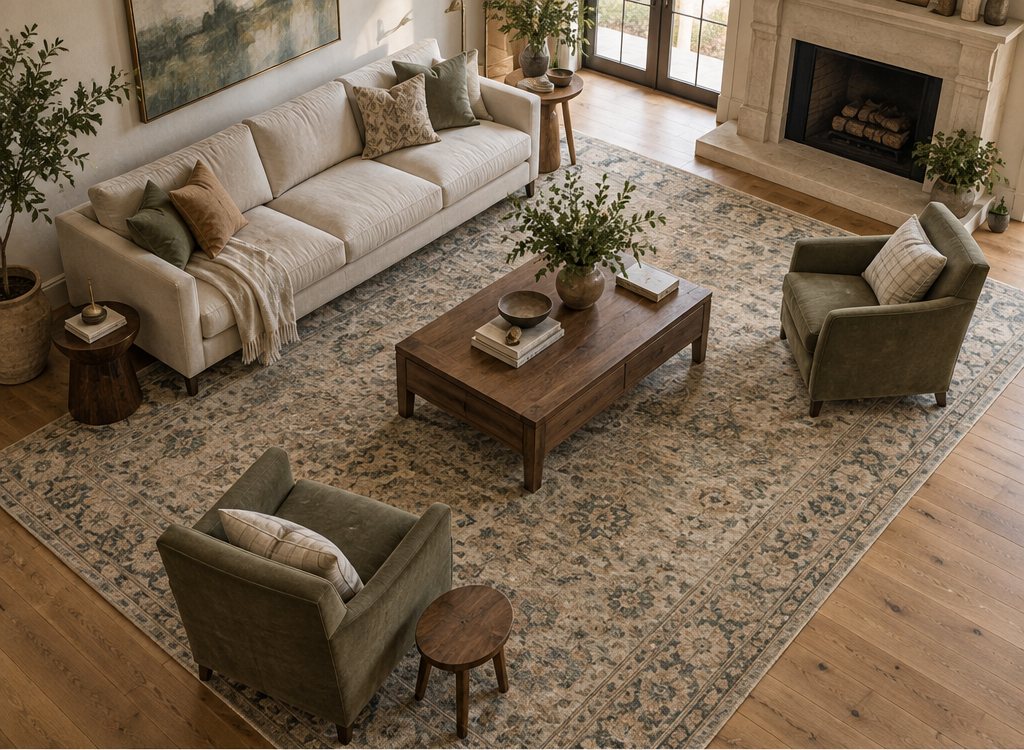
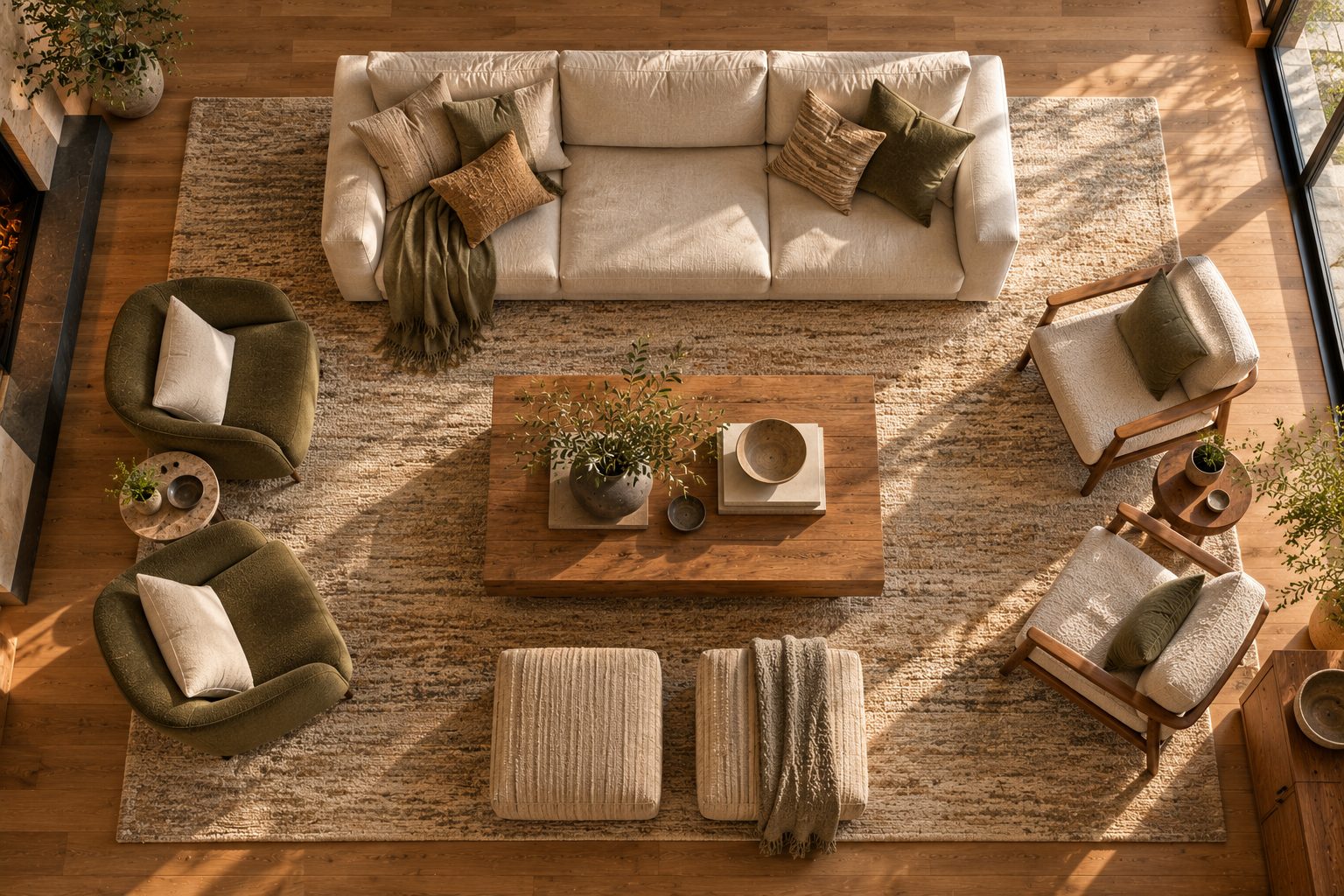
Good living room rug ideas start with size, not color: in most living rooms an 8 x 10 ft (244 x 305 cm) rug is the minimum that lets the front legs of the sofa and chairs sit on it, and a 9 x 12 ft (274 x 366 cm) rug suits rooms over 14 ft (4.3 m) wide. Once the size is right, almost any color or pattern works.
- Most common size: 8 x 10 ft for a standard 12 x 16 ft (3.7 x 4.9 m) living room.
- Border of floor: 12–18 in (30–46 cm) bare floor around a rug in a closed room.
- Placement rule: all legs on, or front legs on; never all furniture floating off the rug.
- Typical 2026 price, 8 x 10 ft: $150–500 machine-made, $500–2,000 tufted wool, $1,500–8,000 hand-knotted.
- Safest colors: beige, cream, warm grey, brown and muted blue.
This page is about ideas: color, pattern, fiber and layout. For the exact sizing method and every furniture-leg rule, our how to choose rug size guide is the reference, and the rug sizes chart lists every standard dimension in feet and centimeters. Below, we pull the most useful parts together with the color and style decisions people actually struggle with.
How big should a living room rug be?
A living room rug should be big enough that at least the front legs of every seat rest on it and it extends 6–12 in (15–30 cm) past each end of the sofa. For most rooms that means 8 x 10 ft; for large rooms, 9 x 12 ft or 10 x 14 ft.
| Room size | Rug size | Metric | Layout it suits |
|---|---|---|---|
| Under 10 x 12 ft (3 x 3.7 m) | 5 x 8 ft or 6 x 9 ft | 152 x 244 cm / 183 x 274 cm | Loveseat and one chair, front legs on |
| 11 x 14 ft (3.4 x 4.3 m) | 8 x 10 ft | 244 x 305 cm | 84 in sofa plus two chairs, front legs on |
| 12 x 16 ft (3.7 x 4.9 m) | 8 x 10 ft or 9 x 12 ft | 244 x 305 cm / 274 x 366 cm | Sofa, chairs, coffee table; all legs on with 9 x 12 |
| 14 x 18 ft (4.3 x 5.5 m) | 9 x 12 ft or 10 x 14 ft | 274 x 366 cm / 305 x 427 cm | Sectional and chairs, all legs on |
| Open plan, 20 ft+ (6 m+) | 10 x 14 ft or 12 x 15 ft | 305 x 427 cm / 366 x 457 cm | Defines the seating zone; leave 24 in walkway |
The usual mistake is a 5 x 7 ft rug floating under a coffee table. It looks like a bath mat in a living room and makes the room feel smaller. If the budget only stretches to a small rug, buy a cheap, large natural-fiber base instead and save the pattern for later. To check your own room, use our rug size calculator.
How to choose rug size for a living room in four steps
- Measure the seating group, not the room: the outside edges of sofa and chairs.
- Add 6–12 in (15–30 cm) beyond the sofa ends and decide whether chairs sit fully or partly on the rug.
- Check the floor border: 12–18 in (30–46 cm) to the walls in a closed room, 8 in (20 cm) minimum in a tight one.
- Tape the outline on the floor with painter's tape and live with it for a day before ordering.
Which large area rugs work best in a living room?
The large area rugs that work best in living rooms are low to medium pile, 0.25–0.6 in (6–15 mm), in wool, a wool blend or a dense polypropylene, because they sit flat under furniture, vacuum easily and do not crush where the sofa feet sit.
Large living room rugs and large lounge rugs, the British phrasing for the same thing, carry the whole floor. At 9 x 12 ft and up, weight and backing matter: a tufted wool rug of that size weighs 40–70 lb (18–32 kg), so plan for two people to lay it. Massive area rugs over 12 x 15 ft are usually custom or broadloom bound to size, which is often the cheaper route; bound carpet for living room use costs roughly $4–12 per sq ft including binding in 2026.
| Fiber | Feel | Durability | Typical 8 x 10 ft price (US, 2026) | Best for |
|---|---|---|---|---|
| Wool, tufted or hand-knotted | Springy, warm | High; resists crushing, soil-hiding | $500–8,000 | Daily-use living rooms |
| Polypropylene, machine-made | Firm, slightly synthetic | Medium-high; stain-resistant, can crush | $150–500 | Budget rooms, kids, rentals |
| Polyester or washable chenille | Soft, thin | Medium; washable versions shed less soil | $200–700 | Pets and young children |
| Jute or sisal | Coarse, textured | Medium; stains with water | $250–1,200 | Layering bases, dry rooms |
| Cotton flat-weave | Thin, cool | Low-medium; shifts without a pad | $150–600 | Summer swaps, layering on top |
| Viscose or "art silk" | Shiny, soft | Low; crushes and water-marks | $200–900 | Not recommended for living rooms |
What color rug goes best in a living room?
The rug color that goes best in most living rooms is one shade darker than the walls and one shade lighter than the sofa, or the reverse; that middle value ties the room together. Neutral rugs in beige, cream, oat and warm grey are the easiest starting point.
#EFE6D6#CDBA9A#A9A39A#7A5638#8CA6BC#1F2A3AHex values are approximate screen references; rug color shifts with pile and light, so always order a sample. Below are the color ideas we get asked about most.
1. Cream rug and beige rug
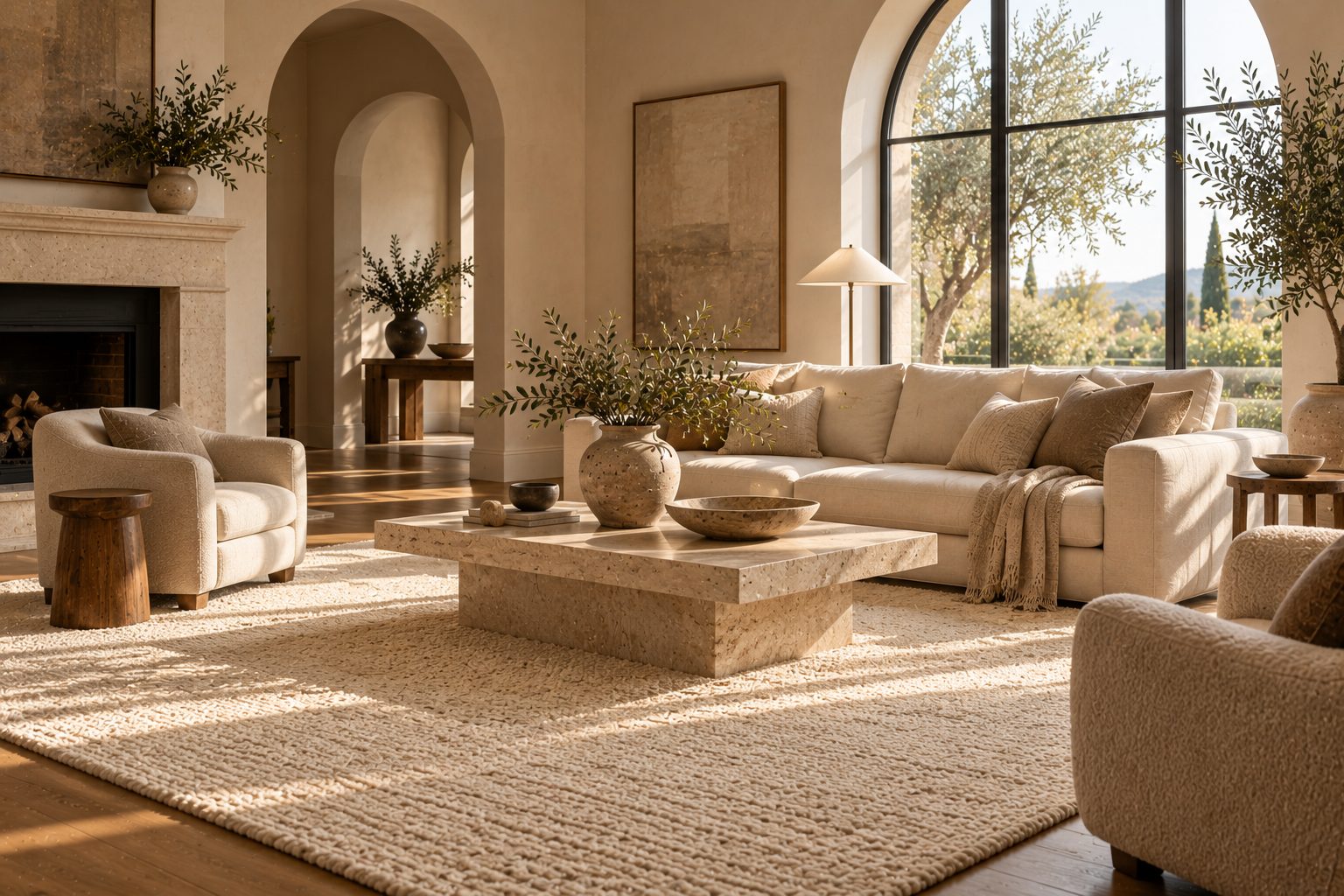
A cream rug makes a dark floor feel lighter and suits Scandinavian, Japandi and warm minimal rooms. Beige is the practical version: it hides dust, sand and pet hair far better than ivory. Choose a textured weave or a tonal pattern so marks blend into the design.
2. Brown rug
Brown color rugs are back in favor as rooms warm up for 2027, from caramel to chocolate. A carpet rug brown in tone grounds a pale sofa and pairs well with walnut and oak. Pair it with a lighter wall so the room does not feel heavy.
3. Grey rug and greyish rug
A grey rug still works, but choose warm greys with a beige or green undertone over the cool blue-greys of the 2010s. A greyish rug with a slightly heathered texture hides more than a flat solid.
4. Blue rug, light blue rug and blue carpet rugs
A blue rug is the easiest color to live with after neutrals: navy and ink blue anchor a room, a light blue rug brightens a north-facing space. Blue sits well with brown leather, natural wood and cream upholstery. Blue carpet rugs in a vintage or faded pattern add color without shouting.
5. Black and white rug
A black and white rug, a stripe, check or graphic flat-weave, adds contrast to a neutral room and suits modern, eclectic and coastal styles. Keep the rest of the pattern quiet: one bold graphic per room. Solid black shows lint and dust; mixed black and white hides both.
6. Colorful rugs
Colorful rugs are the fastest way to add personality, but they decide the room's palette for you. Build the scheme from the rug outward: pick the sofa from its quietest color and one accent from its strongest. A vintage-style rug with faded color dates more slowly than a saturated one.
Which rug patterns and styles are trending for 2027?
The rug styles trending for 2027 are softly faded traditional patterns, tonal textured wool, organic abstract shapes and chunky natural fibers, all in warm earthy palettes. High-contrast geometric shag and cool grey distressed prints are fading.
- Contemporary rugs with tonal pattern: carved or high-low pile in one color, popular in modern rugs and carpets because they add texture without pattern noise.
- Faded vintage and Persian-style: traditional medallions in soft rust, blue and sand; see our persian rugs guide for what to look for in the real thing.
- Organic abstract: loose painterly shapes in earth tones, the modern rug rugs category at its best.
- Chunky natural fiber: braided jute and wool-jute blends as a base layer.
- Irregular shapes: pebble and freeform rugs, good in reading corners, hard to place under a full seating group.
These follow the warmer direction in our living room trends 2027 forecast: softer edges, warmer neutrals, natural materials.
How do you place a rug in different living room layouts?
Place the rug centered on the seating group, not the room, and run its long side parallel to the sofa. The layout of the furniture decides the rug, so plan both together.
- Sofa facing two chairs: 8 x 10 ft with all front legs on; the coffee table sits centered.
- L-shaped sectional: rug tucked 6–8 in (15–20 cm) under both arms; 9 x 12 ft for most sectionals.
- Sofa against the wall: front legs on, rug stopping 6 in (15 cm) short of the wall.
- Two facing sofas: all legs on a 9 x 12 ft, or front legs on an 8 x 10 ft.
- Open-plan living-dining: one rug per zone, with 24–36 in (61–91 cm) of floor between them as a walkway.
Our living room layout ideas cover the furniture side of each layout with clearances.
Rug ideas for a small living room
In a small living room, go bigger, not smaller: a rug that runs under all the furniture makes the floor read as one surface and the room as larger. A 6 x 9 ft rug with the sofa's front legs on usually beats a 5 x 7 ft one. Choose a light, low-pile rug in a tone close to the floor. More tactics are in our small living room ideas.
Should you layer rugs in a living room?
Layering rugs works when the bottom rug is large, flat and plain and the top rug is smaller, patterned and at least 2 ft (61 cm) shorter on each dimension. It is a good fix for a rental carpet, a rug that is too small or a big room that needs warmth.
- Start with the base: a 9 x 12 ft or 10 x 14 ft jute, sisal or flat-weave in a natural tone.
- Add the top rug: a 5 x 8 ft or 6 x 9 ft vintage, Persian-style or graphic rug, centered on the coffee table.
- Offset deliberately or center precisely; a slight accidental angle looks like a mistake.
- Use a thin grip pad between layers so the top rug does not creep.
Mistakes we see with living room rugs
The mistake we see most with living room rugs is buying a rug that is one size too small because the larger size cost more; it is the one change that makes a room look unfinished.
- Too small: furniture floats around a postage-stamp rug.
- Skipping the pad: a rug without a pad slips, wrinkles and wears faster; budget $50–200 for an 8 x 10 ft pad.
- Viscose in a family room: it looks silky in the store and flattens or water-marks in months.
- Pure white with pets or children: buy mid-tones or washable rugs; our pet friendly rugs guide covers specs.
- High pile under a coffee table: shag over 1 in (25 mm) makes tables wobble and doors stick.
- Too many patterns: a patterned rug, patterned curtains and patterned cushions in different scales compete; keep at least one large surface plain.
How we'd do it: our living room rug ideas in practice
If we were choosing a rug for a typical 12 x 16 ft living room today, we would buy an 8 x 10 ft or 9 x 12 ft wool or wool-blend rug in a warm neutral with a tonal pattern, put it on a felt pad, and add color through a smaller vintage rug or cushions later. That combination costs roughly $700–2,500 at typical 2026 prices and survives every change of sofa.
For a family room with dogs or toddlers, we would switch to a washable low-pile rug in beige, brown or blue and accept a slightly flatter look in exchange for being able to clean it. For a formal room, a hand-knotted rug is worth the money. These living room rug ideas all come back to one principle: get the size right, then the fiber, then the color, in that order. Living room rugs set the scale of the whole room, so they are worth measuring twice.
Not sure which size fits your layout? Enter your room and seating dimensions in our free rug size calculator for a recommended size in feet and centimeters.
Free toolCurtain Size CalculatorRod length, panel size, ready-made match and yardage.Shop & source the look
Buy it today — or have it made
Retail links are affiliate links: we may earn a commission at no extra cost to you (disclosure). “Get it made” sends the item to our sourcing desk for factory quotes in custom sizes and finishes.
Frequently asked questions
How big should a living room rug be?
A living room rug should be large enough for at least the front legs of the sofa and chairs to rest on it and should extend 6–12 in (15–30 cm) beyond each end of the sofa. In most living rooms that is 8 x 10 ft (244 x 305 cm); rooms over 14 ft (4.3 m) wide usually need 9 x 12 ft or larger.
How do you choose rug size for a living room?
Measure the outside edges of your seating group, add 6–12 in (15–30 cm) beyond the sofa ends, and leave 12–18 in (30–46 cm) of bare floor to the walls. Then tape the outline on the floor with painter's tape to check it. If you are between sizes, choose the larger rug.
What color rug is best for a living room?
A warm neutral such as beige, cream, oat or warm grey is the most versatile living room rug color, because it works with changing sofas and wall colors. Choose a value between your walls and sofa so the rug links them. Blue and brown are the easiest non-neutral choices; black and white adds contrast in modern rooms.
Should the couch be on the rug?
Yes, at least the front legs of the couch should be on the rug, which visually anchors the seating group. In larger rooms, all four legs on the rug looks more generous. The only layout where the sofa can sit fully off the rug is a very small room, and even then the rug should touch the sofa's front edge.
How do you decorate a small living room with a rug?
Use one rug large enough to sit under the front legs of all the seating, usually 6 x 9 ft (183 x 274 cm) in a small room, in a light, low-pile weave close to the floor tone. A larger rug makes the floor read as one surface, so the room looks bigger. Avoid several small rugs, which break up the space.
Some links may be affiliate links. Regulations and specifications change — always confirm with suppliers and qualified professionals.