How to Choose a Paint Color: 7 Steps, Samples and Light Tests
How to choose a paint color: start from the fixed finishes, pick an undertone, check the LRV, then test 2 × 2 ft samples on two walls for 48 hours. Seven steps, a light-direction chart and a repainting checklist.
Part of our guide: Interior House Paint Ideas: Color Schemes & Room Paint Design
Key takeaways
- Choose paint color last, after flooring, counters, fabrics and big furniture, and pull the undertone from those fixed finishes
- Check LRV: 60–80 for most living spaces, above 80 only in bright rooms, below 30 for deliberate dark drama
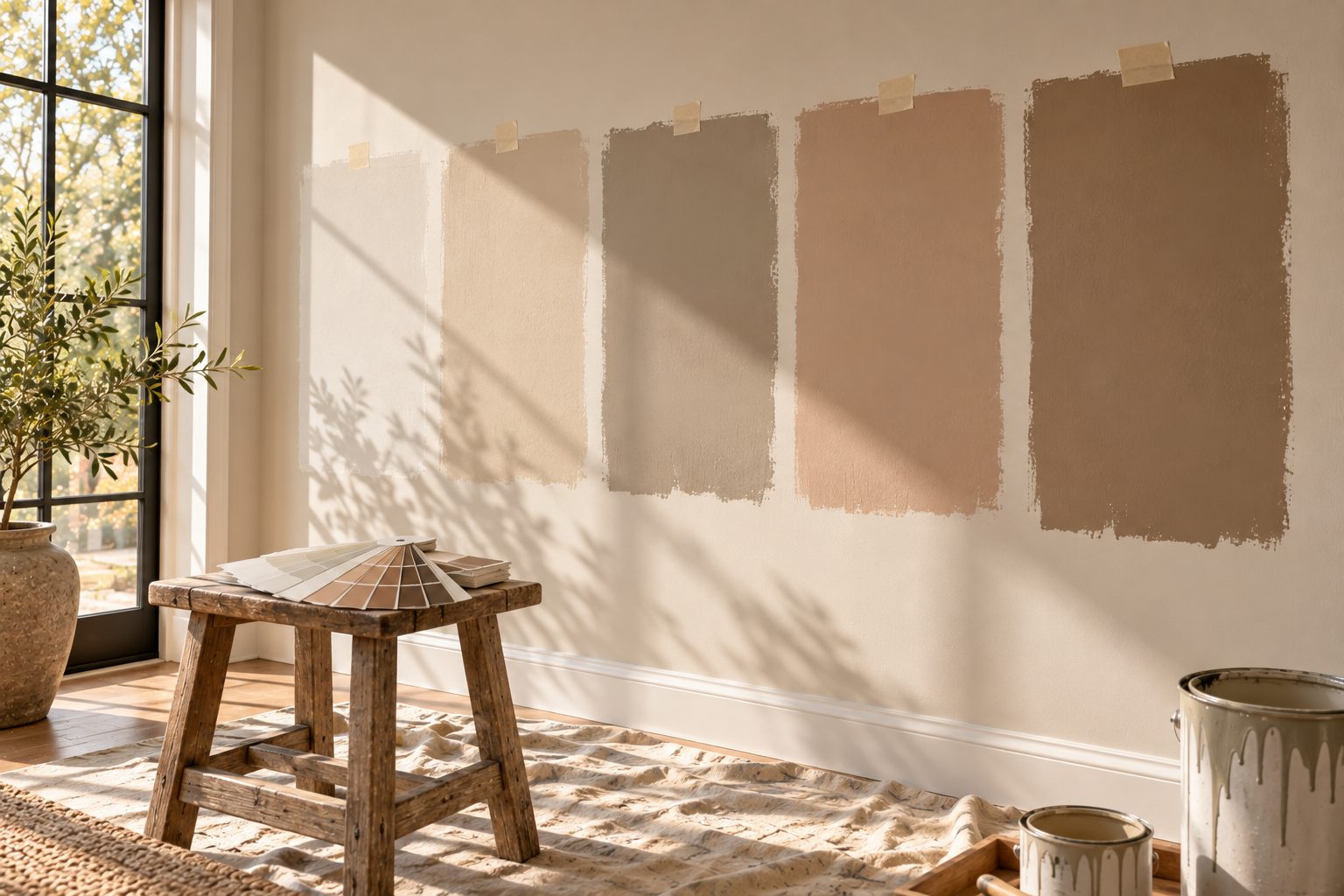
- Never decide from a small chip: test samples at least 2 × 2 ft (60 × 60 cm) on two walls and look at them morning, noon and night
- Use a paint color visualizer to shortlist, and physical samples to decide; screens cannot show undertone under your light
To choose a paint color, start with what will not change (floor, counters, big furniture), pick a warm or cool undertone that matches them, narrow to three shades with a light reflectance value (LRV) suited to the room, then test samples at least 2 × 2 ft (60 × 60 cm) on two walls and look at them for 48 hours. Buy only what still looks right at night.
Paint is the cheapest finish in a room and the easiest to get wrong, because color shifts with light, neighbors and scale. A chip that looks soft gray in the store can read lilac on a north-facing wall. This guide is the decision method; for inspiration on where to use color, our interior painting ideas guide is the companion piece.
- Order: choose fixed finishes and fabrics first; paint color last.
- Undertone: the hidden yellow, red, green, blue or violet bias decides whether a color works.
- LRV: 0 is black, 100 is pure white; most living rooms suit 55–80.
- Sample size: at least 2 × 2 ft, on two walls, for two days.
- Cost to test: about $5–10 per sample pot or $2–7 per peel-and-stick sheet.
How do you choose a paint color for a room?
You choose a paint color by working from the fixed finishes outward, then proving your shortlist with large samples in the room's own light. Skipping either half is why so many rooms get painted twice.
Here is the seven-step method we use on client projects, from a single bedroom to a whole house:
- List what stays. Flooring, countertops, tile, the sofa, rugs and curtains. Note their undertones: is the oak floor orange or yellow, is the marble cool gray or warm cream?
- Decide the mood. Calm and enveloping, bright and airy, or dark and dramatic. That sets your LRV range.
- Pick the undertone. Warm floors and wood want warm or balanced paint; cool stone and chrome want cool or neutral.
- Shortlist three colors. One lighter, one middle, one darker within the same family. Use a paint color visualizer here, not later.
- Order samples. Peel-and-stick paint samples or sample pots, never just small chips.
- Test in place for 48 hours. Two walls, one in direct light and one in shadow, beside trim and next to the floor.
- Decide at night. Look again under the room's own bulbs. The color you still like at 9 pm is the one to buy.
That is the whole answer to how to pick paint colors. The sections below explain each step in more detail and the numbers behind it.
What is an undertone, and why does it matter?
An undertone is the subtle second color inside a paint, such as the green in a greige or the pink in a beige, and it is the reason a color looks different on your wall than on the chip. Matching undertones to your fixed finishes is the most important single step.
The fastest way to see an undertone is to compare. Hold a chip against a sheet of plain printer white and a pure gray card: the bias jumps out. Then hold it beside the strongest fixed finish in the room. A beige with a pink undertone next to orange-toned oak looks muddy; a beige with a yellow-green undertone looks calm. Our neutral paint colors and warm white paint colors guides list common undertones by color family.
#EDE6DA#D9D6CF#C9B79C#8F9C86#5D6B73#A8644AThe hex values above are screen references, not paint formulas. Use them to understand the families, then compare real chips side by side, never in isolation.
How does light direction change paint color?
Light direction changes paint more than any other factor: north light cools and grays colors, south light warms and brightens them, east is warm in the morning and cool later, and west is the reverse. Choose for the light you have, not the light in the store.
| Room faces (northern hemisphere) | Light quality | What happens to color | Best choices | Avoid |
|---|---|---|---|---|
| North | Cool, even, indirect | Colors look grayer and darker | Warm whites, warm greiges, ochres, LRV 60–80 | Cool grays and blue-whites, which turn icy |
| South | Warm, strong, changes through the day | Colors look lighter and warmer | Cool or balanced neutrals, greens, blues | Very yellow creams, which can glare |
| East | Bright warm morning, cool afternoon | Shifts strongly through the day | Balanced neutrals, soft greens | Colors you have only seen in the afternoon |
| West | Cool morning, hot orange evening | Evening light pushes everything warm | Cooler whites, gray-greens, blues | Strong reds and oranges, which overheat |
| Interior, no window | Artificial only | Depends entirely on bulbs | Test under 2700–3000 K, CRI 90+ bulbs | Choosing under store fluorescents |
In the southern hemisphere, swap north and south. Bulbs matter as much as windows: warm 2700 K lamps push colors toward yellow, while 4000 K and above flatten warm colors. Use bulbs with a CRI of 90 or higher when you test, so the samples render honestly.
What LRV should your paint color have?
Most living spaces suit a paint LRV of 55–80; choose 80 or above only for bright rooms you want crisp, and below 30 only when you want a deliberately dark, enveloping room. LRV, or light reflectance value, measures the percentage of visible light a color reflects, from 0 for black to about 100 for pure white.
- LRV 80–93: bright whites. Great on ceilings and in sunny rooms; can glare or look stark in south light.
- LRV 60–80: soft whites and pale neutrals. The safe range for most walls.
- LRV 40–60: mid-tones. Shows clear color, still reflects enough light for daily living.
- LRV 15–40: deep colors. Best for dining rooms, dens, powder rooms and color drenching.
- LRV under 15: near-blacks. Works on cabinetry, doors and small, well-lit spaces.
The LRV is printed on the back of most paint sample cards or listed on the color's page. Dark rooms are not a mistake if you commit: color drenching, painting walls, trim and ceiling in one deep shade, makes a low LRV feel intentional.
How do you use paint samples properly?
Use paint samples big, in pairs and in place: at least 2 × 2 ft (60 × 60 cm) per color, on two different walls, at eye level and near trim, for at least 48 hours. Small chips mislead because color intensifies as area increases.
Peel-and-stick paint samples vs sample pots
Peel and stick paint samples are sheets of real paint on film, typically around 9 × 14 in (23 × 36 cm) up to about 12 in (30 cm) square, and usually cost $2–7 each. They are clean, repositionable and easy to move around a room, which makes them the best way to compare several paint color samples quickly. Sample pots, typically 8 oz (237 ml) for $5–10, let you paint a larger board and see the true sheen. We use stickers to shortlist and one pot of the finalist to confirm.
Paint sample cards and swatches
A paint swatch or strip card is fine for the first cut and for checking undertone against fabric, but never for the final decision. Many stores offer free paint sample cards, and some brands mail a limited number of free paint samples in sticker form; how much are paint samples otherwise? Roughly the price of a coffee each, which is trivial against the cost of repainting.
How to run a color test
- Paint a board, not the wall, so the old color does not show through and you can move it.
- Leave white space between samples, about 2 in (5 cm), so neighboring colors do not bleed into each other visually.
- Place one sample beside trim and one beside the floor to check how they behave together.
- Check at three times: morning, midday and after dark with lamps on.
Are paint color visualizers accurate?
A paint color visualizer is good for shortlisting and for judging contrast between walls, trim and doors, but it is not accurate enough to make the final decision. Screens vary in brightness and calibration, and none can reproduce how your own light shifts an undertone.
Room paint visualizer and house paint visualizer tools let you upload a photo and recolor the walls or facade. They are useful for three things: rejecting colors that are clearly too strong, deciding whether trim should contrast or match, and seeing a whole-house flow from room to room. A house color visualizer or house paint simulator is especially helpful for exteriors, where samples are harder to apply across a full facade. Treat the result as a sketch. Then order samples of the two or three colors that survived. The general color visualizer apps found on phones follow the same rule: shortlist on screen, decide on the wall.
How do you choose paint colors for a whole house?
Choose a whole-house palette of one main neutral, one or two supporting colors and one trim white, then repeat them in different proportions so rooms flow into each other. Open-plan spaces and sightlines decide where color changes are allowed.
- Main neutral: hallways, open living areas and any wall visible from more than one room.
- Supporting colors: bedrooms, offices and dining rooms behind doors, one or two steps darker or in a related hue.
- Accent: one deep color for a powder room, a front door or cabinetry.
- Trim and ceiling: one white for the whole house unless a room is color drenched.
Change color at inside corners and door casings, never mid-wall. If you want help building the scheme with the color wheel, our color wheel interior design guide explains complementary, analogous and triadic schemes, and our ready-made palettes give tested combinations with LRVs.
How do you repaint a room once you have chosen the color?
To repaint a room, clear and protect it, repair and clean the walls, cut in edges, roll two coats with full drying time between them, and finish with trim. What do you need to paint a room? A short, specific kit, below, plus a free day for a bedroom.
What you need to paint a room
- Paint: about 1 gallon (3.8 L) per 350–400 sq ft (33–37 m²) per coat; a 12 × 12 ft bedroom needs about 2 gallons for two coats.
- Tools: 9 in (23 cm) roller frame with 3/8 in nap sleeve, 2–2.5 in (5–6 cm) angled sash brush, tray, extension pole.
- Prep: drop cloths, painter's tape, lightweight filler, sanding sponge, cleaning sponge and mild detergent.
- Primer: only for repairs, stains, new drywall or big dark-to-light changes.
How to paint, in order
Move furniture to the center and cover it. Fill holes, sand flush, wash greasy areas and let them dry. Spot-prime patches. Cut in a 2–3 in (5–8 cm) band along ceilings, corners and trim, then roll the wall in overlapping W shapes while the cut-in is still wet, which avoids picture-framing. Wait the recoat time on the can, usually 2–4 hours for acrylics, and repeat. Paint trim last. That sequence is the core of how to paint a room well, and it applies to any DIY painting project from a bedroom to a hallway. Eggshell or matte suits most bedroom walls, and our interior painting cost guide shows what a painter would charge instead.
Mistakes we see when people choose paint colors
The mistakes we see most are choosing from a tiny chip under store lighting, ignoring the floor's undertone and picking a color that is far too saturated for a full room. Almost every repaint we are asked about traces back to one of these.
- Too bright. A color that looks muted on a chip becomes intense on four walls. Go one or two steps grayer than your first instinct.
- Too many whites. Three different whites on walls, trim and ceiling fight each other. Use one or two, deliberately.
- Testing on the old color. A sample painted over a strong existing color reads wrong. Use a white board or primed patch.
- Deciding in one light. A color chosen at noon may sour under evening lamps.
- Chasing trends room by room. Pick from our paint color trends 2027 if you like, but filter every trend through your own fixed finishes and light.
Our verdict: the right color is rarely the one you liked first. It is the one that still looks right on two walls, at night, next to your floor. Spend $20–40 on samples and two days of patience, and you will paint once.
Want a shortcut? Our palette pack gives ready-made whole-house schemes with undertones, LRVs and trim pairings already tested, so you can go straight to samples with a confident shortlist.
Free toolTile CalculatorWork out tiles, boxes, grout and adhesive with the right wastage.Shop & source the look
Buy it today — or have it made
Retail links are affiliate links: we may earn a commission at no extra cost to you (disclosure). “Get it made” sends the item to our sourcing desk for factory quotes in custom sizes and finishes.
Frequently asked questions
How do you pick paint colors for a room?
Pick paint colors by starting with the fixed finishes, such as floors, counters and large furniture, then choosing a matching undertone and an LRV suited to the room's light. Shortlist three shades in one family, test large samples on two walls for 48 hours and choose the one that still looks right under evening lamps.
How much are paint samples?
Paint samples typically cost $5–10 for an 8 oz sample pot and $2–7 for a peel-and-stick sample sheet in the US. Paper sample cards are usually free in stores. Testing three colors properly costs about $15–30, which is small against the cost of repainting a room you do not like.
Where can I get free paint samples?
Free paint samples are most often the paper sample cards and strip swatches available in paint and home-improvement stores. Some paint makers also offer a limited number of free peel-and-stick samples by mail or as promotions. Free cards are fine for shortlisting, but buy at least one large sample of your finalist before deciding.
What do I need to paint a room?
To paint a room you need paint, about 1 gallon per 350–400 sq ft per coat, a 9 in roller with a 3/8 in nap sleeve, an angled sash brush, a tray, an extension pole, drop cloths, painter's tape, filler and a sanding sponge. Add primer only for repairs, stains, new drywall or major color changes.
Should paint be lighter or darker than the chip?
Paint usually looks lighter and more saturated on a full wall than on a small chip, because color intensifies with area and reflected light. Many designers choose one step grayer or lighter than the chip they first liked. Test a sample at least 2 × 2 ft on the wall to see the real effect.
How do you repaint a bedroom?
Repaint a bedroom by moving and covering furniture, filling and sanding holes, washing the walls, cutting in edges with a brush, then rolling two coats with 2–4 hours drying between them. Paint the ceiling first if you are doing it, trim last. A 12 × 12 ft bedroom needs about 2 gallons and one day.
Some links may be affiliate links. Regulations and specifications change — always confirm with suppliers and qualified professionals.