Peel and Stick Wallpaper: Does It Work, How Long It Lasts, What to Buy
Peel and stick wallpaper works well on smooth, cured satin or eggshell paint, lasts roughly 3–7 years and peels off without damage. Here is what to buy, what it costs per roll and where it fails.
Part of our guide: Wallpaper Trends 2027: Patterns, Types, Costs and Where to Use It
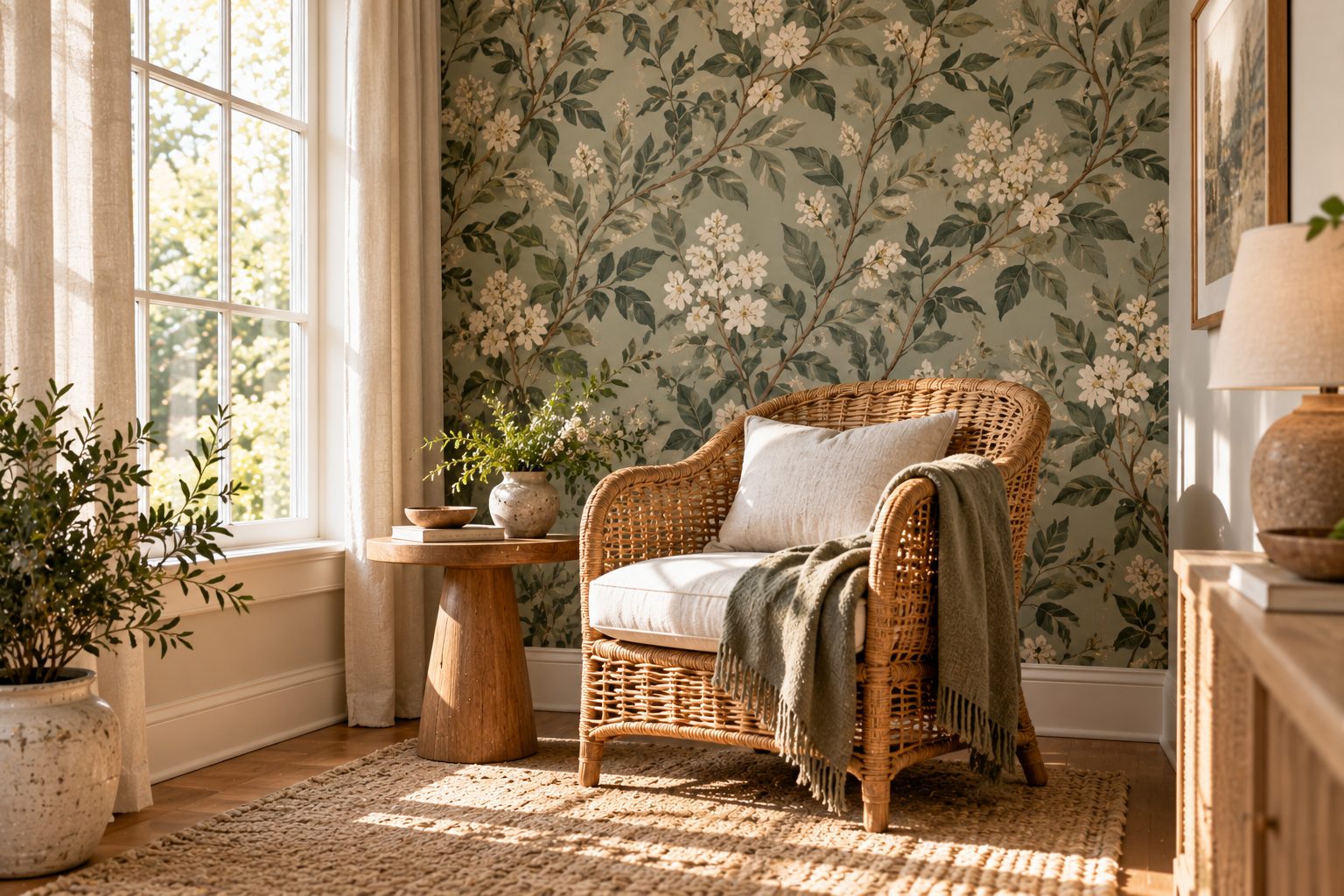
Key takeaways
- Peel and stick wallpaper works on smooth, fully cured satin or eggshell paint; it fails on flat paint, textured walls and fresh paint
- Expect 3–7 years indoors; thicker matte vinyl and woven-texture films with a repositionable adhesive last longest
- Typical 2026 rolls cover 28–31 sq ft (2.6–2.9 m²) and cost $25–90; add 15–20 percent for pattern matching
- Removal is clean if you peel slowly at a low angle, warm stubborn spots with a hair dryer and wait 4 weeks after painting before you hang
Peel and stick wallpaper works well, and removes cleanly, when it goes on smooth, fully cured satin or eggshell paint in a dry room. On that kind of wall it typically lasts 3–7 years. It fails on flat or fresh paint, textured walls and steamy showers. Expect $25–90 for a roll covering about 28–31 sq ft (2.6–2.9 m²).
Peel and stick wallpaper, also sold as self adhesive wallpaper or removable wallpaper, is a vinyl, polyester or paper film with a pressure-sensitive adhesive on the back and a release liner you peel away as you hang. No paste, no water, no booking a paperhanger. That makes it the default renter friendly wallpaper, and it is one of the strands of our wallpaper trends 2027 report, where pattern and texture keep coming back into rooms that were white for a decade.
- Typical roll: 17.5–24 in (44–61 cm) wide, 16.5–18 ft (5–5.5 m) long, 28–31 sq ft per roll.
- Lifespan: about 3–7 years on a well-prepared interior wall.
- Removal: usually clean from cured satin or eggshell paint; risky on flat paint and unprimed drywall.
- Best rooms: bedrooms, living rooms, closets, powder rooms, shelf backs and stair risers.
- Avoid: shower surrounds, behind stoves, exterior walls with condensation.
Does peel and stick wallpaper work?
Peel and stick wallpaper does work, provided the wall is smooth, clean, dry and painted at least four weeks earlier with a satin or eggshell finish; most failures come from the wall, not the paper.
The adhesive is designed to grip a smooth, non-porous surface. Satin and eggshell latex give it that; flat and matte paints are chalky and porous, so the adhesive bonds to the loose surface layer and lets go at the seams, or pulls the paint off when you remove it. Fresh paint is the other big problem: latex keeps releasing moisture and solvents for two to four weeks, and a film laid over it bubbles or curls. Heavy orange-peel or knockdown texture leaves air pockets that show through thin films and loosen over time. If your wall has texture, skim-coat and prime it smooth before you start.
Is peel and stick wallpaper good quality?
Quality varies more than with any other wall finish. Thin, glossy films around 3–4 mil (0.08–0.10 mm) show every bump and stretch when you reposition them. Thicker matte or textured films, roughly 6–10 mil (0.15–0.25 mm), hide minor wall flaws, hold their size and look much closer to traditional wallpaper. So is peel and stick wallpaper good? On the right wall, a thick matte one is; a cheap glossy one looks like contact paper within a year.
Is peel and stick wallpaper easy to remove?
Peel and stick wallpaper is easy to remove from cured satin or eggshell paint: lift a corner and pull slowly back on itself at a low angle, and it usually comes away without residue or damage.
- Start at a top corner. Lift with a fingernail or a plastic putty knife, never a metal blade.
- Peel low and slow. Pull the strip back down against itself at roughly 160–180 degrees rather than straight out.
- Warm stubborn areas. A hair dryer on medium for 20–30 seconds softens the adhesive.
- Clean residue. Warm water with a drop of dish soap on a microfiber cloth; avoid solvents on latex paint.
- Touch up. Keep a sample pot of the original wall color for any lifted flecks.
Removal gets harder with age, heat and sunlight. Paper on a south-facing wall for five summers can bond more firmly than paper in a cool hallway. If your lease requires the walls returned as found, do a test: hang a small offcut behind a sofa for two weeks and peel it off before you commit to the whole room.
Peel and stick vs traditional wallpaper and paste
Peel and stick costs more per square foot than many pasted papers and lasts less long, but it is far faster to hang and removes cleanly, which is why it wins for renters and short-lived rooms.
| Type | Typical 2026 price per roll | Coverage per roll | Lifespan | Removal | Renter friendly |
|---|---|---|---|---|---|
| Peel and stick (vinyl or polyester film) | $25–90 | 28–31 sq ft (2.6–2.9 m²) | 3–7 years | Peels off dry | Yes |
| Prepasted (activate with water) | $30–120 | 28–56 sq ft (2.6–5.2 m²) | 10–15 years | Wet strip, moderate | Sometimes |
| Paste-the-wall nonwoven | $50–200 | 28–57 sq ft (2.6–5.3 m²) | 10–20 years | Dry strippable in one piece | With permission |
| Traditional paper with separate paste | $40–250+ | 28–57 sq ft (2.6–5.3 m²) | 15+ years | Steam or soak, slow | No |
| Grasscloth and natural fiber | $90–350 | 36–72 sq ft (3.3–6.7 m²) | 15+ years | Professional removal | No |
Prices are typical US retail ranges and vary by brand tier, print method and roll size. Coverage figures assume standard single and double rolls; check the label. Professional installation for pasted papers adds roughly $2–6 per sq ft.
Wallpaper and paste remains the better choice in a home you own and plan to keep, especially for a large or high-traffic room. Paste-the-wall nonwovens are the middle ground: you roll adhesive onto the wall, hang dry panels, and later they strip off in whole sheets. Peel and stick wins where you need zero mess, zero tools beyond a smoother and a knife, and a clean exit.
What is the best peel and stick wallpaper?
The best peel and stick wallpaper is a thick, matte or textured film with a repositionable adhesive, a straight or half-drop match you can work with, and a design scaled to the room.
We do not rank brands or products, but we do buy against a short spec list, and it is the same for a studio apartment or a hotel corridor:
- Thickness: 6 mil (0.15 mm) or more; ask for a sample and fold it, since thin films crease sharply.
- Finish: matte or embossed; gloss shows every wall ripple under side light.
- Adhesive: labeled repositionable, so you can lift and re-lay a strip in the first few minutes.
- Width: 20.5–24 in (52–61 cm) panels mean fewer seams than 17.5 in (44 cm) rolls.
- Material: PVC-free polyester or polyolefin films if you care about off-gassing; vinyl for wipeability.
- Print quality: sharp edges, no banding, colors consistent from roll to roll; buy all rolls from one batch.
- Return policy on samples: always order a sample and stick it to the actual wall for a week.
Wallpaper ideas by style
The removable wallpaper ideas that look most convincing use matte textures, large repeats and traditional motifs, because those read as real wallpaper rather than printed film.
#6E7B5E#C99A6B#E6DCC8#2E3D4F#B5523BThe hex values are approximate screen references for 2027-leaning grounds and accents; check printed samples in daylight.
Modern peel and stick wallpaper
The modern versions lean on tonal grounds and quiet texture: limewash and plaster effects, fine linen weaves, soft grids and oversized abstract brushwork. These are the easiest to get right because small misalignments disappear.
Boho wallpaper
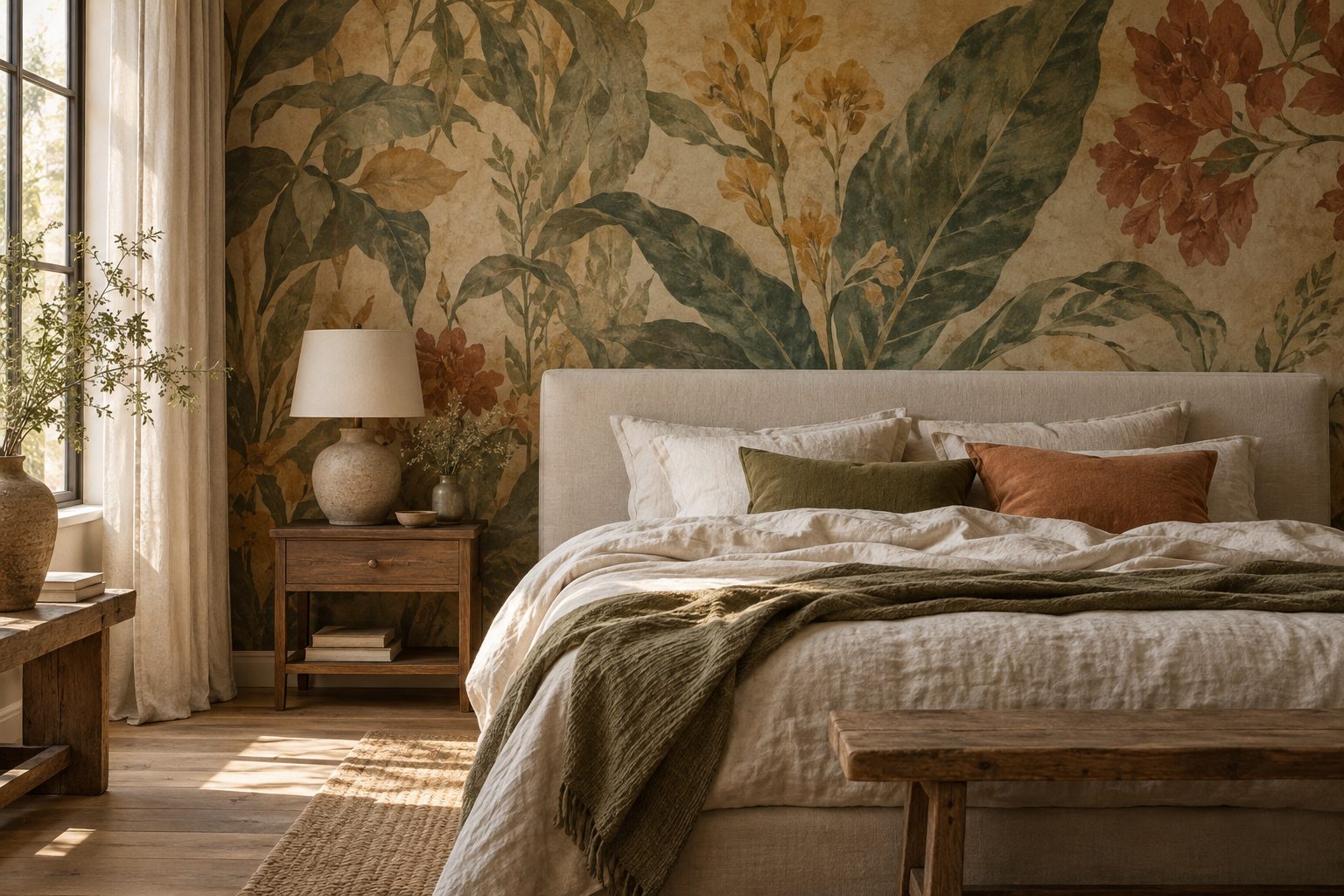
Boho style wallpaper uses palm and banana leaves, block-print motifs, rattan and cane patterns and warm earthy grounds of terracotta, ochre and sage. Boho peel and stick wallpaper works well in bedrooms and behind open shelving; pair it with natural fiber and plants. Our boho interior design guide covers the rest of the room.
Vintage, old wallpaper and country wallpaper patterns
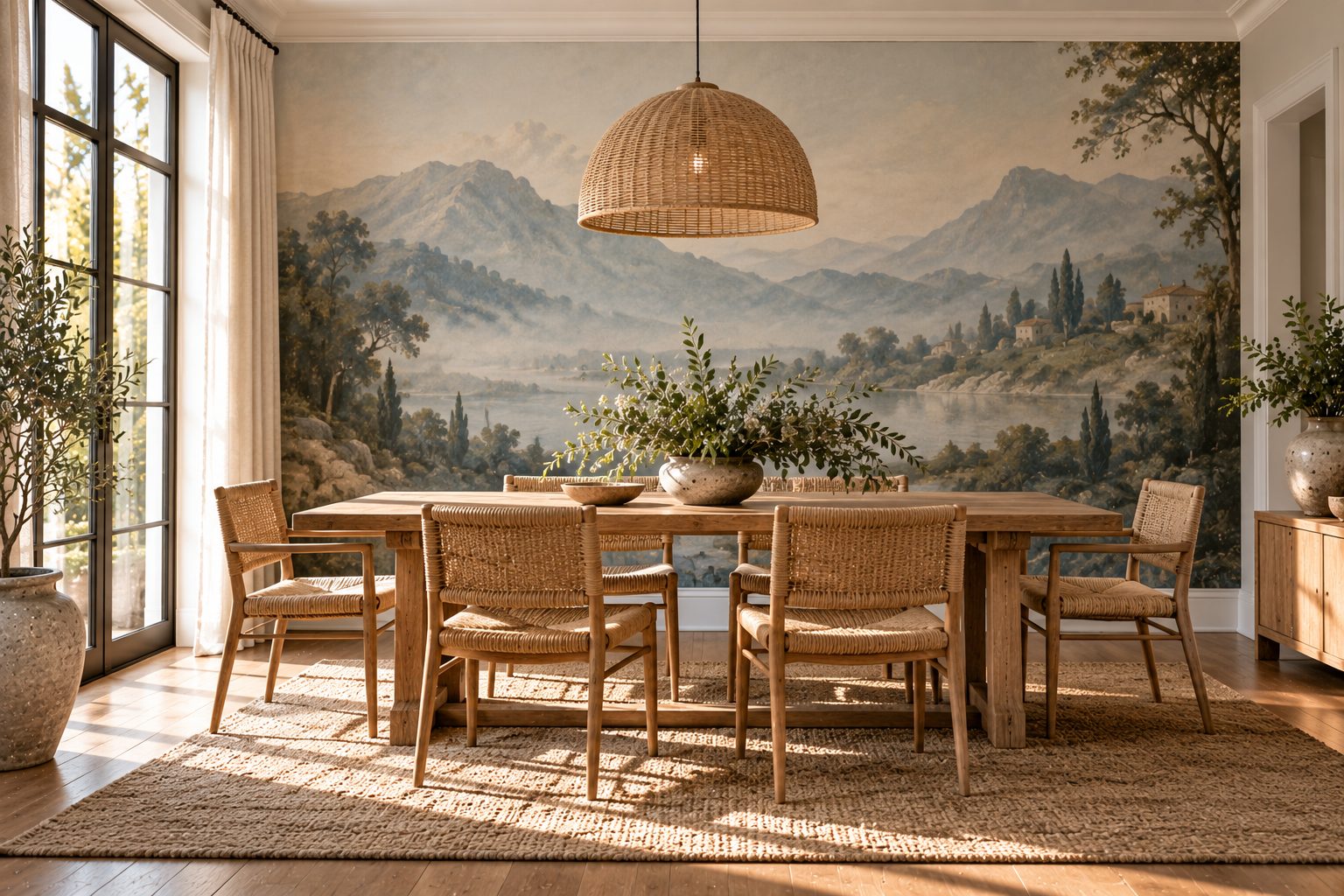
Vintage wallpaper reproductions, small florals, toile, stripes and ticking, give a cottage or country wallpaper look and suit bedrooms, powder rooms and the backs of glass-front cabinets. Old wallpaper designs from the 1960s and 1970s, with big geometrics and saturated florals, are back as fun wallpaper for closets and hallways.
Funky wallpaper and unique wallpaper
Funky wallpaper and unique wallpaper patterns, such as oversized checks, wavy stripes, cartoonish fruit or murals, are ideal in small doses: a powder room, a home bar, an entry or one accent wall. Peel and stick is perfect here because you can change it in two years when the mood passes. For accent placement, see our accent wall ideas.
Peel and stick brick wallpaper and 3D panels
Peel and stick brick wallpaper and peel and stick wallpapers 3D-style foam panels add texture cheaply, but both look best at a distance and should stay in dry, low-contact areas.
Flat printed brick reads convincingly only from 6–8 ft (1.8–2.4 m) or more; up close, the lack of mortar depth gives it away. Foam 3D panels, usually 0.2–0.3 in (5–8 mm) thick, have real relief and soften sound slightly, but they dent, are hard to clean and are combustible, so keep them away from fireplaces, stoves and candles. If you want real texture, see our textured wallpaper guide for embossed and natural-fiber options.
Removable wallpaper for renters and apartments
Removable wallpaper for renters is the safest way to add pattern to an apartment, as long as you get permission, test removal on the actual paint and avoid kitchens and bathrooms with poor ventilation.
Apartment friendly wallpaper projects that pay off for little effort:
- The bed wall: one 10–12 ft (3–3.7 m) wall uses 4–6 rolls.
- Bookcase backs: a single roll often covers two standard bookcases.
- Closet interiors: a surprise pattern behind a door.
- Stair risers: cut strips 7–7.75 in (18–20 cm) tall.
- Powder room: a small room with no shower, ideal for a bold pattern.
In a bathroom, keep peel and stick at least 12 in (30 cm) from the shower and run the extractor fan; our bathroom wallpaper ideas guide covers moisture-safe options. Many renters also use it on kitchen cabinet fronts, which works on smooth laminate but not on wood grain.
How to hang peel and stick wallpaper
Hang peel and stick wallpaper on a clean, cured wall from a plumb line, peeling the liner 12 in (30 cm) at a time and smoothing from the center outward.
- Measure and order. Width × height of each wall, minus large openings, plus 15–20 percent for pattern match and mistakes. Our how much wallpaper do I need guide shows the math.
- Prep the wall. Fill holes, sand smooth, wipe with a damp cloth and let dry 24 hours. Freshly painted walls need 3–4 weeks.
- Acclimate the rolls. Unbox in the room for 24 hours at 60–80°F (16–27°C).
- Draw a plumb line. Use a level, a pencil line about one roll width from the corner; corners are rarely straight.
- Hang the first strip. Leave 2 in (5 cm) overhang at the ceiling, peel back 12 in of liner, align to the line and smooth from the center with a felt-edge smoother.
- Match and overlap. Align the pattern on the next strip; most films butt-join, some need a 1/8–1/4 in (3–6 mm) overlap, so read the instructions.
- Trim. Cut the excess at the ceiling, baseboard and outlets with a fresh snap-off blade against a 6 in (15 cm) taping knife; change the blade every few cuts.
- Press the seams. Run the smoother over every seam once more after an hour.
What a typical wall costs
A 12 ft (3.7 m) wall at 8 ft (2.4 m) high is 96 sq ft (8.9 m²). With 28 sq ft rolls and a 20 percent allowance for matching, that is five rolls, or roughly $125–450 in wall paper peel and stick depending on the tier. A 10 × 12 ft (3 × 3.7 m) bedroom with all four walls papered, minus a door and a window, needs around 12–14 rolls. Large-repeat patterns of 24 in (61 cm) or more push waste toward 25 percent, so check the repeat before you total the order. Adhesive wallpaper sold as wide panels rather than rolls is often priced per panel; convert everything to cost per square foot to compare fairly.
Mistakes we see with self-adhesive wallpaper
The mistake we see most often is hanging peel and stick wallpaper over flat paint or fresh paint, which leads to curling seams within weeks and torn paint when it comes off.
Next come buying the cheapest thin glossy film for a wall that gets raking light, ordering exactly the square footage without allowance for pattern repeat, stretching the film to close a gap (it shrinks back and opens the seam), and putting it in a shower room without ventilation. Our verdict: peel and stick is excellent for renters, for small rooms and for anything you might change within five years. For a primary bedroom or living room you own and plan to keep for a decade, a paste-the-wall nonwoven looks better and lasts longer for similar money.
Before you order, enter your wall widths, height and the pattern repeat into our wallpaper calculator to get the exact number of rolls, including waste for matching.
Free toolWallpaper CalculatorHow many rolls you need, allowing for the pattern repeat.Shop & source the look
Buy it today — or have it made
Retail links are affiliate links: we may earn a commission at no extra cost to you (disclosure). “Get it made” sends the item to our sourcing desk for factory quotes in custom sizes and finishes.
Frequently asked questions
Is peel and stick wallpaper easy to remove?
Yes, peel and stick wallpaper is easy to remove from cured satin or eggshell paint. Lift a top corner and pull the strip slowly back on itself at a low angle; warm stubborn areas with a hair dryer. On flat paint, unprimed drywall or walls painted less than four weeks before hanging, it can pull paint or paper facing away.
Does peel and stick wallpaper work on textured walls?
Peel and stick wallpaper does not work well on textured walls. Orange-peel and knockdown textures leave air gaps, so thin films show the bumps and lose grip at the seams. Light texture may be acceptable with a thick, embossed film; for heavier texture, skim-coat and prime the wall, or choose a paste-the-wall nonwoven instead.
How long does peel and stick wallpaper last?
Peel and stick wallpaper typically lasts about 3–7 years indoors on a well-prepared wall. Thick matte films in cool, dry rooms last longest. Direct sun, heat and humidity shorten its life and can make removal harder, so avoid south-facing walls with strong sun, shower areas and walls behind stoves or radiators.
Is peel and stick wallpaper good for renters?
Peel and stick wallpaper is the best wallpaper option for renters because it goes on without paste and usually comes off without damage. Ask your landlord first, test a sample on the actual paint for two weeks, and keep it out of bathrooms without extractor fans. Keep a little touch-up paint in case small flecks lift.
Can you put peel and stick wallpaper in a bathroom?
You can put peel and stick wallpaper in a bathroom with good ventilation, but keep it at least 12 in (30 cm) from the shower or tub and run the extractor fan during and after bathing. Powder rooms without showers are ideal. In steamy full bathrooms, a vinyl paste-the-wall paper or tile is the more reliable choice.
Some links may be affiliate links. Regulations and specifications change — always confirm with suppliers and qualified professionals.