Wall Murals: Mural Wallpaper Ideas, Sizes and Costs for Every Room
Wall murals turn one wall into a single non-repeating image, and printed mural wallpaper typically costs $3–10 per sq ft. Here are mural ideas by room, the sizes and materials to order, and how to hang one without gaps.
Part of our guide: Wallpaper Trends 2027: Patterns, Types, Costs and Where to Use It
Key takeaways
- A wall mural is one large, non-repeating image split into numbered panels, printed or hand-painted across a whole wall
- Printed mural wallpaper typically costs $3–10 per sq ft; hand-painted wall mural art runs a typical $15–50+ per sq ft
- Measure the widest and tallest points and add 2–4 in (5–10 cm) of bleed on every side before ordering
- Scenic and landscape murals suit bedrooms and dining rooms; washable peel-and-stick suits kids' rooms and rentals
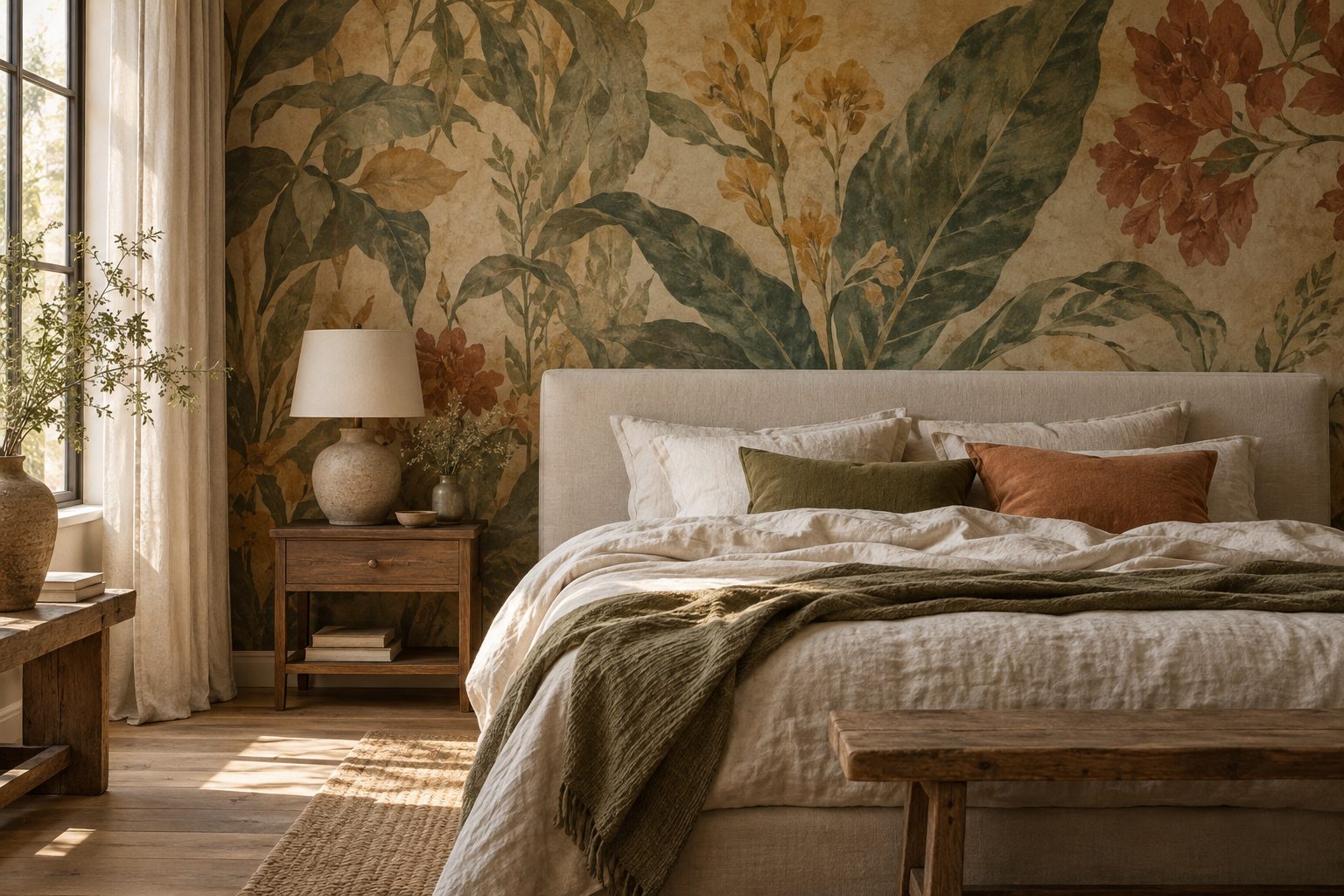
Wall murals are single large images, usually printed as numbered wallpaper panels, that cover one wall without a repeating pattern. Printed mural wallpaper typically costs $3–10 per sq ft, so a 12 × 8 ft (3.7 × 2.4 m) wall comes to roughly $300–960 in material. Scenic landscapes, botanicals and soft abstracts lead the wall mural ideas for 2027.
Murals are one of the clearest threads in our wallpaper trends 2027 report: homeowners are moving from busy small repeats to one confident, painterly image per room. This guide covers which mural to choose for which room, how to size it and what to pay.
- Definition: a mural is one continuous image across a wall; wallpaper is a repeat.
- Typical cost: $3–10 per sq ft printed, $15–50+ per sq ft hand-painted.
- Panel widths: usually 18–39 in (46–100 cm), numbered left to right.
- Bleed: order 2–4 in (5–10 cm) extra on all four sides for trimming.
- Print resolution: 100–150 dpi at final size for custom images.
What is the difference between wall murals and wallpaper?
Wall murals show one non-repeating picture sized to a specific wall, while standard wallpaper repeats a pattern on rolls that you can buy in any quantity.
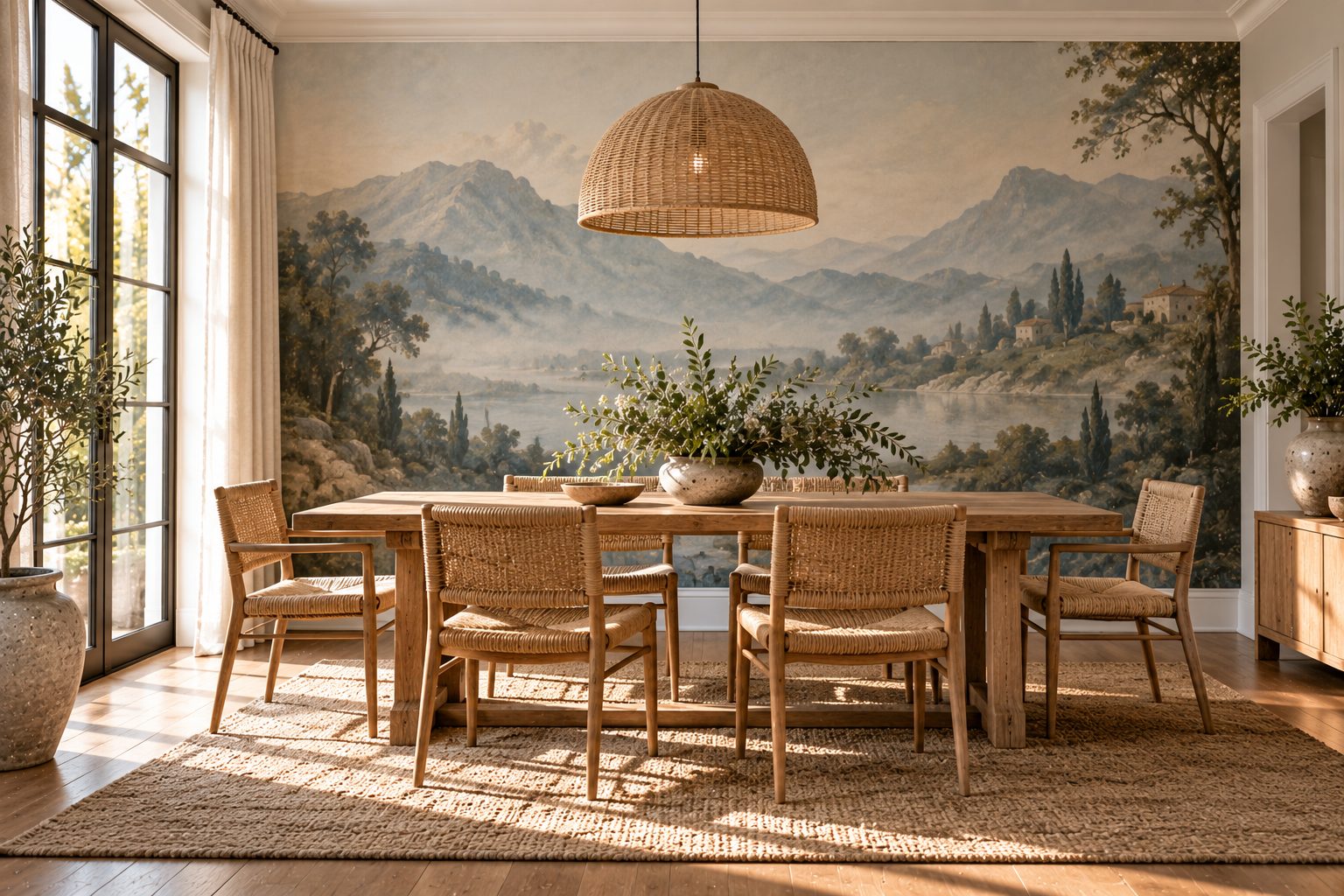
That difference drives how you buy. Ordinary rolls are sold by the roll and matched at a pattern repeat; mural wallpaper is printed to your measurements, or sold as a fixed-size set that you trim. Scenic wallpaper sits between the two: a traditional scenic wallpaper runs as a panoramic sequence of panels, often 10–20 drops wide, that can wrap a whole dining room without repeating. Many people searching for scene wallpaper or wall paper murals mean the same thing, an image you look into rather than a pattern you look at.
A mural also changes how a room feels. A landscape with a low horizon line pushes the wall back and makes a small room read deeper. A close-up botanical brings the wall forward and makes a big room feel more enclosed. Pick the effect first, then the image.
Which wall mural ideas work in each room?
The wall mural ideas that work best are scenic and landscape murals for bedrooms and dining rooms, botanicals for living spaces, and playful, washable designs for kids' rooms and playrooms.
| Room | Mural style | Material to order | Typical wall size | Typical material cost |
|---|---|---|---|---|
| Bedroom (headboard wall) | Misty landscape, soft abstract | Non-woven, matte | 10–14 × 8–9 ft (3–4.3 × 2.4–2.7 m) | $250–1,100 |
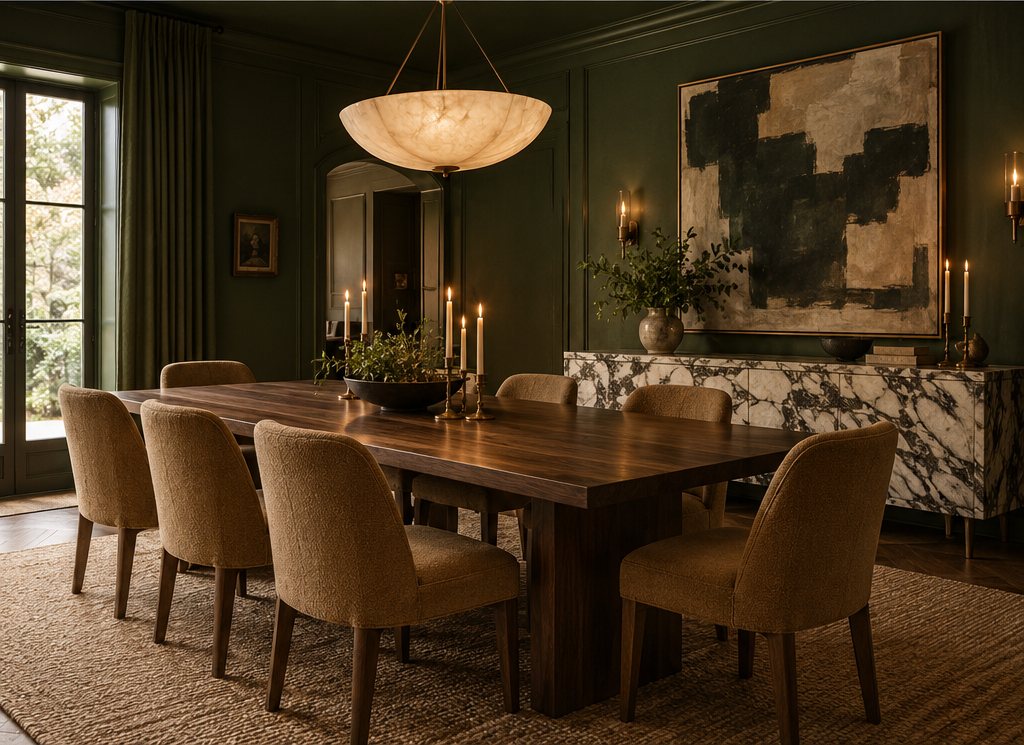
| Dining room | Scenic panorama, chinoiserie-style garden | Non-woven or paper, matte | 2–4 walls, 40–60 linear ft (12–18 m) | $900–4,000 |
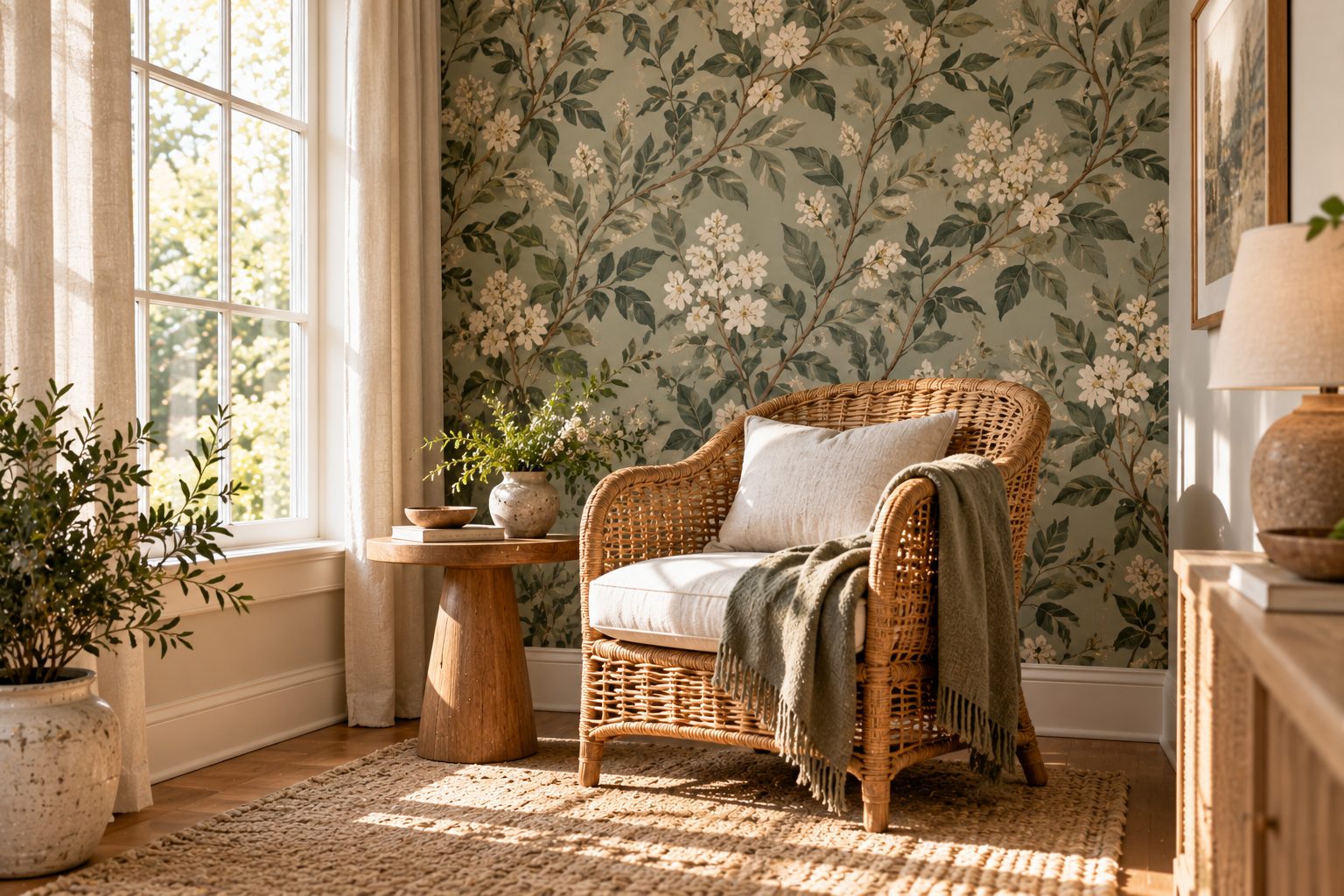
| Living room | Large botanical, painterly abstract | Non-woven, washable | 12–16 × 8–9 ft (3.7–4.9 × 2.4–2.7 m) | $300–1,300 |
| Kids' room or playroom | Map, forest, sky, simple animals | Peel-and-stick or scrubbable vinyl | 8–12 × 8 ft (2.4–3.7 × 2.4 m) | $200–950 |
| Powder room | Dense jungle or dark floral | Vinyl-coated non-woven | 3–4 walls, 20–28 linear ft (6–8.5 m) | $350–1,500 |
| Hallway or stair | Horizontal landscape, ombre | Type II vinyl | 12–30 ft (3.7–9 m) runs | $300–2,000 |
Costs are typical US 2026 ranges for printed material only; professional hanging usually adds $2–6 per sq ft, more for scenic panels that must align across corners.
Are landscape mural wallpaper and scenic wallpaper still in style?
Yes, landscape mural wallpaper and scenic wallpaper are firmly in style for 2027, with soft painterly mountains, lakes and gardens replacing the high-contrast photo forests of the late 2010s.
The current version is quieter. Expect hazy, low-saturation landscapes in sage, mist blue, ochre and clay, usually with a matte finish that looks closer to a painted plaster wall than a photograph. A landscape wall mural behind a bed works best when the horizon sits at or slightly below seated eye level, roughly 36–48 in (91–122 cm) from the floor, so the image reads as a view when you sit up. In a dining room, keep the horizon around 42–50 in (107–127 cm) so it rises just above the chair backs.
#A9B39A#9FB2BE#C99A5B#B5735A#E6DED0These are approximate screen references for the muted landscape palette we see most often in 2027 scenic wallpaper murals. Pull one of them into the trim or ceiling color and the mural looks designed for the room rather than stuck on it. Our 2027 color palettes page has full schemes built around similar tones.
What is the best wallpaper for kids and playrooms?
The best wallpaper for kids is a washable or scrubbable mural in a simple, low-detail design, ideally peel-and-stick so it can change as the child grows.
Children outgrow themes fast. A cartoon-heavy child wallpaper that delights a four-year-old embarrasses a nine-year-old, so we steer clients toward images with a longer life: a soft world map, a forest at dusk, hot-air balloons over hills, a watercolor sky. Kids peel and stick wallpaper is the easy answer for renters and for anyone who expects to redecorate within three to five years. Look for a scrubbable rating, low-VOC inks and a matte surface that does not show greasy fingerprints.
Playroom wallpaper that survives
For playroom wallpaper, run the mural from the ceiling down to a chair rail or wainscot at 32–36 in (81–91 cm), and paint the lower wall in a scrubbable eggshell or satin. That keeps the image above the zone of crayons and toy trucks. If you want the mural to the floor, choose Type II vinyl at 13–22 oz per sq yd, the commercial grade used in hotel corridors. Our wainscoting ideas show how to finish that lower band.
Kids bathroom wallpaper
Kids bathroom wallpaper should be vinyl or vinyl-coated, kept out of direct splash zones and paired with an extractor fan. Fish, waves and simple botanicals hold up well. Keep it above the tub surround or tile line, and never wrap it into the shower itself.
How do you size and order large wall murals?
To size large wall murals, measure the widest and tallest points of the wall, add 2–4 in (5–10 cm) of bleed on every side and order the mural printed to that size.
- Measure at three heights and three widths. Walls are rarely square; use the largest figure of each.
- Add bleed. Add 2–4 in (5–10 cm) to each side, more on old houses with wavy ceilings.
- Mark obstacles. Note windows, doors, outlets and radiators, and where they fall on the image, so no face or focal point ends up behind a headboard or switch.
- Choose the crop. Most custom printers let you slide the image; place the focal point slightly off center and above furniture.
- Check resolution. For your own photograph, aim for 100–150 dpi at the final print size; a 12 ft (3.7 m) wide wall needs an image roughly 14,000–21,000 pixels wide.
- Order a sample. A printed sample shows true color and texture; screens rarely match ink on paper.
- Order everything at once. Reprints from a different batch can shift color.
For huge wall murals that wrap a staircase or open-plan wall above 16 ft (4.9 m) long, ask the printer for a panel layout drawing before production so you can check where seams land against windows and corners. For plain-roll quantities on the remaining walls, our wallpaper calculator works it out from your room size, and our how much wallpaper do I need guide explains repeats.
Should you choose a printed mural or hand-painted wall mural art?
Choose a printed mural for a precise image at a predictable price, and hand-painted wall mural art when you want a one-off piece, texture and the option to adapt the design on the wall.
A hand-painted mural design on wall surfaces typically costs $15–50+ per sq ft depending on detail, so a simple painted landscape on a 10 × 8 ft (3 × 2.4 m) wall might run $1,200–4,000, while a detailed figurative piece can cost far more. The benefits are real: no seams, no peeling corners, and an artist can work around an awkward window. The drawbacks are cost, a week or more of disruption and the fact that it is not removable without repainting. For most wall murals for home use, a well-printed non-woven mural gives 80 percent of the effect for a fraction of the price. Simple geometric murals, such as arches, color-block hills or sunset bands, are an easy DIY painted alternative; our accent wall ideas include several.
How do you hang mural wallpaper without misaligned panels?
Hang mural wallpaper by snapping a plumb line for the first panel, laying the numbered panels out in order and matching each one to the last at eye level before smoothing out.
Prime the wall with a wallpaper primer so the mural can slide during positioning and strip off later. Most non-woven wall mural wallpaper is paste-the-wall: roll adhesive onto the wall one panel width at a time, then hang the dry panel. Start with panel one at the left unless the instructions say otherwise, and let the bleed overlap the ceiling and baseboard. Match the image at eye height first, smooth outward with a plastic smoother, then trim top and bottom with a sharp blade and a wide knife. Change blades every few cuts. A ragged edge is the main giveaway of a DIY mural.
Mistakes we see with wall murals
The mistakes we see most are murals that are too busy for the room, focal points hidden by furniture and images printed from low-resolution files.
- Too much detail in a small room. A dense jungle in a 10 × 10 ft (3 × 3 m) bedroom feels crowded; choose a sky or soft landscape instead.
- The focal point behind the sofa. Plan the crop with furniture in place, using painter's tape to mark sofa and headboard heights.
- Murals on every wall. One mural wall per room is almost always enough outside dining rooms designed for scenic panels.
- Pixelated photos. A phone picture enlarged to 10 ft (3 m) wide looks soft and blotchy up close.
- No sample. Colors on screen are brighter than ink on matte paper.
How we would do it: one matte landscape or botanical mural on the wall you face most, a ceiling and trim color pulled from the image, and plain painted walls elsewhere. That is the most considered way to use wall murals in 2027. Ready to work out panel sizes and roll counts for the rest of the room? Use our wallpaper calculator before you order.
Free toolTile CalculatorWork out tiles, boxes, grout and adhesive with the right wastage.Shop & source the look
Buy it today — or have it made
Retail links are affiliate links: we may earn a commission at no extra cost to you (disclosure). “Get it made” sends the item to our sourcing desk for factory quotes in custom sizes and finishes.
Frequently asked questions
How much does a wall mural cost?
A printed wall mural typically costs $3–10 per sq ft in material, so a 12 × 8 ft (3.7 × 2.4 m) wall is roughly $300–960. Professional hanging adds about $2–6 per sq ft. Hand-painted murals typically cost $15–50 or more per sq ft, depending on the detail, the artist and access.
Are wall murals still in style for 2027?
Yes, wall murals are in style for 2027, especially soft painterly landscapes, scenic gardens and large botanicals in muted colors. High-contrast photo murals, such as sharp forests and city skylines, look dated. The current approach is one matte mural on a single focal wall with coordinated plain walls around it.
Can you put a wall mural in a rental?
Yes, peel-and-stick wall murals are designed for rentals and usually remove cleanly within three to five years from a sound, painted wall. Test a corner first on fresh or flat paint, which can lift. Non-woven paste-the-wall murals also strip dry in whole panels when the wall was primed before hanging.
How do I measure a wall for a mural?
Measure the wall's width and height at three points each and use the largest figures. Add 2–4 in (5–10 cm) of bleed on every side for trimming, and note windows, doors and outlets. Give the printer those final dimensions and check a layout preview to see where seams and focal points fall.
What is the best mural wallpaper for a kids' room?
The best mural wallpaper for a kids' room is a washable, low-VOC peel-and-stick or scrubbable vinyl mural with a simple, long-lasting image such as a map, sky or forest. Run it above a painted lower wall or wainscot at 32–36 in (81–91 cm) so the busiest wear zone stays easy to repaint.
Some links may be affiliate links. Regulations and specifications change — always confirm with suppliers and qualified professionals.