Bathroom Wallpaper Ideas: 12 Looks That Survive Steam and Splash
Bathroom wallpaper ideas work when the paper is vinyl or vinyl-coated, the room vents at 50 CFM or more and the paper stays out of the shower. Here are 12 looks, from fun powder room prints to calm small-bath textures.
Part of our guide: Wallpaper Trends 2027: Patterns, Types, Costs and Where to Use It
Key takeaways
- Choose solid vinyl or vinyl-coated non-woven paper for full bathrooms; any paper works in a well-vented powder room
- Ventilation decides how long bathroom wallpaper lasts: plan at least 50 CFM intermittent extraction and run it 20 minutes after showers
- Keep paper out of the shower and tub surround and 6–12 in (15–30 cm) clear of sink splash, or protect that zone with tile
- Small bathrooms can take bold, large-scale prints; a typical 5 × 8 ft (1.5 × 2.4 m) bath needs only 3–5 double rolls
The best bathroom wallpaper ideas use solid vinyl or vinyl-coated non-woven paper, stay out of the shower and tub surround and rely on a fan of at least 50 CFM. Follow those three rules and almost any pattern works: bold botanicals in a powder room, a soft stripe in a small bath, a fun print behind the vanity.
Bathrooms are where wallpaper gets its most daring use. Our wallpaper trends 2027 report shows that clearly: small rooms with a closed door are where homeowners try the pattern they would not risk in a living room. This guide covers which wallpaper for bathroom walls survives, 12 looks we would specify and how to hang it.
- Material: solid vinyl or vinyl-coated non-woven for full baths; paper, grasscloth and fabric only in powder rooms.
- Ventilation: at least 50 CFM intermittent or 20 CFM continuous, the common US code minimum.
- Splash zone: keep paper 6–12 in (15–30 cm) above sinks, or tile that strip.
- Typical cost: $1–8 per sq ft for bathroom-suitable vinyl papers.
- Typical quantity: 3–5 US double rolls for a 5 × 8 ft (1.5 × 2.4 m) bathroom.
Can you put wallpaper in a bathroom?
Yes, you can put wallpaper in a bathroom as long as you choose a moisture-tolerant paper, use a mildew-resistant paste and ventilate the room so steam clears within about 20 minutes.
The damage in a wallpaper bathroom rarely comes from the occasional splash. It comes from steam sitting on the walls every day until the seams lift and mold grows under the paper. That is why the fan matters as much as the paper. Most US codes call for at least 50 CFM intermittent or 20 CFM continuous extraction in a bathroom; for a full bath with a shower we specify 80–110 CFM with a humidity sensor so it runs on its own.
Powder rooms are the easy case. With no shower, any bathroom wall paper works: fragile grasscloth, hand-printed papers, even fabric. Family bathrooms with daily showers are the demanding case, and that is where solid vinyl earns its place.
Check the existing fan before you choose a paper. Hold a single sheet of toilet tissue under the grille with the fan on: if it does not hold the tissue against the cover, the fan is underperforming or the duct is blocked. Replacement fans at 80–110 CFM and 1.0 sone or quieter typically cost $80–300 plus installation, which is cheap insurance against peeling seams and a full re-paper. A window helps, but most people do not open it in winter, so it should never be the only ventilation in a room with a shower.
What is the best wallpaper for bathroom walls?
The best wallpaper for bathroom walls is solid vinyl or vinyl-coated non-woven, because both resist moisture and can be wiped, while uncoated paper, grasscloth and fabric absorb steam.
| Wallpaper type | Moisture tolerance | Typical cost (US 2026) | Powder room | Full bath with shower |
|---|---|---|---|---|
| Solid vinyl | High; scrubbable | $1–5 per sq ft | Yes | Yes, best choice |
| Vinyl-coated non-woven | Good; washable | $1.50–6 per sq ft | Yes | Yes, with good ventilation |
| Peel-and-stick vinyl | Good face, weaker adhesive in steam | $1.50–5 per sq ft | Yes | Powder rooms and half baths only |
| Uncoated paper or non-woven | Low | $2–10 per sq ft | Yes | No |
| Grasscloth and natural fibers | Very low; stains | $3–12 per sq ft | Yes, away from sink | No |
Costs are typical retail material ranges. Hanging in a bathroom is slower than in a bedroom because of cut-outs around fixtures, so expect $3–6 per sq ft for a professional.
12 bathroom wallpaper decorating ideas we would use
The 12 bathroom wallpaper decorating ideas below are the ones we actually specify, grouped by the kind of room they suit, from small family baths to show-off powder rooms.
For powder rooms and half baths
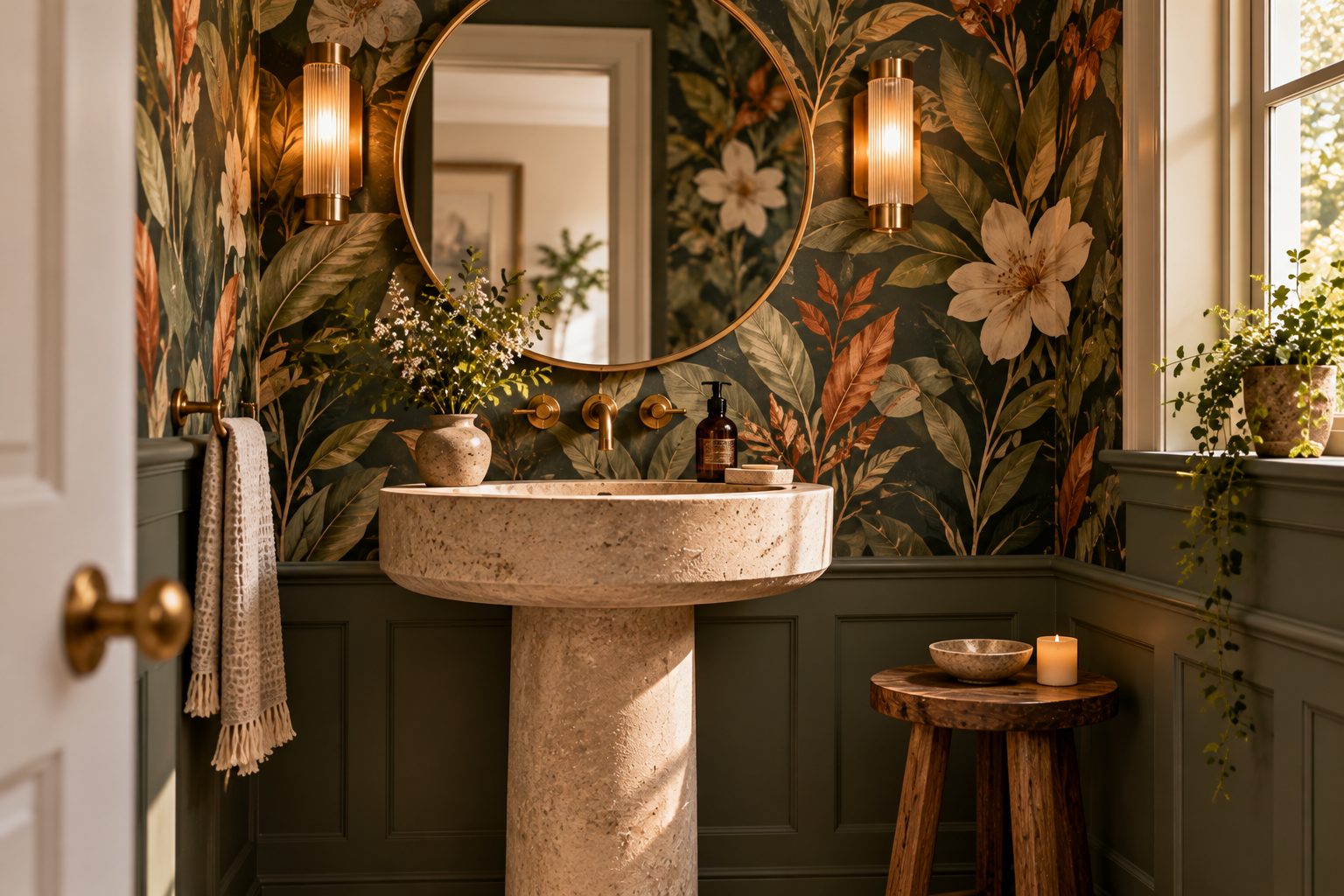
- Dark botanical on all four walls. Deep green or ink-blue leaves, scale 12–24 in (30–61 cm), with brass fittings.
- Scenic mural. A landscape wrapping the room; see our wall mural ideas for sizing.
- Fun bathroom wallpaper. Animals, fruit or illustrated scenes; a powder room is the one room where wit belongs.
- Ceiling paper. A small geometric on the ceiling with plain painted walls, ideal over an 8 ft (2.4 m) half bath.
For small bathrooms
- Soft vertical stripe. Stripes 1–3 in (2.5–7.5 cm) wide make a low room feel taller.
- Large-scale, low-contrast floral. Big motifs in two close tones blur the corners.
- Above-tile band. Tile to 48 in (122 cm), wallpaper above; the classic wallpaper for small bathrooms with a tub.
- Vinyl grasscloth look. Texture without the stain risk; pairs with wood vanities. See textured wallpaper.
For full and primary bathrooms
- Feature wall behind the vanity. One papered wall, the rest tiled or painted.
- Toile or line drawing. Two-tone prints in blue, green or terracotta on cream look calm and age well.
- Checks and plaids. Small-scale, soft-colored checks are the 2027 cottage note.
- Wallpaper plus wainscot. Paneling or beadboard to 36–42 in (91–107 cm), paper above; see our wainscoting ideas.
Which wallpaper design ideas for bathrooms suit 2027?
The wallpaper design ideas for bathrooms that suit 2027 are muted botanicals, painterly scenics, soft checks and stripes and earthy two-tone prints, with fewer high-gloss metallics and black-and-white geometrics.
#5C6B4F#2F3E4E#B76E4C#D9C9A8#8B5A6BThese are approximate screen references for the colors we see most in 2027 bathroom papers. Earthy greens and terracotta work with warm brass and wood; ink blue and plum suit chrome or nickel. Pull one color from the paper into the vanity, the grout or the towels. If you are still choosing the wall color around the paper, see our bathroom paint colors guide.
How much wallpaper does a small bathroom need?
A typical small bathroom of 5 × 8 ft (1.5 × 2.4 m) with an 8 ft (2.4 m) ceiling needs 3–5 US double rolls, depending on tile height and the pattern repeat.
The perimeter of that room is 26 ft (7.9 m), giving about 208 sq ft (19.3 m²) of wall. Subtract a door at about 20 sq ft and any tiled area: if the tub wall is fully tiled, the papered area falls to roughly 120–150 sq ft. A US double roll covers about 56 sq ft (5.2 m²), but after trimming and pattern matching you can realistically use 40–48 sq ft from each one. A wallpaper calculator does these sums for you, including the repeat, so you can order every roll from one batch.
How do you hang wallpaper in a bathroom?
Hang bathroom wallpaper on a primed, dry wall with a mildew-resistant paste, then caulk the edges at tile and fixtures so water cannot creep behind the seams.
- Fix the fan first. Confirm it vents outside, not into the attic, and that it clears steam within 20 minutes.
- Clean and prime. Wash walls, kill any mold with a diluted bleach solution, let dry and apply a mold-resistant wallpaper primer.
- Remove what you can. Take off the mirror, towel bars and switch plates rather than cutting around them.
- Use the right paste. A clear premixed paste with fungicide for vinyl and non-woven; follow the paper label.
- Start at the least visible corner. Usually behind the door, where the last mismatched seam will land.
- Seal the edges. Run a fine bead of clear or paintable silicone where paper meets tile, tub or vanity.
- Wait before showering. Give paste 48–72 hours to cure before steam hits it.
Do the same rules work for kitchen wallpaper and bedroom wallpaper?
Kitchen wallpaper follows the bathroom rules, washable vinyl and no paper behind the cooktop or sink, while wallpaper for bedrooms can be any material, so it is the place for natural fibers and delicate prints.
The best kitchen wallpaper ideas use the paper on a breakfast nook wall, above open shelves or on the ceiling, rather than as a backsplash. Keep it at least 12 in (30 cm) from a cooktop and use tile or glass behind it. Kitchen peel and stick wallpaper is useful for renters and inside glass-fronted cabinets; the steam and grease near a range defeat most peel-and-stick adhesives. Kitchen furniture wallpaper, used to line shelves or wrap old cabinet backs, works well with vinyl peel-and-stick. Our peel and stick wallpaper guide covers adhesives and removal.
Bedroom wallpaper ideas are freer. Wallpaper for an accent wall in a bedroom usually goes behind the headboard, where a large floral, scenic or grasscloth frames the bed. Bedroom decorating ideas with wallpaper also include papering the ceiling over the bed or all four walls in a small guest room. Any room wallpaper choice is easier once you know the room's light and use: soft, matte papers for bedrooms, washable ones for kitchens and baths.
As for where to buy wallpaper, home improvement stores stock basic vinyls, specialist wallpaper shops and online design studios sell designer and custom prints, and trade-only showrooms carry hospitality-rated wallcoverings. Order a sample from any of them first, check the material is vinyl or vinyl-coated for a bathroom, and buy all rolls from the same batch.
Mistakes we see with bathroom wallpaper
The mistakes we see most are papering a poorly ventilated full bath, using peel-and-stick in a steamy shower room and letting paper touch water at the edges of tubs and sinks.
- No working fan. Every failed bathroom wallpaper job we have inspected had weak or no ventilation.
- Peel-and-stick next to a shower. Steam softens the adhesive and corners curl within months.
- Paper to the tub edge. Tile or a painted band should take the first 6–12 in (15–30 cm) of splash.
- Grasscloth near the sink. One splash leaves a permanent water ring.
- Timid pattern in a tiny room. Small baths can take big, bold patterns; tiny prints often look busy.
- Skipping the primer. Paper pasted straight onto bare drywall bonds to the face paper and tears it off when you strip it later.
- Mismatched batches. Two batches side by side show a shade shift you will notice every morning at the mirror.
How we would do it: a powder room gets a bold botanical or scenic on all four walls; a family bath gets tile to 48 in (122 cm) and a washable vinyl stripe or soft floral above, with a humidity-sensing fan. That approach makes bathroom wallpaper ideas last for a decade rather than a season. Measure your bathroom and get exact roll counts with our wallpaper calculator before you order.
Free toolTile CalculatorWork out tiles, boxes, grout and adhesive with the right wastage.Shop & source the look
Buy it today — or have it made
Retail links are affiliate links: we may earn a commission at no extra cost to you (disclosure). “Get it made” sends the item to our sourcing desk for factory quotes in custom sizes and finishes.
Frequently asked questions
Is it a good idea to wallpaper a bathroom?
Yes, wallpapering a bathroom is a good idea if you choose solid vinyl or vinyl-coated paper, use mildew-resistant paste and have a fan of at least 50 CFM that clears steam within about 20 minutes. Powder rooms without showers can take any wallpaper, including grasscloth and delicate printed papers.
What kind of wallpaper is best for a bathroom?
Solid vinyl wallpaper is best for a full bathroom with a shower because it resists moisture and can be scrubbed. Vinyl-coated non-woven papers are a good second choice with strong ventilation. Uncoated paper, grasscloth and fabric belong only in powder rooms or half baths without showers.
Can you use peel and stick wallpaper in a bathroom?
Yes, but only in powder rooms and half baths, or well-ventilated bathrooms away from the shower. Steam softens peel-and-stick adhesive, so corners and seams lift in rooms with daily showers. In a full bath, choose paste-applied vinyl wallpaper and seal edges at tile and tub with clear silicone.
Does wallpaper make a small bathroom look bigger?
Wallpaper can make a small bathroom look bigger when it uses vertical stripes, large-scale low-contrast patterns or soft scenic images that blur the corners. Tiny, high-contrast prints tend to make walls feel busy and closer. Papering the ceiling with the same design also makes a small room feel taller and more unified.
How do you protect wallpaper in a bathroom?
Protect bathroom wallpaper by running a fan of at least 50 CFM during and for 20 minutes after every shower, sealing edges at tile, tub and vanity with clear silicone, and keeping paper 6–12 in (15–30 cm) clear of sink splash. Wipe splashes promptly and choose solid vinyl for any wall the shower steam reaches.
Some links may be affiliate links. Regulations and specifications change — always confirm with suppliers and qualified professionals.