Window Treatment Ideas: 18 Options With Sizes, Costs and Fabrics
The best window treatment ideas pair one light-control layer with one soft layer: a shade inside the frame and drapery hung 4–6 in above it. Here are 18 options with sizes, fabrics and typical 2026 costs.
Part of our guide: Curtain Size Guide: Length, Width, Fullness and Rod Height Explained
Key takeaways
- Most rooms need two layers: a shade or blind for privacy and light, and drapery for softness, insulation and height
- Hang drapery rods 4–6 in (10–15 cm) above the frame and extend them 8–12 in (20–30 cm) past each side so panels stack off the glass
- Specify drapery at 2–2.5 times the rod width in fullness; anything under 1.8x looks thin and cheap
- Woven wood shades, ripplefold linen and inside-mount Roman shades are the window treatments that look most current going into 2027
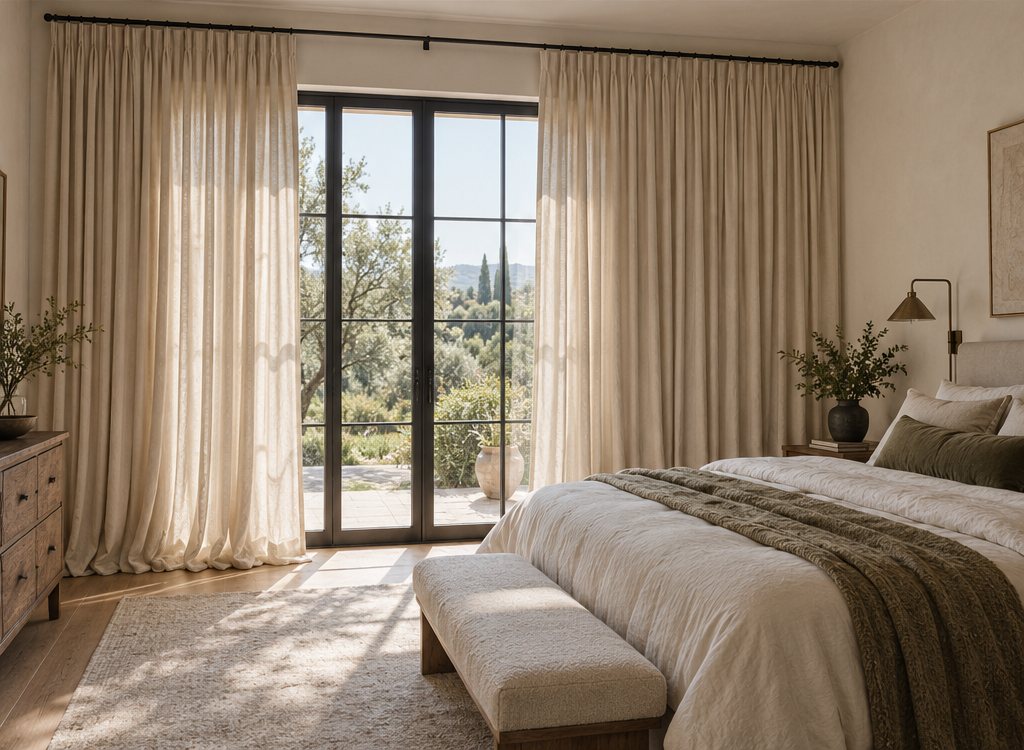
The best window treatment ideas combine a working layer and a decorative layer: an inside-mount shade or blind for privacy and light control, and full-length drapery hung 4–6 in (10–15 cm) above the frame for height, softness and insulation. Budget roughly $150–600 per window for ready-made pieces and $600–2,500 for custom, lined drapery and shades.
- Two layers: shade or blind for function, drapery or curtains for decoration, in almost every living room and bedroom.
- Height: rod 4–6 in (10–15 cm) above the frame, or halfway to the ceiling on low windows.
- Width: rod 8–12 in (20–30 cm) beyond the frame each side so open panels stack off the glass.
- Fullness: 2–2.5 times the rod width in fabric for pleated or ripplefold drapery.
- Length: floor-skimming at 1/2 in (12 mm) off the floor; puddling only in formal, low-traffic rooms.
Measuring is the step most people skip, and it is the step that makes or breaks every idea on this page. Our curtain size guide covers standard panel lengths and widths in depth; this article is about choosing what to hang, layering it and spending in the right place.
What are the main window treatment options?
The main window treatment options are drapery and curtains, fabric shades, hard blinds, shutters, woven natural shades and window film, and each solves a different mix of privacy, light, insulation and style.
Window treatments split into soft and hard. Soft treatments (curtains, draperies, Roman shades) add texture and absorb sound; hard treatments (blinds, shutters, cellular shades) control light precisely and survive humidity better. The table compares the window treatment options we specify most often.
| Treatment | Best for | Light control | Insulation | Typical cost per window (2026, US) |
|---|---|---|---|---|
| Lined drapery panels | Living rooms, bedrooms | Medium; high with blackout lining | Good with interlining | $150–400 ready-made; $600–2,000 custom |
| Flat or relaxed Roman shade | Kitchens, bedrooms, bay windows | Medium to high | Moderate | $200–450 ready-made; $450–1,200 custom |
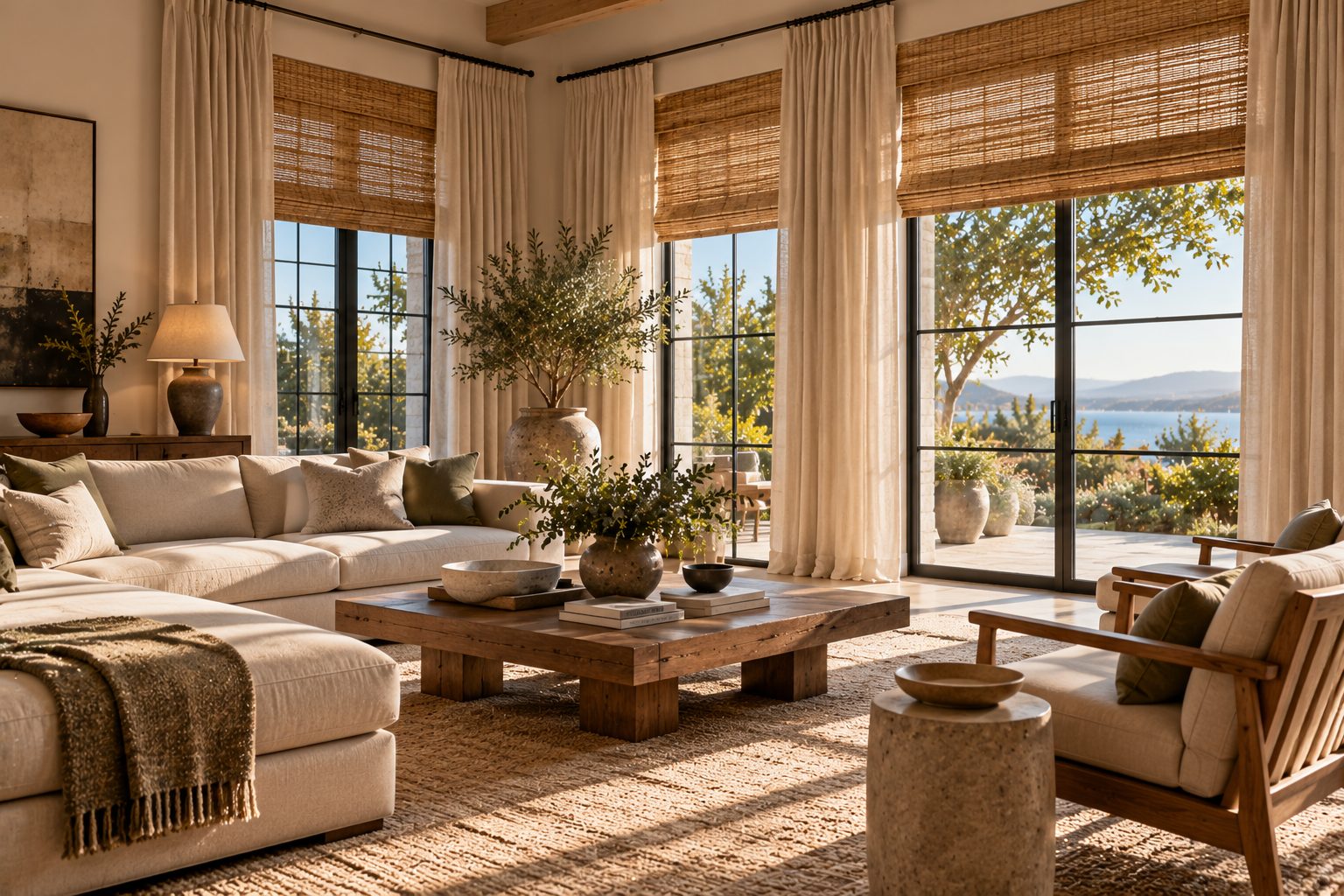
| Woven wood or jute shade | Living rooms, sunrooms | Low; medium with liner | Low | $120–350 ready-made; $350–900 custom |
| Cellular (honeycomb) shade | Bedrooms, cold climates | High; top-down options | Best of any shade | $80–250 ready-made; $250–600 custom |
| Wood or composite shutters | Street-facing rooms, bathrooms | High, adjustable louvers | Good | $300–900 installed |
| Solar roller shade | Offices, sunny glazing | Glare only; 3–10% openness | Low | $100–300 ready-made; $300–700 custom |
| Frosted or decorative film | Bathrooms, sidelights | Privacy, not darkness | None to slight | $5–15 per sq ft installed |
Price bands are typical US ranges for a 36 × 60 in (91 × 152 cm) window and rise steeply for motorization, oversize glazing and specialty fabrics.
What are the best window treatment ideas for the living room?
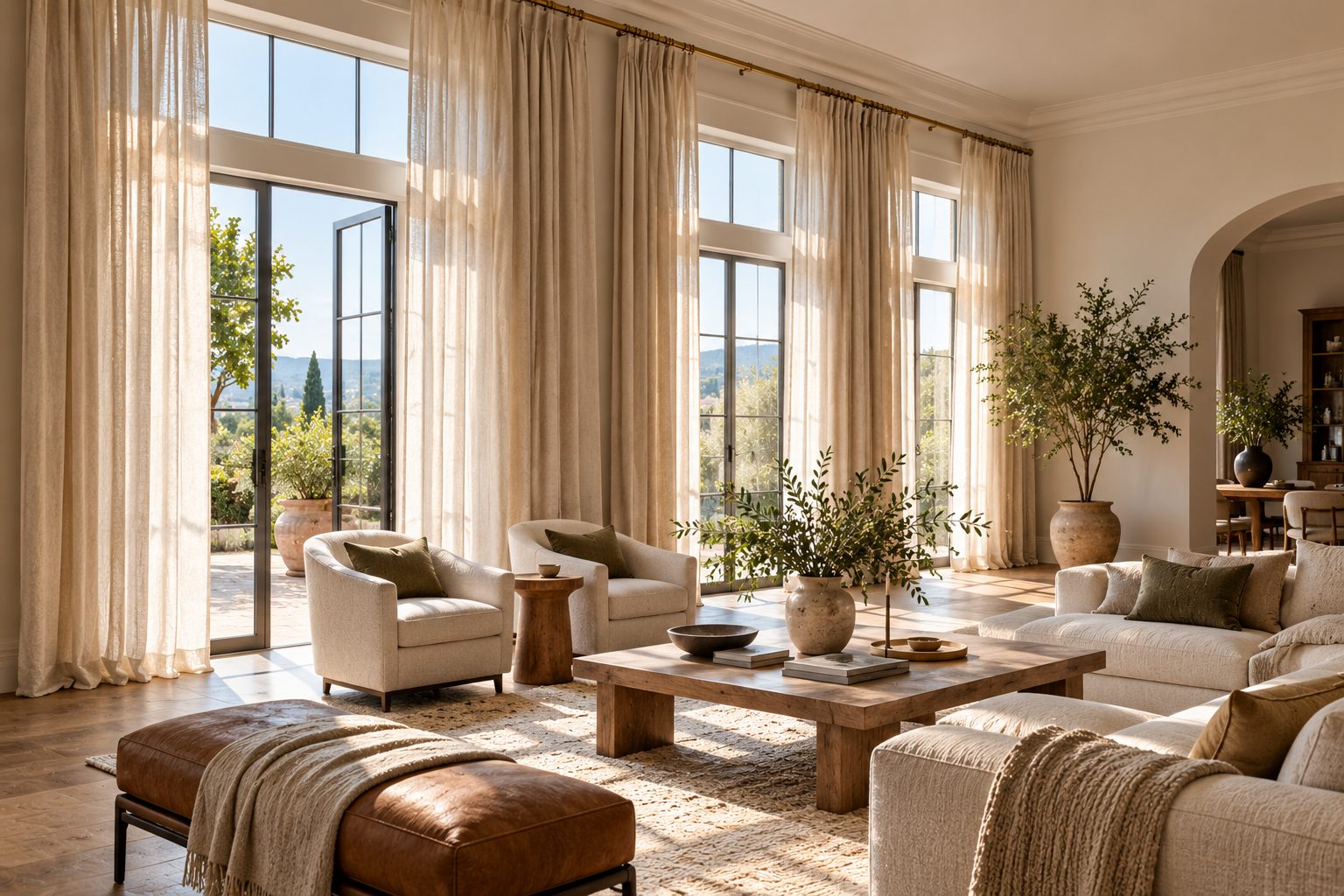
The best window treatment ideas for the living room are lined full-length drapery over a woven or flat Roman shade, because the pair gives daytime glare control and an evening layer that warms the room.
Living room window treatments get the most visual attention in the house, so this is where fullness and length matter most. Hang the rod close to the ceiling on windows under 7 ft (213 cm) tall to make the room feel taller. On wide picture windows, use three or four panels rather than two oversize ones so each panel stacks neatly. Our living room curtain ideas article goes further into fabric weights and colors for this room.
1. Ripplefold drapery on a slim track
Ripplefold gives even, soft S-shaped waves and is the most modern window treatment for large glazing. It runs on a ceiling or wall-mounted track, slides easily and stacks tightly, about 15–20 percent of the track width when open.
2. Pinch-pleat linen with a woven shade underneath
The classic two-layer approach: a double or triple pinch pleat at 2.5x fullness, with a natural woven shade inside the frame. It reads warm and tailored without looking formal.
3. Floor-to-ceiling sheers
A wall of unlined sheers at 2.5–3x fullness blurs mismatched windows and an awkward radiator. Add blackout shades behind only if you watch television in daylight.
4. Café curtains on the lower half
Café curtains on a tension or slim rod cover the lower half of a street-facing window, keep privacy and leave the top open for light. They work well in older homes and kitchens.
For more on how the living room is changing, see our living room trends 2027 report.
Which window shade ideas suit kitchens, bedrooms and bathrooms?
Kitchens and bathrooms suit wipeable, moisture-tolerant shades such as flat Romans in performance fabric, faux-wood blinds and frosted film, while bedrooms need blackout capability first and decoration second.
- Kitchen: a flat Roman shade above the sink in polyester-blend fabric that tolerates steam, or a woven shade where there is no grease nearby. Keep fabric 6 in (15 cm) clear of any cooktop.
- Bedroom: blackout-lined drapery plus a room-darkening cellular or Roman shade inside the frame. Light leaks at the sides, so overlap outside-mount shades by 2–3 in (5–8 cm) each side.
- Bathroom: composite shutters, faux-wood blinds or frosted film. Natural wood, silk and untreated linen warp, spot or mildew in a room over 60 percent humidity.
- Nursery and media room: blackout roller shade in side channels, with drapery over it for softness.
- Sunroom: solar shades with 3–5 percent openness cut glare while keeping the view; see our sunroom ideas for glazing-heavy rooms.
What are the trendy and latest window treatments for 2027?
The trendy window treatments heading into 2027 are textured natural fibers, softly relaxed Roman shades, ripplefold linen in warm earth tones and slim bronze or brass hardware, replacing gray blackout panels and grommet tops.
The latest window treatments move with the wider shift to warm, tactile rooms. Linen and linen-cotton blends at 250–320 gsm hang heavier and wrinkle less than pure lightweight linen. Woven jute, bamboo and paper-yarn shades bring texture without pattern. Interior design window treatments now favor tone-on-tone color: drapery a shade or two off the wall rather than a contrast.
#D8CBB3#B59A78#8C6E54#7A806A#E9E3D6These are approximate screen references; always order fabric cuttings and view them at the window in morning and evening light. What is fading: grommet-top panels, crushed velvet, heavy swags with jabots, and cool gray blackout curtains that look like a hotel corridor.
What are some unique and decorative window treatment ideas?
Unique window treatment ideas use pattern, trim and unexpected placement, such as banded leading edges, pelmets, painted shutters or a single drapery panel tied back on one side, while keeping the hardware simple.
Decorative window treatments earn their cost when the room is otherwise quiet. These are the window dressing ideas we come back to:
- Contrast banding: a 2–4 in (5–10 cm) band of solid fabric down the leading edge of a plain drapery panel.
- Upholstered pelmet or cornice: a padded box 10–14 in (25–36 cm) deep that hides hardware and squares up an awkward window.
- Tape trim on Roman shades: a grosgrain or woven tape inset 1–2 in (2.5–5 cm) from the edges, one of the easiest decorative window coverings ideas to commission.
- Painted shutters: café or full-height shutters in a deep color, matching the trim.
- Single panel, asymmetric: one wide panel pulled to one side on a narrow window next to a wall.
- Printed shade, plain drapery: put the pattern on the smaller Roman shade and keep the larger drapery solid.
Curtains vs draperies vs shades: which do you need?
Choose curtains for casual, unlined looks at lower cost, draperies for lined, pleated, made-to-measure panels, and shades when the window is behind a sink, a sofa or a radiator, or when stack-back space is tight.
In everyday speech the words overlap, but in the trade they mean different products. Curtains are usually ready-made, lighter and hung from rings, tabs or a rod pocket. Draperies window treatments are lined, often interlined, pleated and made to the exact drop. Shades raise and lower within or above the frame and take no wall space when open. When planning curtains and window treatments ideas for one room, keep the drapery and shade in the same color family and vary only the texture.
How to choose and measure window treatments, step by step
Choose window treatments by deciding the job first (privacy, darkness, glare or decoration), then the mount, then the fabric, and only measure once those decisions are fixed.
- Define the job. Blackout for bedrooms, glare for screens, privacy for the street, softness for living spaces.
- Check frame depth. Inside-mount shades need at least 3/4–2 in (19–51 mm) of flat frame depth depending on the system; otherwise mount outside.
- Measure three widths and three heights. For inside mounts use the smallest; for outside mounts add 2–3 in (5–8 cm) each side.
- Set the rod position. 4–6 in (10–15 cm) above the frame or within 1–2 in (2.5–5 cm) of the ceiling, extended 8–12 in (20–30 cm) per side.
- Calculate fabric fullness. Rod width × 2–2.5 for pleated drapery, × 2.2 for ripplefold, × 2.5–3 for sheers.
- Finish the length. Measure rod to floor and deduct 1/2 in (12 mm) for a floor-skimming hem.
- Order samples and hardware first. Hang a cutting for two days before ordering panels.
Our step-by-step how to hang curtains guide covers bracket spacing and anchors once the order arrives.
Mistakes we see with window treatments
The mistakes we see most are rods mounted tight to the frame, panels that are too narrow to close, curtains that stop above the floor and expensive fabric hung on flimsy hardware.
Narrow panels are the most common failure: two standard 50 in (127 cm) panels on a 72 in (183 cm) rod look stretched, not full. A rod mounted on the frame shrinks the window and blocks daylight when panels are open. Floor-to-sill curtains on a tall window make the room feel unfinished, and "high-water" panels an inch above the floor look like a mistake. We also see unlined linen fade and rot on south-facing windows inside three or four summers; a cotton sateen lining costs little and doubles the life of the face fabric. Finally, buy hardware rated for the weight. Lined and interlined drapery can weigh 4–8 lb (2–4 kg) per panel, so place a center bracket on any rod over 60 in (152 cm).
Our verdict: how we'd dress a typical window
For a typical living room or bedroom window, we would hang lined ripplefold or pinch-pleat linen drapery at 2.2x fullness on a slim bronze rod near the ceiling, with a cordless flat Roman or woven shade inside the frame. That pairing handles light, privacy and insulation, and it looks right in modern, traditional and transitional rooms alike. Spend on lining and fullness before you spend on fabric price per yard: a mid-priced linen at proper fullness beats an expensive fabric hung skimpy every time. We would leave pattern for one small shade or a banded edge, not a wall of printed drapery.
Ready to work out panel widths and rod lengths for your windows? Plug your measurements into our free curtain size calculator to get fullness, panel count and finished length in seconds.
Free toolCurtain Size CalculatorRod length, panel size, ready-made match and yardage.Shop & source the look
Buy it today — or have it made
Retail links are affiliate links: we may earn a commission at no extra cost to you (disclosure). “Get it made” sends the item to our sourcing desk for factory quotes in custom sizes and finishes.
Frequently asked questions
What is the most popular window treatment?
Drapery panels over a shade or blind is the most popular window treatment combination in US homes. The shade handles privacy and light, and the drapery adds softness, insulation and visual height. On their own, cellular shades and faux-wood blinds remain the most common single treatments because they are affordable, durable and easy to operate.
Are window treatments going out of style?
Window treatments are not going out of style, but specific looks are. Grommet-top panels, heavy swags, crushed velvet and cool gray blackout curtains are fading. Natural woven shades, relaxed Roman shades and ripplefold linen in warm neutrals are replacing them as rooms move toward texture and warm earth tones for 2027.
How high should you hang curtains above a window?
Hang curtains 4–6 in (10–15 cm) above the window frame, or about halfway between the frame and the ceiling if the gap is larger. On low ceilings, mount the rod 1–2 in (2.5–5 cm) below the ceiling to make the room feel taller. Extend the rod 8–12 in (20–30 cm) past each side of the frame.
Should curtains touch the floor?
Yes, in most rooms curtains should skim the floor, with about 1/2 in (12 mm) of clearance so the hem does not drag or collect dust. A 1–2 in (2.5–5 cm) break gives a softer look in bedrooms. Puddling 4–6 in (10–15 cm) on the floor suits formal rooms only, never high-traffic spaces or homes with pets.
How much do custom window treatments cost?
Custom window treatments typically cost $450–1,200 per window for a lined Roman shade and $600–2,000 for a pair of lined, pleated drapery panels in 2026, including fabrication but not always installation. Motorization adds $300–800 per window, and specialty fabrics, interlining and oversize glazing push costs higher.
Some links may be affiliate links. Regulations and specifications change — always confirm with suppliers and qualified professionals.