Wallpaper Trends 2027: Patterns, Types, Costs and Where to Use It
Wallpaper trends 2027 center on large-scale florals, scenic murals, stripes, tone-on-tone grasscloth and papered ceilings. Compare 6 wallpaper types by cost, durability and best rooms, and learn where it works.
Part of our guide: Wall Treatments Guide: 14 Wall Finishes & Covering Ideas
Key takeaways
- Wallpaper is firmly in style for 2027, used more boldly than in the 2010s: whole rooms, ceilings and murals rather than one accent wall
- The leading patterns are large-scale botanicals, scenic murals, stripes and tone-on-tone textures such as grasscloth
- Non-woven paper is the best all-round choice; grasscloth needs dry rooms; vinyl suits baths and kitchens
- Peel and stick is worth it for renters and small walls, not for large or humid rooms
Wallpaper is in style for 2027, and it is being used more boldly than at any point in twenty years. The wallpaper trends for 2027 are large-scale florals and botanicals, scenic murals, stripes, tone-on-tone textures such as grasscloth, and papered ceilings. Expect to pay $40–150 per roll for good non-woven paper and $2–6 per sq ft for professional hanging.
It is October 2026 as we write, so we separate what is visible from what is forecast. Whole-room florals, grasscloth and murals are already everywhere in 2026 projects; papered ceilings and paper paired with painted molding are the direction we expect to grow through 2027. This article is part of our wall treatments guide, which compares paper with paint, plaster and paneling.
- Pattern direction: big scale, nature-led motifs, stripes and quiet woven textures.
- Placement: whole rooms, ceilings and small spaces such as powder rooms, rather than a single accent wall.
- Best all-round type: non-woven, paste-the-wall, strippable in one piece.
- Typical cost: $40–150 per roll for paper, $2–6 per sq ft for installation.
- Waste allowance: 10–15 percent for plain papers, 15–25 percent for large pattern repeats.
Is wallpaper in style for 2027?
Yes, wallpaper is in style for 2027, and the trend is toward using it across whole rooms and ceilings rather than on one feature wall. Two forces drive it. Non-woven papers have made hanging and removal far easier than the old pasted papers, and the wider move away from all-white and all-gray interiors has pushed people toward pattern and texture. Trendy wallpaper in 2027 is less about novelty prints and more about the kind of paper that looks like it could have been there for decades: botanicals, stripes, woven grass and hand-painted scenes.
The accent wall, the single papered wall behind a bed or sofa, is the part that looks dated. Papering all four walls, or the walls plus the ceiling, reads as deliberate. In a small room it is often more calming than one busy wall, because the pattern becomes the background rather than an interruption.
Color is shifting too. The cool grays and stark black-and-white graphics of the late 2010s are giving way to garden greens, faded terracotta, ochre, soft indigo and warm plaster grounds, the same earthy palette that runs through 2027 paint and textiles. Metallic inks and high-shine finishes are being used far more sparingly, usually as a fine highlight on a matte ground rather than an all-over sheen.
What wallpaper patterns are trending for 2027?
The wallpaper patterns 2027 is bringing forward are large-scale florals and botanicals, scenic murals, stripes, tone-on-tone textures and patterned ceilings, mostly in muted earth and garden colors.
Large-scale florals and botanicals
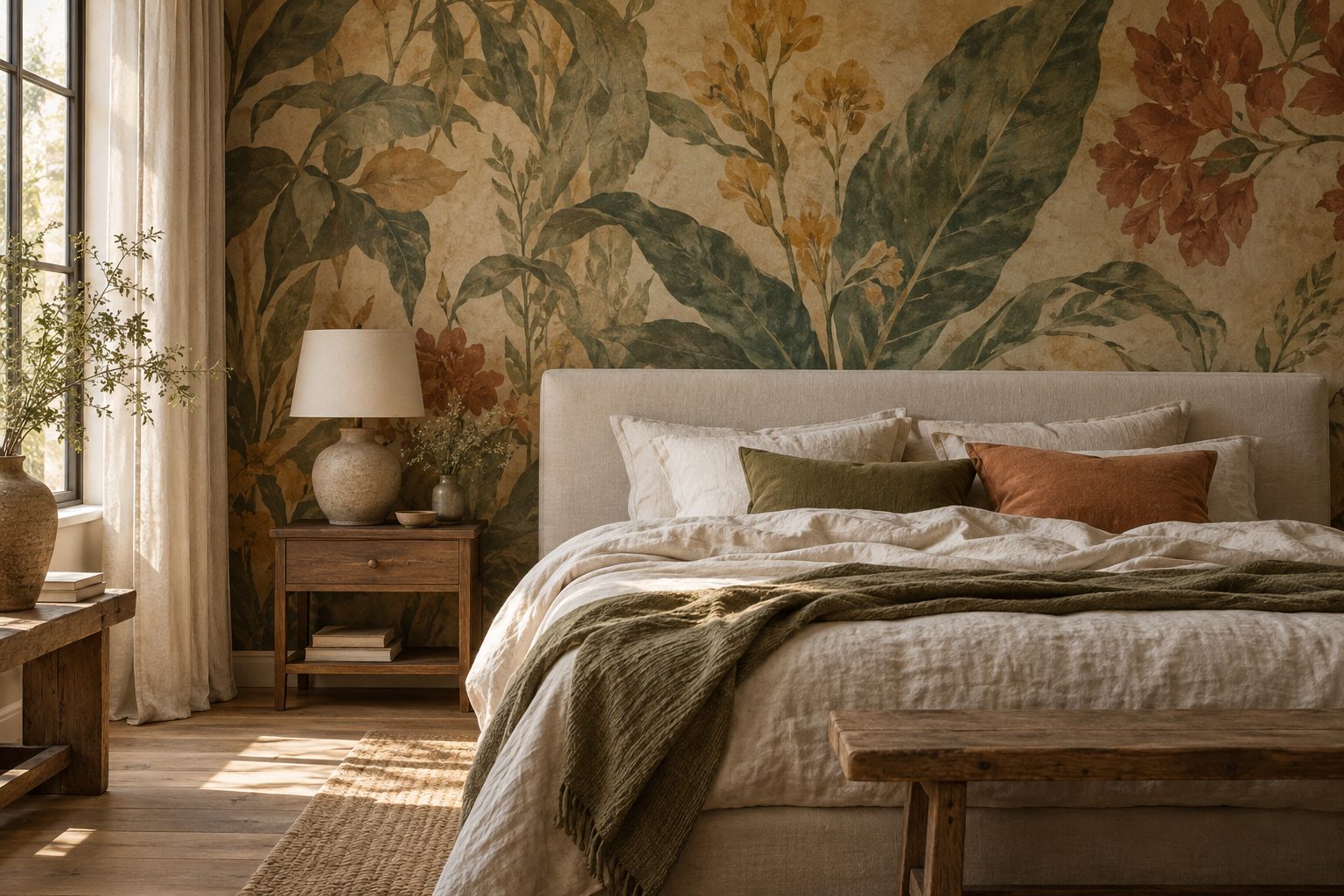
Oversized leaves, trailing vines and painterly flowers with repeats of 25–36 in (64–91 cm) or more. Big scale actually works better in small rooms because fewer motifs fit on the wall, so it feels less busy. Sage, olive, terracotta and faded indigo grounds lead.
Scale is the detail people get wrong most often. A motif that looks bold on a sample can disappear across a 12 ft (3.7 m) wall, while a small busy repeat can look like static. Tape a full drop, or at least a 3 ft (91 cm) length, to the wall and view it from the doorway before ordering.
Scenic murals
Mural wallpaper printed to the exact wall size: landscapes, misty forests, painted gardens and chinoiserie-style scenes. Murals suit dining rooms and the wall behind a bed, and they are typically sold per sq ft rather than per roll.
Stripes
Ticking, awning and fine pinstripes, often in two close tones. Vertical stripes add apparent height to an 8 ft (2.4 m) ceiling; horizontal stripes on a lower half-wall below a chair rail are a 2027 detail worth watching.
Tone-on-tone textures
Grasscloth wallpaper, linen-look and textured wallpaper in a single color, often matched to the trim. These add depth without pattern and suit offices, bedrooms and living rooms that need warmth but not busyness.
Papered ceilings
Ceiling wallpaper is the forecast part of the list. A small-scale pattern or a soft texture overhead works in powder rooms, dining rooms and bedrooms, especially where the walls are painted a matching color.
Which type of wallpaper should you choose?
Choose non-woven wallpaper for most rooms, vinyl for kitchens and bathrooms, grasscloth for dry living spaces and peel and stick only for small or temporary walls. The table compares the six main types.
| Type | Typical cost | Durability | Best rooms |
|---|---|---|---|
| Non-woven | $40–150 per roll (about 57 sq ft / 5.3 m²) | Good; breathable, strips dry in one piece | Living rooms, bedrooms, halls, dining rooms |
| Vinyl (solid or vinyl-coated) | $30–120 per roll | Very good; scrubbable, moisture tolerant | Kitchens, bathrooms, kids' rooms, rentals |
| Grasscloth and natural fiber | $80–300+ per roll (about 72 sq ft / 6.7 m²) | Fair; marks easily, seams visible, fades in sun | Offices, bedrooms, low-traffic living rooms |
| Mural (printed to size) | $5–15 per sq ft ($55–160 per m²) | Good on non-woven or vinyl base | Dining rooms, bedroom feature walls, powder rooms |
| Peel and stick | $1.50–5 per sq ft ($16–55 per m²) | Fair; can lift in heat and humidity | Rentals, closets, shelving backs, small walls |
| Textile (linen, silk, wool) | $15–40+ per sq ft ($160–430+ per m²) | Fair; needs expert hanging, dry rooms only | Formal living rooms, primary bedrooms |
Costs are typical 2026 US ranges for the paper itself; designer and hand-printed papers can run several times higher. Professional installation usually adds $2–6 per sq ft, or more for grasscloth, murals and textiles, which need a specialist.
Is peel and stick wallpaper worth it?
Peel and stick wallpaper is worth it for renters, small walls and short-term updates, but not for large rooms, humid spaces or walls you want to look professionally finished. It is fast and removable, and on a smooth, eggshell-painted wall it can last several years. Its weak points are seams that open in heat, patterns that are hard to align on long runs, and a slight plastic sheen that gives it away up close. It can also pull paint off when removed if the wall was painted with flat paint or less than a month earlier.
Our rule: use peel and stick on the back of bookshelves, inside closets, on a single wall in a rental, or in a child's room you expect to redo. For a dining room or a primary bedroom, pay for non-woven paper and a decorator.
Where should you put wallpaper in a house?
Put wallpaper where it gets seen but not handled or splashed: powder rooms, dining rooms, bedrooms, entries and ceilings are the strongest places, with kitchens and bathrooms reserved for vinyl.
- Powder room: the best room to be brave. Small wall area, no shower steam, and a big pattern or mural makes it memorable.
- Dining room: murals and botanicals above a painted dado rail at 32–36 in (81–91 cm), which protects the paper from chair backs.
- Bedroom: the best bedroom wallpaper ideas are all four walls in a soft botanical or grasscloth, or a mural behind the bed sized to the headboard wall.
- Entry and hall: stripes or a durable vinyl; hallways take knocks, so avoid grasscloth below 36 in (91 cm).
- Ceilings: small repeats or textures, ideally in rooms with walls painted a matching color.
- Kitchens and bathrooms: vinyl or vinyl-coated paper only, kept 12 in (30 cm) clear of showers and cooktops.
How do you pair wallpaper with paint and molding in 2027?
In 2027 the strongest look pairs wallpaper with trim, doors and ceilings painted in one color pulled from the paper, so the whole room reads as a single, layered envelope. This is wallpaper's version of color drenching: instead of white trim framing a pattern, the trim disappears into it. Paper above painted paneling or picture-frame molding is the other big move; our wall molding ideas guide covers box spacing and profiles.
#8A9A7B#B5654A#E6DCC8#4E5D6C#6F6A3EThese hex values are approximate references for the grounds and motif colors we see most in 2027 collections. Match paint to the paper itself in daylight, not to a screen. A practical formula: ground color of the paper becomes the ceiling color, the darkest motif color becomes the trim or the paneling below a rail, and everything else stays quiet.
How to hang wallpaper so it looks professional
Professional-looking wallpaper depends on preparation and planning the first drop, not on hanging speed. If you are hanging non-woven paper yourself, follow this sequence:
- Measure and order. Use our wallpaper calculator with the pattern repeat, and add 10–25 percent waste. Buy every roll from one batch.
- Prepare the wall. Fill, sand and prime with a wallpaper primer. Glossy or patchy walls cause bubbles and seam lift.
- Plan the seams. Mark drop widths around the room so no seam lands within 2 in (5 cm) of a corner or window edge.
- Start at the focal point. Center the first drop or the main motif on the wall people see first, using a plumb line.
- Paste the wall. For non-woven, roll paste onto the wall, hang dry paper, smooth from the center out.
- Butt the seams. Never overlap; roll seams lightly and wipe paste off the face at once.
- Trim with a fresh blade. Change the blade every two or three cuts for clean edges at ceiling and baseboard.
What wallpaper trends are fading?
The wallpaper trends fading for 2027 are the single bright accent wall, cool gray damasks, glossy metallic geometrics and novelty prints that read as a joke after a year.
- The lone accent wall: replaced by whole-room paper, ceilings or a mural sized to one complete wall.
- Gray and silver damask: replaced by warm botanicals and tone-on-tone textures.
- High-gloss metallic geometrics: replaced by matte grounds with, at most, a fine metallic line.
- Faux brick, shiplap and wood-plank prints: replaced by real texture such as grasscloth, linen or actual paneling.
- Tiny busy repeats in large rooms: replaced by bigger scale and calmer stripes.
None of these needs ripping out tomorrow if you still enjoy it, but if you are redecorating, these are the looks we would leave behind.
Our verdict on modern wallpaper for 2027
Modern wallpaper in 2027 rewards commitment: paper a whole small room or a whole bedroom rather than one wall, and you will get a more calming and less dated result. The trends we would invest in are grasscloth and tone-on-tone textures, which age well, and large botanicals in a powder room or dining room. Murals are worth it where you have one uninterrupted wall. Papered ceilings are a lovely detail but still a forecast, so try one in a small room first. Of all the wallpaper trends 2027 has lined up, these are the ones that will still look right in five years. The single biggest mistake we see is ordering too little paper and running into a second batch with a slightly different color.
Before you buy, run your wall sizes and pattern repeat through our free wallpaper calculator to get the exact roll count, waste included.
Free toolWallpaper CalculatorHow many rolls you need, allowing for the pattern repeat.Shop & source the look
Buy it today — or have it made
Retail links are affiliate links: we may earn a commission at no extra cost to you (disclosure). “Get it made” sends the item to our sourcing desk for factory quotes in custom sizes and finishes.
Frequently asked questions
Is wallpaper in style for 2027?
Yes. Wallpaper is in style for 2027 and is being used more boldly, across whole rooms and ceilings rather than one accent wall. Non-woven papers make it easier to hang and remove, and the move away from all-white and gray interiors favors pattern and texture such as botanicals, stripes and grasscloth.
What wallpaper patterns are trending for 2027?
Large-scale florals and botanicals, scenic murals, stripes, tone-on-tone textures such as grasscloth, and papered ceilings are trending for 2027. Colors lean toward sage, olive, terracotta, faded indigo and warm plaster grounds. Big-scale patterns often work better in small rooms because fewer motifs fit on the wall.
Is peel and stick wallpaper worth it?
Peel and stick wallpaper is worth it for renters, closets, shelf backs and small walls, where speed and easy removal matter. It is not worth it for large rooms, bathrooms or formal spaces, because seams can lift in heat and humidity and the slight sheen looks less refined than non-woven paper hung by a decorator.
Where should you put wallpaper in a house?
Put wallpaper in powder rooms, dining rooms, bedrooms, entries and on ceilings, where it is seen but not handled or splashed. Use vinyl in kitchens and bathrooms, keep paper 12 in (30 cm) from showers and cooktops, and protect dining-room paper with a painted dado rail at 32–36 in (81–91 cm).
Some links may be affiliate links. Regulations and specifications change — always confirm with suppliers and qualified professionals.