Kitchen Backsplash Ideas: Materials, Heights and 2027 Trends
The best kitchen backsplash ideas pair one honest material with the right height: an 18 in (46 cm) tile run to the uppers, or a full-height slab. Expect $10–150 per sq ft installed, depending on material.
Part of our guide: Wall Treatments Guide: 14 Wall Finishes & Covering Ideas
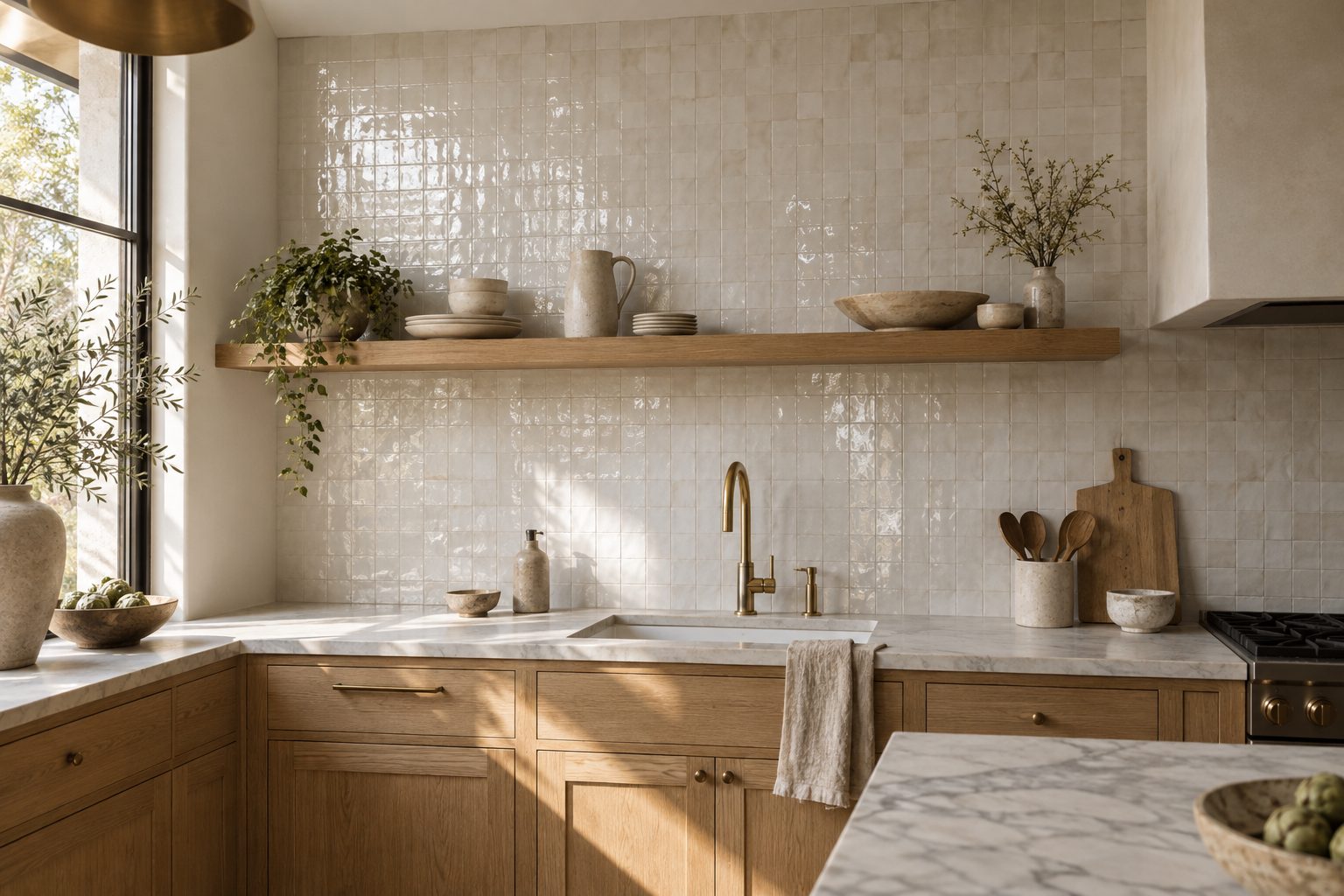
Key takeaways
- White or cream ceramic and porcelain tile, in a 3 × 6 in or 2.5 × 8 in format, is still the most popular kitchen backsplash in the US
- Installed costs run from $10–25 per sq ft for ceramic to $60–150 per sq ft for a marble slab backsplash; most kitchens need 30–40 sq ft
- Run a standard backsplash 18 in (46 cm) up to the wall cabinets, or take it to the ceiling or hood when there are no uppers
- For 2027 the direction is handmade zellige, full-height slab and matte, tactile surfaces over glossy glass mosaics
The best kitchen backsplash ideas start with one durable, easy-to-clean material and the right height: an 18 in (46 cm) run of tile between counter and wall cabinets, or a full-height slab where there are no uppers. White ceramic or porcelain tile remains the most popular choice, zellige and slab stone lead the 2027 trend, and installed costs range from $10 to $150 per sq ft.
A kitchen backsplash protects the wall behind the counter from water, grease and heat, and it is usually the largest area of decorative surface in the room. That makes it the place where most kitchens either come together or look dated within five years. This guide is part of our wall treatments guide, and it covers the materials, the heights, the color pairings and the installation sequence we use when specifying a backsplash for clients.
- Typical area: 30–40 sq ft (2.8–3.7 m²) for a standard L-shaped kitchen at 18 in (46 cm) high.
- Installed cost: $10–25 per sq ft for ceramic, $30–60 for zellige, $60–150 for a marble or quartzite slab.
- Standard height: 18 in (46 cm) from countertop to the underside of the wall cabinets; 30 in (76 cm) or more behind a range.
- Most popular: white or off-white subway-format ceramic, closely followed by large-format porcelain and quartz slab.
- 2027 direction: handmade texture, matte glazes, full-height slabs and warm whites rather than bright white gloss.
What is the most popular backsplash for a kitchen?
The most popular kitchen backsplash is still a white or off-white ceramic tile in a rectangular subway format, because it is cheap, durable, easy to replace and works with almost any cabinet color. What has changed is the detail. The classic 3 × 6 in (7.5 × 15 cm) brick-bond subway is giving way to longer, slimmer formats like 2.5 × 8 in (6 × 20 cm) and 2 × 10 in (5 × 25 cm), laid vertically, in a straight stack or in a herringbone. Glazes have moved from flat bright white to off-white and cream with a slight wave or crackle, which reads as handmade at a machine-made price.
Behind the classic subway, three kitchen backsplash designs dominate current projects:
- Quartz or porcelain slab: the countertop material carried up the wall in one or two pieces, with no grout lines to clean.
- Zellige and handmade-look tile: small, glossy, uneven squares and rectangles that catch light; see our zellige tile guide for sizing and sealing.
- Large-format porcelain: 24 × 48 in (60 × 120 cm) panels in stone or concrete looks, giving a slab effect at roughly half the cost.
Which kitchen backsplash materials work best?
Porcelain and glazed ceramic are the best all-round backsplash tiles for kitchen use; slab stone and quartz give the most luxurious result, and zellige gives the most character per dollar. Choose by how you cook, how much grout you are willing to clean, and how the material behaves behind a hob. The table compares the eight backsplash materials we specify most often.
| Material | Installed cost per sq ft | Upkeep | Look | Best for |
|---|---|---|---|---|
| Glazed ceramic | $10–25 | Low; seal cement grout once a year | Classic, glossy or matte, huge color range | Budget remodels, rentals, subway layouts |
| Porcelain | $12–30 (large format $20–40) | Very low; non-porous body | Stone, concrete or plain; tight joints | Heavy cooks, slab look on a budget |
| Zellige (handmade terracotta) | $30–60 | Medium; seal tile and grout, chips are part of the look | Uneven, light-catching, artisanal | Feature walls, warm and Mediterranean kitchens |
| Marble or quartzite slab | $60–150 | Medium to high; etches with acid, reseal every 6–12 months | Book-matched veining, seamless | Luxury kitchens, full height backsplash |
| Quartz slab | $50–120 | Low; avoid direct heat over 300°F (150°C) | Uniform, matches the countertop | Busy families, minimal kitchens |
| Glass tile or sheet | $20–50 | Low on sheet glass; mosaics show grout | Reflective, colored, contemporary | Small, dark kitchens; back-painted glass panels |
| Metal (stainless, copper, zinc) | $25–60 | Medium; scratches and patinas | Industrial or warm, living finish | Behind ranges, professional-style kitchens |
| Microcement | $15–30 | Medium; needs a sealed, food-safe topcoat | Seamless, matte, plaster-like | Minimal and Japandi kitchens, over old tile |
The mistake we see most often is choosing an absorbent material for the zone behind the cooktop. Honed marble and unsealed zellige both stain from oil splatter within months, so if you love them, use a slab of quartz or porcelain behind the range, or commit to sealing twice a year. Use the tile calculator to size your order; add 10 percent for straight lays and 15 percent for herringbone or handmade tile, which has more breakage.
What are the best modern kitchen backsplash ideas for 2027?
Modern kitchen backsplash ideas for 2027 favor texture over shine: handmade glazes, honed stone slabs, vertical stack bonds and tile run to the ceiling instead of stopping at the cabinets. The backsplash trends 2026 brought into the mainstream, such as warm whites, slab backsplashes and ledges, are maturing into a calmer, more architectural look. Our tile trends 2027 report covers the wider tile market; these are the kitchen backsplash ideas modern clients ask for most, and the kitchen tile ideas we are specifying now.
- Full-height slab with a ledge: the countertop stone carried up the wall with a 3–4 in (8–10 cm) deep shelf at 18 in (46 cm) for oil and salt.
- Vertical stack bond: slim 2 × 10 in (5 × 25 cm) tiles laid straight and vertical, which makes a standard 8 ft (2.4 m) ceiling feel taller.
- Tonal zellige backsplash: cream, sage, clay or deep green handmade tile with matching grout, so the wall reads as a single textured surface.
- Checkerboard and two-tone: 4 in (10 cm) squares in two close tones, such as cream and oat, rather than black and white.
- Fluted and three-dimensional tile: ribbed porcelain or ceramic used on a single wall, usually behind open shelving.
- Plaster-look surfaces: microcement or tadelakt-style finishes for a seamless, matte backsplash in minimal kitchens.
The overall direction connects to the warmer, more tactile kitchens in our kitchen trends 2027 forecast: less contrast, more material honesty.
What backsplash is timeless?
A timeless backsplash is a simple shape in a natural or neutral material, laid in a classic pattern with a grout color close to the tile. White or cream rectangular tile, honed marble, plain terracotta and slab stone have all been used in kitchens for over a century and still look right. What dates a backsplash is rarely the material; it is the trend layered on top of it.
Use these rules if longevity matters more than novelty:
- Keep the format classic: rectangles, squares and herringbone age well; hexagon mosaics, arabesques and multicolor patterns are tied to specific decades.
- Match the grout: a grout within one or two shades of the tile reads calm for decades; high-contrast charcoal grout on white tile is the fastest way to date a kitchen.
- Prefer matte or soft gloss: high-gloss glass mosaics and metallic accents were the signature of the 2000s and look it.
- Choose a natural color: warm white, cream, stone, clay or a muted green that relates to the countertop and floor.
How high should a kitchen backsplash be?
A standard kitchen backsplash is 18 in (46 cm) high, running from the countertop to the underside of the wall cabinets, which sit 54 in (137 cm) above the floor on a 36 in (91 cm) counter. Behind a range, the tile should continue to the hood, which hangs 24–30 in (61–76 cm) above the cooktop. Where there are no wall cabinets, a full height backsplash to the ceiling looks deliberate; stopping at an arbitrary height does not.
| Situation | Recommended height | Notes |
|---|---|---|
| Under wall cabinets | 18 in (46 cm), counter to cabinet | Tile tucks 1/4 in (6 mm) behind the cabinet's light rail |
| Behind range with hood | Counter to underside of hood, 24–30 in (61–76 cm) | Use a heat-tolerant, non-porous material here |
| Open shelving, no uppers | To the ceiling, or 60–72 in (152–183 cm) to a shelf line | End on a shelf, window head or ceiling, never mid-air |
| Slab backsplash | 4 in (10 cm) curb, 18 in, or full height | A 4 in curb alone looks builder-grade in 2027 |
| Window on the run | Tile to the sill and wrap the reveal | Line up grout joints with the window edges |
Side ends matter as much as height. Finish tile at the outer edge of the countertop or the cabinet side panel, with a matching bullnose, a metal edge trim or a clean cut stone edge.
What backsplash goes with white cabinets?
The best backsplash for white cabinets adds either warmth or texture. With white cabinets, choose a backsplash that adds either warmth or texture: a cream zellige, a veined stone slab, a soft green glaze or terracotta all work better than a second flat white kitchen backsplash tile. White-on-white can look beautiful, but only if the two whites share an undertone and the tile has surface movement. A bright blue-white tile against warm white cabinets is the most common clash we are asked to fix.
#F4EFE6#E8DCC8#B9A88E#A3B09A#B8714E#5A5F57- Warmth: cream or oat handmade tile with matching grout, or plain terracotta squares for a Mediterranean feel.
- Contrast without harshness: sage, deep green or ink-blue glazes, kept to the backsplash only.
- Luxury: a honed marble or quartzite slab with gray or taupe veining that picks up the hardware.
- Minimal: a white quartz slab or matte porcelain panel with no visible joints.
Hold samples against the actual cabinet door, vertically, under both daylight and your kitchen lighting at its real color temperature, ideally 2700–3000K.
How to do a backsplash in a kitchen
A tiled kitchen backsplash takes a confident beginner two to three days, while slabs, zellige and herringbone layouts are worth paying an installer $8–25 per sq ft labor for. This is the sequence for a standard kitchen tile backsplash on drywall:
- Measure and plan: calculate the area of every section, add 10–15 percent waste, and draw the layout so cut tiles fall at the ends and behind appliances, not in the center over the sink.
- Prepare the wall: remove outlet covers, switch off power, scrape off loose paint, and patch and sand until flat; behind a sink, use cement board or a waterproofing membrane.
- Set a level line: the countertop is rarely level, so screw a ledger batten one tile height up and work from that line, filling the bottom row last.
- Apply adhesive: use a thinset or premixed tile mastic for small ceramic tile and a polymer-modified thinset for porcelain, glass and stone, combed with the trowel size the tile maker specifies.
- Set the tile: press tiles with a slight twist, use spacers of 1/16–1/8 in (1.5–3 mm), and check level every three rows; zellige is usually laid with joints of 1/16 in or less.
- Grout: after 24 hours, remove spacers and grout with sanded grout for joints over 1/8 in and unsanded below that; wipe the haze with a damp sponge.
- Caulk and seal: run color-matched silicone, not grout, along the countertop joint and inside corners, then seal cement grout and porous tile after 72 hours.
Our verdict: how we would choose a kitchen backsplash
If we had one kitchen backsplash idea to recommend for most homes, it would be a warm white or cream handmade-look tile in a vertical stack, run to the ceiling where the wall allows, with matching grout and a porcelain or quartz slab behind the range. It costs a fraction of a stone slab, cleans easily and will look considered in 2037 as well as 2027.
Spend more where the backsplash is the main event. In a kitchen with open shelving and no wall cabinets, a full-height marble or quartzite slab is the single upgrade that most changes the room. In a rental or a quick refresh, a good porcelain in a large format and a fresh grout color does more than any trend tile. Whatever you choose, sample at full size: a 12 in (30 cm) square on the wall for a week tells you more than any showroom board.
Ready to price your wall? Send us your measurements and preferred material through our tile sourcing desk and we will return factory quotes for ceramic, porcelain, zellige and slab options.
Free toolTile CalculatorWork out tiles, boxes, grout and adhesive with the right wastage.Shop & source the look
Buy it today — or have it made
Retail links are affiliate links: we may earn a commission at no extra cost to you (disclosure). “Get it made” sends the item to our sourcing desk for factory quotes in custom sizes and finishes.
Frequently asked questions
What is the most popular backsplash for a kitchen?
A white or off-white ceramic tile in a rectangular subway format is the most popular kitchen backsplash. It is inexpensive at $10–25 per sq ft installed, easy to clean and works with any cabinet color. Current versions use longer formats such as 2.5 × 8 in, vertical or herringbone layouts, and cream glazes with a handmade wave.
What backsplash is timeless?
A simple shape in a natural or neutral material is timeless: white or cream rectangular tile, plain terracotta, honed marble or a stone slab, laid in a classic pattern with grout close to the tile color. Trend details such as high-contrast grout, glossy glass mosaics and multicolor patterns are what date a kitchen.
How high should a kitchen backsplash be?
A standard kitchen backsplash is 18 in (46 cm) high, from the countertop to the underside of the wall cabinets. Behind a range it should continue up to the hood, 24–30 in above the cooktop. Where there are no wall cabinets, run the backsplash to the ceiling or to a shelf line so it ends deliberately.
What backsplash goes with white cabinets?
Cream zellige, veined marble or quartzite, sage or deep green glazes and terracotta all pair well with white cabinets because they add warmth or texture. If you choose a white tile, match its undertone to the cabinets and pick a surface with some movement, or the two whites will clash and look flat.
How to do a backsplash in a kitchen?
Plan the layout and add 10–15 percent waste, prepare and flatten the wall, set a level batten, apply thinset or mastic, and set the tile with 1/16–1/8 in spacers. Grout after 24 hours, caulk the countertop joint with silicone, and seal cement grout and porous tile after about 72 hours.
Some links may be affiliate links. Regulations and specifications change — always confirm with suppliers and qualified professionals.