Contemporary vs Modern Interior Design: The Real Difference
Contemporary vs modern interior design comes down to time: modern is a fixed style from roughly 1920–1970, while contemporary means the design of right now and changes every 10 years or so. Here is how to tell them apart.
Part of our guide: Interior Design Styles: 24 Decorating Styles Explained for 2027
Key takeaways
- Modern design is a historical style from roughly the 1920s to the 1970s; contemporary design is whatever is current and keeps evolving
- Modern favors right angles, primary accents, steel, glass and teak; 2026 contemporary favors curves, warm neutrals, plaster and pale oak
- A contemporary home is defined by current construction: open plan, large glass, flat or low roofs and flush detailing
- Most real rooms are modern contemporary blends: a modern-era piece or two inside a contemporary envelope
The difference between contemporary and modern interior design is time. Modern design is a fixed historical style from roughly the 1920s to the 1970s, built on function, right angles and materials such as steel, glass and teak. Contemporary design means the design of right now, so it changes about every decade; in 2026 it is warm, curved, matte and textural. The two overlap, but they are not the same.
People use the words interchangeably, and furniture shops do too, which is why searching for modern interior design ideas returns pictures of rooms that are, strictly, contemporary. This guide is part of our interior design styles guide. It defines both, compares them across seven points and shows how to blend them, which is what most good rooms actually do.
- Modern: a style with a start and end date, roughly 1920–1970, including mid-century modern.
- Contemporary: the design of the present; it borrows freely and changes every 8–12 years.
- Lines: modern is rectilinear and structural; 2026 contemporary is soft, rounded and low.
- Palette: modern uses white, black, wood and primary accents; contemporary uses warm neutrals and tonal schemes.
- Overlap: both avoid ornament, favor open plans and treat light as a material.
What is the difference between modern and contemporary?
Modern design refers to a specific historical movement, while contemporary design refers to the present moment, so modern stays the same and contemporary keeps changing. A modern room from 1955 and a modern-style room furnished in 2026 should look broadly alike: low teak credenza, a molded-plywood lounge chair, a tapered-leg sofa, a wall of glass. A contemporary room from 2006 and one from 2026 look quite different: the first had gloss, chrome, gray and sharp corners, the second has matte plaster, bouclé, warm white and curves.
The confusion is understandable. In everyday English, "modern" means new. In design, it names a movement that began in early 20th-century Europe, grew through the mid-century years in America and Scandinavia, and was effectively complete by the 1970s. "Contemporary," by contrast, literally means "of the same time." The phrase modern contemporary is often used for rooms that combine modern-era pieces with current finishes, and that hybrid is now the most common look in new homes.
What is modern design?
Modern design is a 20th-century style that rejected ornament in favor of function, honest materials, open space and simple geometric form. Its core idea is that a building or object should express what it does and how it is made. In interiors, that produced a recognizable vocabulary that still defines modern home interior design:
- Structure on show: exposed beams, steel columns, cantilevered stairs and furniture whose frames are visible.
- Open plans: living, dining and kitchen flowing together, divided by furniture and level changes rather than walls.
- Walls of glass: floor-to-ceiling windows connecting the interior to the landscape.
- Industrial materials beside natural ones: tubular steel, plate glass and terrazzo next to teak, walnut, leather and wool.
- Geometric restraint: rectangles, grids and repeated modules, with color used in blocks.
Mid-century modern, roughly 1945–1970, is the warmer, more domestic chapter of modern design, with tapered legs, organic curves and plenty of wood. It is the version most people mean when they say they love modern furniture; our mid-century modern guide covers it in detail.
What does contemporary mean in interior design?
In interior design, contemporary means the style that reflects current tastes, materials and technology, so its look shifts as those things change. Contemporary interior design is not anchored to a period; it absorbs whatever designers and manufacturers are doing now, including revivals of older styles.
In 2026, contemporary design has five clear traits, and most of them carry into 2027:
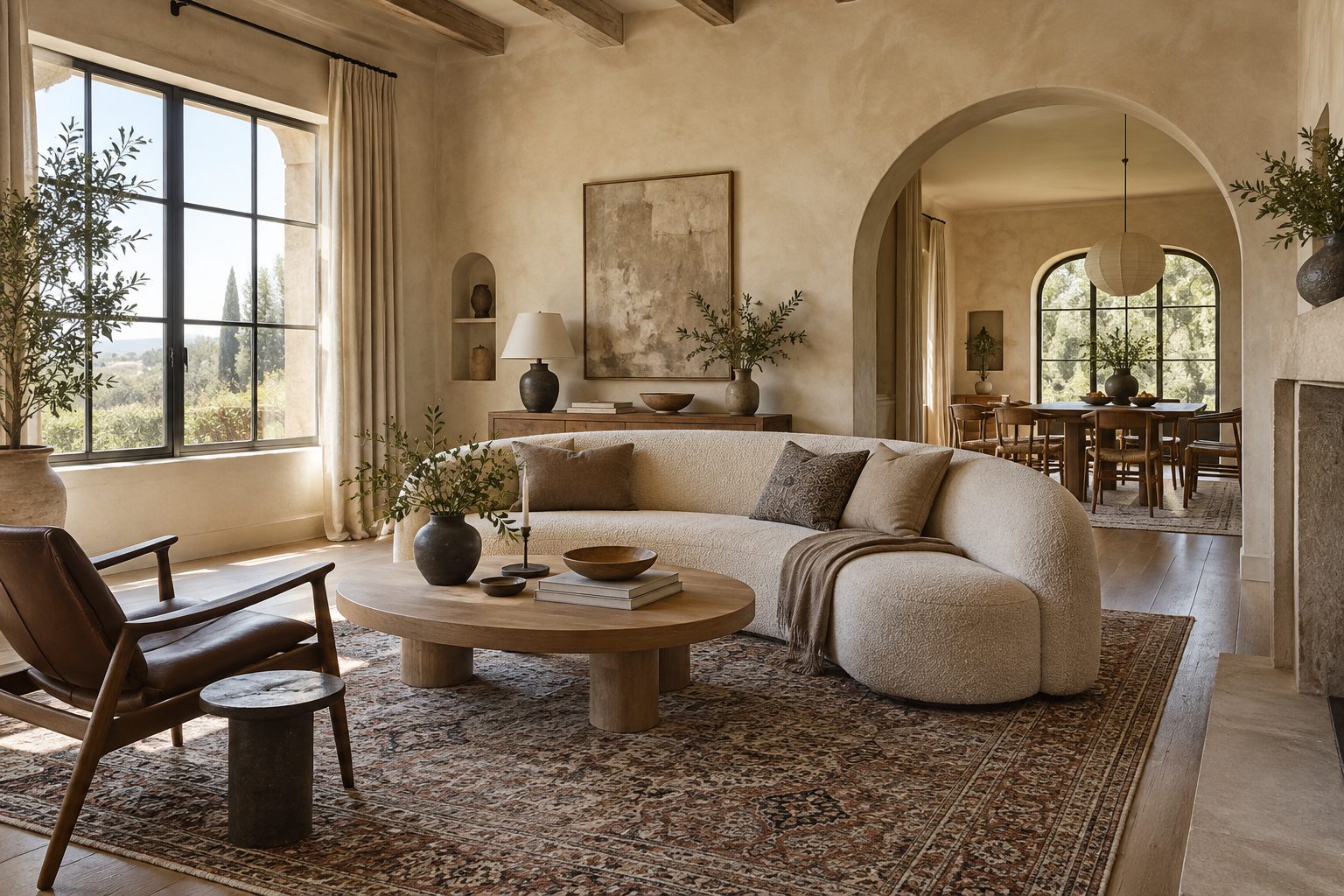
- Curves: rounded sofas, oval tables, arched openings and pill-shaped mirrors.
- Warm neutrals: oat, putty, warm white, clay and mushroom instead of cool gray.
- Matte and textured surfaces: lime plaster, microcement, honed stone, bouclé and wool.
- Low, deep furniture: sofa seats at 16–17 in (41–43 cm) high and 24–26 in (61–66 cm) deep.
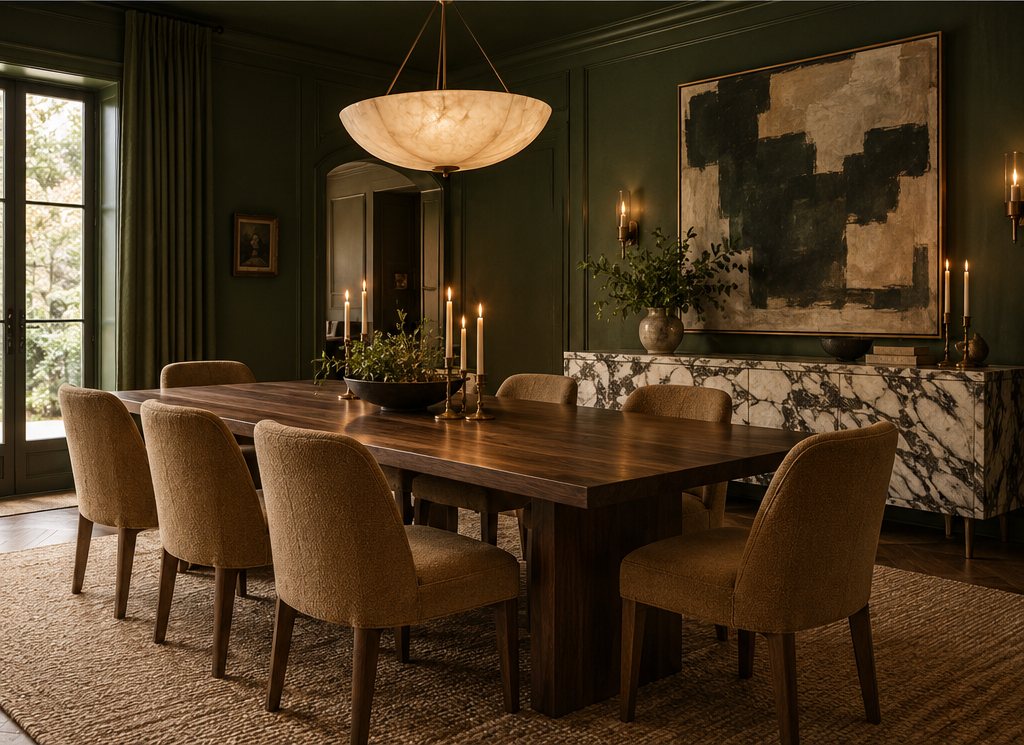
- Sculptural lighting: oversized paper, linen or alabaster pendants, often off-center.
Two current strands of contemporary design are covered separately: organic modern, which adds natural materials and earthy color, and warm minimalism, which strips back further while keeping the warmth.
Contemporary vs modern interior design compared
Side by side, modern design looks structured and graphic while contemporary design looks softer and more tactile, and the gap is widest in shape, palette and finish. This table compares the two across the points that decide how a room looks and what you buy.
| Point | Modern | Contemporary (2026) |
|---|---|---|
| Era | About 1920–1970, fixed | The present, changes every 8–12 years |
| Lines | Straight, rectilinear, structural, some organic curves in mid-century pieces | Soft curves, rounded corners, low and horizontal |
| Palette | White, black, natural wood, primary or earthy accents in blocks | Warm whites, oat, clay, mushroom, tonal layering |
| Materials | Teak, walnut, molded plywood, tubular steel, glass, leather, terrazzo | Plaster, microcement, travertine, pale oak, bouclé, linen, aged brass |
| Furniture | Tapered legs, molded shells, slim frames, raised off the floor | Plinth bases, deep seats, modular and curved forms |
| Decor | Graphic art, sculptural objects, very little | Ceramics, large-scale art, textiles, plants |
| Finish | Mixed: oiled wood, polished chrome, lacquer | Matte, honed, brushed, hand-finished |
| How it changes over time | It does not; new pieces are reproductions or reinterpretations | It will look different by the mid-2030s |
The practical consequence: modern furniture tends to hold its value and style because the look is settled, while contemporary furniture is more likely to date. That is not a reason to avoid contemporary design, but it is a reason to spend more on the timeless pieces and less on the trend-led ones.
What is a contemporary style home?
A contemporary style home is a house designed in a current architectural idiom: open plan, large windows, simple massing, flat or low-pitched roofs and flush, minimal detailing. Inside, a contemporary home usually has 9–10 ft (2.7–3.0 m) ceilings, few or no moldings, flat-panel doors, large-format floor tile or wide-plank wood, and kitchens that open fully to the living space.
The word is also used loosely for any recent build with a neutral, open interior, even when the exterior is traditional. That kind of house is better described as transitional, which our transitional interior design guide covers. A true contemporary home makes its windows, rooflines and materials the main event; a modern home, by contrast, is a house from the modern era or a faithful new build in that style, often with a flat roof, post-and-beam structure and clerestory windows.
What is contemporary furniture?
Contemporary furniture is furniture designed and made now, reflecting current proportions and materials; in 2026 that means low, deep, rounded pieces in natural textures. Modern furniture is the opposite in spirit: slim, leggy and graphic.
- Contemporary sofa: 90–110 in (229–279 cm) wide, 38–42 in (97–107 cm) deep, curved or modular, on a plinth or hidden legs, in bouclé, wool or performance linen.
- Modern sofa: 72–84 in (183–213 cm) wide, 30–34 in (76–86 cm) deep, tight back, tapered or metal legs, often leather or tweed.
- Contemporary coffee table: round or organic, stone or plaster, 14–16 in (36–41 cm) high.
- Modern coffee table: rectangular or surfboard, wood or glass, 15–17 in (38–43 cm) high on slim legs.
A useful rule: if a piece sits on legs and shows daylight underneath, it reads modern; if it sits on the floor as a mass, it reads contemporary.
Colors and materials for each style
Modern palettes are graphic, with a clean base and blocks of color, while contemporary palettes are tonal, built from close shades of warm neutral. The swatches below show the two side by side: the first three are modern, the last three contemporary.
#F4F2EE#8B5A2B#D99A2B#E9E1D4#C8B79E#A06A50Modern rooms often add one strong color, mustard, olive, burnt orange or cobalt, in a single chair or artwork. Contemporary rooms tend to stay within three or four shades of one hue family and add depth through texture: plaster against linen against honed stone.
How to combine modern and contemporary design
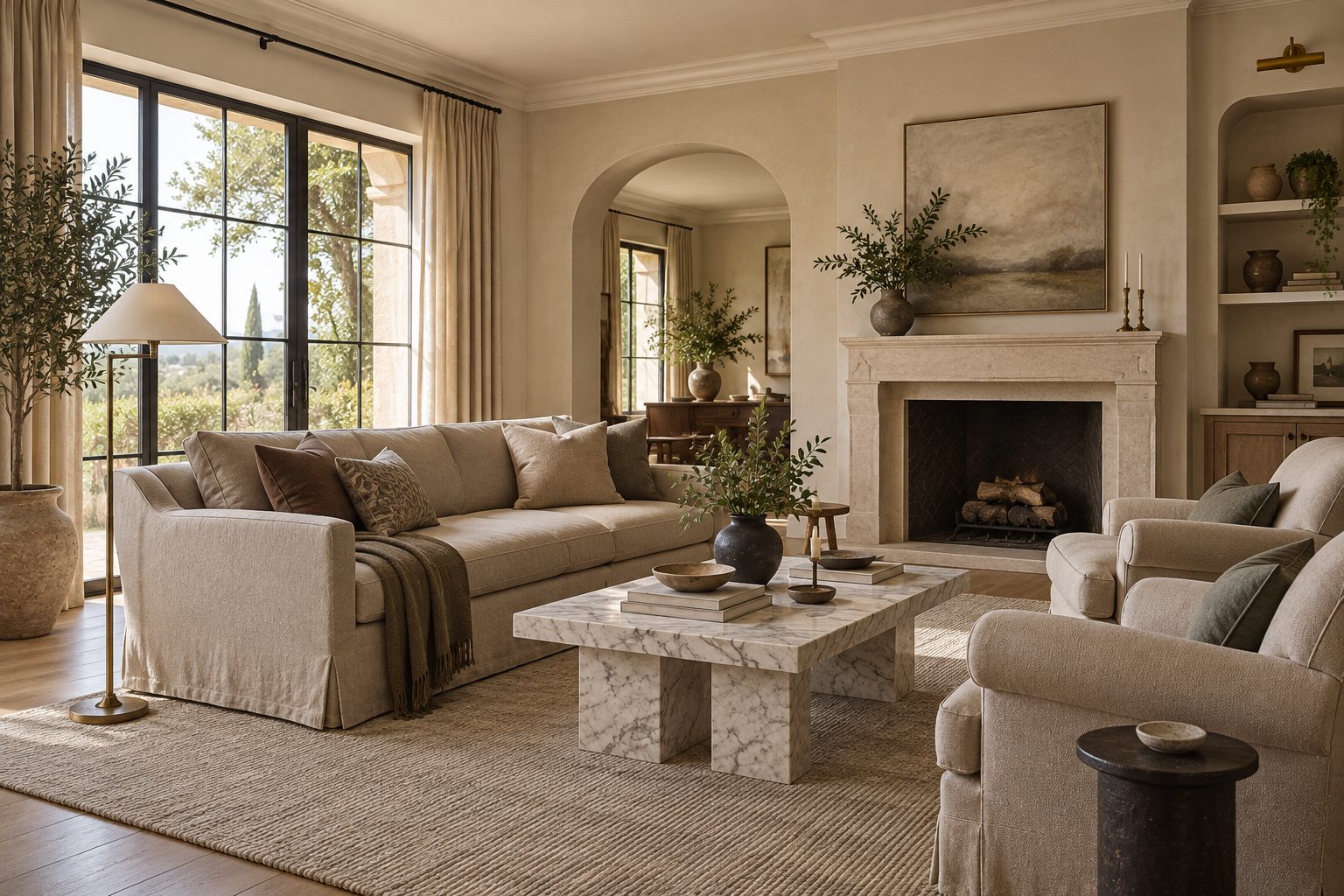
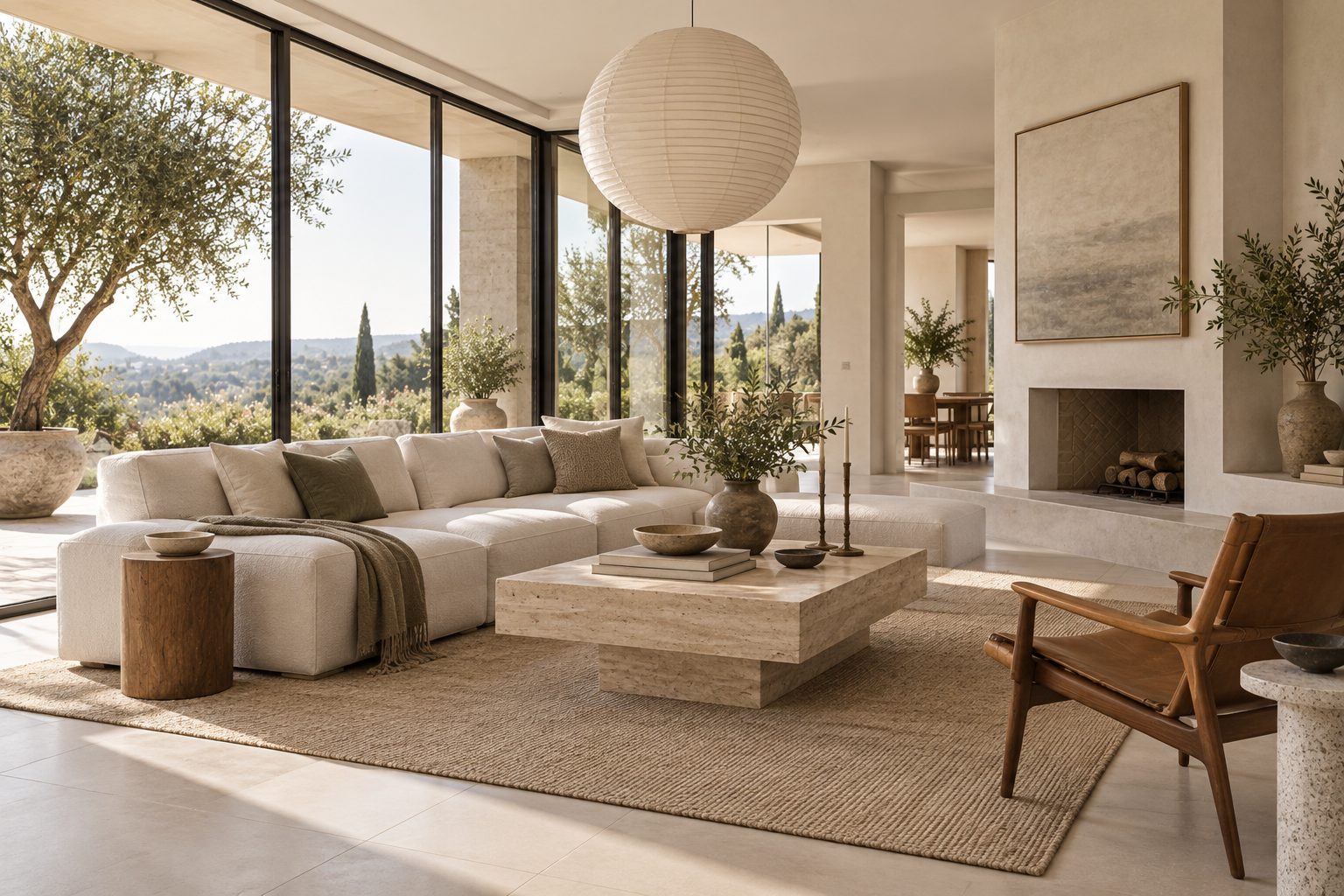
Modern and contemporary design combine best when the envelope is contemporary and a few defining pieces are modern, because modern furniture reads as sculpture against soft, warm walls. This is how we approach a modern contemporary room:
- Set a contemporary shell: warm white or limewash walls, wide-plank pale oak or microcement floors, minimal trim.
- Pick one modern hero: a mid-century lounge chair, a teak credenza or a tubular-steel dining chair set.
- Keep the big upholstery contemporary: a deep, low sofa in a textured neutral anchors the room.
- Repeat one wood: let the modern piece's teak or walnut appear once more, in a side table or frame.
- Light both ways: one sculptural contemporary pendant, one modern task or floor lamp.
Modern and contemporary rooms compared, room by room
Room by room, the difference between modern and contemporary design shows most in the kitchen and living room, where finishes and furniture shapes do the talking. These are the specifications we would use for each.
Living room
A modern living room centers on a long, low credenza, a tight-back sofa on slim legs and one iconic lounge chair, set on a flat-weave or short-pile rug with a geometric pattern. A contemporary living room centers on a deep modular or curved sofa, a round stone coffee table and a large tonal rug, usually 9 × 12 ft (274 × 366 cm), with a sculptural pendant or floor lamp as the focal light. Both keep accessories sparse.
Kitchen
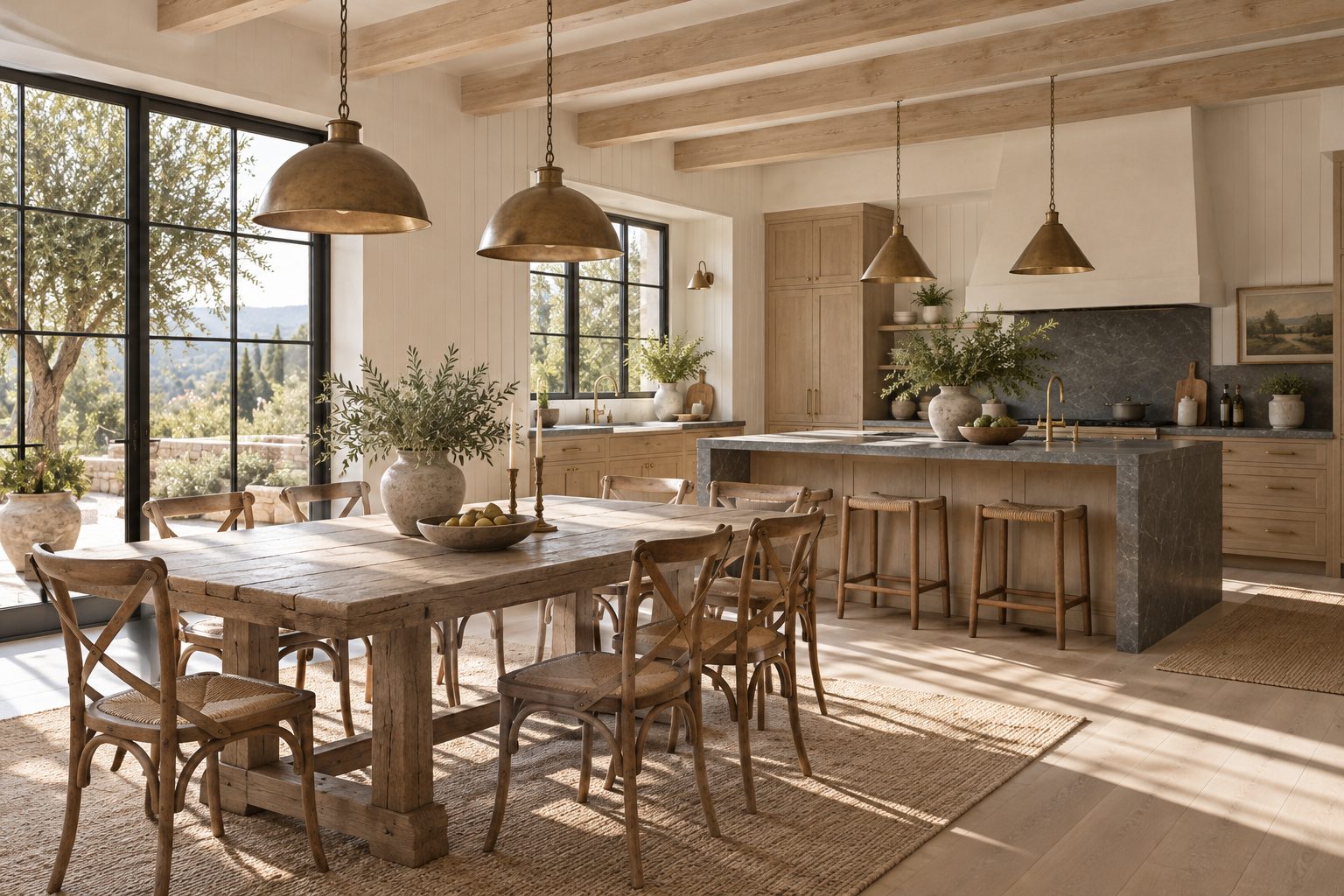
Modern kitchens use flat slab fronts in walnut veneer or colored lacquer, thin countertops, and a single line of open shelving or a pass-through to dining. Contemporary kitchens use handleless or integrated-pull fronts in matte paint or pale oak, thick honed stone or microcement surfaces, a full-height slab backsplash and appliances hidden behind panels. Islands in contemporary kitchens are often 42–48 in (107–122 cm) deep with a rounded or waterfall end.
Bedroom
The modern bedroom has a slim platform bed on legs, a walnut or teak dresser and graphic bedding. The contemporary bedroom has a low upholstered or plinth bed, a wall-to-wall headboard panel or built-in storage, layered linen bedding in close neutrals and wall lights mounted on the headboard wall instead of lamps on nightstands.
Our verdict
If you want a room that will look right in fifteen years, lean modern for the furniture you buy to keep and contemporary for the surfaces you can repaint or replace. Modern design is a settled style, so a good modern chair is an investment; contemporary design is a moving target, so we would spend on its envelope, plaster, oak and lighting, rather than on trend-specific furniture shapes. In practice the best 2027 rooms we see are exactly that mix: a warm contemporary shell with two or three modern pieces that give it a backbone.
Still unsure which way you lean? Take our free style quiz; it separates modern, contemporary and transitional preferences in about four minutes and gives you a palette to start from.
Free toolTile CalculatorWork out tiles, boxes, grout and adhesive with the right wastage.Shop & source the look
Buy it today — or have it made
Retail links are affiliate links: we may earn a commission at no extra cost to you (disclosure). “Get it made” sends the item to our sourcing desk for factory quotes in custom sizes and finishes.
Frequently asked questions
What is the difference between modern and contemporary?
Modern design is a fixed historical style from about 1920 to 1970, built on function, straight lines, steel, glass and teak. Contemporary design is the style of the present and changes roughly every decade; in 2026 it is curved, warm, matte and textural. Modern stays the same, contemporary keeps evolving.
What does contemporary mean in interior design?
In interior design, contemporary means reflecting current tastes, materials and technology. It is not tied to a period, so it changes over time. Today it means rounded furniture, warm neutral palettes, matte plaster and stone, low deep seating and sculptural lighting.
What is modern design?
Modern design is a 20th-century movement that rejected ornament in favor of function, honest materials, open plans and simple geometric forms. In interiors it shows up as walls of glass, exposed structure, tapered-leg and molded furniture, and a palette of white, black and wood with blocks of accent color.
What is a contemporary style home?
A contemporary style home is built in a current architectural language: open plan, large windows, simple massing, flat or low-pitched roofs and minimal trim. Inside it usually has high ceilings, flat-panel doors, wide-plank or large-format floors and a kitchen that opens fully to the living space.
What is contemporary furniture?
Contemporary furniture is furniture designed now, reflecting current proportions and materials. In 2026 that means low, deep and rounded pieces, often on plinth bases, in bouclé, wool, linen, stone and pale oak. Modern furniture, by contrast, is slimmer, raised on tapered or metal legs and more graphic.
Some links may be affiliate links. Regulations and specifications change — always confirm with suppliers and qualified professionals.