Curved Sofas: Are They Practical? Sizes, Layouts & Styling
A curved sofa is practical in the right room and a mistake in the wrong one. The four types, the sizes each needs, how to float one with a round rug, the fabrics that suit curves and what to measure first.
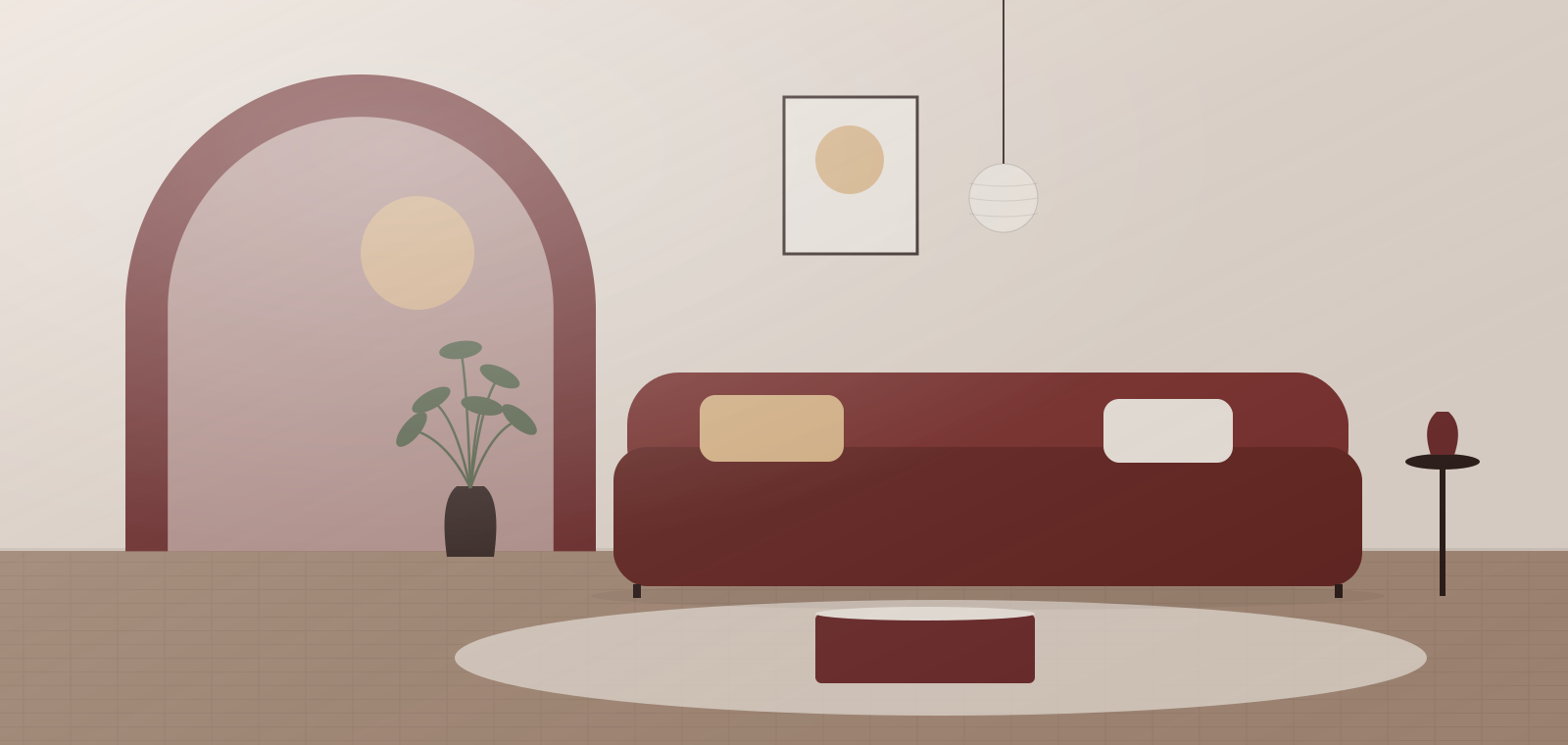
Key takeaways
- A curved sofa needs a room at least 12 ft (3.7 m) wide to float; on a wall, choose a curved back sofa instead
- Expect 44–52 in (112–132 cm) of depth on a crescent against 36–40 in for a straight three-seater
- Float it 24 in (61 cm) off the wall and pair it with a round rug and a round coffee table
- Bouclé, velvet and stretch performance fabrics follow a curve; stiff linen shows every seam
A curved sofa is practical when the room is at least 12 ft (3.7 m) wide and the sofa can float away from the walls; it is impractical in a narrow room that needs every inch against a wall. A crescent needs 10–14 in (25–35 cm) more depth than a straight sofa of the same seat count, so the decision is floor plan first, looks second.
Why curves are back
Curves are back because open-plan living rooms need furniture that defines a zone from every angle, and a straight sofa only does that from the front. A rounded sofa reads as a finished object whether you see its back from the kitchen or its front from the TV, which is exactly the problem an open-plan home poses. The second driver is comfort culture: the shift toward lower, deeper, softer seating that began with the modular sectional has reached its natural end point in the crescent.
The 2027 direction, which we cover in living room trends 2027, is curves everywhere: arched doorways, round rugs, drum coffee tables and rounded upholstery working together rather than a single statement curve dropped into a rectilinear room. That matters for buying. A curved couch looks odd as the only soft shape in a room of hard corners; it looks inevitable when the rug and the table echo it.
- At a glance: a curved sofa is any sofa whose seat, back or overall footprint follows an arc rather than a straight line.
- Depth penalty: a curved three-seater occupies 44–52 in (112–132 cm) front to back, against 36–40 in (91–102 cm) for a straight one.
- Room minimum: 12 × 14 ft (3.7 × 4.3 m) to float a crescent; 10 × 12 ft (3 × 3.7 m) for a gently curved back sofa placed on a wall.
- Price band: curved frames cost 20–40 percent more than straight equivalents because the frame is built in segments and the fabric is cut on the bias.
Types: curved back, crescent, C-shaped, curved sectional
There are four types of curved sofa, and they range from a mild bend that behaves like a normal sofa to a full C shape that is really a room divider. Knowing which one you are looking at prevents most sizing mistakes.
- Curved back sofa: the seat is close to straight but the back rail bows outward by 4–8 in (10–20 cm) at the center. It sits on a wall like a conventional sofa, needs only a little extra depth and is the practical entry point. Widths run 80–96 in (203–244 cm).
- Crescent sofa: the whole piece follows a shallow arc, typically a segment of a circle 12–16 ft (3.7–4.9 m) in diameter. A three-seat crescent is 96–110 in (244–279 cm) tip to tip and 44–52 in (112–132 cm) deep at the center. It wants to float.
- C-shaped sofa: a deeper arc, sometimes more than a half circle, seating four to six people who face one another. Footprints start around 110 × 70 in (279 × 178 cm) and go up to 150 × 90 in (381 × 229 cm). A C shaped sofa is a conversation piece for a large room, and a poor choice for television.
- Curved sectional sofa: modular units, usually a mix of wedge-shaped corner sections and straight or slightly curved seats, that assemble into a curve. Because the modules arrive separately, curved sectional furniture is the type that fits through doors and can be reconfigured later. Modules are 30–40 in (76–102 cm) wide and 38–44 in (97–112 cm) deep.
| Type | Typical width (tip to tip) | Depth at center | Seats | Best placement |
|---|---|---|---|---|
| Curved back sofa | 80–96 in (203–244 cm) | 38–42 in (97–107 cm) | 3 | On a wall or floating |
| Crescent | 96–110 in (244–279 cm) | 44–52 in (112–132 cm) | 3–4 | Floating, facing a focal point |
| C-shaped | 110–150 in (279–381 cm) | 70–90 in (178–229 cm) | 4–6 | Center of a large room |
| Curved sectional | 110–160 in (279–406 cm) | 38–44 in (97–112 cm) per module | 4–7 | Floating or in a corner |
| Round sofa couch (full circle or half) | 84–120 in (213–305 cm) diameter | — | 4–8 | Lobbies, very large rooms |
The round sofa couch, a full or three-quarter circle, belongs in a hotel lobby or a room over 20 ft (6 m) in both directions. For a home, the first two types do most of the work.
Do curved sofas work in small spaces?
A curved sofa works in a small space only if it is a curved back sofa on a wall or a compact two-seat crescent under 84 in (213 cm) wide; anything larger loses the room. The reason is the depth penalty. In a 10 × 12 ft (3 × 3.7 m) living room, a straight 84 in (213 cm) sofa at 38 in (97 cm) deep leaves a 36 in (90 cm) walkway with a coffee table. Swap in a crescent at 48 in (122 cm) deep and the walkway drops below 30 in (76 cm).
A curved sectional sofa for small space use is possible if you pick a two-module or three-module version of 80–95 in (203–241 cm) overall and set it diagonally across a corner, which uses the dead triangle behind it. Pair it with a round rug of 6 ft (183 cm) and a small drum table and the arrangement reads as generous rather than cramped. Skip the chaise return; it is the piece that blocks the path. For more ways to make a small room feel larger, see small living room ideas, and check the two-thirds wall rule in how to choose sofa size before you order.
Layout rules: floating it, pairing with a round rug and coffee table
The rule that makes a curved couch sofa succeed is to float it at least 24 in (61 cm) off any wall, then anchor it with a round or oval rug and a round coffee table so the curves reinforce one another. A curve pressed against a flat wall leaves a wedge of dead space behind the ends that collects dust and looks unresolved.
- Find the focal point. The center of the arc should face the fireplace, the view or the TV. Mark that line on the floor with tape.
- Set the distance. Place the front edge of the seat 8–10 ft (2.4–3 m) from a TV screen of 55–65 in, or so a coffee table sits 16–18 in (40–45 cm) from the seat.
- Choose the rug. A round rug should be at least as wide as the sofa is long; for a 100 in (254 cm) crescent that means an 8–9 ft (244–274 cm) round rug. An oval or a rectangle at 8 × 10 ft (244 × 305 cm) also works, with all front legs on the rug. Our rug size calculator handles the arithmetic.
- Add the table. A round or kidney-shaped coffee table 36–42 in (91–107 cm) across at 14–16 in (35–40 cm) high follows the inside of the arc. Avoid a rectangular table; its corners fight the curve.
- Close the circle. Two armchairs or a pair of stools opposite the sofa complete a conversation group with 8 ft (2.4 m) or less between facing seats.
Behind a floating curved sofa, a console 12–14 in (30–35 cm) deep or a pair of floor lamps gives the back a reason to be seen. The full set of arrangements, including the diagonal corner and the two-sofa face-off, is drawn out in Living Room Layout Ideas: 10 Furniture Arrangements That Work.
Fabrics that suit curves
The best fabrics for a curved sofa are ones that stretch or drape around a radius without puckering: bouclé, velvet and knitted performance fabrics, in that order of popularity. Stiff linens and heavy woven jacquards fight the curve and show seams at every segment of the frame.
- Bouclé: the looped wool or wool-blend pile hides the seams that a curved frame requires and gives the rounded silhouette a soft, sculptural look. Specify a Martindale rating of at least 25,000 cycles and a pilling grade of 4 or better; cheap polyester bouclé pills in months. Weight of 500–700 gsm holds its shape on a curve.
- Velvet: a short, dense pile in cotton or polyester follows the arc closely and catches light along the curve, which is why velvet is the favorite for rounded couch designs in deep colors. Cotton velvet marks and crushes; polyester or performance velvet at 40,000+ Martindale is the practical choice for a family room.
- Performance knits and stretch weaves: engineered with a small percentage of elastane so the fabric molds around the frame without darts. Easy to clean, resistant to fading and increasingly available in textured finishes that read as bouclé.
- Leather: possible, but only on gently curved backs. A tight radius needs many panels and the seams become the design.
#E4DBCF#B9A58E#6B2F2B#4A5A4C#2F3138Color follows the same logic as shape: a mid-tone neutral in oat, camel or mushroom makes the curve the statement; a deep oxblood or forest velvet makes the sofa the room. If the covers need to come off for washing, read Washable Couches: Removable Covers, Fabrics & What to Look For, because a curved cover is harder to refit than a straight one and the zip layout matters.
Measuring for a curved sofa
Measure three things before buying a curved sofa: the overall footprint as a rectangle, the depth at the center of the arc, and the door and stair route, because a one-piece crescent is the hardest sofa to deliver. Product pages list a width and a depth, but a curve occupies a rectangle that is wider than the straight-line width suggests.
- Footprint rectangle: ask for the width tip to tip and the depth at the deepest point, then tape that rectangle on the floor. A 104 in (264 cm) crescent with a 50 in (127 cm) center depth needs roughly a 9 × 4.5 ft (2.7 × 1.4 m) rectangle plus 24 in (61 cm) of clearance behind it.
- Arc length and radius: the seat arc length tells you how many people sit comfortably; allow 24–26 in (61–66 cm) per person along the front edge. The radius tells you which round rug and table follow it; a 7 ft (213 cm) radius pairs with an 8 ft (244 cm) round rug.
- Seat depth and height: curved seats run deep, 24–28 in (61–71 cm), because the frame is built for lounging. Seat height of 16–18 in (41–46 cm) is common; check it against the rest of the seating.
- Door openings: a one-piece crescent must go through the door on its end, so compare the cross-section diagonal, usually 55–62 in (140–158 cm), to the door width. Most fail a 32 in (81 cm) door. Buy a modular curved sectional or a piece with detachable back and legs if the route is tight.
Made-to-order is common for curved pieces because standard sizes are so limited. Upholstery factories will adjust the radius, width and seat depth to your drawing; lead times of 10–16 weeks including sea freight are typical, and FOB prices for a three-seat bouclé crescent commonly land in the 700–1,800 USD band depending on frame construction and fabric grade.
Pros and cons
The honest verdict is that a curved sofa is a superb piece for a mid-size to large open-plan room and a compromise everywhere else. Weigh the list before you fall for the shape.
| Pros | Cons |
|---|---|
| Defines a seating zone in an open plan from every angle | Needs 10–14 in (25–35 cm) more depth than a straight sofa |
| Encourages conversation; everyone half-faces everyone | Poor for TV viewing on deeper C shapes; end seats face away |
| Softens rooms full of hard edges and right angles | Wastes the space behind it if pushed against a wall |
| Seats more people per inch of arc than the same width straight | Costs 20–40 percent more; fewer stock sizes and fabrics |
| Bouclé and velvet hide seams and wear well | One-piece versions are hard to deliver and to re-cover |
| Pairs naturally with round rugs and tables already in the room | Harder to resell; the shape is specific to the room it was bought for |
If the pros win, the piece to look for is a curved bouclé sofa with removable covers, a kiln-dried hardwood frame and a seat depth around 26 in (66 cm). You will find one in our warm minimal living room edit in the shop, and the sourcing desk can quote the same silhouette in your own fabric and radius.
Free toolRug Size CalculatorFind the right rug size for your room and furniture.Shop & source the look
Buy it today — or have it made
Retail links are affiliate links: we may earn a commission at no extra cost to you (disclosure). “Get it made” sends the item to our sourcing desk for factory quotes in custom sizes and finishes.
Frequently asked questions
Is a curved sofa comfortable?
Yes, for lounging and conversation; curved sofas are built with deep 24–28 in (61–71 cm) seats and low backs that suit relaxed sitting. They are less comfortable for upright reading or for watching a TV from the end seats of a deep C shape, where you sit at an angle to the screen.
Can you put a curved sofa against a wall?
You can, but it is not recommended for a crescent or C shape, because the arc leaves a wedge of dead space behind each end that looks unfinished and traps dust. A curved back sofa with a near-straight seat sits on a wall well; deeper curves should float at least 24 in (61 cm) out.
What size curved sofa is right for my space?
Choose the largest curve whose footprint rectangle leaves a 36 in (90 cm) walkway all round. A 12 × 14 ft (3.7 × 4.3 m) room takes a 96–104 in (244–264 cm) crescent; a 10 × 12 ft room suits a curved back sofa under 88 in (224 cm) or a two-module curved sectional.
What are the biggest pros and cons of curved sofa?
The biggest pro is that a curved sofa defines a seating zone from every angle, which suits open-plan rooms and conversation. The biggest cons are the extra 10–14 in (25–35 cm) of depth, a 20–40 percent price premium and awkward delivery for one-piece designs. Buy modular if either matters.
What should you look for when choosing curved couch?
Look for a kiln-dried hardwood frame built in glued segments, high-resilience foam of at least 1.8 lb per cubic foot, a fabric with 25,000+ Martindale cycles that drapes around a radius, and removable covers. Then check the footprint rectangle and the door route before you pay.
Some links may be affiliate links. Regulations and specifications change — always confirm with suppliers and qualified professionals.