Transitional Interior Design: Classic Comfort With Clean Lines
Transitional interior design blends traditional silhouettes with contemporary restraint: neutral walls, 2 metal finishes at most, and furniture that is classic in shape but simple in detail. Here is how to get it right.
Part of our guide: Interior Design Styles: 24 Decorating Styles Explained for 2027
Key takeaways
- Transitional interior design pairs classic furniture shapes with clean, unornamented detailing and a calm neutral palette
- Keep it to 2 metal finishes, 2–3 wood or painted tones and pattern at small scale only
- Transitional furniture has simple turned or tapered legs, track or soft-roll arms and tailored upholstery
- It is the most resale-friendly style in the US, which is why most new homes are staged this way
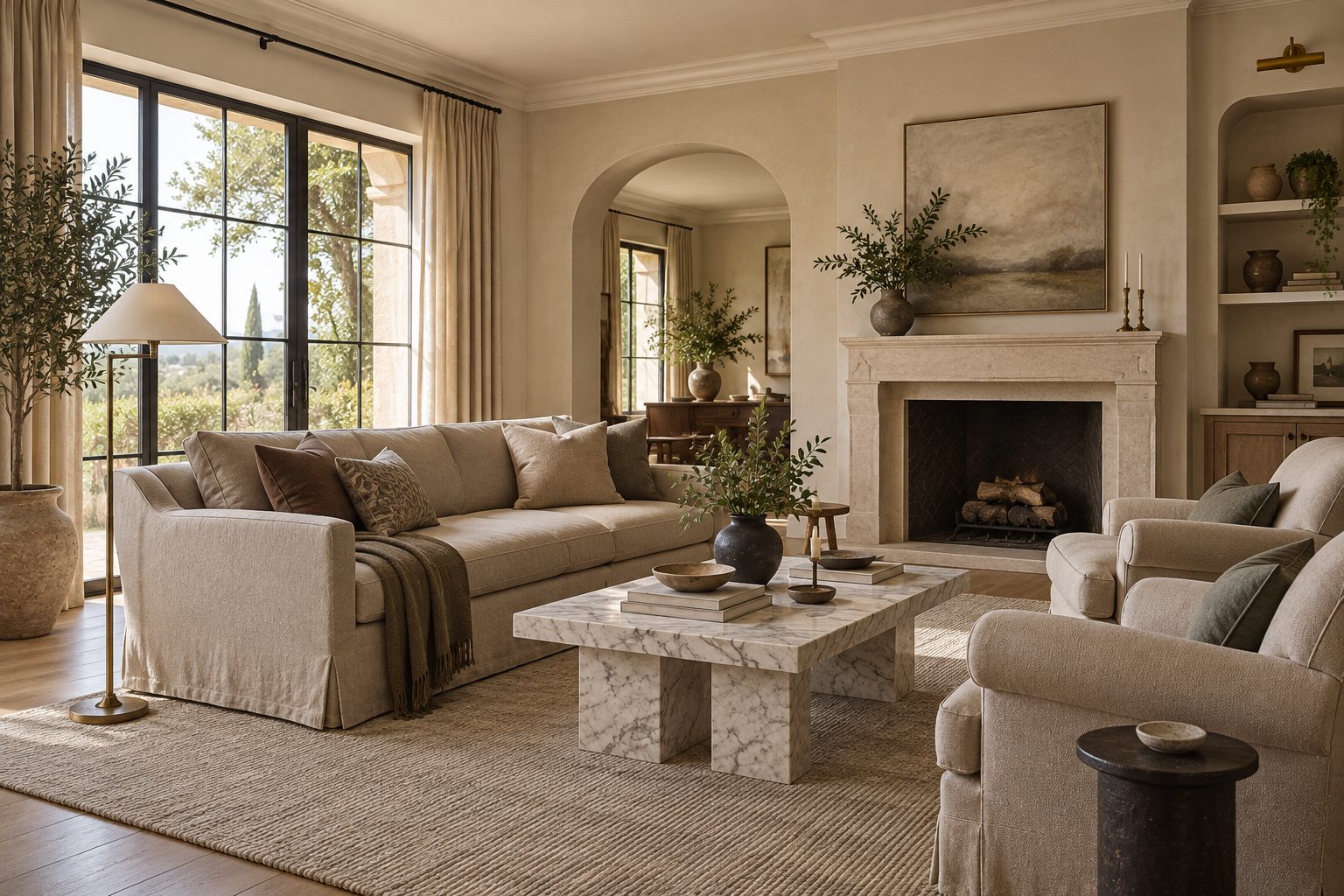
Transitional interior design is a blend of traditional and contemporary style: classic furniture shapes and moldings, stripped of ornament and set against a calm neutral palette. A transitional room typically uses 2 metal finishes at most, 2–3 wood or painted tones, and pattern only at small scale, so it feels comfortable and familiar without looking old-fashioned or cold.
Transitional is the style most American homes quietly default to, and it is easy to get vaguely right and hard to get genuinely good. This guide is part of our interior design styles guide, and it covers definitions, palettes, furniture specs and a room-by-room plan, with the details that separate a polished transitional style home from a beige one.
- Definition: traditional silhouettes plus contemporary simplicity, roughly 50/50.
- Palette: greige, warm white, soft gray, taupe and navy, with walls at LRV 55–75.
- Metals: 2 finishes at most, typically brushed nickel or aged brass plus matte black.
- Furniture: track or soft-roll arms, tapered or simple turned legs, tailored upholstery.
- Pattern: small-scale and tonal: herringbone, subtle stripes, tone-on-tone textures.
What does transitional mean in interior design?
In interior design, transitional means a style that bridges traditional and contemporary, keeping the comfort and proportion of the first and the simplicity of the second. The word describes a middle ground, not a period. A transitional style interior design scheme might have a classic rolled-arm sofa, but in a solid linen with no fringe; crown molding, but painted the same color as the walls; a chandelier, but a simple metal ring rather than crystal.
The style took its name in the 1990s, when homeowners wanted rooms that felt warm and grown-up without the heavy drapery and dark wood of traditional design. It has stayed in use ever since because it absorbs trends slowly: a transitional room in 2027 has softer curves and warmer neutrals than one from 2010, but the formula is the same.
What is transitional style?
Transitional style is defined by balance: roughly half traditional, half contemporary, with neither side allowed to dominate. In practice, that balance shows up in a handful of consistent choices:
- Classic shapes, simple finishes: wingback, slipper and English-arm silhouettes, upholstered in plain fabrics rather than chintz or damask.
- Architecture without fuss: crown molding, wainscoting and paneled doors, but in one color and without carved detail.
- Neutral envelope: walls, trim and large upholstery in warm whites, greige and taupe; color comes in through art, pillows and one accent piece.
- Texture over pattern: linen, wool, bouclé, leather and woven grasscloth do the work that florals do in traditional rooms.
- Mixed materials, restrained: one stained wood, one painted finish, two metals, one stone.
- Symmetry, loosened: paired lamps or chairs anchor the room, but the rest of the arrangement is relaxed.
The test we use: if you removed one traditional element and one contemporary element, would the room still look intentional? If it tips into either camp, rebalance.
What is a transitional home?
A transitional home is a house whose architecture or furnishings combine classic detailing with modern simplicity, typically with painted trim, open plan living and a neutral palette. Most American houses built since the late 1990s are transitional by default: a traditional exterior with gables and divided-light windows, and an interior with open kitchens, 9 ft (2.7 m) ceilings and simple flat-panel or Shaker-style cabinetry.
A transitional style home is also the easiest to sell. Its neutral bones let buyers imagine their own furniture, which is why stagers lean on transitional decor even when the house leans another way. If you are unsure what your house is, our contemporary vs modern interior design guide helps you sort the clean-lined half of the equation, and traditional interior design covers the other half.
What colors work in transitional home decor?
Transitional home decor uses warm neutrals on walls and large surfaces, mid-tone woods, and one or two deeper accents such as navy, charcoal or olive. Light reflectance value (LRV) matters: keep main walls at LRV 55–75, which reads light without the stark glare of pure white, and use a deeper color at LRV 10–25 for an island, a front door or a study.
#EDE7DD#D3CABC#B3A797#8E9196#2F3E52#6A6A55For trim, match the wall color in a higher sheen, or go one step lighter. Contrasting bright white trim against greige walls is the most dated version of transitional decor; tonal trim is how 2027 rooms do it. Our neutral paint colors guide lists warm whites and greiges by LRV and undertone.
What is transitional furniture?
Transitional furniture is furniture with classic proportions and simplified detail: tapered or simple turned legs, track or soft-roll arms, tailored upholstery and little or no carving. It is designed to sit equally well with antiques and with contemporary pieces, which is what makes the transitional furniture style so practical in mixed households.
| Piece | Transitional spec | Typical size | Avoid |
|---|---|---|---|
| Sofa | Track or soft English arm, tight or single-cushion back, tapered legs | 84–96 in (213–244 cm) wide, 36–40 in (91–102 cm) deep | Skirts with kick pleats, nailhead overload |
| Accent chair | Slipper, barrel or simplified wingback in solid fabric or leather | 28–32 in (71–81 cm) wide | Tufted, carved frames |
| Coffee table | Rectangular or oval, wood or stone top, simple base | Two-thirds of sofa length, 16–18 in (41–46 cm) high | Mirrored or ornate gilt |
| Dining table | Pedestal or four-leg, oak or walnut, eased edges | 36–42 in (91–107 cm) wide | Heavy trestles with carving |
| Dining chairs | Upholstered parsons or simple spindle back | 18–20 in (46–51 cm) seat height | Matching set with the table |
| Bed | Upholstered panel or channel headboard, tailored | Headboard 54–60 in (137–152 cm) tall for a queen | Sleigh beds, heavy footboards |
| Case goods | Flat or Shaker fronts, simple pulls, one wood tone | Dresser 60–72 in (152–183 cm) wide | Bow fronts, applied carving |
Upholstery should run at 25,000–40,000 Martindale double rubs for family rooms, in performance linen blends, wool or leather. Wood tones should stay within two families; our how to mix wood tones guide explains how to pair a mid-tone oak with a painted finish.
Transitional vs traditional vs contemporary
Traditional is ornate and historic, contemporary is current and minimal, and transitional sits deliberately between them, borrowing shapes from one and restraint from the other. The comparison matters most when you are buying the big pieces.
| Element | Traditional | Transitional | Contemporary |
|---|---|---|---|
| Palette | Rich reds, blues, golds, pattern | Greige, warm white, navy accent | Warm neutrals or stark contrast |
| Lines | Curved, carved, ornamented | Classic shapes, plain detail | Clean, low, sculptural |
| Fabrics | Damask, chintz, velvet with fringe | Linen, wool, leather, small-scale pattern | Bouclé, solid weaves, leather |
| Wood | Dark mahogany, cherry | Mid-tone oak, walnut, painted | Pale oak or none |
| Metals | Polished brass, gilt | Nickel, aged brass, matte black | Chrome, blackened steel |
| Architecture | Deep moldings, contrasting trim | Moldings in wall color | Flat casings or none |
| Accessories | Many, collected, symmetrical | Edited, in pairs and threes | Few, sculptural |
The transitional vs traditional decision usually comes down to ornament and color: if you want pattern, carving and saturated color, you are traditional. The transitional vs contemporary decision comes down to comfort: if you want rolled arms, skirted chairs and paired lamps, you are transitional.
How to design a transitional style living room
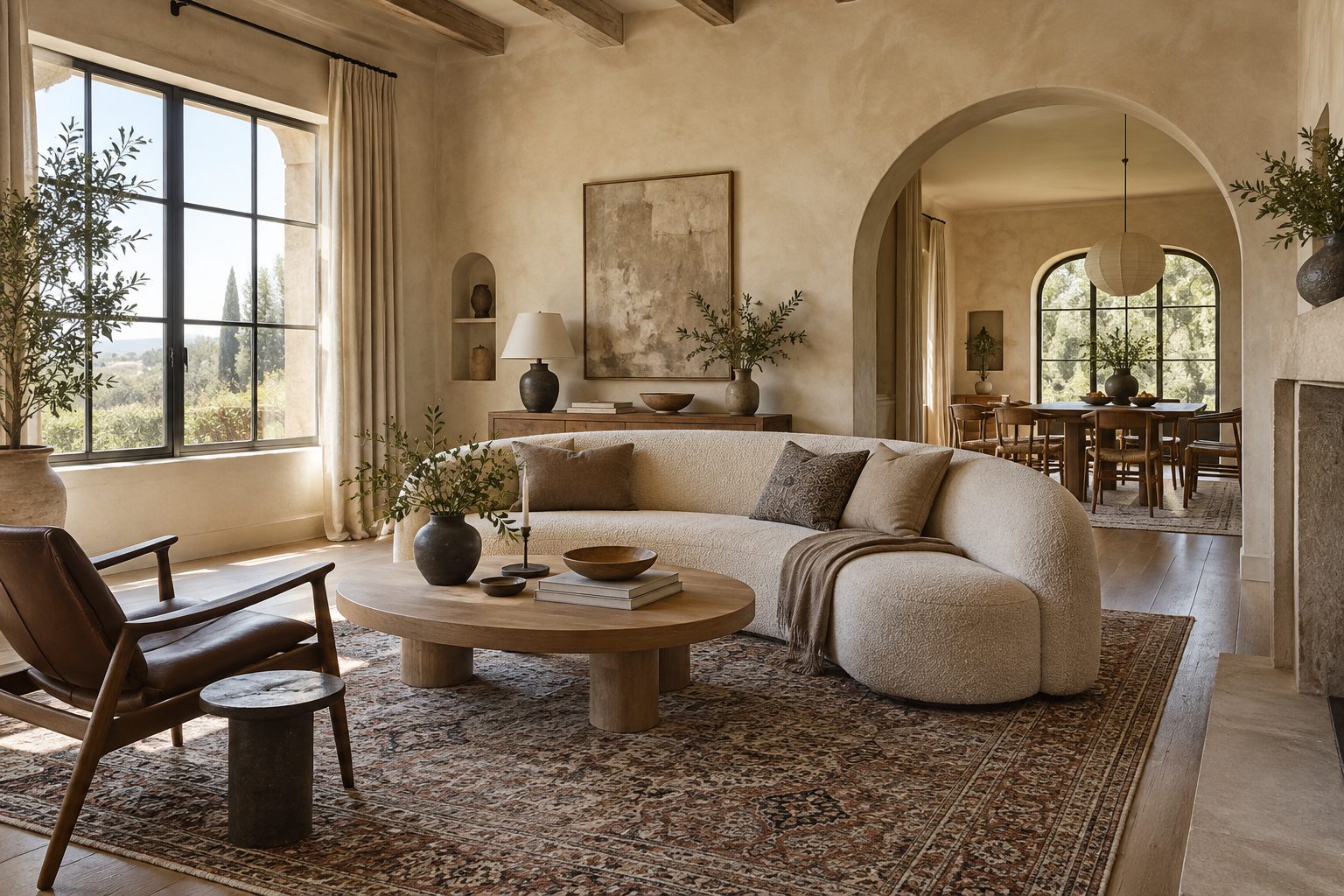
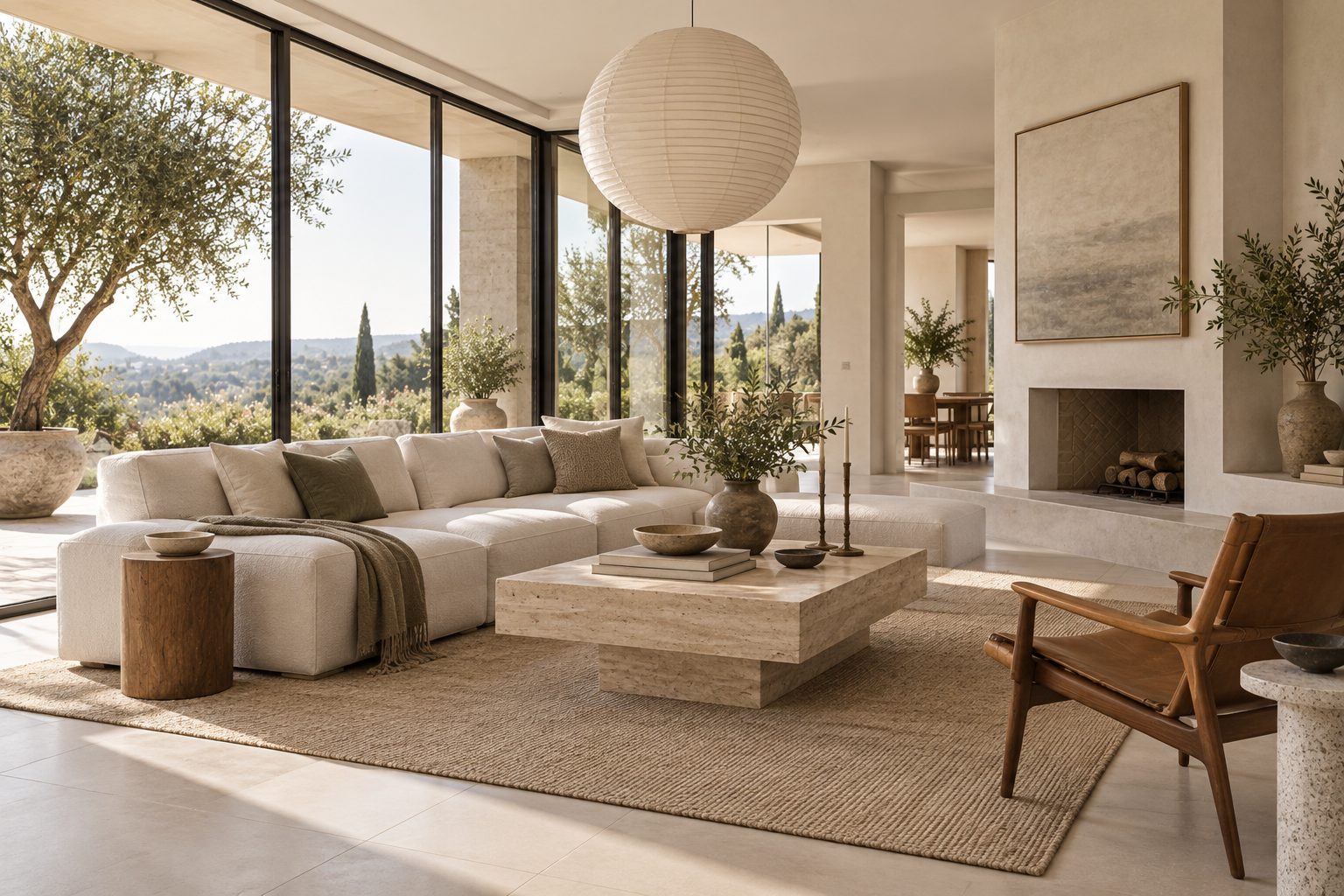
A transitional style living room rests on a tailored sofa, paired chairs, a neutral rug and layered lighting, arranged around a single focal point with a loose symmetry. Here is the order we work in:
- Set the envelope. Paint walls and trim in one warm neutral at LRV 60–70, with trim in satin and walls in matte or eggshell.
- Choose the focal point. A fireplace, a large window or built-in shelving. Center the seating group on it.
- Size the sofa. In a 14 × 18 ft (4.3 × 5.5 m) room, an 88–92 in (224–234 cm) track-arm sofa is right; check the sofa size guide for other rooms.
- Add paired chairs. Two slipper or barrel chairs opposite the sofa, 36–42 in (91–107 cm) apart, give the symmetry transitional relies on.
- Lay the rug. Wool or wool-viscose in a tonal pattern, large enough that every front leg sits on it, usually 8 × 10 ft or 9 × 12 ft (244 × 305 cm or 274 × 366 cm).
- Light in three layers. Recessed or flush ambient at 2700–3000K, a pair of table lamps, and one statement fixture in a simple metal or linen shade.
- Edit the accessories. Group in odd numbers, limit pattern to pillows and one throw, and leave at least a third of each surface clear.
Transitional decor in the kitchen, dining room and bedroom
Transitional decor carries from room to room through the same three moves: classic shapes, tonal color and two metals, adjusted for how each room is used. Repeating those moves is what makes a whole house read as one transitional scheme rather than a series of unrelated rooms.
Kitchen
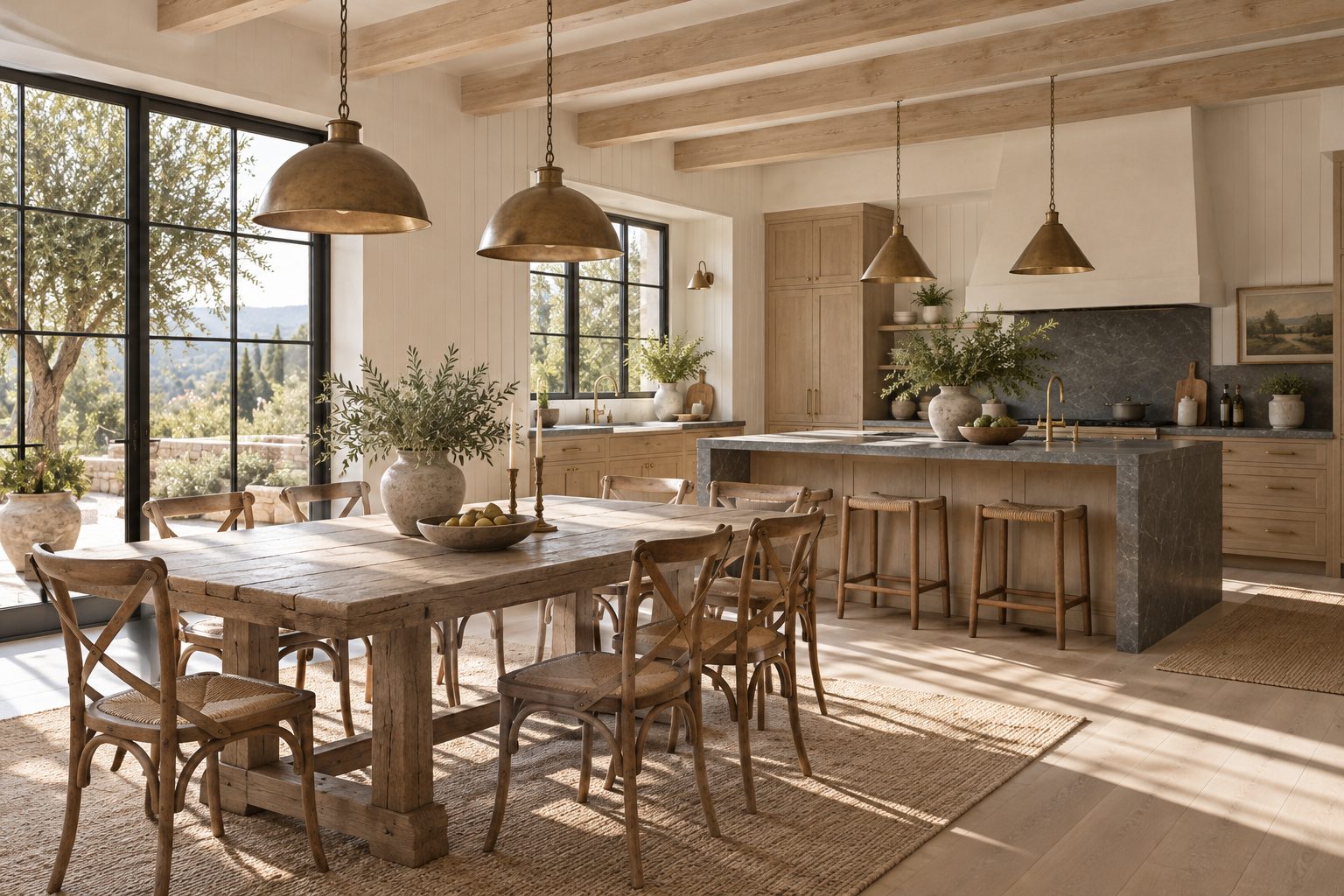
Shaker or slim-rail cabinet doors are the transitional default, painted in warm white or greige on the perimeter and a deeper navy, olive or stained oak on the island. Pair them with a honed quartz or marble-look counter at 1.25 in (3 cm), a simple zellige or handmade-look ceramic backsplash taken to the underside of the upper cabinets, and two or three lantern or dome pendants spaced 24–30 in (61–76 cm) apart over the island. Hardware should be one metal for pulls and the faucet, with a second metal allowed only in the lighting.
Dining room
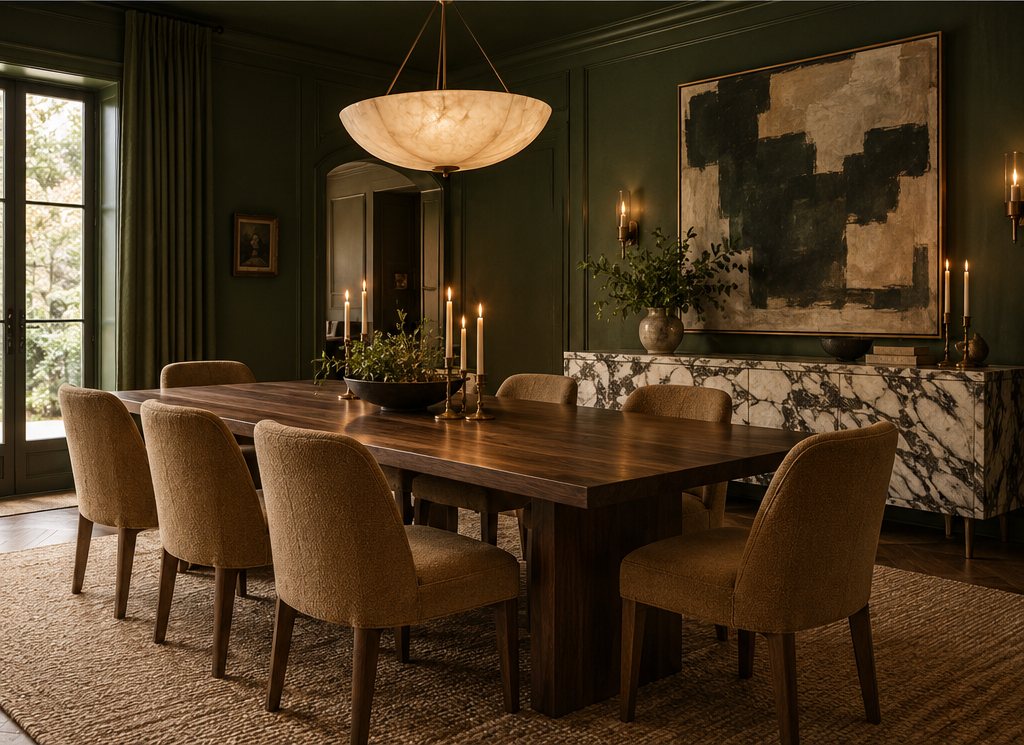
A round pedestal table for four to six, 48–60 in (122–152 cm) in diameter, softens a square room; a rectangular table 36–42 in (91–107 cm) wide suits longer rooms. Upholstered parsons chairs in a wipeable linen blend, a simple drum or ring chandelier hung 30–36 in (76–91 cm) above the tabletop, and a flat-weave or low-pile rug extending 24 in (61 cm) beyond the chairs complete the room.
Bedroom
An upholstered channel or panel headboard, matching nightstands with lamps at 24–28 in (61–71 cm) tall, layered white and oatmeal bedding and lined curtains hung close to the ceiling are the transitional bedroom formula. Keep the case goods in one wood tone and use the bench or a single chair to introduce texture, such as bouclé, leather or a woven cane back.
Our verdict: how we would do transitional in 2027
Transitional works best when it leans slightly warmer and more textural than its 2010s version, and when one or two pieces carry genuine character. We would swap cool gray for greige and warm white, use tonal trim rather than contrasting white, choose oak over espresso finishes and bring in one curved piece, a barrel chair or an oval coffee table, to stop the room from feeling square. The biggest mistake we see is a room so neutral and matched that nothing is memorable; one vintage rug, one good piece of art or one antique chest fixes it.
Ready to furnish? Send your floor plan and spec list to our furniture sourcing desk for factory quotes on tailored sofas, chairs and case goods in transitional proportions.
Free toolCurtain Size CalculatorRod length, panel size, ready-made match and yardage.Shop & source the look
Buy it today — or have it made
Retail links are affiliate links: we may earn a commission at no extra cost to you (disclosure). “Get it made” sends the item to our sourcing desk for factory quotes in custom sizes and finishes.
Frequently asked questions
What is transitional style?
Transitional style is an interior design style that blends traditional and contemporary design in roughly equal measure. It keeps classic furniture shapes, moldings and symmetry but removes ornament, uses a warm neutral palette, limits metals to two finishes and relies on texture rather than bold pattern.
What is a transitional home?
A transitional home combines classic architecture or furnishings with modern simplicity: painted trim, open-plan living, neutral walls and furniture that is traditional in shape but plain in detail. Most US houses built since the late 1990s fall into this category, which is why it is also the most resale-friendly style.
What does transitional mean in interior design?
In interior design, transitional means a bridge between traditional and contemporary style. It describes a balance rather than a period: a rolled-arm sofa in plain linen, crown molding painted the wall color, or a simple metal chandelier in place of crystal. The aim is comfort without clutter.
What is transitional furniture?
Transitional furniture has classic proportions with simplified detail: tapered or simple turned legs, track or soft-roll arms, tailored upholstery in solid fabrics, and flat or Shaker-style fronts on case goods. It is designed to sit comfortably beside both antiques and contemporary pieces.
What is the difference between transitional, contemporary and traditional?
Traditional design is ornate, patterned and historic; contemporary design is current, minimal and sculptural; transitional sits between them, borrowing classic shapes from traditional and restraint from contemporary. Choose traditional for pattern and carving, contemporary for clean low lines, and transitional for comfort with calm, neutral detailing.
Some links may be affiliate links. Regulations and specifications change — always confirm with suppliers and qualified professionals.