Traditional Interior Design: 8 Elements & Modern Traditional
Traditional interior design draws on 18th- and 19th-century European and American rooms: symmetry, millwork, curved and turned furniture, layered pattern and warm, mid-tone color. Modern traditional keeps the symmetry and millwork, simplifies the furniture and pattern, and pairs antiques with plain upholstery.
Part of our guide: Home Interior Design Ideas: House Styles, Rooms & Layouts
Key takeaways
- Traditional interior design is defined by symmetry around a focal point, millwork, curved and turned furniture, layered pattern and warm mid-tone color
- Modern traditional keeps the symmetry, millwork and classic shapes but cuts pattern to one or two fabrics, lifts walls to a warm white and mixes antiques with plain upholstery
- Lay the living room out on an axis through the fireplace or window with the sofa centered, a pair of chairs, matched lamps and a rug that takes every seat
- Traditional walls sit at LRV 25–60 in matte or eggshell; gloss on walls makes the style look like a showroom
- Furnishing a 15x18 ft living room runs $12,000–30,000 traditional or $10,000–25,000 modern traditional at mid-range quality
Traditional interior design is a style built on the rooms of 18th- and 19th-century Europe and America, and it is recognizable by eight things: symmetry around a focal point, architectural millwork such as crown molding and wainscoting, furniture with curved or turned legs, layered patterns in florals, stripes and damasks, warm mid-tone colors, dark or mid-tone wood, matched pairs of lamps and chairs, and classical art and accessories. Modern traditional interior design keeps the first three and simplifies the rest.
It is the default style of houses built before 1950, and in 2027 it is back as the reference point for rooms that want to feel settled rather than styled, under the names modern traditional, new traditional and contemporary traditional. This guide covers the defining elements, the difference between traditional and its modern versions, room-by-room rules, palettes and what it costs to furnish a room in the style. It is part of our home interior design ideas hub, and it sits close to quiet luxury interiors, which is traditional with the pattern turned off.
- Origins: Georgian, Federal, Regency and Victorian rooms, filtered through 20th-century decorating.
- Layout: symmetrical, anchored on a fireplace or a window, with furniture in conversational groupings 8–10 ft (2.4–3 m) across.
- Furniture: rolled or scrolled arms, skirted or turned-leg sofas, wing and club chairs, wood case pieces with molding and brass hardware.
- Color: warm whites, creams, sage, navy, burgundy, hunter green and gold, in matte and eggshell finishes.
- Cost: furnishing a 15x18 ft (4.6x5.5 m) living room in a mid-range traditional scheme runs $12,000–30,000; a modern traditional version $10,000–25,000.
What defines traditional interior design?
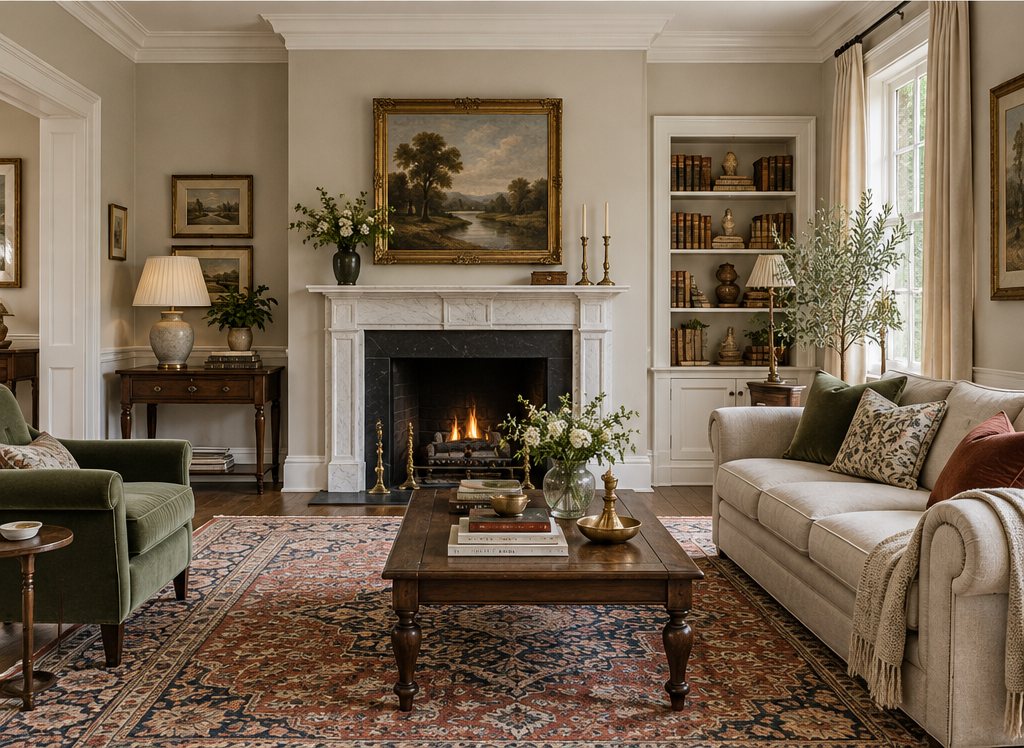
Traditional style interior design is defined by order: a room balanced side to side, furnished in matched pairs, finished with molding, and layered with pattern and textiles in a warm palette. It is historical in its references but not a reproduction; it is the decorating language of the early 20th century, when Georgian and Regency proportions were made comfortable with deep sofas and skirted chairs. The eight elements below, taken together, make a room read as traditional.
| Element | What it looks like | Typical spec | In modern traditional |
|---|---|---|---|
| Symmetry | Pairs of chairs, lamps and sconces either side of a focal point | Fireplace or window on the room's axis; sofa centered on it | Kept, but one pair is enough |
| Millwork | Crown molding, baseboards, chair rail, wainscoting, paneled doors | Crown 4–7 in (10–18 cm); base 5–8 in (13–20 cm); wainscot 32–36 in (81–91 cm) | Kept, often painted the wall color |
| Furniture lines | Rolled arms, turned or cabriole legs, camelback sofas, wing chairs | Sofa 84–96 in (213–244 cm); seat height 18–19 in (46–48 cm) | Simplified: straight or slim rolled arms, exposed legs |
| Pattern | Florals, damasks, toiles, stripes, plaids, layered together | Three to five patterns per room in one palette | One or two patterns, often on a chair or curtains only |
| Color | Warm, mid-tone, saturated: navy, burgundy, hunter green, gold, cream | LRV 25–60 on walls; eggshell or matte | Pale warm neutrals with one deep accent room |
| Wood | Mahogany, cherry, walnut; polished or antique finish | Case pieces with molding; brass or bronze hardware | Lighter oak and walnut mixed with one dark antique |
| Textiles | Lined, interlined curtains with valances or pelmets; wool and oriental rugs | Curtains at 2–2.5x fullness; rug 8x10 ft (2.4x3 m)+ | Plain linen curtains on rings; vintage or flat-weave rugs |
| Accessories | Oil paintings, gilt mirrors, porcelain, books, ginger jars | Grouped in threes and fives; symmetrical on mantels | Fewer, larger pieces; one gilt mirror, one lamp pair |
The two elements people most often miss are scale and finish. Traditional furniture is larger, a 90 in (229 cm) sofa rather than 78 in (198 cm), a 30 in (76 cm) lamp rather than 24 in (61 cm), because its rooms had 9–11 ft (2.7–3.4 m) ceilings. Finishes are low-sheen: matte or eggshell walls, satin trim, waxed wood rather than gloss lacquer. Under an 8 ft (2.4 m) ceiling at full gloss it looks like a showroom; kept matte it looks like a house.
What is the difference between traditional and modern traditional?
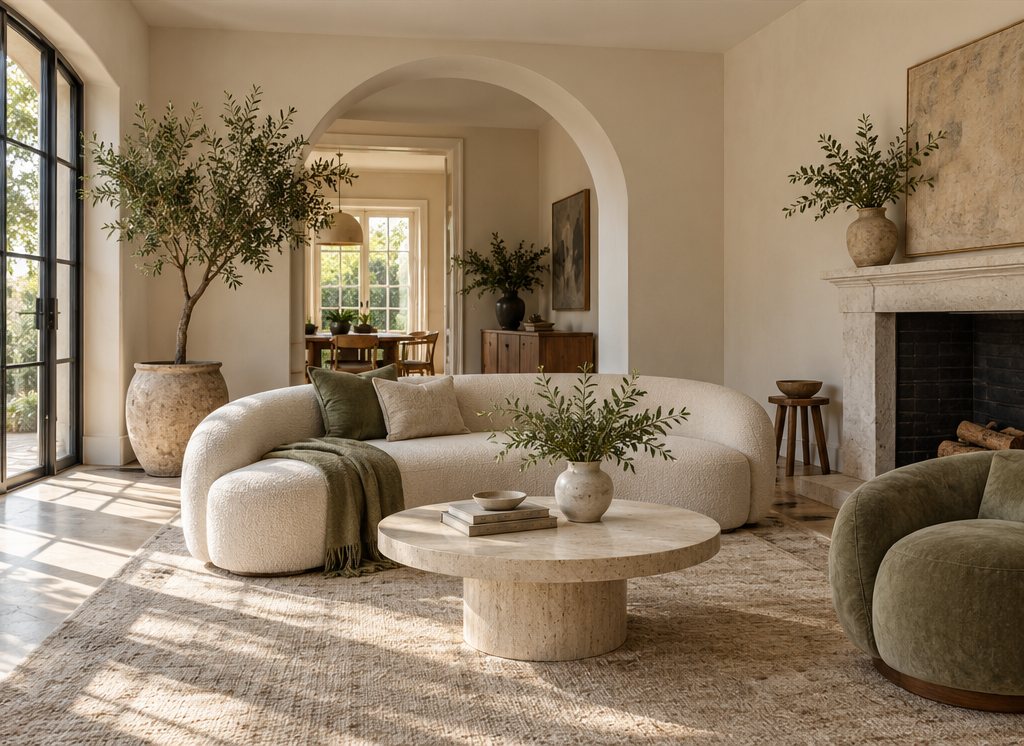
Modern traditional interior design keeps the bones of traditional, the symmetry, the millwork, the classic furniture shapes and the warm palette, and strips out the layering: fewer patterns, lighter colors, plainer fabrics, a mix of antique and new pieces, and empty space where a traditional room would have a third side table. The result reads as classic without reading as formal. New traditional interior design and contemporary traditional interior design are the same idea under different names, with contemporary traditional usually meaning a slightly more modern furniture mix and new traditional a slightly more cottage one.
Side by side
- Walls: traditional uses mid-tone color or wallpaper above a chair rail; modern traditional uses a warm white or pale neutral on walls and millwork alike, with one color-drenched room.
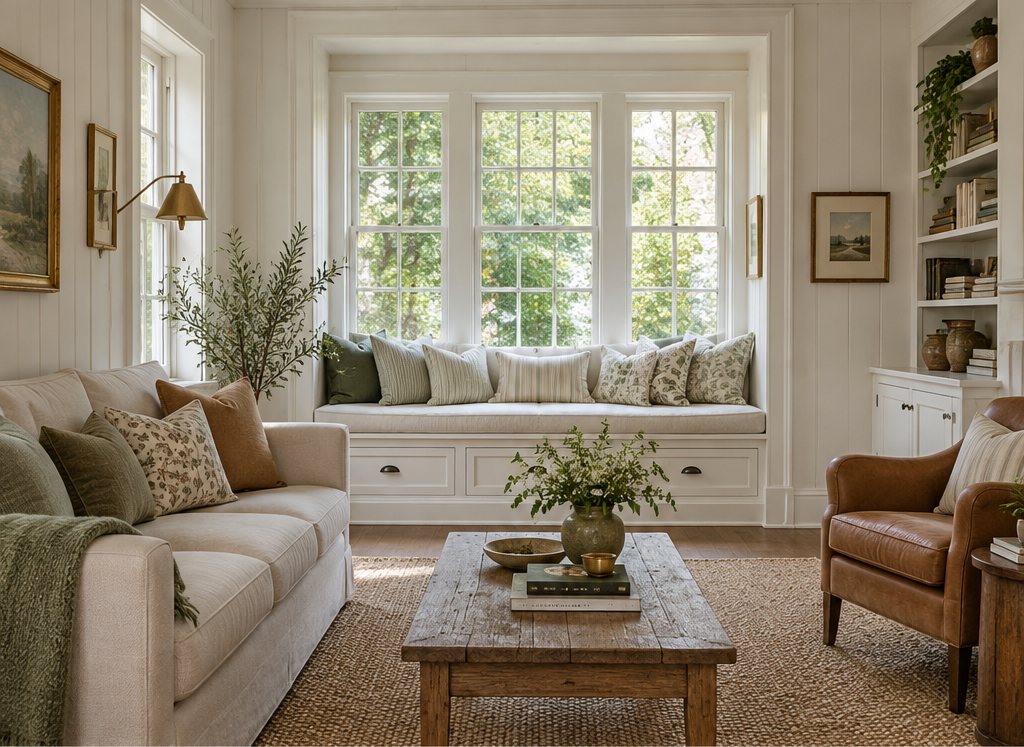
- Sofa: traditional is a skirted or rolled-arm sofa in a damask or velvet; modern traditional is a slim rolled-arm or English-arm sofa in plain linen or a performance weave on turned legs.
- Chairs: traditional pairs two matching wing chairs; modern traditional pairs one antique chair with one modern one, or uses a pair of plain slipper chairs.
- Rug: traditional uses a bordered oriental in red and navy; modern traditional uses a faded vintage rug, a flat-weave or a plain wool with a narrow border.
- Curtains: traditional has lined curtains with a valance, swag or pelmet; modern traditional has plain floor-length linen on a slim iron or brass rod.
- Lighting: traditional pairs porcelain or brass lamps with pleated silk shades and a crystal chandelier; modern traditional keeps the lamp pair, switches the shades to linen and the chandelier to a plain brass or iron fixture.
- Accessories: traditional groups porcelain, books and framed prints on every surface; modern traditional leaves most surfaces clear and hangs one large piece of art over the sofa.
The practical test is to count: a traditional living room has four or five fabric patterns and 30–40 decorative objects; a modern traditional decorating style gets the same room to one or two patterns and 10–15 objects, with furniture 10–15 percent smaller for modern ceiling heights.
How do you lay out a traditional living room?
Lay out a traditional living room on an axis through the fireplace or the main window, with the sofa facing or flanking it, a pair of chairs opposite or either side, a coffee table 18 in (46 cm) from the sofa, and a lamp on a table at each end of the sofa. The conversation group should be 8–10 ft (2.4–3 m) across so people can talk without raising their voices, and every seat should sit on the rug. Symmetry does not have to be perfect, the pair of chairs can differ, but the two sides of the axis should carry equal visual weight.
- Find the axis. Stand in the main doorway; the fireplace, a large window or a built-in bookcase on the wall opposite or to one side becomes the focal point. Everything is placed relative to it.
- Center the sofa on the focal point, 84–96 in (213–244 cm) long in a room over 14 ft (4.3 m) wide, facing the fireplace or at a right angle to it with 7–9 ft (2.1–2.7 m) between sofa and fireplace.
- Add the chair pair, wing, club or slipper chairs, 28–34 in (71–86 cm) wide, flanking the fireplace or facing the sofa across the coffee table, angled 10–15 degrees toward each other.
- Set the rug so all four legs of the sofa and the chairs are on it; 8x10 ft (2.4x3 m) or 9x12 ft (2.7x3.7 m) in most rooms, with a border or a vintage pattern. See living room layout ideas for the alternative groupings.
- Place the lamp pair on matching or near-matching end tables, 26–30 in (66–76 cm) tall overall so the shade bottom is at a seated eye level of 40–42 in (102–107 cm).
- Add the secondary seating, a bench in front of the fireplace, a small chair in a corner, or a window seat, so the room seats six to eight for a gathering.
- Finish the walls: a large mirror or painting over the mantel at 60 in (152 cm) to center, sconces either side at 60–66 in (152–168 cm), and a bookcase or a pair of prints on the opposite wall. Hanging heights are in how to hang art.
What colors are used in traditional interiors?
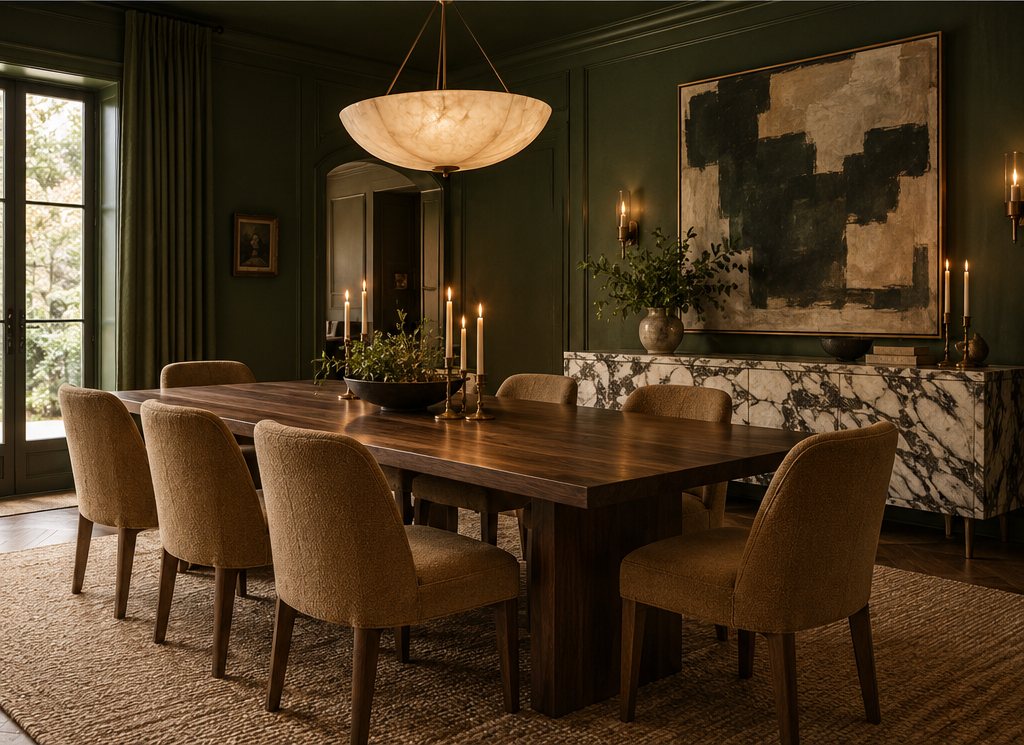
Traditional interiors use warm, saturated mid-tones drawn from natural pigments: cream and warm white for ceilings and trim, sage and olive green, navy and slate blue, burgundy and oxblood, mustard and old gold, and the browns of the wood itself. Walls in the classic version sit at a light reflectance value of 25–60, which is darker than most modern rooms, and the palette is kept to three colors per room plus wood and metal. Modern traditional lifts the walls to a warm white at LRV 75–85 and uses the deep colors in one room, a library, a dining room or a powder room, or on a single piece of upholstery.
#F2EADB#8A9A7B#2E3A52#6E2E2E#C8A24A#5C4033Finish does as much as hue. A navy dining room in a matte or dead-flat paint reads as traditional; the same navy in semi-gloss reads as a nightclub. Use matte or eggshell on walls, satin on trim and millwork, and reserve gloss for a lacquered front door or a single piece of furniture; the rules are in the paint sheen guide. For a whole-house scheme, run one warm white through the halls and public rooms and give each closed room its own color, the approach set out in how to choose an interior color scheme, and browse the palette library for traditional sets.
What furniture and fabrics belong in a traditional home?
Traditional home interiors are furnished with upholstered sofas and chairs in classic shapes, wood case furniture with molded edges and brass hardware, and fabrics in natural fibers: linen, wool, cotton velvet, silk and chintz. The upholstery shapes to know are the camelback and the English roll-arm sofa, the wing chair, the club chair, the slipper chair and the bergère with its exposed wood frame; the case pieces are the chest of drawers, the secretary, the highboy, the sideboard and the pedestal dining table. In a modern traditional home decor scheme, one or two of these pieces are antiques or good reproductions and the rest is plain, new upholstery.
Specifications that keep it comfortable
- Sofa: 84–96 in (213–244 cm) long, 38–40 in (97–102 cm) deep, seat height 18–19 in (46–48 cm), with a sprung seat and feather-wrapped foam cushions; a tight back or loose cushions both work.
- Chairs: wing chairs 30–34 in (76–86 cm) wide and 42–46 in (107–117 cm) tall; club chairs 32–36 in (81–91 cm) wide; slipper chairs 24–28 in (61–71 cm) wide with no arms.
- Fabrics: 25,000–40,000 Martindale for family rooms; linen and cotton for slipcovers, wool and velvet for formal rooms, chintz and toile for pattern. Choose patterns at three scales, a large floral, a medium stripe and a small check, if layering.
- Wood: mix two or three tones, a dark antique with mid-tone new pieces, and keep the undertone warm; the rules are in how to mix wood tones.
- Curtains: lined, floor-length, at 2–2.5 times fullness, on a rod set 4–6 in (10–15 cm) above the frame and 6–10 in (15–25 cm) past it each side; sizes in the curtain size guide.
- Rugs: an oriental or a bordered wool for the classic room, a faded vintage or a flat-weave for the modern traditional one, always large enough to take every seat.
What are the best traditional interior design ideas for 2027?
The traditional interior design ideas doing the most work in 2027 are the ones that update the formula without losing it: painted millwork in the wall color, one antique per room, plain linen on classic shapes, warm white walls with a single deep room, and brass and iron lighting in simple forms. Decorating traditional in 2027 is less about reproducing a period than about borrowing its order and comfort.
- Color-drench the millwork. Paint wainscoting, trim, doors and walls in one color, a warm white in living rooms, a deep green or navy in a study; it keeps the architecture and loses the fussiness.
- Add wainscoting where there is none. A 32–36 in (81–91 cm) applied-molding or raised-panel wainscot costs $12–30 per linear ft and is the fastest way to give a plain room traditional bones; ideas are in wainscoting ideas.
- One antique, one modern. A Georgian chest under a plain modern mirror, or a contemporary sofa facing a pair of antique chairs; the contrast is the point.
- Swap the chandelier for brass or iron. A plain brass lantern or a six-arm iron chandelier at 30–36 in (76–91 cm) above a dining table keeps the formality without the crystal.
- Hang sconces in pairs. Brass or plaster wall sconces either side of a mirror, a bed or a fireplace are the cheapest symmetry available, from $60 each for plug-in versions.
- Use pattern in one place. A floral or a stripe on the curtains or a pair of chairs, with everything else plain; or a patterned wallpaper in one small room only.
What does it cost to furnish a traditional room?
Furnishing a 15x18 ft (4.6x5.5 m) traditional living room from scratch costs $12,000–30,000 at mid-range quality, and $10,000–25,000 for a modern traditional version with fewer pieces; antiques and custom upholstery push either past $50,000, while a careful mix of secondhand case pieces and new upholstery can bring a convincing room in at $6,000–10,000. The table gives a realistic breakdown.
| Item | Traditional (mid-range) | Modern traditional (mid-range) | Notes |
|---|---|---|---|
| Sofa, 90 in (229 cm), rolled arm | $2,500–5,000 | $2,000–4,000 | Linen slipcover saves $500–1,000 over fixed velvet |
| Pair of armchairs | $2,000–5,000 | $1,500–4,000 | Antique frames re-covered: $600–1,200 each plus fabric |
| Coffee table and two end tables | $1,500–3,500 | $1,200–3,000 | Secondhand mahogany is the value buy |
| Rug, 9x12 ft (2.7x3.7 m) | $1,500–5,000 (wool, bordered) | $800–3,000 (vintage or flat-weave) | Hand-knotted wool runs $4,000+ |
| Lamp pair and chandelier or pendant | $1,200–3,000 | $800–2,000 | Plain brass fixtures cost less than crystal |
| Curtains, 2 windows, lined, 2.5x fullness | $1,500–4,000 | $800–2,500 | Valances and pelmets add $300–800 per window |
| Millwork: crown and chair rail, 66 linear ft | $1,500–4,000 | $1,500–4,000 | Wainscoting adds $12–30 per linear ft |
| Art, mirror and accessories | $1,500–5,000 | $800–2,500 | One large mirror over the mantel: $300–1,200 |
| Total | $13,000–34,000 | $9,400–25,000 |
On a tight budget, spend on the sofa, the rug and the curtains and buy the case pieces secondhand; a 19th-century mahogany chest routinely costs less than a new veneered one. On a generous budget, the money goes to custom upholstery, hand-knotted rugs and interlined curtains.
How do you choose between traditional, modern traditional and other classic styles?
Choose traditional if the house has the architecture for it, 9 ft (2.7 m) ceilings, original millwork, a fireplace, and you want a layered, collected room; choose modern traditional for a house with 8 ft (2.4 m) ceilings, less millwork and a tighter budget, or if you prefer plain fabrics and clear surfaces; and consider quiet luxury if you want traditional's materials with no pattern, or transitional for an even mix of classic and modern pieces.
In practice the decision turns on three questions. How much pattern can you live with: four or five fabrics is traditional, one or two is modern traditional, none is quiet luxury. How much do you own already: a house full of inherited mahogany and oriental rugs is cheaper to lighten than to replace. And how much time do you have: a traditional room is assembled over years, a modern traditional one in a season. Either way, the direction fits the wider move toward settled rooms in interior design trends 2027.
Free toolWallpaper CalculatorHow many rolls you need, allowing for the pattern repeat.Frequently asked questions
What is traditional interior design?
Traditional interior design is a style based on 18th- and 19th-century European and American rooms, defined by symmetry around a focal point, architectural millwork, furniture with curved or turned legs, layered patterns such as florals and stripes, warm mid-tone colors, dark or mid-tone wood, matched pairs of lamps and chairs, and classical art and accessories.
What is modern traditional interior design?
Modern traditional keeps the symmetry, millwork, classic furniture shapes and warm palette of traditional style but simplifies it: one or two patterns instead of four or five, warm white walls with a single deep room, plain linen on rolled-arm sofas, a mix of antique and new pieces, and far fewer accessories. It is also called new traditional or contemporary traditional.
What colors are used in traditional interior design?
Warm cream and white for trim and ceilings, with sage and olive green, navy and slate blue, burgundy and oxblood, mustard and old gold on walls and upholstery, in matte or eggshell finishes at a light reflectance value of 25–60. Modern traditional lifts the walls to a warm white and uses the deep colors in one room or on one piece.
What furniture is traditional style?
Rolled-arm and camelback sofas, wing, club, slipper and bergère chairs, and wood case pieces such as chests of drawers, secretaries, sideboards and pedestal dining tables, usually in mahogany, cherry or walnut with brass hardware. Traditional sofas are large, 84–96 in long, because the rooms they were designed for had 9–11 ft ceilings.
Is traditional interior design still in style in 2027?
Yes, in its modern traditional form. Rooms with symmetry, millwork and classic shapes but pale walls, plain fabrics and fewer objects are one of the strongest directions of 2027, because they feel settled rather than styled. Full-pattern traditional rooms are rarer in new projects but remain the natural style for houses built before 1950.
How do you make a traditional room look modern?
Paint walls, trim and millwork one warm white, cut the fabric patterns to one or two, slipcover or re-cover the sofa in plain linen, replace a crystal chandelier with plain brass or iron, swap the oriental rug for a faded vintage or flat-weave, clear most surfaces, and hang one large piece of art over the sofa. Keep the symmetry and the matched lamp pair.
How much does it cost to decorate a traditional living room?
A 15x18 ft living room furnished from scratch at mid-range quality costs $12,000–30,000 traditional or $10,000–25,000 modern traditional, covering a sofa, a pair of chairs, tables, a 9x12 ft rug, lamps, lined curtains, millwork and accessories. Buying case pieces secondhand and slipcovering new upholstery brings it to $6,000–10,000.
Some links may be affiliate links. Regulations and specifications change — always confirm with suppliers and qualified professionals.