Home Decor Accessories: Ideas, Sizes and Styling Rules by Room
Home decor accessories look curated when they follow a few rules: groups of three, one hero piece per surface, art centered at 57–60 in (145–152 cm). Room-by-room ideas for walls, shelves and tables, with costs.
Part of our guide: Home Interior Design Ideas: House Styles, Rooms & Layouts
Key takeaways
- Home decor accessories work in groups of three or five, with one tall, one medium and one low object on every surface
- Wall decor is the biggest accessory: size art to about two-thirds of the furniture below and center it at 57–60 in (145–152 cm)
- Repeat each color and material at least three times in a room so accessories look chosen rather than collected
- Buy fewer, larger, better-made pieces; most rooms need 15–25 accessories, not 60
Home decor accessories are the movable, finishing layer of a room: art, mirrors, vases, lamps, cushions, throws, trays, books, plants and objects. They look curated when you follow three rules: group them in threes or fives, give every surface one hero piece, and repeat each color or material at least three times. A typical room needs 15–25 accessories.
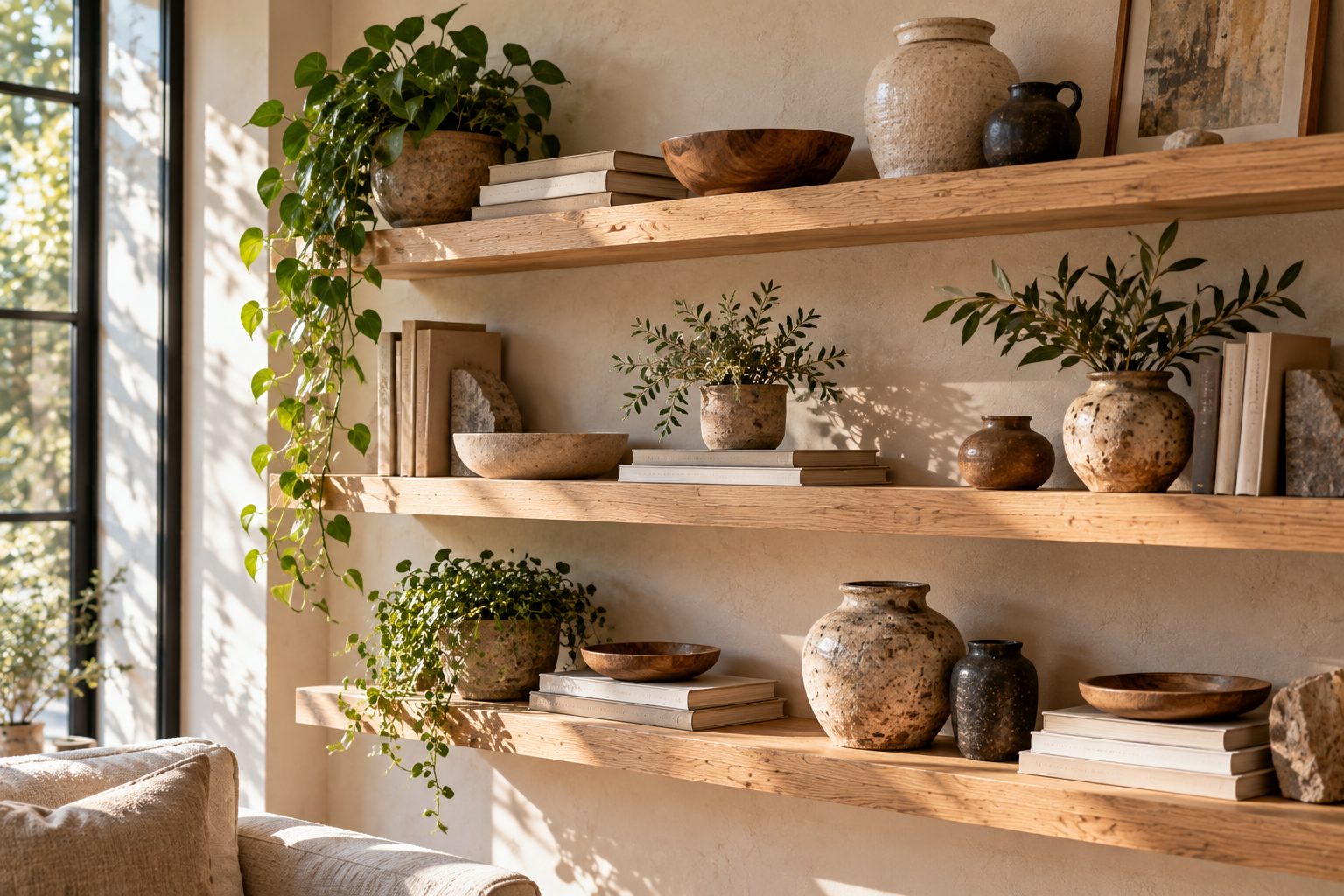
- Grouping: odd numbers, mixed heights (tall, medium, low), one shared color or material.
- Wall art: about two-thirds of the furniture width, centered at 57–60 in (145–152 cm).
- Breathing room: leave 30–40 percent of any shelf or console empty.
- Typical spend: $500–2,500 to accessorize a living room from scratch at mid-market prices.
Furniture decides how a room works; accessories decide whether it feels like yours. That is why ideas home accessories searches dwarf almost every other decorating query, and why the same sofa can look like a showroom or a home depending on what surrounds it. This guide is part of our home interior design ideas series and covers what to buy, how big, where it goes and what to skip.
What are home decor accessories?
Home decor accessories are the decorative, mostly portable objects that finish a furnished room, from wall art and mirrors to vases, cushions, lamps, trays and plants. They differ from furniture in that they can be moved, swapped or stored without tools, which makes them the cheapest way to change a room's style or season.
We sort home accessories into five groups, because each has different sizing rules:
| Group | Examples | Typical size range | Typical US cost per piece (2026) |
|---|---|---|---|
| Wall decor | Art, mirrors, wall hangings, plates, shelves | 16 × 20 in to 48 × 60 in (41 × 51 to 122 × 152 cm) | $40–1,500 |
| Textiles | Cushions, throws, rugs, curtains | Cushions 18–24 in (46–61 cm); throws 50 × 60–70 in (127 × 152–178 cm) | $30–400 |
| Lighting accents | Table lamps, candles, picture lights | Lamps 20–30 in (51–76 cm) tall | $60–600 |
| Tabletop objects | Vases, bowls, trays, boxes, sculpture | 4–24 in (10–61 cm) tall | $15–400 |
| Living and natural | Plants, branches, stones, books | Floor plants 4–7 ft (1.2–2.1 m) | $10–300 |
Prices are typical mid-market US ranges. Original art, antiques and handmade ceramics run higher, and that is often where the money is best spent.
How do you choose home decor accessories that look curated?
Choose home decor accessories by deciding the room's palette and two or three materials first, then buying fewer, larger pieces that repeat them. Curated rooms are not about expensive objects; they are about repetition and restraint.
- Set the palette. Pick two base neutrals and one or two accent colors from the rug, sofa or art.
- Pick three materials. For example, oak, stoneware and brass, or rattan, linen and terracotta.
- Buy the big pieces first. Art, mirror, lamps and a large vase set the scale; small objects fill in later.
- Repeat everything three times. If rust appears in a cushion, repeat it in a vase and a book spine.
- Mix old and new. At least one vintage, handmade or travel piece per room stops it feeling bought in one trip.
- Edit. Remove a fifth of what you placed, then live with it for a week.
Not sure what direction to take? Our free style quiz answers the common question "what is my home decor style" in about two minutes and suggests matching palettes.
Wall decor ideas: the biggest accessory in any room
Wall decor is the largest and most visible accessory in a room, so get its scale right before buying anything smaller: one large piece or a planned group should fill about two-thirds of the width of the furniture beneath it. Good wall decor ideas are less about what you hang than how big and how high.
| Wall situation | Recommended art width | Hanging height |
|---|---|---|
| Above an 84 in (213 cm) sofa | 54–63 in (137–160 cm) overall | Bottom edge 8–10 in (20–25 cm) above sofa back |
| Above a queen bed, 60 in (152 cm) wide | 40–45 in (102–114 cm) | Bottom edge 8–12 in (20–30 cm) above headboard |
| Above a 48 in (122 cm) console | 32–36 in (81–91 cm) | Bottom edge 6–10 in (15–25 cm) above console |
| Empty wall, 10 ft (3 m) wide | 48–60 in (122–152 cm), or a gallery group | Center at 57–60 in (145–152 cm) |
| Narrow wall between windows | Vertical piece, 60–75 percent of wall width | Center at 57–60 in (145–152 cm) |
For multi-frame walls, keep 2–3 in (5–8 cm) between frames and treat the group as one big piece; our gallery wall guide walks through layouts.
Wall accessories ideas beyond framed art
- Mirrors: round or arched, 30–40 in (76–102 cm), to bounce light in halls and dark rooms.
- Textile wall decor and hanging pieces: woven hangings, quilts or rugs on a batten, which also soften echo.
- Plates and baskets: clusters of 7–15 in one palette, ideal on kitchen and dining walls.
- Sconces as decor: a pair of plug-in sconces either side of art doubles as wall furnishing and light.
- Shelves and ledges: a 4 in (10 cm) picture ledge lets you rotate prints without new nail holes.
Wall furnishing ideas like paneling, limewash or wallpaper count too: a textured wall needs far less hanging decor.
Living room wall decor and accessories
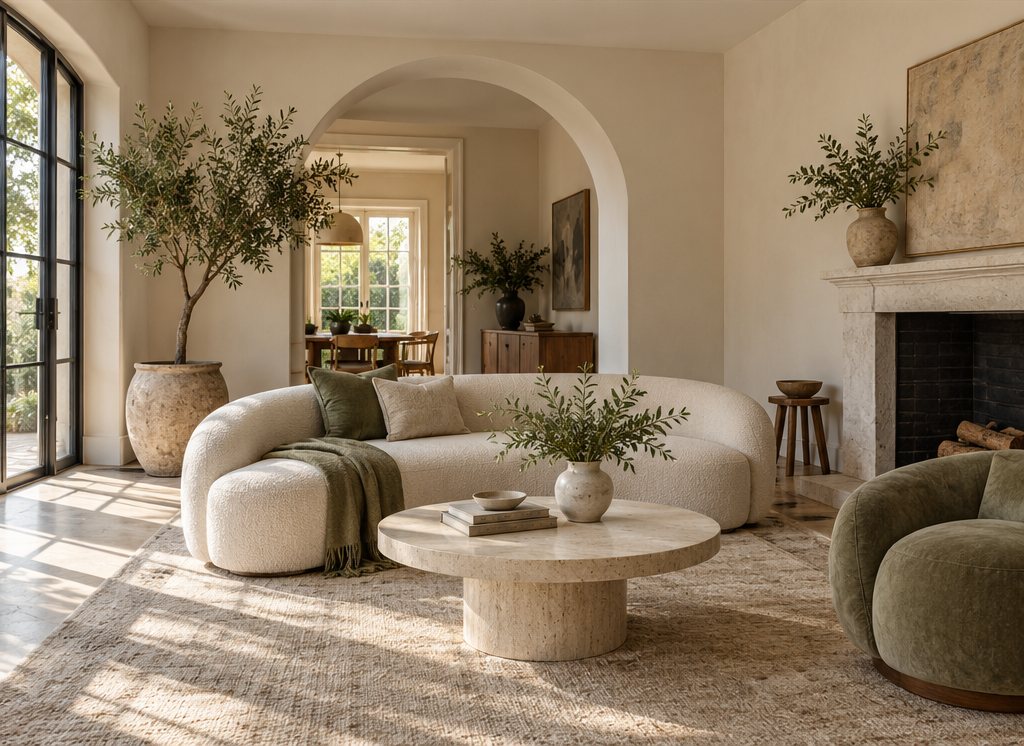
Living room wall decor should anchor the sofa wall with one large piece or a planned group, while tabletop accessories cluster on the coffee table, console and shelves in groups of three. The living room carries the most accessories in the house, so it is where discipline matters most.
For living room wall decor ideas, our detailed living room wall art ideas guide covers styles and sizes; the short version is one oversized canvas or a symmetrical pair above the sofa, and a mirror or textile on the opposite wall. Lounge wall decor follows the same scale rules.
- Coffee table: a tray with three objects, a stack of two or three books and one low vase, under 12 in (30 cm) tall so it does not block sight lines.
- Sofa: two to five cushions, 20–22 in (51–56 cm) on a standard sofa, plus one throw folded over an arm.
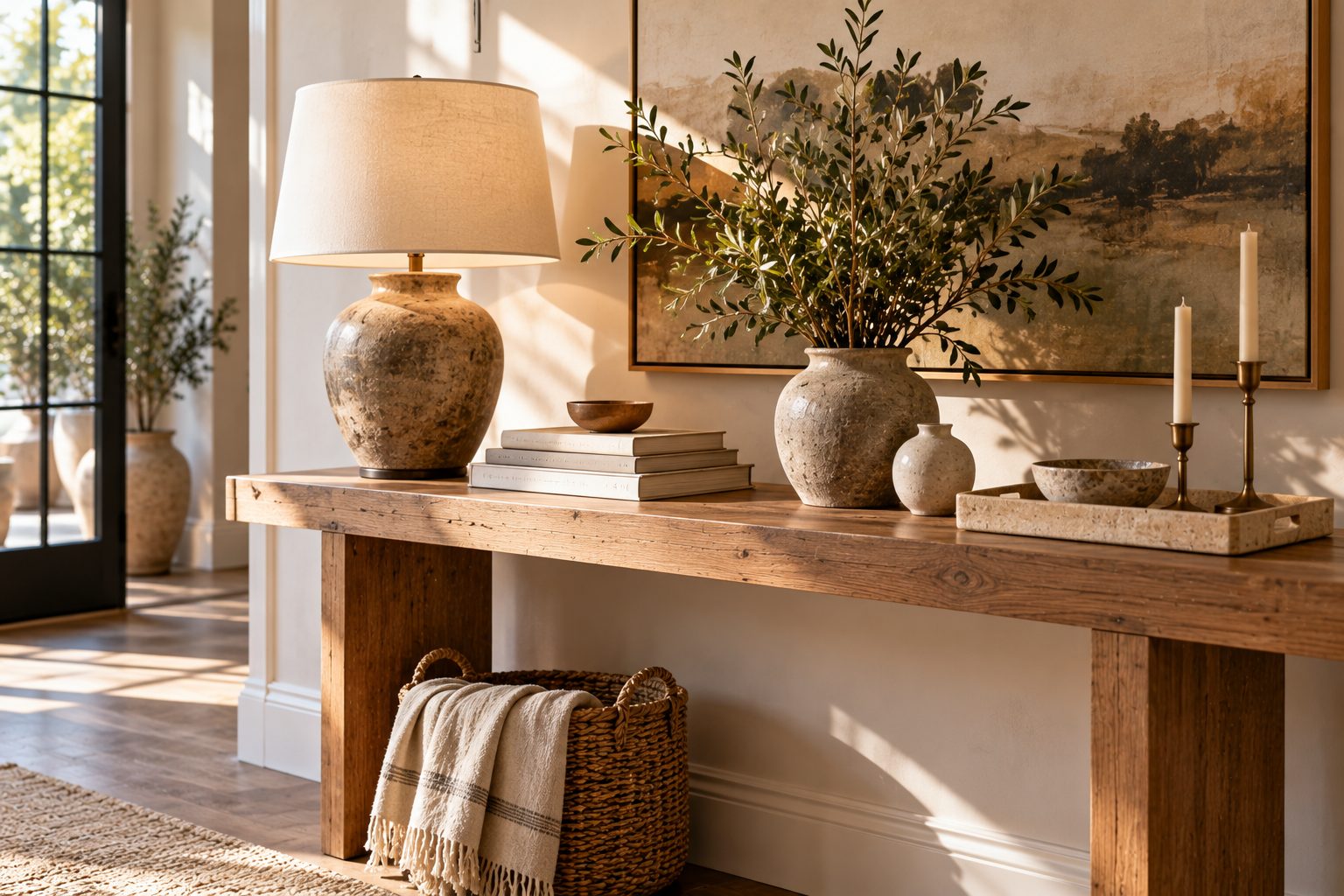
- Console: a lamp at one end, a tall vase or branches at the other, something low between.
- Floor: one large plant, 4–6 ft (1.2–1.8 m), in a corner that gets light.
Bedroom wall decor ideas and room accessories
Bedroom wall decor ideas work best when they stay calm and low-contrast: a single large piece or a pair above the headboard, soft textiles and a small number of personal objects on nightstands. Bedrooms need fewer room accessories than living rooms, not more.
- Above the bed: one piece about two-thirds of the bed width, or a pair of matching frames over twin nightstands. Use lightweight frames with secure fixings; nothing glass-heavy over sleeping heads.
- Wall design ideas for bedrooms: an upholstered or paneled headboard wall, a limewashed wall or a full-wall mural can replace art entirely.
- Nightstands: a lamp with a shade 14–16 in (36–41 cm) wide, a small tray, one book and one plant or object.
- Textiles: two sleeping pillows, two euro shams at 26 in (66 cm) square, one lumbar cushion and a throw at the foot.
For wall decor for bedroom spaces that double as offices or teen rooms, a pinboard or picture ledge lets the display change without new holes.
Entry, kitchen and bathroom accessories
Entry, kitchen and bathroom accessories should be practical first and decorative second: every object in these rooms gets handled, splashed or knocked, so choose fewer pieces in tough materials. A good rule is that each accessory here must either hold something or light something.
Entry
Give the entry a mirror 24–36 in (61–91 cm) wide above a console or bench, a lamp or sconce, a catch-all bowl or tray for keys, and hooks at 60–66 in (152–168 cm) for coats. A runner or washable rug finishes it. This is the first room guests see, so it deserves one of the better pieces in the house.
Kitchen
Keep counters to a few working accessories grouped near the range or sink: a wooden board leaned against the backsplash, a crock of utensils, a bowl of fruit and one plant or herb pot. Glazed ceramic, stone, wood and glass all wipe clean; fabric and paper do not.
Bathroom
Bathroom accessories should be humidity-proof: pump bottles on a stone or ceramic tray, cotton towels in one color, a sealed framed print and a plant that likes steam. Plated metals and unsealed wood tarnish or swell quickly next to a shower.
Aesthetic room decor and unique home decor
Aesthetic room decor, as people use the phrase, means a room with a clear, consistent look, and the fastest way there is a tight palette, one textural material repeated everywhere and lighting that glows rather than glares. Unique home decor comes from pieces that cannot be bought in multiples: vintage finds, handmade ceramics, family objects and original art.
#EDE6DA#C9A27A#7F8B6A#A2553A#3C3A36Hex values are approximate. A palette like this, warm neutrals with one earthy accent and a dark anchor, suits most 2027 interiors. For room decor that feels personal, set a rule that at least a third of accessories in each room are old, handmade or meaningful. Warm 2700K bulbs, a few candles and a string of small lamps rather than one overhead light do more for atmosphere than any object.
Cheap room decor is easy to find; the trick is buying it in materials that age well. Plain glass, unglazed terracotta, cotton, linen and solid wood look fine at any price, while shiny plated metal and printed slogans look cheap almost immediately.
Is it OK to mix metals in home decor?
Yes, it is fine to mix metals in home decor, as long as you choose one dominant metal and one or two accents and repeat each one at least twice in the room. Two metals almost always work; three can work with care; four looks accidental.
- Dominant: about 60–70 percent of metal finishes, often the light fixtures or hardware.
- Accent: 20–30 percent, in frames, trays or a lamp base.
- Spark: 10 percent or less, a single candlestick or bowl.
Warm brass with cool chrome, or bronze with blackened steel, are reliable pairings. Our how to mix metals guide has room-by-room examples.
How do you decorate a new home with accessories?
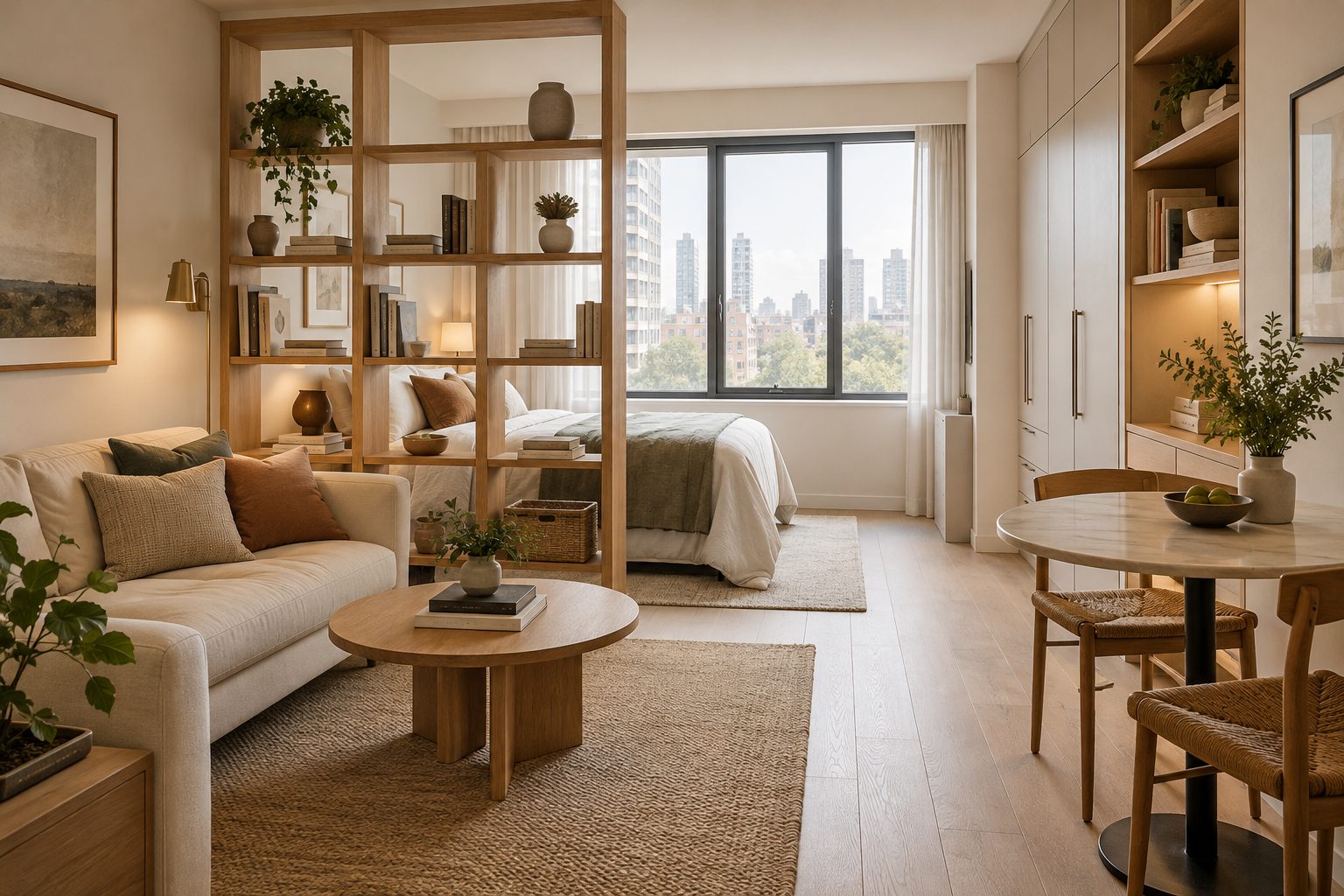
Decorate a new home by living in it with furniture and lighting for a few weeks before buying accessories, then accessorizing room by room in order of use: living room, bedroom, entry, kitchen and dining. Buying everything in one weekend is how houses end up looking like catalogs.
- Unpack what you own. Place existing art and objects first; you will need fewer purchases than you think.
- Light each room. At least two or three lamps per living space before any decor.
- Hang the big wall pieces. Sofa wall, bed wall and entry first.
- Add textiles. Rugs, curtains, cushions and throws soften new-house echo.
- Fill surfaces last. Shelves and tables, a few pieces at a time over months.
For the dining room specifically, see our dining room wall decor guide.
Mistakes we see with home decor accessories
The mistakes we see most with home decor accessories are buying too many small pieces, hanging art too high, and choosing every object in a different color and material. In our experience, a room with 15 well-chosen accessories always looks better than one with 50 random ones.
- Small art on big walls: a 16 × 20 in (41 × 51 cm) print over an 84 in (213 cm) sofa looks lost.
- Everything at one height: line up five objects of the same height and they read as a row, not a group.
- Matching sets: identical lamp, vase and frame collections look staged; mix at least one era or texture.
- No empty space: surfaces with nothing bare look cluttered, however good the objects.
- Theme pieces: word signs, novelty objects and fashion-of-the-month colors date first.
Our verdict: spend most of your accessory budget on two or three large pieces, a big artwork, a good lamp and a substantial vase or plant, and keep the rest of your home wall decor and small objects simple and slowly collected.
Accessorizing several rooms, units or a hospitality project? Send your palette, room list and quantities to our decor sourcing desk for coordinated factory quotes.
Free toolWallpaper CalculatorHow many rolls you need, allowing for the pattern repeat.Shop & source the look
Buy it today — or have it made
Retail links are affiliate links: we may earn a commission at no extra cost to you (disclosure). “Get it made” sends the item to our sourcing desk for factory quotes in custom sizes and finishes.
Frequently asked questions
What are home decor accessories?
Home decor accessories are the decorative, mostly portable items that finish a furnished room: wall art, mirrors, vases, bowls, trays, cushions, throws, lamps, candles, books and plants. They can be moved or swapped without tools, which makes them the cheapest and fastest way to change a room's style, color or season.
How many accessories should a room have?
Most rooms look best with roughly 15–25 accessories, counting art, lamps, cushions and tabletop objects. Group them in threes or fives with mixed heights, give each surface one hero piece and leave 30–40 percent of shelves and consoles empty so the eye has somewhere to rest.
Is it OK to mix metals in home decor?
Yes, mixing metals in home decor is fine when one metal dominates and one or two others act as accents, each repeated at least twice. Warm brass with chrome, or bronze with blackened steel, are reliable pairings. More than three metal finishes in one room tends to look unplanned.
What is my home decor style?
Your home decor style is the look you return to: notice the materials, colors and shapes in rooms you save or admire, then name the closest style, such as Japandi, modern farmhouse or organic modern. A short style quiz helps, and most homes end up as a blend of two styles with one leading.
How do you decorate a living room wall with hangings?
Decorate a living room wall with hangings by choosing one large textile or a planned group about two-thirds the width of the sofa below, with the bottom edge 8–10 in (20–25 cm) above the sofa back. Hang textiles from a sleeve and wooden batten so the weave is not damaged or stretched.
Some links may be affiliate links. Regulations and specifications change — always confirm with suppliers and qualified professionals.