Dining Room Wall Decor: 12 Ideas With Sizes, Heights and Costs
Dining room wall decor works best as one large piece sized to about two-thirds of the furniture below it, hung 6–10 in above a sideboard. Here are 12 ideas with sizes, heights and typical costs.
Part of our guide: Dining Room Trends 2027: Dining Room Colors, Tables and Lighting
Key takeaways
- Size dining room art to roughly two-thirds of the sideboard or table length and hang it 6–10 in (15–25 cm) above the furniture
- Seated rooms read art lower than hallways: aim for a center height of 57–60 in (145–152 cm), or lower above a buffet
- One large piece, a mirror or a full-wall treatment beats a scatter of small frames in almost every dining room
- Keep paper, fabric and unglazed art at least 24 in (61 cm) away from serving zones and radiators
Good dining room wall decor is one large, well-placed piece rather than many small ones: art or a mirror about two-thirds the width of the sideboard or table, hung 6–10 in (15–25 cm) above the furniture, with its center near 57–60 in (145–152 cm) from the floor. Paneling, murals and plate walls work when they cover the whole wall.
- Width rule: art at 60–75 percent of the furniture below it.
- Height rule: bottom edge 6–10 in (15–25 cm) above a sideboard, center near eye level when seated and standing.
- Typical cost: $150–1,200 for a large print or canvas, $200–900 for a big mirror, $8–25 per sq ft for installed paneling.
- Lighting: 2700–3000K, CRI 90+ so food and art read true.
Walls are the cheapest way to change how a dining room feels, and they are the part of the room most people leave blank. This guide sits inside our dining room trends 2027 overview, which covers tables, chairs and lighting; here we deal only with what goes on the walls, and how big, how high and how much.
What is the best dining room wall decor?
The best dining room wall decor is a single large artwork or mirror on the main wall, supported by good lighting and, where the room allows, a wall treatment such as paneling or limewash. Dining rooms are viewed from a fixed point, the chairs, so one strong focal piece holds the eye better than a busy arrangement. Dining room wall decor also has to survive steam, candle soot and chair backs, which narrows the materials a little.
We define dining room wall decor as anything fixed to or applied on the walls of an eating space: art, mirrors, shelving, plates, textiles, paneling, paint and wallpaper. The table below compares the main options.
| Option | Typical size | Typical US cost (2026) | Best for |
|---|---|---|---|
| Large framed art or canvas | 36 × 48 in to 48 × 60 in (91 × 122 to 122 × 152 cm) | $150–1,200 | Above a sideboard or on the table wall |
| Oversized mirror | 30 × 48 in to 40 × 72 in (76 × 122 to 102 × 183 cm) | $200–900 | Small or dark rooms, opposite a window |
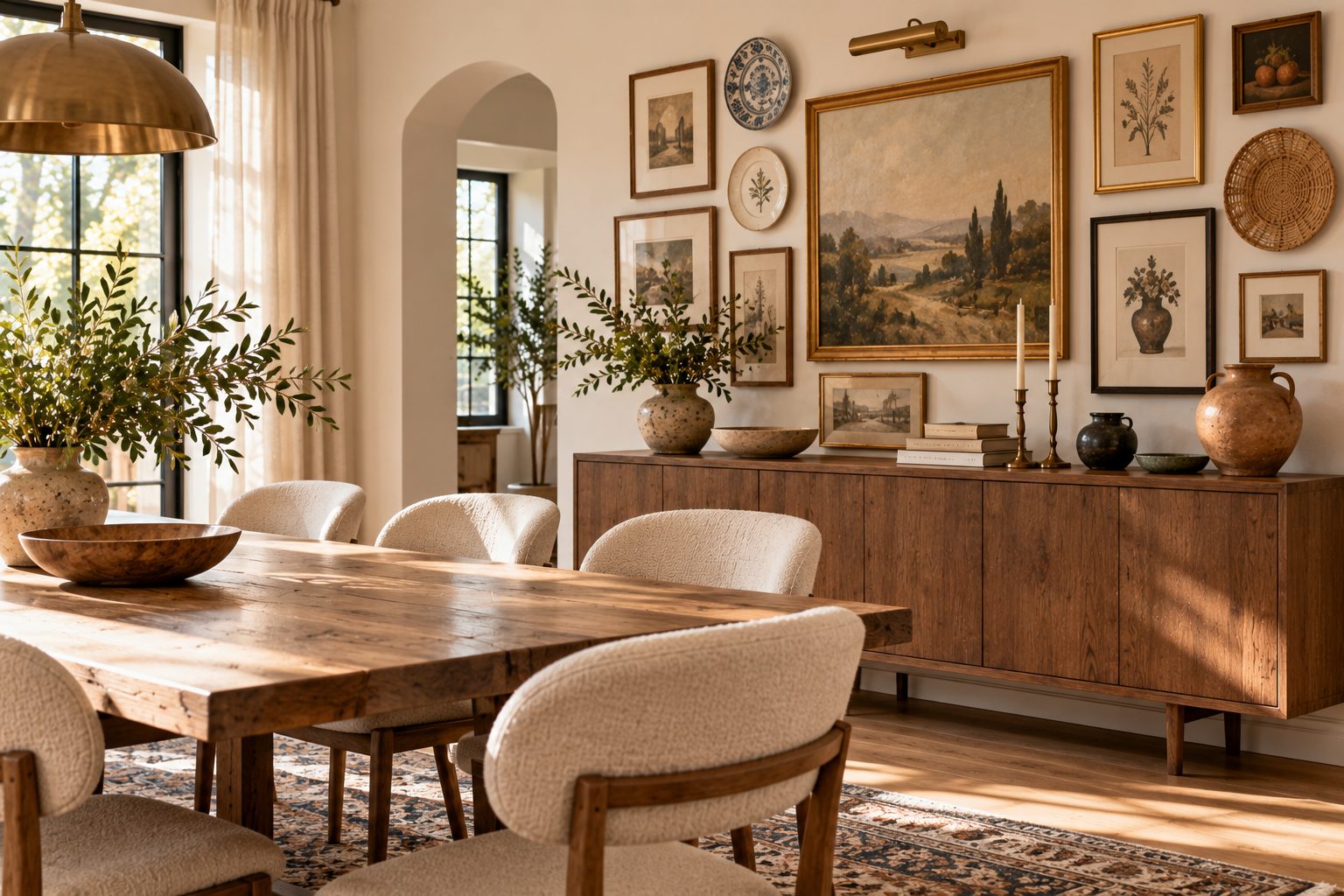
| Gallery wall (5–9 frames) | 60–96 in (152–244 cm) overall width | $250–1,500 | Casual and eclectic rooms |
| Plate wall | 9–15 plates, 6–12 in (15–30 cm) each | $100–600 | Traditional and farmhouse rooms |
| Wainscoting or paneling | Lower third, 32–36 in (81–91 cm) high | $8–25 per sq ft installed | Formal rooms, protecting walls from chairs |
| Mural wallpaper | Printed to wall size | $5–15 per sq ft plus hanging | One feature wall or all four walls |
| Wall-mounted shelf or ledge | 48–72 in (122–183 cm) long, 4–10 in (10–25 cm) deep | $60–400 | Rotating art, ceramics, serving pieces |
Prices are typical US ranges for mid-market pieces. Original art, antique mirrors and hand-painted murals sit well above them.
How big should art be in a dining room?
Art in a dining room should be about two-thirds the width of the furniture beneath it, or roughly half to two-thirds of the wall width when nothing sits below it. Above a 72 in (183 cm) sideboard, look for a piece 44–54 in (112–137 cm) wide. On a bare 10 ft (305 cm) wall behind the table, a single 48–60 in (122–152 cm) piece or a pair of 30 in (76 cm) pieces with a 4–6 in (10–15 cm) gap works.
The error we see most is art that is too small: a 16 × 20 in (41 × 51 cm) frame floating on a long wall looks like an afterthought. If budget is tight, buy a large print in a simple frame rather than a small original. Vertical pieces suit walls between windows; horizontal pieces suit the long wall behind a buffet or banquette.
How high should you hang dining room wall art?
Hang dining room wall art with its center at 57–60 in (145–152 cm) from the floor on an empty wall, or with its bottom edge 6–10 in (15–25 cm) above any sideboard or buffet. People sit in a dining room, so art can sit a touch lower than the hallway standard without looking wrong.
- Measure the furniture. Note sideboard height (usually 30–36 in / 76–91 cm) and width.
- Pick the gap. 6–10 in (15–25 cm) between furniture top and frame bottom; closer for lamps and tall vessels below, never more than 12 in (30 cm).
- Find the hanging point. Add the gap to the furniture height, then add the distance from the frame bottom to its wire or D-ring.
- Template it. Tape kraft paper cut to size on the wall and look from a seated position at the far end of the table.
- Fix it properly. Use two hooks or a French cleat for anything over 20 lb (9 kg), and screw into studs or rated wall anchors.
For multi-frame layouts, our gallery wall guide covers spacing (2–3 in / 5–8 cm between frames) and how to plan the grid on paper first.
Dining room wall decor ideas that actually work
The dining room wall decor ideas that work best are the ones that cover enough wall to read from the table: large art, a big mirror, full-height treatments or a curated shelf. These are the twelve we use most often, grouped by what they solve.
Art and mirrors
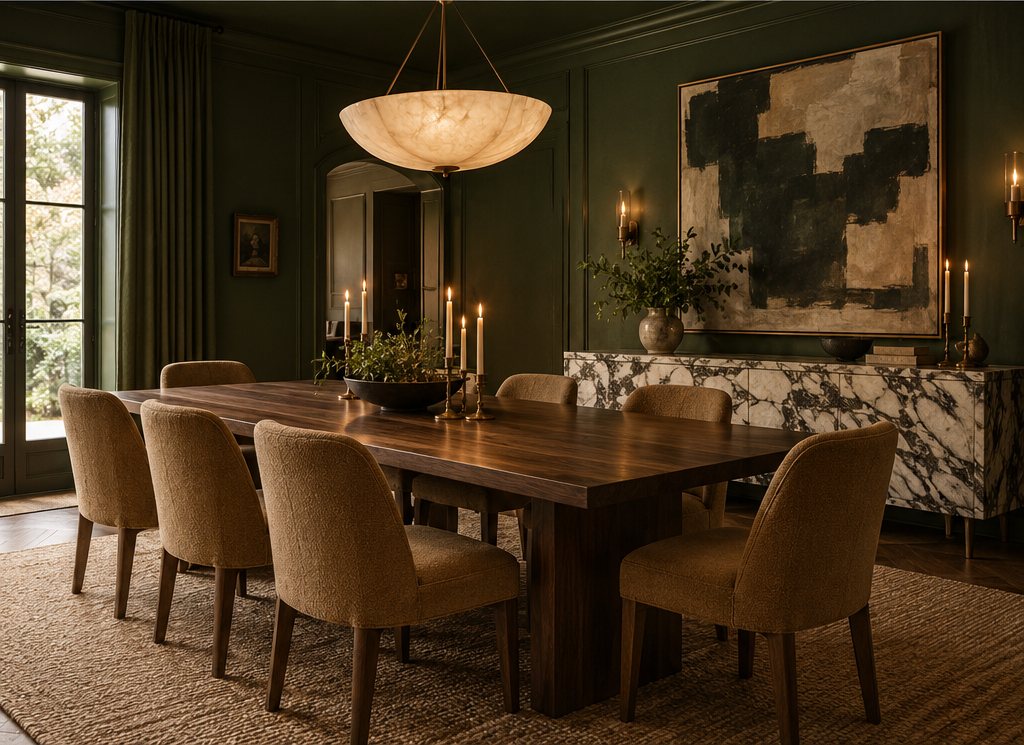
- 1. One oversized canvas. Abstract or landscape, 40 × 50 in (102 × 127 cm) or larger. The simplest modern dining room wall art.
- 2. A matched pair or triptych. Two or three equal frames above a long sideboard, spaced 3–5 in (8–13 cm) apart.
- 3. An arched or round mirror. Bounces window light and candlelight; place it opposite or beside a window, not facing a messy kitchen.
- 4. A lit artwork. A picture light at 2700K turns a modest print into the evening focal point. See our picture lights guide for arm lengths.
Wall hanging ideas for dining room walls
- 5. Woven or textile hanging. Rugs, quilts and tapestries add warmth and soften echo; hang from a sleeve and batten, never with nails through the weave.
- 6. A plate wall. 9–15 plates in one palette, mixed sizes, with 2–3 in (5–8 cm) gaps and spring or adhesive hangers.
- 7. Baskets or sculptural objects. Flat woven baskets in a loose cluster suit casual and coastal dining areas.
Wall treatments and dining room wall design ideas
- 8. Wainscoting or picture-frame molding. A rail at 32–36 in (81–91 cm) takes chair knocks; paint the panels semi-gloss so they wipe clean.
- 9. A scenic mural. Garden and landscape murals are the formal dining room decorating idea of the moment.
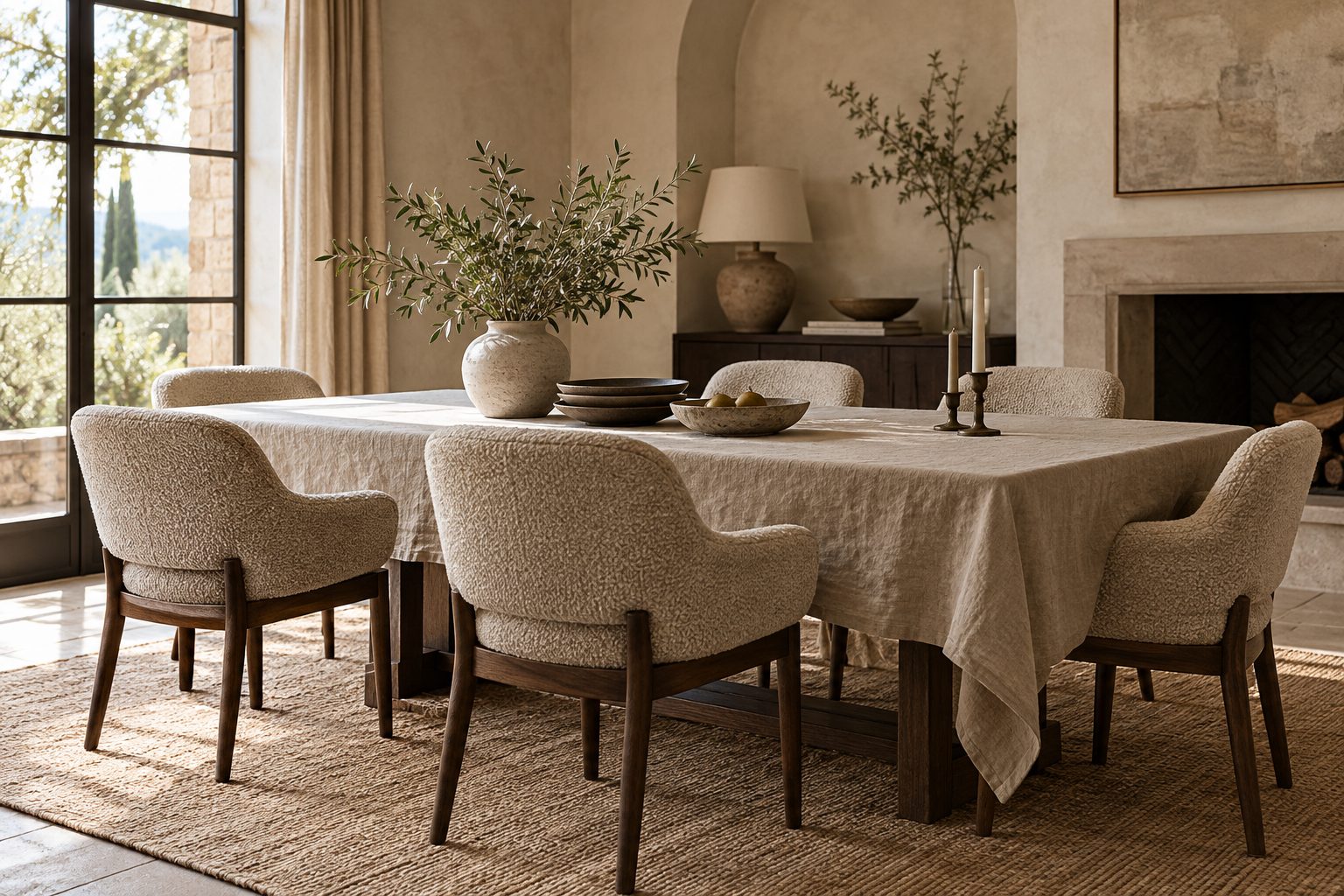
- 10. Limewash or plaster. Soft movement on the wall means you need less art.
- 11. A long picture ledge. Two ledges at 4 in (10 cm) deep let you rotate prints by season.
- 12. Open shelving with serving pieces. A display wall of bowls and glass works in a dining area off the kitchen.
What colors work for dining room walls in 2027?
Dining room walls for 2027 lean toward deep, warm, food-flattering colors such as oxblood, olive, tobacco brown and warm plaster white, often drenched across walls, trim and ceiling. Darker colors make art pop and make candlelight feel generous; mid-LRV warm whites (around 70–82) keep a small room open.
#5E2A2A#5F6142#7A5236#E8DFCF#2F3A3FHex values are approximate screen references; test real samples in evening light, because dining rooms are mostly used after dark. With a dark wall, choose art with light grounds or wide pale mats; with a pale wall, go for strong contrast or a dark frame.
How do you decorate a modern dining room wall?
Decorate a modern dining room wall with one large abstract or photographic piece, a slim black, oak or metal frame, and plenty of empty wall around it. Modern dining room wall decor is about restraint: a single piece, a long low sideboard and a sculptural pendant, aligned on the same center line. Skip the word-art signs and the clusters of small frames.
For modern dining room design ideas that go beyond art, try a full-height fluted or slatted panel on one wall, or a frameless mirror the length of a banquette. Keep the palette to two colors plus wood, and let the light fixture be the second focal point. Our dining table pendant light guide covers sizing it at half to two-thirds the table width.
What should you put on the dining room table and around the room?
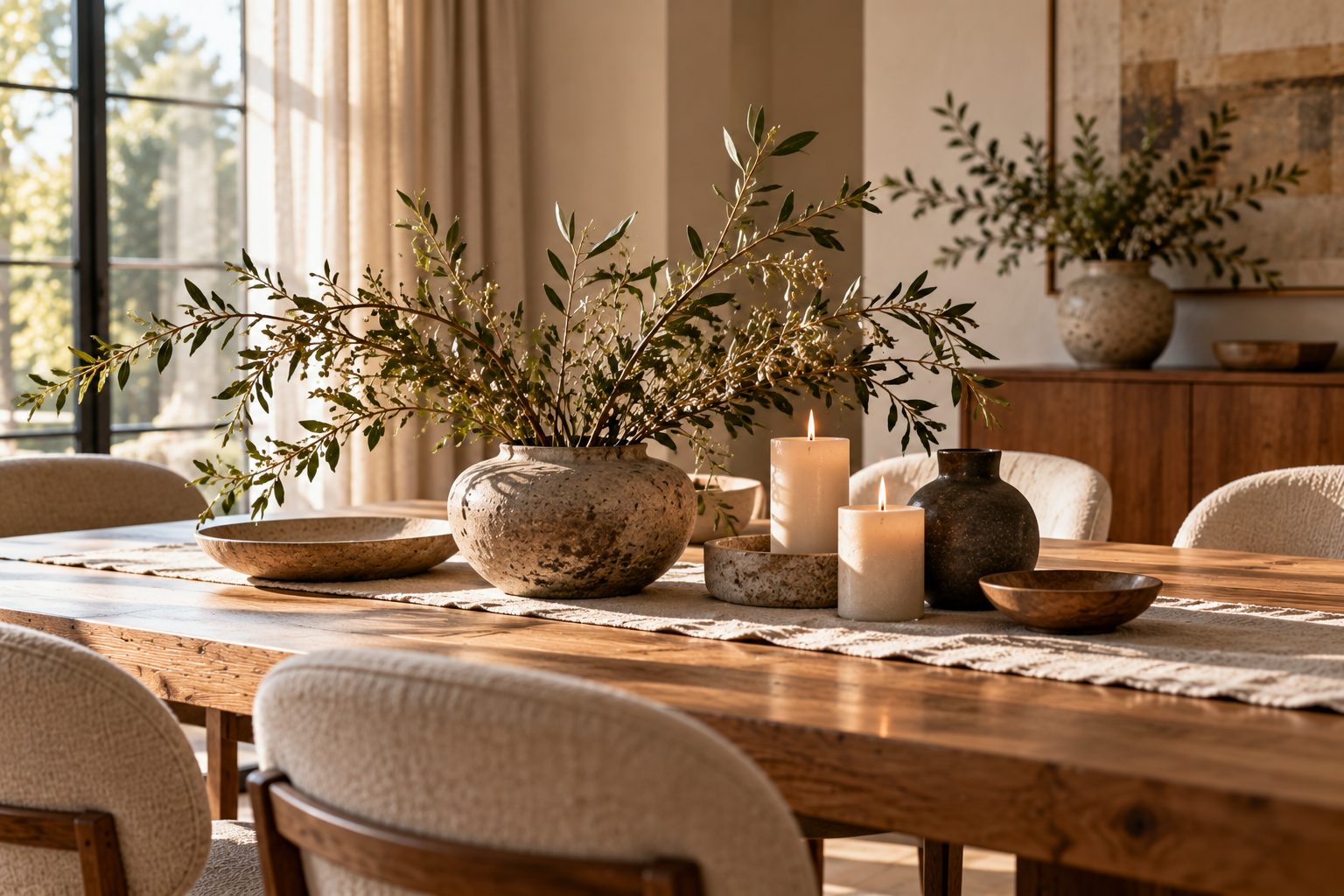
Put one low centerpiece on the dining room table, under 12 in (30 cm) high so people can see each other, and let the walls carry the decoration. A runner, a bowl or a pair of candlesticks is enough. The same restraint applies to the rest of the dining area decor: one rug sized at least 24 in (61 cm) beyond the table edge on every side (our dining room rug guide has the sizing), one sideboard, one statement wall.
For smaller accessories on sideboards and shelves, our home decor accessories guide covers grouping in odd numbers and varying height.
Mistakes we see on dining room walls
The mistakes we see most on dining room walls are art that is too small, art hung too high, and too many small pieces competing with the light fixture. In our experience, fixing just the first two transforms a room more than any purchase.
- Hanging to the ceiling, not the furniture. Art floating 20 in (51 cm) above a buffet looks disconnected.
- Ignoring the seated view. Check sight lines from the chairs, not from the doorway.
- Glare. Glossy glazing opposite a window or under a pendant bounces light; use anti-reflective acrylic or an unglazed canvas.
- Paper near heat and steam. Keep prints and textiles away from radiators, buffets with warmers and the kitchen pass-through.
- Theme overload. Fork-and-spoon art and "Eat" signs date a room fast.
Our verdict: if you do one thing, buy the biggest piece the wall can take and hang it 8 in (20 cm) above the sideboard. That single move solves most dining room interior decorating problems.
Need large art, mirrors or wall panels for a home, restaurant or hotel dining space? Send sizes and quantities to our decor sourcing desk for factory quotes.
Free toolWallpaper CalculatorHow many rolls you need, allowing for the pattern repeat.Shop & source the look
Buy it today — or have it made
Retail links are affiliate links: we may earn a commission at no extra cost to you (disclosure). “Get it made” sends the item to our sourcing desk for factory quotes in custom sizes and finishes.
Frequently asked questions
How do you decorate a dining room wall?
Decorate a dining room wall with one large artwork or mirror about two-thirds the width of the furniture below, hung 6–10 in (15–25 cm) above it. Add a picture light or wall sconces, and consider paneling or a mural on the lower or full wall. Avoid scattering small frames, which look busy from the table.
What size art should go above a dining room sideboard?
Art above a sideboard should be about 60–75 percent of the sideboard's width. For a 60 in (152 cm) sideboard, look for art 36–45 in (91–114 cm) wide; for a 72 in (183 cm) sideboard, 44–54 in (112–137 cm). A pair of equal frames with a small gap can stand in for one wide piece.
How high should a picture be hung in a dining room?
Hang it with its center at about 57–60 in (145–152 cm) from the floor on a bare wall, or with the bottom edge 6–10 in (15–25 cm) above a sideboard or buffet. Diners view art while seated, so slightly lower placement than in a hallway looks natural and keeps the piece connected to the furniture.
Should a dining room have a mirror?
A dining room benefits from a mirror when it is small, dark or has a window to reflect. Place it opposite or beside the window to bounce daylight and candlelight, and avoid positions where it reflects the kitchen or a cluttered wall. A mirror 30–40 in (76–102 cm) wide suits most sideboards.
What is the best wall color for a dining room?
Warm, food-flattering colors work best in dining rooms: oxblood, olive, tobacco brown and deep inky blues for drama, or warm whites with an LRV of about 70–82 for small rooms. Test samples in evening light, because most dining happens after dark under 2700–3000K lighting.
Some links may be affiliate links. Regulations and specifications change — always confirm with suppliers and qualified professionals.