Picture Lights: Sizes, Mounting Heights, Bulbs and Swing Arm Sconces
Picture lights should span half to two-thirds of the frame width and sit 3–6 in (8–15 cm) above it, with 90+ CRI LEDs at 2700–3000K. Sizes, power options, installation and when a swing arm sconce is the better buy.
Part of our guide: How to Hang Art and Build a Gallery Wall: Heights, Spacing, Layouts
Key takeaways
- Choose a picture light about one-half to two-thirds the width of the frame, so a 30 in (76 cm) frame takes a 14–20 in (36–51 cm) light
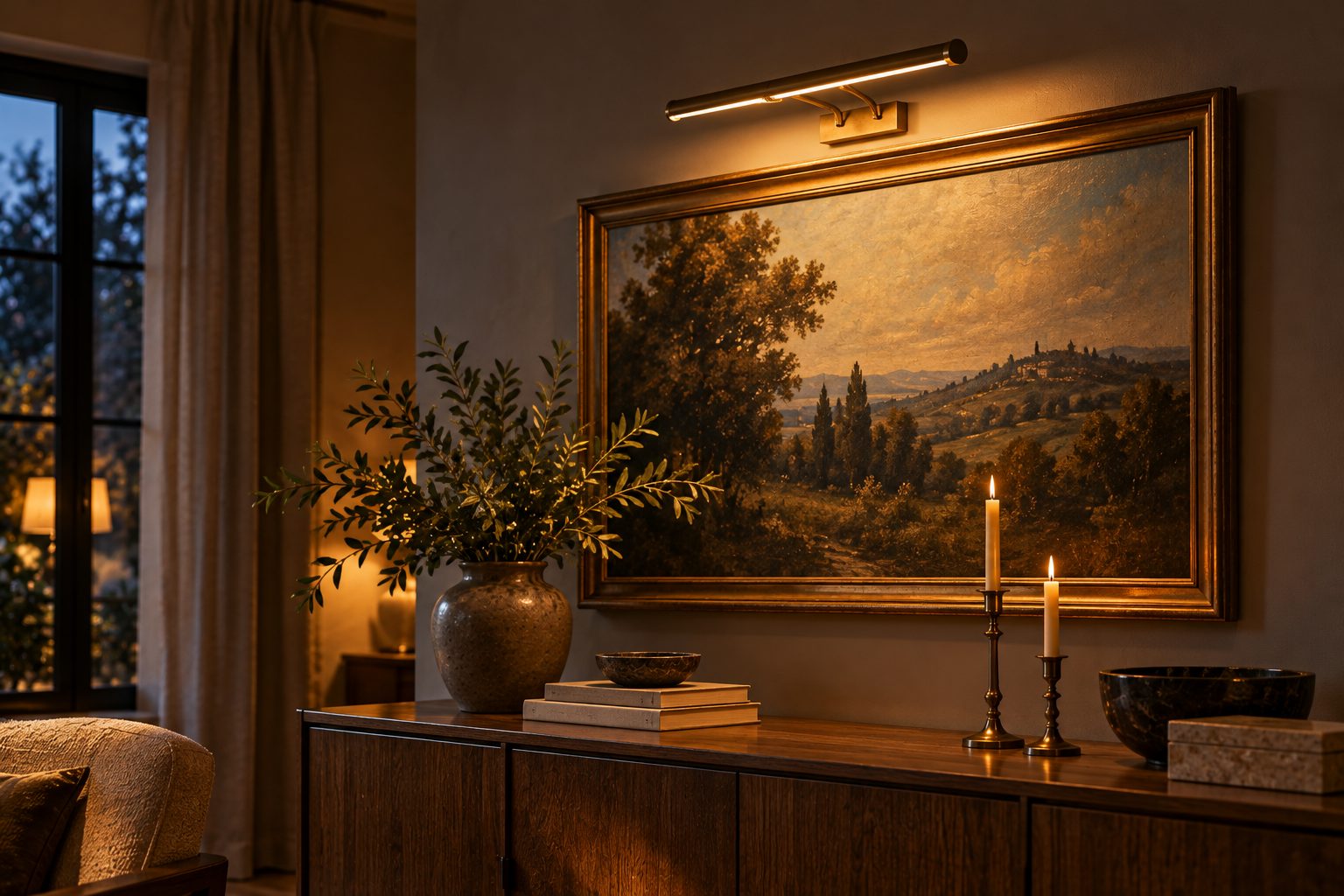
- Mount it 3–6 in (8–15 cm) above the frame with an arm long enough to aim the beam at about 30 degrees onto the center of the work
- Use LEDs of 90+ CRI at 2700–3000K and 150–400 lumens; they put out almost no UV or heat
- A swing arm sconce is a different tool: it lights a person reading, not a painting, and belongs beside beds and chairs
A picture light should be about one-half to two-thirds the width of the artwork's frame, so a 30 in (76 cm) frame takes a 14–20 in (36–51 cm) light, mounted 3–6 in (8–15 cm) above the frame. Fit it with LEDs of 90+ CRI at 2700–3000K and 150–400 lumens; they render color truthfully and give off almost no damaging heat or UV.
Lighting is the last step of hanging art, after spacing and height, which our guide on how to hang a gallery wall covers in full. A good picture light turns one painting into the focus of the room; a badly sized one throws a hot stripe across the top third and leaves the rest in shadow.
- Width: 1/2 to 2/3 of the frame width; never wider than the frame.
- Position: 3–6 in (8–15 cm) above the frame top, or clamped to the frame itself.
- Light: 150–400 lumens, 2700–3000K, CRI 90 or higher, dimmable.
- Power: hardwired, plug-in with a cord cover, or rechargeable battery.
- Typical cost: $60–200 basic, $200–600 mid-range, $600–1,500+ for solid brass gallery fixtures.
What is a picture light?
A picture light is a slim, shaded fixture on a short arm that sits above a painting or print and washes it with light from above. The picture light fixture can mount on the wall, which is what most people mean by a wall mounted picture light, or clip to the back of a heavy frame. Either way the shade hides the source, so you see the art rather than the bulb.
It is easy to confuse three related fixtures. A picture light sconce, sometimes sold as an art sconce or picture sconce, is designed to light a wall object. A swing arm sconce is designed to light a person. A wall picture lamp is often just a marketing name for either one, so read the specification, not the name: a true wall light for artwork has a long, shallow shade and an aimable head.
What size picture light do you need?
Size the picture light to the frame, not the room: half to two-thirds of the frame width for landscape works and a longer arm for deep frames or tall canvases. Vertical pieces need reach more than width, because the light has to travel further to reach the bottom edge.
| Frame width | Light width | Arm reach | Typical output |
|---|---|---|---|
| Up to 18 in (46 cm) | 8–12 in (20–30 cm) | 4–6 in (10–15 cm) | 100–200 lm |
| 18–30 in (46–76 cm) | 12–20 in (30–51 cm) | 6–8 in (15–20 cm) | 150–300 lm |
| 30–48 in (76–122 cm) | 20–30 in (51–76 cm) | 8–10 in (20–25 cm) | 250–400 lm |
| 48–72 in (122–183 cm) | 30–40 in (76–102 cm), or two lights | 10–14 in (25–36 cm) | 400–700 lm total |
| Over 72 in (183 cm) | Ceiling spots or two picture lights | n/a | Aimed track or recessed adjustable |
For frames taller than about 40 in (102 cm), a picture light alone will fade toward the bottom. Either choose a model with a longer arm or add an adjustable recessed or track spot aimed at 30 degrees from vertical, which lights the whole surface evenly.
Which picture lights for wall art: hardwired, plug-in or battery?
Hardwired picture lights look best, plug-in models are the practical middle ground and rechargeable battery lights are the renter's answer, now bright enough for most canvases. Each comes with a trade-off you should accept before buying.
- Hardwired: needs a junction box behind the frame, so the art hides it. Plan it during a renovation; an electrician typically charges $150–400 per new box in finished drywall.
- Plug-in: a cord runs down the wall to an outlet. Paint a slim raceway the wall color, or run the cord behind a console. See our plug-in wall sconces guide for cord-hiding methods.
- Battery or rechargeable: no wiring at all, 40–100 hours per charge at moderate brightness and usually a remote or timer. Our battery-operated wall sconces guide explains real run times.
How high should you mount a picture light?
Mount a wall picture light 3–6 in (8–15 cm) above the top of the frame and angle the head so the beam lands near the center of the artwork at roughly 30 degrees. Hang the art first, at the usual 57–60 in (145–152 cm) to its center, then mark the light. Mounting the light lower crowds the frame; mounting it higher means a longer arm and more light lost on the wall.
Frame-mounted lights clamp or screw to the back of the stretcher or frame and move with the piece. They suit heavy frames and collectors who rehang often, but check that the frame can carry an extra 1–3 lb (0.5–1.4 kg) without tilting forward.
Which bulbs protect artwork?
LEDs of CRI 90 or higher at 2700–3000K are the right light for art: they render reds and skin tones accurately and emit negligible UV and very little heat. Look for an R9 value above 50 if the work has strong reds. Old halogen and incandescent picture lights run hot enough to dry varnish and fade pigments close to the lamp, so replace them with integrated LED models or LED lamps that fit the original socket.
Keep brightness modest. Paintings on paper, watercolors and photographs are the most light-sensitive, so dim them and switch them off when nobody is in the room. Oil and acrylic on canvas tolerate more. As a rule, the artwork should read about two to three times brighter than the surrounding wall, not ten times, so a dimmer is worth more than extra lumens. For a whole-room plan, our living room lighting ideas show how accent light sits within the ambient and task layers.
Are swing arm wall sconces a better choice?
A swing arm wall sconce is the better choice when you need to light a book, a desk or a face rather than a picture, which is why swing arm sconces bedroom installs have replaced many bedside lamps. The arm folds flat against the wall when not in use and extends 18–30 in (46–76 cm) over a bed or chair, freeing nightstand space.
Swing arm lamp, swing arm light and wall arm lamp all describe the same idea, and an articulating wall sconce simply adds a second joint so you can move the shade up and down as well as sideways. An arm sconce with a fixed arm is technically not a swing arm at all; check before buying for a reading spot.
How to place a swing arm sconce
- Beside a bed: mount 48–60 in (122–152 cm) from the floor, roughly 20–24 in (51–61 cm) above the mattress top, with the backplate just outside the headboard edge.
- Beside a reading chair: bottom of the shade at about seated shoulder height, 40–44 in (102–112 cm) from the floor, set slightly behind the chair arm.
- Light: 300–500 lumens, 2700K, with a switch on the fixture or a dimmer at the bed.
How do you install a picture light?
A plug-in or battery picture light installs in 15–30 minutes with a drill and anchors; a hardwired one needs a box behind the frame, ideally fitted by an electrician.
- Hang the artwork first at its final height and mark the center line on the wall.
- Mark the light 3–6 in (8–15 cm) above the frame top on the center line, using painter's tape for a level reference.
- Find the fixing: stud, masonry or a drywall anchor rated for at least 10 lb (4.5 kg); plaster needs a masonry bit and plugs.
- Mount the backplate, then the arm and head; for hardwired models connect at a box sitting behind the frame.
- Aim and dim at night: tilt the head until the bottom edge of the work is lit, then dim until there is no hot stripe at the top.
- Manage the cord on plug-in models with a paintable raceway or route it behind furniture.
How we'd light a painting
Our default is a hardwired LED picture light, 2700K, CRI 95, on a dimmer, in a finish that matches the frame or the room's other metals, and we only reach for ceiling spots when a work is taller than about 40 in. The mistake we see most often is a light that is too short and too bright: a 10 in fixture over a 40 in canvas, turned up to full, so the top edge glares and the bottom is gray. The second is a cool 4000K strip that makes a warm oil painting look like a reproduction. Spend on CRI and a dimmer before you spend on a heavier brass body.
If you are lighting several pieces, a collection or a hotel corridor of art, send us the frame sizes, wall construction and finish through our lighting sourcing desk and we will quote picture lights and sconces matched as a set.
Free toolPaint CalculatorWork out exactly how much paint to buy.Shop & source the look
Buy it today — or have it made
Retail links are affiliate links: we may earn a commission at no extra cost to you (disclosure). “Get it made” sends the item to our sourcing desk for factory quotes in custom sizes and finishes.
Frequently asked questions
What size picture light should I buy?
Buy a picture light that is one-half to two-thirds the width of the frame. A 24 in (61 cm) frame suits a 12–16 in (30–41 cm) light and a 36 in (91 cm) frame a 20–24 in (51–61 cm) light. Never exceed the frame width, and choose a longer arm for tall or deep-framed pieces.
How far above a painting should a picture light be?
Mount a picture light 3–6 in (8–15 cm) above the top of the frame. That keeps the fixture visually tied to the art while giving the arm room to aim the beam at about 30 degrees onto the center of the work. Hang the artwork first, then position the light from it.
Do LED picture lights damage paintings?
No, good LED picture lights do not damage paintings in normal use, because they emit negligible UV and very little heat. Choose CRI 90 or higher at 2700–3000K, keep brightness moderate with a dimmer and switch off light-sensitive works on paper and photographs when the room is empty.
Can you install a picture light without wiring?
Yes, plug-in and rechargeable battery picture lights need no new wiring. Plug-in models run a cord to an outlet, ideally hidden in a painted raceway. Rechargeable models run roughly 40–100 hours per charge and often include a remote and timer, which makes them a good choice for renters and plaster walls.
How high should a swing arm sconce be beside a bed?
Mount a swing arm sconce 48–60 in (122–152 cm) from the floor, roughly 20–24 in (51–61 cm) above the top of the mattress. Place the backplate just outside the headboard so the arm can swing over the pillow for reading and fold back flat against the wall when not in use.
Some links may be affiliate links. Regulations and specifications change — always confirm with suppliers and qualified professionals.