Wall Sconces: Styles, Placement Heights & Room-by-Room Guide
Wall sconces explained by type, mounting height and room: up/down, swing-arm, picture, globe, plug-in and battery fixtures, a room-by-room height table, spacing rules, wiring options and bulb specs.
Key takeaways
- Mount living-space wall sconces at 60–66 in (152–168 cm) to center; bedside swing-arms 30–36 in above the mattress
- Space fixtures 6–10 ft (1.8–3 m) apart, or pair them 6–12 in outside a mirror, headboard or fireplace
- Hardwire where you own the walls, plug in where you rent, and treat battery sconces as decorative at 50–200 lumens
- Use 2700K, CRI 90+ bulbs at 200–450 lumens each and put every group of sconces on its own dimmer
Wall sconces are light fixtures mounted to the wall rather than the ceiling, and they are the layer most rooms are missing. Mount them with the light source at 60–66 in (152–168 cm) from the floor, space them 6–10 ft (1.8–3 m) apart, and choose 2700K bulbs at 200–450 lumens per fixture. This guide sorts the types, gives heights for every room and settles the hardwired, plug-in or rechargeable question.
The confusion most buyers have is not style but category: a "sconce" can be a hardwired architectural fixture, a swing-arm reading lamp, a battery puck in a brass shade or a plug-in with a cord. Each type has a different job and a different mounting rule, so this guide runs from the types, through placement height and spacing, into room-by-room advice and finally power and bulbs.
- Definition: a wall sconce is any wall-mounted light fixture whose light source sits on an arm, in a shade or behind a diffuser, typically projecting 4–10 in (10–25 cm) from the wall.
- Standard height: 60–66 in (152–168 cm) to the center of the fixture in living spaces; 30–36 in (76–91 cm) above a mattress for bedside reading.
- Spacing: 6–10 ft (1.8–3 m) between fixtures on a run; one per 8–10 ft (2.4–3 m) of wall for ambient fill.
- Output: 200–450 lumens per fixture for ambient and accent, 450–800 lumens for reading.
- Price band: $40–120 for a plug-in or battery sconce, $80–350 for a hardwired residential fixture, $300–1,200+ for solid brass, alabaster or blown-glass pieces.
Types: up/down, swing-arm, picture light, globe, plug-in, battery
There are six sconce types worth knowing, and picking the right one is more important than picking the finish. Each puts light in a different place, which is why a swing-arm fails as a hallway light and an up/down fixture fails as a reading light.
- Up/down sconce. A closed cylinder or box that throws light upward and downward in two cones, leaving the fixture itself dark. It is an architectural wash for hallways, stair walls and either side of a fireplace. Typical size 4–6 in (10–15 cm) wide by 8–12 in (20–30 cm) tall; output 300–600 lumens.
- Swing-arm sconce. A lamp on one or two hinged arms that extend 12–30 in (30–76 cm) from the wall, with a fabric or metal shade. This is the bedside and reading-chair fixture: you pull the light to the page and push it away. It replaces a table lamp and frees a nightstand.
- Picture light. A slim horizontal head on a short arm that angles light down across a painting or a run of shelves. Choose a head about half to two-thirds the width of the frame; a 30 in (76 cm) canvas wants a 14–20 in (35–50 cm) picture light.
- Globe sconce. An opal or clear glass sphere, 6–10 in (15–25 cm) in diameter, on a short stem or flush backplate. It glows in all directions and reads as a soft ambient point, which is why globes dominate modern wall sconces for living rooms and bathrooms in 2027. Expect 200–400 lumens with a frosted globe; use a clear globe only with a decorative filament bulb dimmed low.
- Plug-in sconce. Any of the styles above supplied with a 6–8 ft (1.8–2.4 m) cord and an inline switch, so it hangs on two screws and plugs into an outlet. It is the renter's answer and the fastest retrofit; our companion guide Plug-In Wall Sconces: Renter-Friendly Lighting Without an Electrician covers cord routing and placement in detail.
- Battery sconce. A shade or globe with a rechargeable LED puck or a removable battery pack inside. No wiring at all, but limited brightness (usually 50–200 lumens) and a charging routine. Read Battery-Operated Wall Sconces: Do They Actually Work? before you buy a set for a whole room.
Two further distinctions matter when you shop for a sconce light fixture. Direction: a shaded sconce with an open top and bottom throws light both ways, a downlight-only shade concentrates on a surface, and an uplight bounces off the ceiling for the softest fill. And projection: a fixture that extends more than 4 in (10 cm) into a corridor narrower than 36 in (90 cm) will catch shoulders and, in some jurisdictions, breach accessibility rules, so keep hallway sconces slim.
How high to hang wall sconces
Hang a wall sconce so its light source sits at or just above eye level, 60–66 in (152–168 cm) from the finished floor, unless it lights a task, in which case it sits where the task is. The common mistake is to mount at the same height as a light switch, about 48 in (122 cm), which puts a bare bulb straight into the eyes of anyone seated.
| Location | Height to fixture center | Measured from | Notes |
|---|---|---|---|
| Living room, general wall | 60–66 in (152–168 cm) | Finished floor | Lower end for 8 ft ceilings, upper end for 9–10 ft |
| Bedside, swing-arm | 30–36 in (76–91 cm) | Top of mattress | Bottom of shade at seated eye level, arm reaches the pillow |
| Bedside, fixed shade | 48–56 in (122–142 cm) | Finished floor | Centered 6–12 in outside the mattress edge |
| Hallway | 60–66 in (152–168 cm) | Finished floor | Projection under 4 in in halls narrower than 36 in |
| Staircase | 60–66 in (152–168 cm) | Each tread nosing | Follow the pitch line; one per 4–6 treads |
| Bathroom vanity, beside mirror | 60–66 in (152–168 cm) | Finished floor | Roughly at face height; 28–40 in apart |
| Above a mirror or art | 75–80 in (190–203 cm) | Finished floor | Picture light head 4–8 in above the frame |
| Fireplace flanks | 60–72 in (152–183 cm) | Finished floor | Align with mantel or 12–18 in above it |
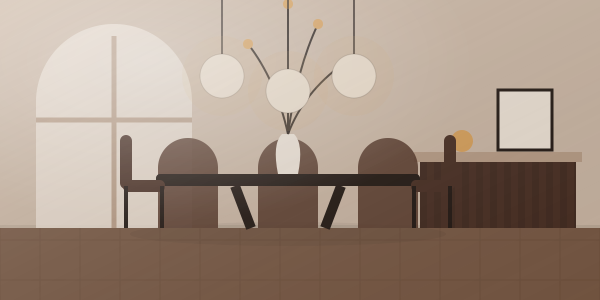
| Dining room | 60–66 in (152–168 cm) | Finished floor | Shaded, low output, on a dimmer |
| Outdoor entry door | 66–72 in (168–183 cm) | Finished porch | Fixture about a quarter to a third of door height |
Two adjustments to the table. If the room has 10 ft (3 m) ceilings or higher, push wall fixtures toward the upper end of each range so they do not look stranded at waist height. And if the fixture is exposed, meaning the bulb is visible from a seated position, raise it or add a diffuser; the rule is that the eye should meet the shade, not the source. These are industry-standard ranges; check the fixture's own template, since the mounting point rarely sits at the center of the light.
Spacing and how many you need
Space wall sconces 6–10 ft (1.8–3 m) apart along a run, and plan one fixture for every 8–10 ft (2.4–3 m) of wall when they provide ambient light. Closer than 6 ft the pools of light merge and the wall looks like a row of runway lights; farther than 10 ft the space between goes dark and the sconces read as isolated ornaments.
- Measure the wall and subtract 2–3 ft (60–90 cm) at each end so fixtures do not crowd a corner or a door frame.
- Divide by 8 ft (2.4 m) and round to the nearest whole number for a corridor or a long living room wall. A 20 ft (6 m) hallway takes two or three fixtures; a 30 ft (9 m) run takes three or four.
- Pair around a focal point instead of spacing evenly when the wall holds a fireplace, headboard, mirror or console. Set the pair 6–12 in (15–30 cm) outside the edges of the object, or 28–40 in (70–100 cm) apart for a mirror.
- Check the lumens. Sconces alone rarely light a room; treat them as 20–30 percent of the total. A 15 × 18 ft (4.6 × 5.5 m) living room wanting 2,000–2,700 lumens of ambient light gets 600–800 of it from two or three sconces, with the balance from ceiling fixtures and lamps. Our lighting calculator gives the target for any room size.
Odd numbers look intentional on a long blank wall; pairs look intentional around a center. The exception is a stair wall, where fixtures follow the treads and the count is whatever the run demands, usually one per 4–6 steps.
Wall sconces for the living room
In a living room, wall sconces do their best work as the third layer: a soft wall wash at 60–66 in (152–168 cm) that takes the load off the ceiling and lets you turn the downlights off after dinner. The best wall sconces for living room use are shaded or diffused, put out 200–450 lumens each, and sit on their own dimmer so they can drop to a glow.
Three placements work almost every time. Flanking the fireplace or the media wall, 60–72 in (152–183 cm) high and aligned with the mantel or the top of the TV, gives the room a symmetrical anchor. Above a sofa, a pair of swing-arm wall lamps for living room reading, mounted 48–54 in (122–137 cm) from the floor and 12–18 in (30–45 cm) beyond the sofa arms, replaces two end-table lamps and clears the tables for drinks. Behind a reading chair in a corner, a single articulated arm at 50–56 in (127–142 cm) turns dead space into a proper nook. Whatever the placement, hold 6 in (15 cm) minimum from a curtain edge or a door casing so the fixture does not look wedged.
Style-wise, 2027 favors quiet, material-led modern wall sconces: fluted opal glass on unlacquered brass, plaster or gesso cones that disappear into a limewashed wall, small pleated fabric shades in oat and rust, and matte-black articulated arms that read as furniture rather than hardware. Scale them to the room: a fixture 8–12 in (20–30 cm) tall suits an 8–9 ft (2.4–2.7 m) ceiling, and you can go to 14–18 in (35–45 cm) under 10 ft (3 m) or more. Match the metal to one other finish in the room, such as the door hardware or a coffee table base, rather than to everything; see how to mix metals for the two-finish rule.
#F3EBDD#C99A5B#E8DCCB#B8602F#2B2A28For where sconces sit in the whole scheme, from ceiling to lamp to candle, read how to layer lighting; the short version is that a living room needs three circuits, and sconces are usually the second.
Bedroom, hallway, staircase and bathroom sconces
Outside the living room, the mounting rule changes with the task: bedrooms need reach, hallways need rhythm, stairs need safety and bathrooms need face light plus a damp rating.
Bedroom
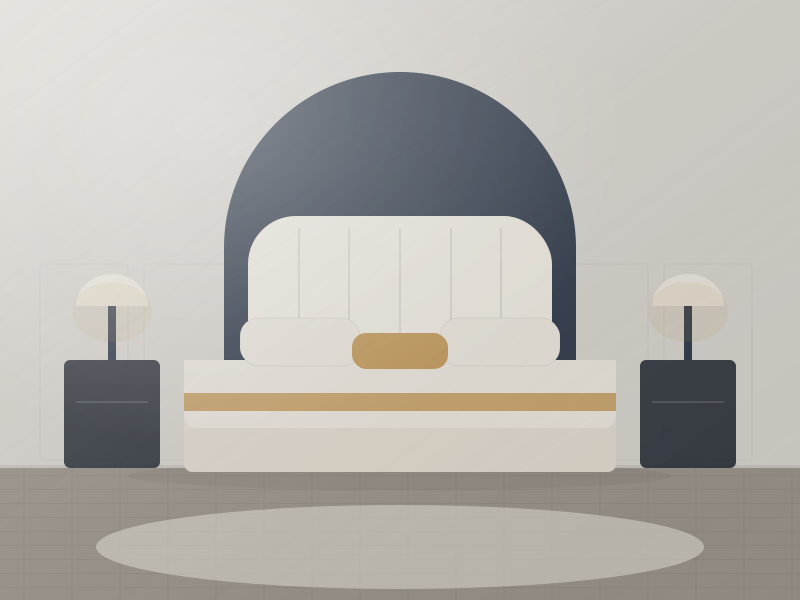
Bedside wall mounted lamps free 12–14 in (30–35 cm) of nightstand and let each sleeper control their own light. Mount a swing-arm so the shade bottom sits 30–36 in (76–91 cm) above the mattress top, which lands around 54–60 in (137–152 cm) from the floor on a standard bed, and center each fixture 6–12 in (15–30 cm) outside the mattress edge so the arm reaches the pillow without extending fully. Specify 400–600 lumens for reading with a shade that blocks the bulb from the partner's side, and a switch on the fixture or at bedside height. A fixed sconce lamp above a headboard reads as decorative and is fine for ambient light, but it will not serve as a reading light for someone lying down.
Hallway
Hallway sconces do what a row of ceiling spots never does: they light the walls, which is what makes a corridor feel wider. Mount at 60–66 in (152–168 cm), space 6–10 ft (1.8–3 m), keep projection under 4 in (10 cm) in a narrow hall and choose up/down or shaded fixtures at 300–500 lumens. In a hall under 42 in (107 cm) wide, put them all on one wall.
Staircase
On a stair, mount sconces 60–66 in (152–168 cm) above the nosing of the tread directly below each fixture, so the row follows the pitch of the stair. One fixture every 4–6 treads, plus one at each landing, gives even light without glare when you look up the flight. Use down-throwing or fully shaded fixtures; an exposed bulb at eye height on a stair is the one place a sconce becomes a hazard.
Bathroom
At the vanity, a pair of sconces at 60–66 in (152–168 cm) either side of the mirror, 28–40 in (70–100 cm) apart, lights the face evenly from both sides and removes the shadows an overhead bar creates under the eyes and chin. Anything within about 24 in (60 cm) of a basin or 8 ft (2.4 m) of a bath or shower needs a damp or wet rating; in Europe that means IP44 or better in zone 2. The full rules are in Bathroom Sconces: Height, Spacing & Choosing Damp-Rated Fixtures.
Hardwired vs plug-in vs rechargeable
Hardwired sconces are the right answer when you can open the wall, plug-in sconces when you cannot, and rechargeable sconces only when the fixture is decorative rather than functional. The choice is about permission and brightness far more than about looks; the same brass globe is available in all three forms.
| Power type | Installation | Typical output | Control | Typical cost per fixture | Best for |
|---|---|---|---|---|---|
| Hardwired | Junction box in the wall; electrician or licensed DIY where permitted | 300–800 lumens, any bulb | Wall switch, dimmer, smart switch | $80–350 plus $100–250 install per box | Owned homes, new builds, renovations |
| Plug-in | Two screws or a picture hook, cord to an outlet | 300–800 lumens, any bulb | Inline switch, smart plug, plug-in dimmer | $40–150 | Rentals, retrofits, bedsides near outlets |
| Rechargeable / battery | Two screws or adhesive strip | 50–200 lumens | Touch, remote, timer | $30–120 | Stone or tile walls, art accent, seasonal displays |
Hardwiring is worth the cost wherever you own the walls. A boxed fixture on a dimmer switch is the only option that behaves like architecture: no cord, no charging, full brightness and control from the door. Budget $100–250 per location for an electrician to add a box off an existing circuit in an open or accessible wall, more if the wall is masonry or the run is long. Anything involving new circuits, junction boxes or switch loops must follow your local electrical code, which in most places means a licensed electrician or, where DIY is allowed, an inspection; treat the figures here as orientation, not instruction.
Plug-in sconces give you 90 percent of the effect at 30 percent of the cost, provided there is an outlet within the cord's 6–8 ft (1.8–2.4 m) reach and you are willing to manage the cord with a paintable channel. Battery and rechargeable sconces complete the set for walls where neither wiring nor cords are possible, but be honest about their role: at 50–200 lumens they are candles with a switch, not lamps. The two companion guides linked above weigh each option in depth.
Bulbs: color temperature, lumens, dimmers
Fit wall sconces with 2700K LED bulbs at CRI 90 or higher, 200–450 lumens each for ambient light and 450–800 for reading, and put every group on a dimmer. Sconces sit at eye level, so bulb quality shows more here than in any ceiling fixture.
- Color temperature. 2700K is the warm white that matches incandescent and flatters skin and timber; 3000K reads cleaner and suits kitchens and modern bathrooms; anything above 3500K on a wall looks clinical. Keep every sconce in a room within 300K of the other fixtures. Dim-to-warm LEDs, which slide from 2700K toward 1800K as they dim, are the best upgrade a sconce can get.
- Lumens, not watts. A 40 W incandescent equivalent is about 450 lumens; 25 W is about 250 lumens. Two shaded sconces at 300 lumens light a hallway; a reading swing-arm wants 450–800 lumens with a shade that directs it down.
- CRI. Choose CRI 90+ so paint, fabric and faces render truly; CRI 80 bulbs make warm neutrals go gray. This matters most where the sconce washes a colored or limewashed wall.
- Bulb shape. Exposed sconces take a G16.5 or G25 globe, a T-type tube or a small filament bulb, and look best at 100–200 lumens dimmed further; shaded fixtures take a standard A-shape or candelabra base hidden inside. Check the base, E12 candelabra or E26 medium in North America and E14 or E27 in Europe and most other markets, before ordering bulbs in bulk.
- Dimmers. Match the dimmer type to the bulb: LED-rated trailing-edge or ELV dimmers avoid flicker and buzz. For plug-in fixtures, an inline LED dimmer or a smart plug with dimming does the job; for hardwired runs, one dimmer per group of two to four sconces, on its own circuit from the ceiling lights.
- Integrated LED or replaceable bulb. Integrated fixtures are slimmer and often brighter per size, but when the diode fails in 10–15 years the fixture goes with it. For anything you intend to keep, choose a replaceable bulb.
Care is simple. Dust glass and metal monthly with a dry microfiber cloth, clean glass diffusers with a mild soap solution and a soft cloth, never a glass cleaner containing ammonia on lacquered or living-finish brass, and let unlacquered brass darken; that patina is the point. Fabric shades take a lint roller or a gentle vacuum with a brush head.
Ready to choose? The globe wall sconces in our shop edit cover the frosted-glass and brass looks in this guide at retail, and for a project of ten fixtures or more the sourcing desk can quote the same styles made to your specification.
Free toolTile CalculatorWork out tiles, boxes, grout and adhesive with the right wastage.Shop & source the look
Buy it today — or have it made
Retail links are affiliate links: we may earn a commission at no extra cost to you (disclosure). “Get it made” sends the item to our sourcing desk for factory quotes in custom sizes and finishes.
Frequently asked questions
How high should you install wall sconces?
Center most wall sconces 60–66 in (152–168 cm) above the finished floor, at or just above eye level. For bedside reading, set a swing-arm so the shade bottom is 30–36 in (76–91 cm) above the mattress. Push toward the upper figure under ceilings of 10 ft (3 m) or more, and always check the fixture's own mounting template.
How many wall sconces do you need for a room?
Plan one sconce for every 8–10 ft (2.4–3 m) of wall, spaced 6–10 ft (1.8–3 m) apart, or a pair 6–12 in (15–30 cm) outside the edges of a fireplace, mirror or headboard. A typical 15 × 18 ft living room uses two to four; a 20 ft hallway uses two or three. Sconces supply roughly 20–30 percent of a room's total lumens.
Do wall sconces need to be hardwired, or can they be plug-in?
They can be either. Hardwiring is best when you own the walls and want full brightness on a wall dimmer; plug-in sconces give the same light from an outlet within 6–8 ft (1.8–2.4 m) using a cord cover, and suit rentals. Battery sconces need no power at all but top out around 200 lumens, so they work as accent light only.
What's the real difference between the main types of wall sconces?
The difference is where the light goes. Up/down and globe sconces wash a wall for ambient light, swing-arms deliver adjustable light to a book or a chair, picture lights aim a narrow beam at art, and plug-in or battery versions of any of these trade wiring for a cord or a charge. Pick by task first, then by finish.
What should you look for when choosing sconce light?
Look for a diffused or shaded source at 2700K and CRI 90 or higher, 200–450 lumens for ambient use or 450–800 for reading, a replaceable bulb, dimmer compatibility and a projection under 4 in (10 cm) in narrow halls. Check the damp or IP rating for bathrooms and the safety certification required in your market.
Some links may be affiliate links. Regulations and specifications change — always confirm with suppliers and qualified professionals.