Bathroom Sconces: Height, Spacing & Choosing Damp-Rated Fixtures
Bathroom sconces explained for buyers: damp versus wet ratings and IP codes, the 60–66 in mounting height, spacing from the mirror, one versus two fixtures, finishes that match your hardware and shade styles.
Key takeaways
- Every bathroom fixture needs at least a damp rating; use wet-rated or IP65 within reach of the tub or shower
- Mount side sconces at 60–66 in (152–168 cm) to the light source, 28–40 in (71–102 cm) apart
- Two sconces per single vanity, three for a double; 400–800 lumens each at 2700–3000K, CRI 90+
- Match the sconce finish to the faucet or contrast with one other metal, never three
Bathroom sconces belong at eye level, 60–66 in (152–168 cm) from the floor to the center of the fixture, mounted either side of the mirror 28–40 in (71–102 cm) apart, and every fixture in the room needs at least a damp-location rating. Get those three things right and the rest is finish and shade style. Here are the ratings, placement, count and looks.
- Rating: damp-rated minimum anywhere in a bathroom; wet-rated or IP44+ within reach of the shower or bath.
- Height: 60–66 in (152–168 cm) to the center of the light source for side-mounted sconces.
- Spacing: 28–40 in (71–102 cm) apart, 36 in (91 cm) being the sweet spot for a single-sink vanity.
- Output: 400–800 lumens per sconce, 2700–3000K, CRI 90 or higher.
- Cost: roughly 60–180 USD each for a well-made fixture in solid brass or steel with a glass shade.
Damp-rated vs wet-rated vs IP ratings
A damp-rated sconce handles steam and condensation; a wet-rated or IP44-and-above sconce handles direct water, and only the second belongs within arm's reach of a shower or bath. That is the whole distinction, and it decides which fixtures you can even consider before style enters the conversation.
In North America, fixtures are listed for dry, damp or wet locations. A dry-rated sconce is for hallways and bedrooms; it has no sealing at all and will corrode or short in a humid room. Damp-rated fixtures have sealed wiring compartments and finishes that tolerate condensation, which is what a typical bathroom with an exhaust fan produces. Wet-rated fixtures are gasketed against direct spray and are the only correct choice inside a shower enclosure, over a freestanding tub or anywhere within about 3 ft (90 cm) horizontally and 8 ft (2.4 m) vertically of the tub rim or shower floor. Most codes call that zone out explicitly; check yours, because the exact distance varies.
Europe, the UK, the Middle East and much of Asia use IP codes instead. The two digits describe protection against solids and liquids. IP20 is a bare interior fixture. IP44 resists splashing from any direction and is the usual minimum for a sconce beside a basin. IP65 is jet-proof and is what you want inside a wet room or over a bath. The UK goes further and divides the bathroom into zones: zone 1 (inside the bath or shower footprint up to 7 ft 4 in, 2.25 m) needs IP65 in practice, zone 2 (24 in, 60 cm, around zone 1) needs IP44, and outside those zones a standard fixture is acceptable, though we still specify IP44 for anything mounted on a bathroom wall because steam does not respect zone boundaries.
| Rating | Protection | Where it belongs in a bathroom |
|---|---|---|
| Dry location / IP20 | None against moisture | Nowhere in a bathroom |
| Damp location / IP44 | Condensation, steam, splashes | Beside the vanity mirror, general walls |
| Wet location / IP65 | Direct spray, jets | Inside the shower, over the bath, wet rooms |
| Low-voltage wet / IP67 | Temporary immersion | Steam rooms, fixtures below tub-rim height |
Two practical notes. First, the rating applies to the fixture as sold; swapping in an open-bottom shade or a bare bulb can void it. Second, any wiring, switching or new circuit in a bathroom is regulated work in almost every jurisdiction. Treat everything here as background knowledge and have a licensed electrician confirm the zone, the circuit protection and the switch position before you buy.
Bathroom sconces: mounting height and distance from the mirror
Side-mounted bathroom wall sconces should sit with the light source at 60–66 in (152–168 cm) from the finished floor, which puts the glow at face height and lights both sides of the face evenly with no shadows under the brows and chin. Overhead light alone does the opposite, which is why hotel bathrooms with a single downlight make everyone look tired.
The rule adapts to who uses the room. In a household where the adults are around 5 ft 4 in to 6 ft 1 in (163–185 cm), 64 in (163 cm) to the center of the shade suits both. For a children's bathroom drop to 58–60 in (147–152 cm). If the sconce has a long vertical shade, measure to the middle of the illuminated portion rather than the mounting plate, and in a room with a low 7 ft 6 in (229 cm) ceiling keep the top of the fixture at least 6 in (15 cm) below the ceiling line so it does not read as a cornice.
Distance from the mirror matters as much as height. Leave 2–4 in (5–10 cm) between the mirror edge and the nearest point of the fixture so the sconce does not appear to touch the frame, and make sure the back plate lands on wall, not on the mirror, unless the mirror is designed to be drilled. When the mirror runs wall to wall, mount the sconces directly on the glass with a mirror-mount kit or, more simply, hang them above the mirror at 75–80 in (190–203 cm) as a pair or a bar. Our Bathroom Vanity Lighting Ideas: Over the Mirror, Beside It & Beyond guide compares those placements in detail.
Pay attention to the electrical box too. Standard boxes are set for a fixture with a small back plate; if you choose a sconce with a slim 4 in (10 cm) canopy, the box must sit exactly where the fixture will, because there is no room to hide an offset. Confirm box positions before tiling.
One sconce, two sconces or a bar?
Two bathroom vanity sconces flanking the mirror is the correct answer for any single-sink vanity 30–48 in (76–122 cm) wide; a bar above the mirror is the answer when the mirror is wider than the wall allows for side mounting. A single vanity sconce is a compromise for powder rooms under 30 in (76 cm) wide.
Spacing for a pair is 28–40 in (71–102 cm) center to center. Below 28 in the two lights merge into one hot spot; above 40 in the face falls into the shadow between them. For a 36 in (91 cm) vanity with a 24–28 in (61–71 cm) mirror, sconces at 34–36 in (86–91 cm) apart land neatly on either side. Each fixture should deliver 400–800 lumens, so the pair gives 800–1,600 lumens on the face, comfortably above the 500 lux task level that makeup and shaving want. Use warm white, 2700–3000K, and insist on CRI 90 or higher; a CRI 80 lamp makes skin and marble both look grey.
Double vanities of 60–72 in (152–183 cm) work best with three sconces: one at each end and one between the two mirrors, spaced 30–36 in (76–91 cm) apart. Four sconces around two separate mirrors look busy and rarely fit the wall. For a wide single mirror where side mounting is impossible, choose a linear bar 24–36 in (61–91 cm) long, two-thirds to three-quarters of the mirror width, mounted with its center 75–80 in (190–203 cm) above the floor; you lose the flattering side light, so add a dimmable illuminated mirror or a second layer of light elsewhere. If your bathroom is one of several rooms getting sconces, Wall Sconces: Styles, Placement Heights & Room-by-Room Guide sets out how the heights shift in halls, bedrooms and living rooms.
- Measure the vanity width and the mirror width, and mark the mirror's centerline on the wall.
- Decide side or top mounting based on the wall space left each side of the mirror (you need at least 6 in, 15 cm).
- Mark the sconce centers at 60–66 in (152–168 cm) high and 28–40 in (71–102 cm) apart, symmetrical about the centerline.
- Check the rating for the position: damp beside the vanity, wet or IP65 within reach of the tub or shower.
- Have the electrician set boxes to those marks before tiling, and put the sconces on a dimmer separate from the ceiling light.
Sizing the fixture itself follows the mirror: the height of the sconce body should be roughly one-quarter to one-third of the mirror height. For a 36 in (91 cm) tall mirror that means a fixture 9–12 in (23–30 cm) high. For total room lumens, including sconces, ceiling and shower light, our lighting calculator does the arithmetic.
Finishes that match your hardware
Match the sconce finish to the faucet and cabinet hardware, or deliberately contrast it with one other metal, and never let a third metal into the room. Bathrooms are small enough that a stray finish reads as a mistake rather than a layer.
Finishes behave differently in a humid room. Polished chrome and polished nickel are the most durable and easiest to keep spotless, and chrome is the coolest in tone, so it pairs with grey and white marble and blue-green tiles. Brushed nickel hides water marks and suits warm greys and taupes. Brass has several personalities: lacquered brass stays bright, unlacquered brass darkens and spots within months, which some people want and some hate, and antique or burnished brass arrives pre-aged. If you are pairing a sconce with pulls and knobs, Brass Cabinet Hardware: Antique, Brushed & Unlacquered Pulls Explained covers which brass finishes are stable enough to match across a room. Matte black is the most forgiving in a family bathroom, though it shows soap spray and the powder coating will chip if the glass shade is knocked against it during cleaning. Bronze, oil-rubbed or dark, reads traditional and is the hardest to match across manufacturers because there is no standard tone.
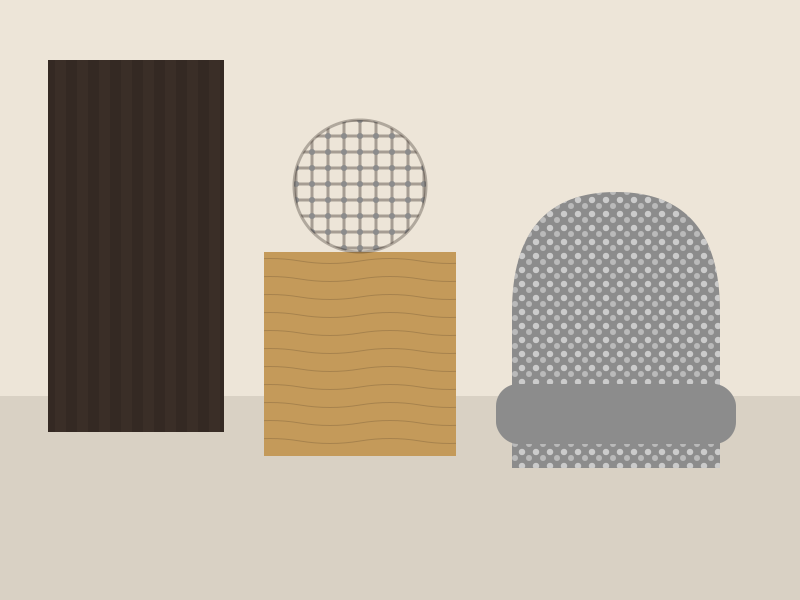
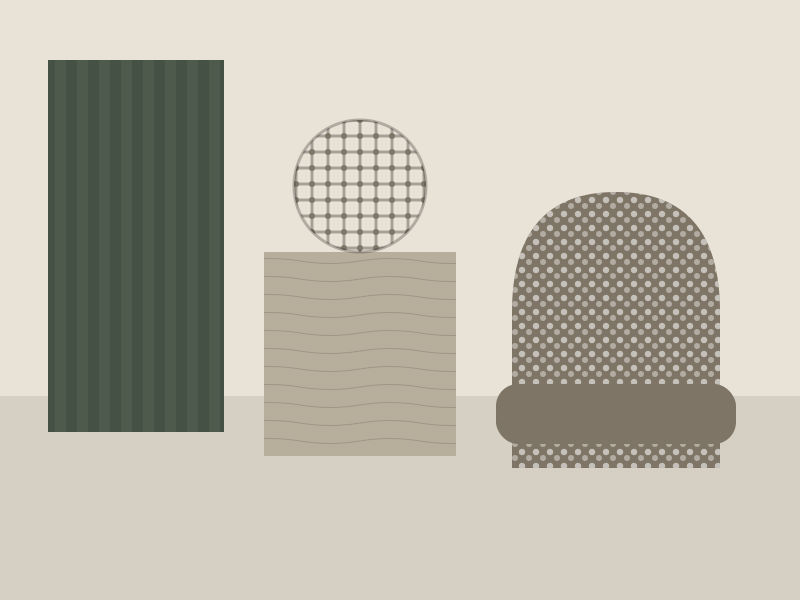
#D9D3C8#B8B2A8#C9A66B#5A4A3E#2B2B2BThe pairing we specify most often in 2027 is aged brass sconces with brass faucets against a warm off-white tile, with matte black kept for the mirror frame or nothing at all. For the cooler direction, polished nickel sconces with nickel taps and a green or blue-grey tile is quietly luxurious. Ask for solid brass or steel bodies rather than zinc alloy; zinc pits in a steamy room and the plating lifts within a few years.
Styles: globe, cylinder, pleated, fluted glass
Choose the shade by the light it throws, not the shape alone: opal glass and pleated fabric give a soft, even wash for the face, while clear fluted glass and open cylinders give sparkle and shadow and need a frosted lamp to be flattering. The shade decides whether the fixture is task lighting or jewelry.
- Globe sconces in opal glass are the modern bathroom sconces default for good reason: a 6–8 in (15–20 cm) orb diffuses light in all directions with no hot spots. Choose a shade of at least 6 in for a 30 in (76 cm) vanity and 8 in for 42 in (107 cm) and wider. Look for a three-piece body (back plate, arm, socket cup) in a single metal.
- Cylinder sconces are slim, 4–5 in (10–13 cm) diameter, and either closed (soft) or open top and bottom (dramatic up-and-down light). Open cylinders make a small powder room feel taller; closed opal cylinders are the practical choice beside a shaving mirror.
- Pleated shades in linen or cotton, 5–7 in (13–18 cm) across, are the 2027 return to softness. They are damp-rated only when the fabric is treated and the lampholder is sealed, so confirm the listing. Keep them away from the shower zone and specify a removable shade you can vacuum.
- Fluted or ribbed glass shades echo reeded vanity fronts and fluted tiles, the strongest bathroom material trend of the moment. Clear fluted glass throws striped light on the wall; frosted fluted glass keeps the texture and loses the glare. Pair with a 2700K frosted lamp of 500–600 lumens.
- Picture-light and swing-arm bath sconces suit traditional rooms and reading-in-the-bath layouts, but arms add moisture-exposed joints, so keep them at least 5 ft (1.5 m) from the tub or use a wet-rated version.
Whatever the style, keep the lamp itself hidden or frosted, use integrated LED only if the driver is replaceable, and put the pair on a dimmer. A bath sconce lighting scheme that dims from 100 percent for makeup to 20 percent for a late bath is the single upgrade guests notice most in a rental or hotel room. For a hospitality order, damp-rated solid brass sconces in a globe or cylinder form are readily produced to your finish at factory MOQs of around 50–100 pieces.
If you would rather start from a curated shortlist, our shop collects the sconces, mirrors and finishes from this edit as a ready-to-buy set, and the sourcing desk can quote a matching pair or a hotel run against your drawings.
Free toolTile CalculatorWork out tiles, boxes, grout and adhesive with the right wastage.Shop & source the look
Buy it today — or have it made
Retail links are affiliate links: we may earn a commission at no extra cost to you (disclosure). “Get it made” sends the item to our sourcing desk for factory quotes in custom sizes and finishes.
Frequently asked questions
How high should you install bathroom sconces?
Mount side sconces so the center of the light source sits 60–66 in (152–168 cm) above the finished floor, roughly eye level for adults. Measure to the illuminated part of the shade, not the back plate, and drop to 58–60 in in a children's bathroom. Sconces above a mirror sit at 75–80 in (190–203 cm).
How many bathroom sconces do you need for a room?
Two flanking the mirror is right for a single vanity up to 48 in (122 cm) wide; a double vanity of 60–72 in (152–183 cm) takes three, one at each end and one between the mirrors. Use a single sconce or a bar above the mirror only when the wall is too narrow for side mounting.
What's the real difference between the main types of bathroom sconces?
The difference is how they handle water and how they throw light. Damp-rated fixtures tolerate steam; wet-rated or IP65 fixtures tolerate direct spray and are required near the tub or shower. Opal globes and pleated shades give soft, flattering light for the face, while open cylinders and clear fluted glass give drama and need a frosted lamp.
What should you look for when choosing sconce light fixture bathroom?
Check the rating first: damp-location or IP44 minimum, wet or IP65 near water. Then confirm a solid brass or steel body rather than zinc alloy, a finish that matches your faucet, 400–800 lumens at 2700–3000K with CRI 90 or higher, a dimmable driver or lamp, and a shade size about a quarter to a third of the mirror height.
What should you look for when choosing bathroom sconce lights?
Prioritize even, shadow-free light at face height, which means a diffusing shade in opal glass or treated fabric mounted at 60–66 in. Then look for a replaceable lamp or driver, a sealed lampholder, a finish that will not pit in humidity, and a back plate that covers your existing electrical box.
Some links may be affiliate links. Regulations and specifications change — always confirm with suppliers and qualified professionals.