Outdoor Wall Lights: Sizes, Mounting Heights, Ratings and Costs
Outdoor wall lights work when they are about one-third of the door height, mounted 66–72 in (168–183 cm) up, wet-rated and 400–800 lumens at 2700–3000K. Sizes, ratings, materials, costs and installation.
Part of our guide: Wall Sconces: Styles, Placement Heights & Room-by-Room Guide
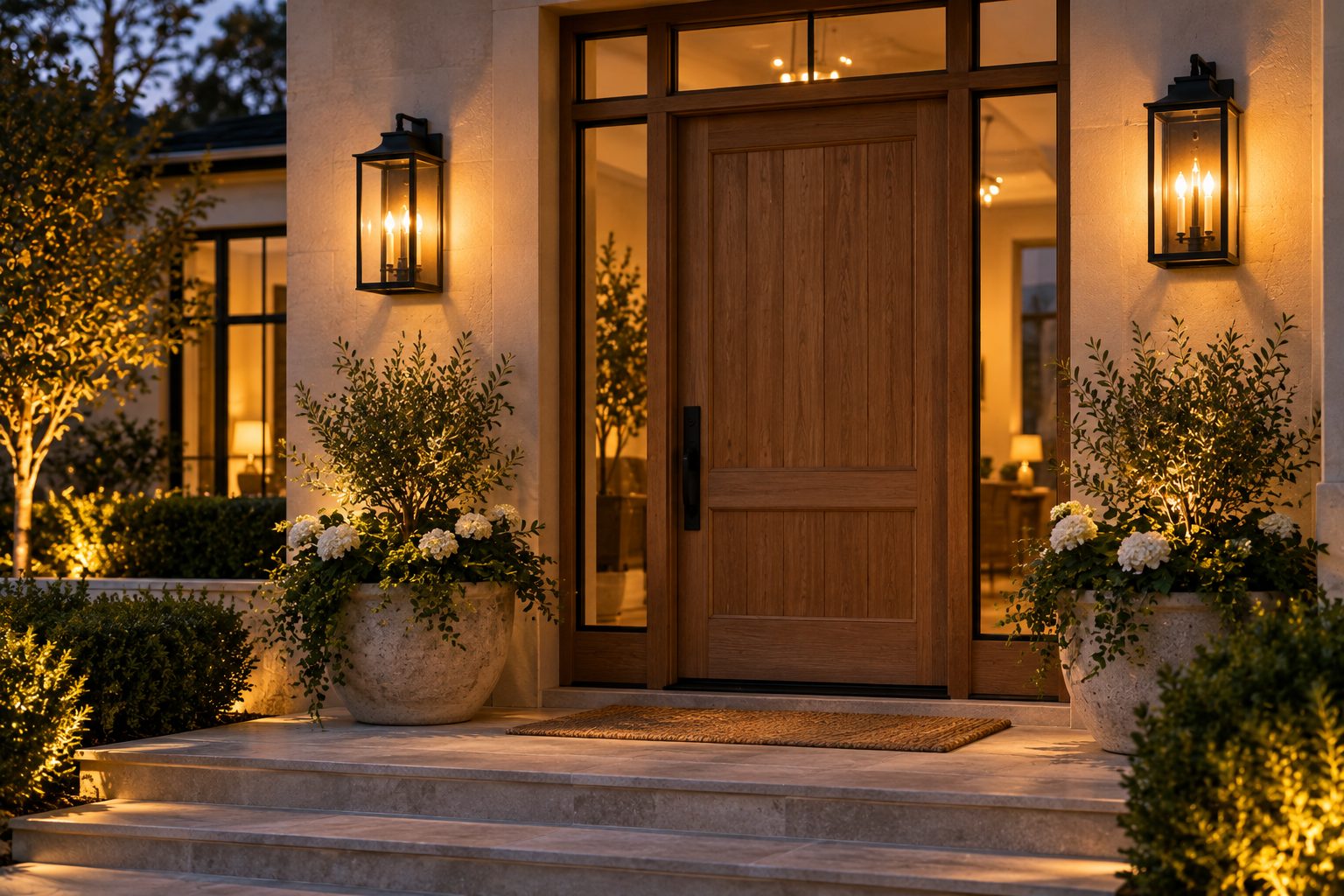
Key takeaways
- Size outdoor wall lights at roughly one-third of the door height for a single fixture and one-quarter to one-third each for a pair
- Mount the center of the fixture 66–72 in (168–183 cm) above the threshold, or line the top up with the top of the door frame
- Choose wet-location listing (IP44 minimum, IP65 on exposed walls) and 316 stainless, solid brass or copper near the coast
- Aim for 400–800 lumens at 2700–3000K per entry fixture, fully shielded, on a dusk-to-dawn sensor or timer
Outdoor wall lights should be roughly one-third the height of the door they flank, so 20–27 in (51–69 cm) tall for a single fixture beside a standard 80 in (203 cm) door, mounted with their center 66–72 in (168–183 cm) above the threshold. Choose wet-location rated fixtures (IP44 or better) giving 400–800 lumens at 2700–3000K, and almost any style will look right.
Exterior lighting follows the same logic as the indoor fixtures in our wall sconces guide, but weather, scale and neighbors change the numbers. Fixtures look half their real size from the street, rain and salt attack cheap finishes, and a bare bulb that seems fine at the showroom becomes glare at night. These are the specifications we use on real facades.
- Size: one-third of door height for one fixture, one-quarter to one-third each for a pair.
- Height: fixture center 66–72 in (168–183 cm) above the threshold, or top aligned with the door head.
- Rating: wet-location listing or IP44 minimum; IP65 for walls with no overhang.
- Light: 400–800 lumens per entry fixture, 2700–3000K, shielded or frosted.
- Typical cost: $40–150 for a basic fixture, $150–450 mid-range, $350–900+ for solid brass or copper.
What are outdoor wall lights?
An outdoor wall light is a fixed luminaire hardwired to a junction box on an exterior wall and built to survive rain, sun and temperature swings. The category covers the exterior wall lantern, the cylinder or box exterior sconce, gooseneck barn lights and low flush bulkheads. Exterior wall lights do three jobs at once: they let you find the keyhole and see faces at the door, they mark steps and level changes, and they give the facade a nighttime shape.
The difference between outdoor wall light fixtures and indoor ones is the listing. In the US a fixture is listed for dry, damp or wet locations. Damp-rated outdoor wall sconces can sit under a deep porch roof that keeps direct rain off; anything on an open wall, or where wind drives rain sideways, needs a wet-location listing. Outside North America the equivalent is an IP rating: IP44 resists splashing water, IP65 resists water jets and dust and is what we specify for open walls.
What size outdoor wall lights do you need?
Most people buy outdoor wall lights that are too small, so size up: one-third of the door height for a single fixture and one-quarter to one-third for each of a pair. Distance shrinks everything. A 12 in (30 cm) lantern looks generous in a box on the kitchen table and like a doorbell from the curb.
| Location | Fixture height | Mounting height | Light output |
|---|---|---|---|
| Front door, single fixture | 20–27 in (51–69 cm) | Center 66–72 in (168–183 cm) above threshold | 600–800 lm |
| Front door, pair | 16–24 in (41–61 cm) each | Center 66–72 in, 6–12 in (15–30 cm) off the trim | 400–600 lm each |
| Double or tall entry door, 96 in (244 cm) | 24–32 in (61–81 cm) | Top in line with door head | 600–1,000 lm each |
| Garage door, 7 ft (213 cm) | 18–24 in (46–61 cm) | Center 7–8 ft (213–244 cm) above drive | 600–1,200 lm each |
| Back door or side door | 10–16 in (25–41 cm) | Center 66–72 in above step | 400–600 lm |
| Patio or deck wall run | 8–14 in (20–36 cm) | 6–7 ft (183–213 cm), every 8–10 ft (2.4–3 m) | 200–400 lm each |
A quick test before ordering: cut cardboard to the fixture's outline, tape it to the wall and look at it from the sidewalk. If you have to ask whether it is too big, it is probably right. Where the door has sidelights, mount on the outer casing rather than squeezing a fixture between door and glass.
Which types of exterior wall lights suit which jobs?
Pick the fixture type by what the light must do: lanterns announce an entry, up-down sconces graze a wall, gooseneck lights wash a garage or sign, and bulkheads light paths and service doors.
Exterior wall lantern
The classic exterior wall lantern, with a glass box or cage around a bulb, suits traditional, colonial and farmhouse facades. Choose seeded, frosted or ribbed glass, or a lantern with an internal opal shade, so you see glow rather than a bare filament. Clear glass with a bright lamp is the single biggest source of porch glare.
Modern exterior sconce
Cylinders, cubes and slim plates that throw light up and down are the default modern exterior sconce. They make two scallops of light on the wall and almost no glare, which is why modern outdoor wall sconce lighting reads so calm on stucco, brick and board-formed concrete. Look for beam angles stated by the maker; narrow beams of 10–25 degrees draw crisp lines, wider 40–60 degree beams wash more wall.
Gooseneck and barn lights
A dish shade on a curved arm points light down onto a garage door, a stoop or house numbers. Arms of 10–18 in (25–46 cm) keep the light off the siding. They are honest, durable outdoor sconces lighting fixtures and work on cottage, industrial and modern farmhouse houses.
Flush bulkheads and step lights
Low-profile bulkheads with an impact-rated diffuser (IK08 or above) belong beside side doors, in narrow passages and on walls people brush past. Recessed step lights set 12–18 in (30–46 cm) above the tread do the job outdoor wall lamps cannot: putting light on the edge of each step.
What ratings and materials should outdoor wall sconces have?
Buy for the climate first and the look second: powder-coated aluminum is fine inland, but within a few miles of salt water only 316 stainless steel, solid brass, copper or marine-grade coatings last. The finish is what fails, usually in two to five years, long before the electronics.
| Material | Typical fixture price | Coastal performance | How it ages |
|---|---|---|---|
| Powder-coated aluminum | $40–250 | Poor to fair; pits and chalks in salt air | Fades and blisters at chips |
| Marine-grade coated aluminum | $150–450 | Good with pretreatment and sealed coat | Holds color 5–10 years |
| 304 stainless steel | $100–350 | Fair; tea-staining near the sea | Stays bright inland |
| 316 stainless steel | $150–500 | Very good | Minimal change, rinse twice a year |
| Solid brass or bronze | $300–900+ | Excellent | Darkens to a brown patina unless lacquered |
| Copper | $250–800+ | Excellent | Browns, then greens to verdigris over years |
| Composite or polymer | $40–200 | Very good, no corrosion | Can yellow or chalk in strong UV |
Prices are typical 2026 US ranges per fixture. Finish color matters as much as metal. Matte black is still the most common choice, but bronze, aged brass and a natural verdigris look softer against warm 2027 exterior palettes, and they hide water spots better than glossy black. If you are repainting, pick the light finish alongside the trim color; our exterior house paint colors guide shows which combinations work.
#1F1F1E#4B3A2C#A9844E#5F8572#E9E6DFThe hex values are approximate screen references for metal finishes; real patinas shift with weather and light.
Are LED exterior wall lights better than bulb fixtures?
LED exterior wall lights use 75–85 percent less power than incandescent and last 25,000–50,000 hours, so the real choice is between integrated LED fixtures and fixtures with a standard socket. Both are LED wall lights in practice; the trade-off is repairability.
- Integrated LED: slimmer shapes, better optics and sealed IP65 bodies. When the driver fails, often after 8–12 years in heat, you replace the whole fixture. Ask for a 5-year warranty and a stated L70 lifetime.
- Socket fixtures: take an LED lamp on wall-mounted lanterns, so you can change color temperature or brightness later. Use lamps rated for enclosed fixtures, or they overheat inside sealed glass.
- Retrofit LED lights for sconces: candelabra E12 and medium E26 LED filament lamps of 300–800 lumens suit most lanterns; avoid anything over 3000K.
Check three numbers on any LED wall sconce light fixtures you shortlist: lumens, Kelvin and CRI. Watts no longer tell you brightness, so use our lumens to watts chart to translate an old 60 W lantern into roughly 800 lumens. CRI of 80 is fine outdoors; 90 makes brick, timber and planting look richer. For the full list of fixture families, see our guide to types of light fixtures.
How bright should outdoor wall lamps be?
An entry needs 400–800 lumens per fixture, a garage 600–1,200, and a patio wall only 200–400 per fixture, always at 2700–3000K and shielded so the source is not visible from the street. Brighter is not safer: glare shrinks your pupils and makes the yard beyond the light harder to see.
Dark-sky practice is now written into many local codes, and it is good design anyway. Fully shielded fixtures that point light down, 3000K or warmer, and light only where people walk keep the facade calm and stop light spilling into a neighbor's bedroom. On a terrace or around a paver patio, low wall lights at 200–300 lumens plus a few step lights are usually all you need once you sit down.
Which controls should you add to exterior wall lights?
Put entry lights on a dusk-to-dawn photocell or an astronomical timer, and keep motion sensors for side paths, garages and trash areas. A photocell built into the fixture is the simplest upgrade; mount it where porch light or headlights will not fool it into switching off. Better still is a smart switch or timer that dims to 30 percent after midnight and brightens on motion, which saves energy and keeps the house lit without lighting up the street all night.
Motion sensors should have adjustable range and hold time. Set a 1–5 minute hold and aim the detection zone away from the sidewalk so passing cars and dogs do not trigger it every few seconds.
How do you install an outdoor wall light?
Replacing an existing outdoor wall light on a sound junction box is a 30–60 minute job; adding a new box or circuit is electrician work and needs a permit in most US jurisdictions. Typical 2026 US electrician rates run $150–350 to swap a fixture and $300–900+ to run a new feed.
- Kill the power at the breaker, not just the switch, and confirm with a non-contact tester.
- Check the box. It must be weatherproof, securely fixed and flush with the siding; add a mounting block on lap or shingle siding so the base sits flat.
- Fit the crossbar supplied with the fixture and check its holes line up with the fixture base.
- Connect the wires: black to black, white to white, bare or green to the ground screw, with wire nuts rated for the conductor size.
- Seal the top and sides with exterior silicone and leave the bottom 1 in (25 mm) unsealed so trapped water can drain.
- Fit the lamp and glass, restore power, then check the light at night from the street before you call it done.
Mistakes we see with outdoor sconces
The mistakes we see most often are fixtures that are too small, too bright and too cool, followed closely by cheap finishes on coastal houses. We regularly replace 10 in (25 cm) lanterns beside 8 ft doors with 20 in versions and the facade looks finished for the first time. We also see 5000K daylight lamps that make a warm brick house look like a parking garage, clear-glass lanterns with 1,100 lumen bulbs that blind visitors, and a single fixture placed on the hinge side of the door, so the lock side sits in shadow.
How we would do it: a pair of shielded, wet-rated lanterns or up-down sconces at one-quarter to one-third of door height, solid brass or 316 stainless near the coast, 2700K lamps around 500 lumens each, on a photocell with a dimming schedule. Then one modest wall light at each secondary door and nothing pointing at the sky. That combination of outdoor wall lights costs less than most people expect and fixes how the house looks after dark.
Sourcing exterior fixtures for a renovation, development or hospitality project? Send quantities, mounting surfaces and your climate zone to our lighting sourcing desk and we will match you with factories that can certify wet-location performance and coastal finishes.
Free toolPaint CalculatorWork out exactly how much paint to buy.Shop & source the look
Buy it today — or have it made
Retail links are affiliate links: we may earn a commission at no extra cost to you (disclosure). “Get it made” sends the item to our sourcing desk for factory quotes in custom sizes and finishes.
Frequently asked questions
How high should outdoor wall lights be mounted?
Mount outdoor wall lights so the center of the fixture is 66–72 in (168–183 cm) above the threshold, slightly above eye level. On tall or double doors, align the top of the fixture with the top of the door frame instead. Garage lights usually sit higher, with the center 7–8 ft (213–244 cm) above the driveway.
What size outdoor light should go beside a front door?
A single fixture should be about one-third of the door height, so 20–27 in (51–69 cm) tall beside a standard 80 in (203 cm) door. For a pair, choose one-quarter to one-third of the door height each, around 16–24 in (41–61 cm). Fixtures look smaller from the street, so size up when unsure.
What is the difference between damp and wet rated outdoor lights?
Damp-rated lights can be used under a covered porch or deep eave where rain does not hit them directly, while wet-rated lights are built for direct rain, snow and hose spray. Use wet-rated fixtures, or IP65 outside North America, on any wall without a protective overhang.
What color temperature is best for outdoor wall lights?
Use 2700–3000K for outdoor wall lights. Warm white flatters brick, wood and planting, matches interior lighting seen through windows and meets most dark-sky guidelines. Avoid 4000K and above on houses; cool light looks harsh, attracts more insects and makes the facade look commercial.
How many lumens do outdoor wall lights need?
Front-door fixtures need about 400–800 lumens each, garage lights 600–1,200 and patio or deck wall lights 200–400. Shielded or frosted fixtures can run at the higher end without glare. More lumens than this rarely improves safety and usually just creates glare and light spill.
Some links may be affiliate links. Regulations and specifications change — always confirm with suppliers and qualified professionals.