Exterior House Paint Colors: 2027 Combinations, LRV and Real Costs
The exterior house paint colors that age best are warm whites, greige, muted green, deep navy and soft black. Here is how to pair body, trim and door, check LRV, test samples and budget $3,000–$9,000 for a typical house.
Part of our guide: Interior House Paint Ideas: Color Schemes & Room Paint Design
Key takeaways
- The safest exterior house paint colors are warm whites, greige and muted green, with soft black or deep navy reserved for trim, doors or small houses with strong lines
- Build every scheme as body, trim and accent: one main color on roughly 60–70 percent of the facade, a trim color and one door or shutter accent
- Check LRV before you buy: very dark body colors under about LRV 20 get hot in sun and need vinyl-safe formulas on plastic siding
- Painting a typical 1,500–2,500 sq ft (140–230 m²) house exterior costs roughly $3,000–$9,000 professionally in the US in 2026
The exterior house paint colors that look right for longest are warm whites, greige, muted sage or olive green, deep navy and soft black, chosen to suit the roof, brick or stone that will not change. Pick a body color with an LRV between about 25 and 80, a contrasting trim color, and one accent for the door, then test large samples on two sides of the house.
- Most reliable body colors: warm white, cream, greige, putty, sage and gray-green.
- Scheme structure: body color on 60–70 percent of the facade, trim on 20–30 percent, door or shutters on about 10 percent.
- Light reflectance: whites read about 10–20 percent lighter outdoors than on the chip; dark colors read darker and hotter.
- Typical cost: about $3,000–$9,000 to have a 1,500–2,500 sq ft (140–230 m²) house painted, labor included.
- Repaint cycle: roughly 7–10 years on wood and fiber cement in a moderate climate, sooner on sun-baked south and west walls.
Exterior color decisions follow the same logic as rooms inside, only at a bigger scale and in harder light. Our interior painting ideas pillar covers the indoor side; this guide is about outside house colors, from the first sample to the final coat.
What are the best exterior house paint colors for 2027?
The best exterior house paint colors for 2027 are warm, slightly muddied neutrals and grounded earth tones rather than stark white or cool gray. Builders and homeowners are moving away from the blue-gray and pure-white farmhouse look toward cream, putty, greige, olive and ink, mirroring the warmer palettes in our paint color trends 2027 report.
The table sorts the main exterior paint colors by family, with typical LRV (light reflectance value, 0 for black to 100 for pure white), the house styles they suit and the trim we would pair with each.
| Color family | Typical LRV | Suits | Trim pairing | Watch out for |
|---|---|---|---|---|
| Warm white / cream | 75–85 | Colonial, farmhouse, Mediterranean | Same white, or soft black | Glare in full sun; dirt on lower courses |
| Greige / putty | 45–65 | Ranch, transitional, new builds | Warm white or bronze | Can look beige next to red brick |
| Mid gray | 30–50 | Craftsman, coastal, modern | Crisp white | Turns blue under north light |
| Sage / olive green | 25–50 | Cottage, Tudor, wooded lots | Cream or deep green | Too yellow next to a green lawn |
| Navy / ink blue | 6–15 | Cape Cod, colonial, coastal | Bright white | Fades fastest on south walls |
| Soft black / charcoal | 3–10 | Modern, barn style, small cabins | Natural wood or black-on-black | Heat gain; shows dust and pollen |
| Terracotta / clay | 15–30 | Spanish revival, desert modern | Cream or warm white | Clashes with orange-toned brick |
LRV bands are typical ranges across common exterior paint lines; the exact number is printed on the back of most color chips and in the manufacturer's color data.
How do you choose outside house colors combinations?
Choose outside house colors combinations by starting with the fixed elements — roof, brick, stone and windows — and picking a body color that shares their undertone, then a trim and an accent. A charcoal roof wants cool or neutral bodies; a brown or terracotta roof wants warm ones. Fighting the roof is the most common reason a freshly painted house looks wrong.
These are the house color schemes we return to most often, each written as body, trim and door:
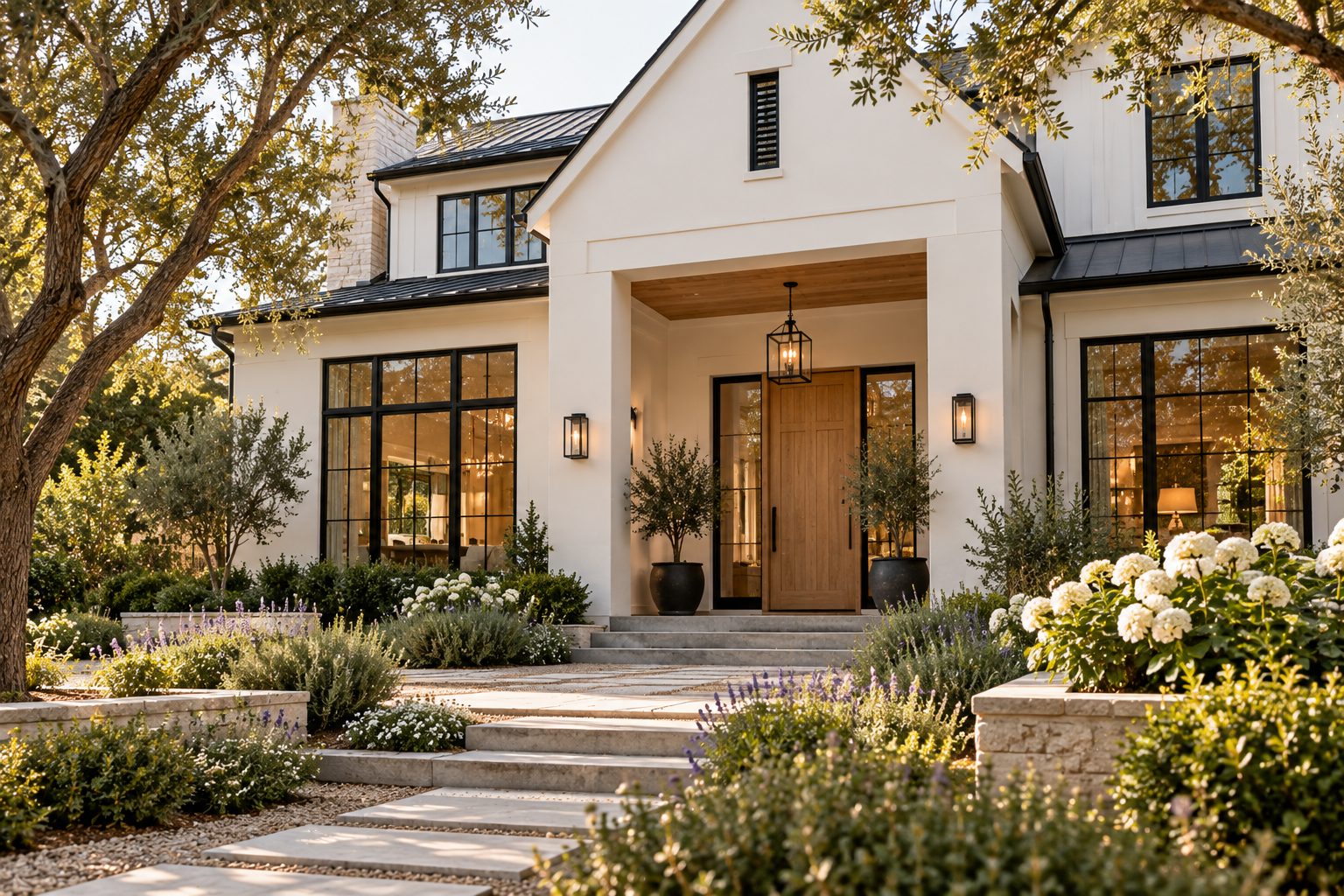
- Warm white, white, black: cream body, the same cream on trim, soft black door and lanterns. Timeless on colonial and farmhouse shapes.
- Greige, warm white, oak: putty body, warm white trim, stained natural wood door. The easiest scheme on a new build.
- Sage, cream, deep green: gray-green body, cream trim, forest or olive door. Excellent near trees.
- Navy, white, brass: ink blue body, crisp white trim, brass hardware and a red or natural wood door.
- Charcoal, charcoal, cedar: soft black body and trim with cedar soffits or a wood door. Strong on modern and barn-style houses.
#EDE7DA#C9C0AE#7E8471#2F3A4A#2A2826#9C5B3FThe hex values are screen approximations; exterior light shifts every color, so treat them as a starting point for samples. If you are still choosing a whole-house palette, our interior color schemes guide uses the same 60-30-10 logic indoors, which helps the front door and the hallway feel related.
White exterior paint: how to get white right
White exterior paint works best as a slightly warm, slightly gray white with an LRV between about 75 and 85, not a pure bright white above 90. Sunlight bleaches a facade, so a white that looks creamy on the chip often reads clean on the house, while a stark white glares and looks blue in shade.
White exterior house paint undertones
Match the undertone to the house. White exterior house paint with a yellow or red undertone flatters brick, stone and wood; a neutral white with a hint of gray suits board-and-batten and fiber cement; a cool white belongs only on very modern houses with gray or black window frames. To read undertones, hold the chip against a sheet of plain printer paper outdoors: the warmth or coolness shows immediately.
White on white exterior paint
White on white exterior paint — the same white on body and trim, or two whites a step apart — gives a calm, expensive look and hides awkward trim proportions. Use the same color in a flat or low-sheen finish for the siding and satin or semi-gloss for the trim, so the trim reads through sheen rather than color. If you prefer a visible step, go about 5–10 LRV points brighter on the trim, never darker.
Are gray exterior paint colors still a good choice?
Gray exterior paint colors are still a good choice when they are warm grays or greige, but cool blue-grays are dating fast and look cold under overcast skies. Grey exterior house colors were the default of the 2010s; the ones that survive are those with a beige, green or taupe undertone.
Test any gray on the north side of the house first. North light pulls gray toward blue, and a color that looks like soft stone on a sunny chip can turn icy on the shaded side. Pair a mid-gray with warm white trim rather than pure white, and add warmth with a wood door, bronze lanterns or terracotta planters.
Which dark and earthy exterior home colors work?
Dark and earthy exterior home colors — navy, olive, charcoal, soft black and clay — work best on houses with clean lines, generous trim and enough setback that the facade is not seen up close. They make a house look smaller and more solid, which suits cabins, barns and modern boxes but can shrink a modest ranch.
Heat matters. A body color with an LRV under about 20 can heat siding well above air temperature in direct sun, and standard vinyl siding can warp or buckle as a result. On vinyl, use only colors the paint maker lists as vinyl-safe, which use heat-reflective pigments. Dark colors also fade faster on south and west elevations, so expect to touch up those walls a few years before the rest.
If you love a dark color but your house is large or plain, try it first on the front door, shutters or a garage door. That is the cheapest of all exterior paint ideas to test and the easiest to reverse.
How do you test exterior paint colors before committing?
Test exterior paint colors with large painted boards viewed at different times of day on at least two sides of the house, never with small chips held at arm's length. Exterior light is several times brighter than indoor light, and small swatches shrink and lighten outdoors.
- Shortlist three body colors. One lighter and one darker than your favorite, all with an undertone that matches the roof.
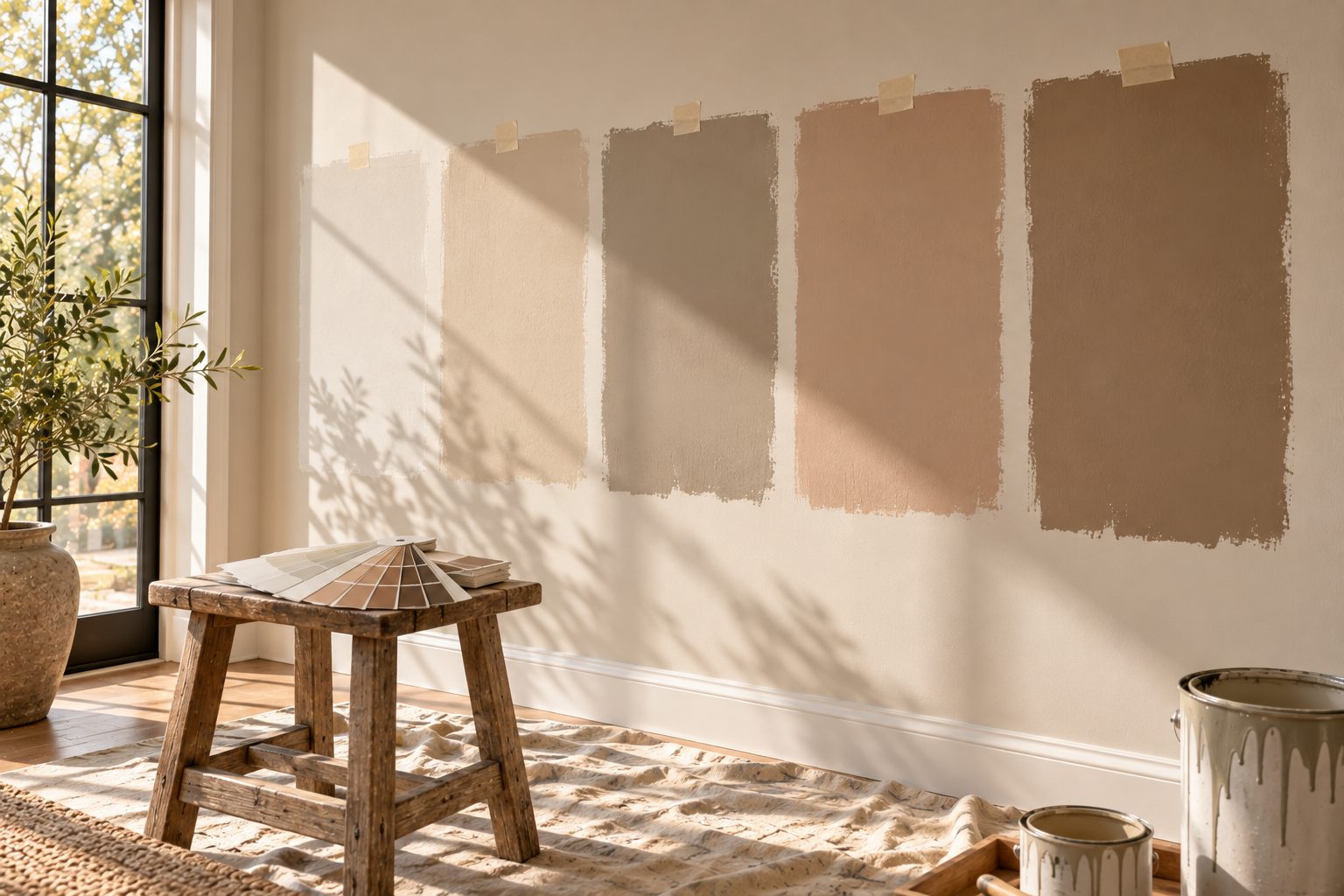
- Paint sample boards. Use poster board or primed hardboard at least 24 × 24 in (60 × 60 cm), two coats each, with a strip of trim color along one edge.
- Place them on the facade. Tape them to the sunniest and shadiest walls, at eye level and away from existing trim.
- Look morning, noon and evening. Over two or three days, including one overcast day, and from the street at about 50 ft (15 m).
- Check against fixed materials. Hold each board next to the roof, brick, stone and window frames.
- Buy one quart and paint a section. A 4 × 8 ft (1.2 × 2.4 m) patch of siding settles any remaining doubt before you order gallons.
What does it cost to paint a house exterior?
Painting a house exterior professionally costs about $3,000–$9,000 for a typical 1,500–2,500 sq ft (140–230 m²) home in the US in 2026, or roughly $1.50–$4.00 per sq ft of paintable wall surface. Labor is usually 70–85 percent of the bill; paint is the smaller line.
| House size (floor area) | Typical pro cost (typical 2026 US range) | Paint needed, two coats | DIY paint cost |
|---|---|---|---|
| 1,000 sq ft (93 m²), one story | $2,000–$4,500 | 8–12 gal (30–45 L) | $400–$900 |
| 1,500 sq ft (140 m²), one story | $3,000–$6,000 | 10–15 gal (38–57 L) | $500–$1,100 |
| 2,000 sq ft (186 m²), two story | $4,000–$7,500 | 12–18 gal (45–68 L) | $600–$1,400 |
| 2,500 sq ft (232 m²), two story | $5,000–$9,000 | 15–22 gal (57–83 L) | $750–$1,700 |
| 3,000+ sq ft (279+ m²), two story | $6,500–$12,000+ | 18–28 gal (68–106 L) | $900–$2,200 |
Prices rise with height, heavy scraping, lead-safe work on pre-1978 houses, wood repair and many colors. Gallon counts assume siding coverage of roughly 250–350 sq ft per gallon; to size your own job, use our how much paint do I need guide.
What exterior paint should you buy?
Buy a 100 percent acrylic latex exterior paint for siding and trim on almost every house; it flexes with wood, resists UV and cleans up with water. Premium lines carry more resin and pigment, which shows up as better hide, slower fading and a longer repaint cycle.
- Body: flat or low-sheen on wood, fiber cement and stucco; it hides surface flaws.
- Trim and windows: satin or semi-gloss, which sheds water and wipes clean.
- Front door: semi-gloss or gloss exterior enamel, a urethane-modified acrylic or a waterborne alkyd.
- Masonry and brick: breathable elastomeric or mineral coatings, or limewash; see our limewash paint guide before painting brick.
- Primer: bonding primer on bare wood, previously stained surfaces and glossy old paint.
Plan exterior home painting for dry weather between about 50 and 90°F (10–32°C), with no rain forecast for 24–48 hours and no dew forming before the paint skins over in the evening.
Mistakes we see with exterior house paint ideas
The mistake we see most is choosing exterior paint from an indoor chip in the evening and ending up with a house two shades lighter and much bluer than expected. Here are the others, roughly in order of how often we fix them:
- Ignoring the roof. A warm greige under a cold charcoal roof looks muddy; match undertones.
- Too many colors. More than three, plus natural wood, makes a facade busy. Keep gutters and downspouts in the trim or body color.
- Stark white trim on cream siding. It makes the cream look dirty. Choose a trim white with the same undertone.
- Dark colors on vinyl. Without a vinyl-safe formula, warped panels are a real risk.
- Skipping neighbors. Check homeowner association rules and look at the houses either side so your scheme does not clash.
Our verdict: if you are unsure, a warm white or putty body with soft black trim, or a muted sage with cream trim, will look good on most American house styles for a decade. Spend your boldness on the door. For style-by-style context, our house architectural styles guide shows which colors each shape was built to carry.
Ready to buy? Measure your walls and run the numbers in our free paint calculator to get gallons for body, trim and door before you head to the paint counter.
Free toolPaint CalculatorWork out exactly how much paint to buy.Shop & source the look
Buy it today — or have it made
Retail links are affiliate links: we may earn a commission at no extra cost to you (disclosure). “Get it made” sends the item to our sourcing desk for factory quotes in custom sizes and finishes.
Frequently asked questions
What does it cost to paint a house exterior?
Painting a house exterior usually costs about $3,000–$9,000 for a 1,500–2,500 sq ft (140–230 m²) home in the US, roughly $1.50–$4.00 per sq ft of wall surface. Height, scraping, wood repair, lead-safe practices on older houses and the number of colors all push the price up. Doing it yourself cuts the cost to paint and equipment, typically $600–$1,700.
What is the most popular exterior house color?
Warm white and off-white remain the most widely chosen exterior house colors, followed by greige, gray and muted green. For 2027 the trend is toward warmer, earthier versions: cream rather than bright white, putty rather than blue-gray, olive and sage rather than mint. Soft black and navy are popular for trim, doors and modern houses.
What color trim goes with a white house?
Soft black, charcoal or the same white in a higher sheen are the trim colors that suit a white house best. Black trim gives crisp contrast and frames windows; same-white trim gives a calm, seamless look. Avoid a brighter, cooler white on the trim than the body, because it makes the siding look dingy by comparison.
How long does exterior paint last?
Exterior paint typically lasts 7–10 years on wood and fiber cement siding and 10–15 years on stucco and masonry, when a quality acrylic is applied over good preparation. South- and west-facing walls fade and peel first. Dark colors, cheap paint, painting in cold or damp weather and skipping primer all shorten the repaint cycle.
Should exterior trim be lighter or darker than the house?
Exterior trim can be either, but it should be clearly different in value or sheen from the body. Light trim on a mid or dark body is the traditional choice and highlights windows; dark trim on a light body is the modern choice and gives a graphic outline. Matching trim to body in a higher sheen works well on simple facades.
Some links may be affiliate links. Regulations and specifications change — always confirm with suppliers and qualified professionals.