Beige Paint Colors: Best Light, Warm and Cream Beiges for Walls
The best beige paint colors are soft, warm neutrals at an LRV of roughly 55–75 with a yellow, pink or green undertone. Here are light, warm and cream beiges, 8 color codes, room advice and the colors that go with beige.
Part of our guide: Neutral Paint Colors: How to Choose Common Paint Colors That Work
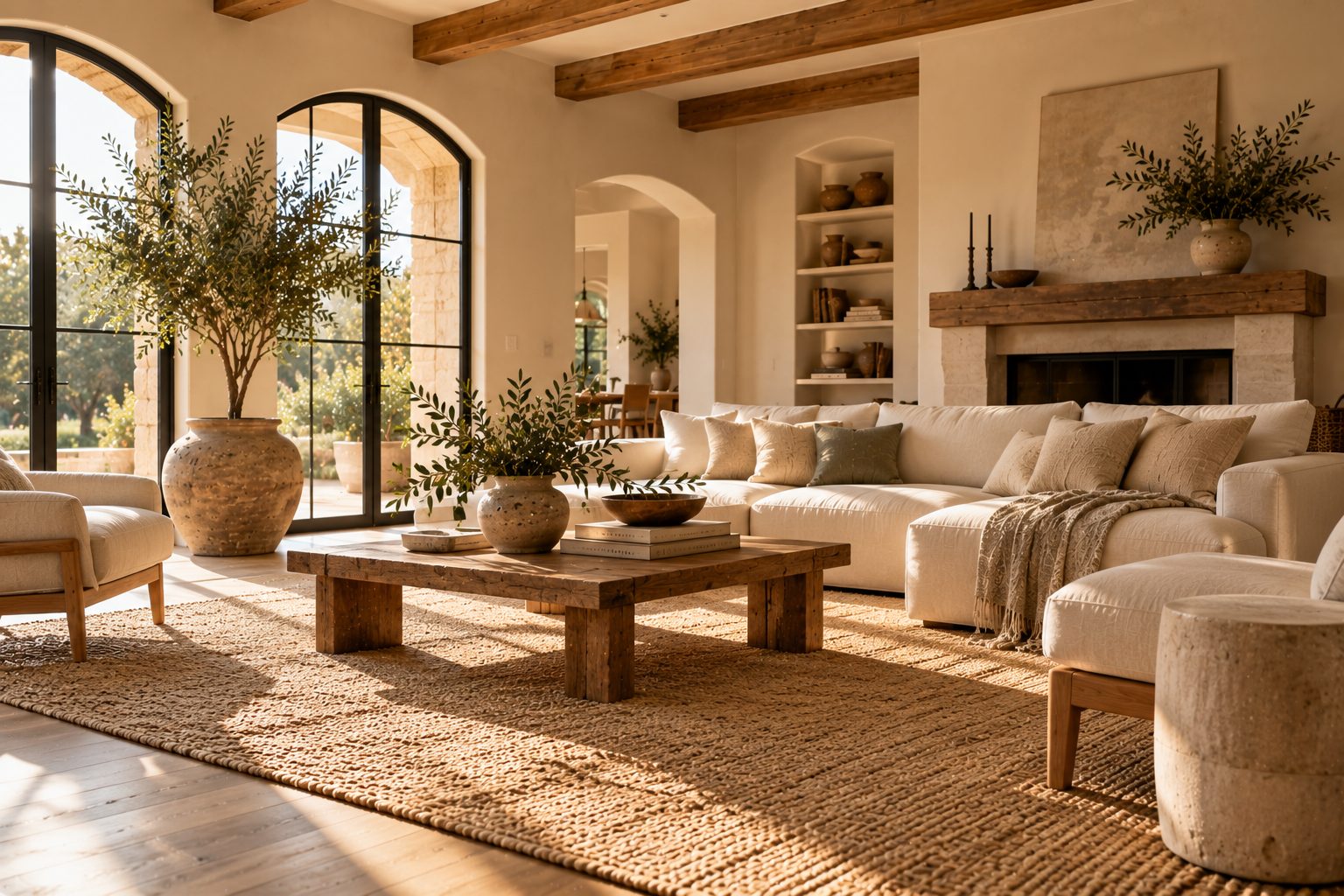
Key takeaways
- Beige paint colors are warm neutrals made from white with yellow, brown and sometimes pink or green; most wall beiges sit at LRV 55–75
- The undertone decides everything: yellow beiges glow, pink beiges turn peachy in sun, green beiges turn muddy in north light
- Cream is lighter and yellower than beige; greige is beige with gray added and reads cooler
- Pair beige with warm white trim, oak, walnut, olive, terracotta and black accents; avoid stark blue-white trim
The best beige paint colors are soft, warm neutrals with an LRV of about 55–75 and a clear undertone: yellow for a sunny glow, pink for warmth in cool rooms or green for a modern, earthy feel. For most homes in 2027, a mid-light beige around LRV 62–70 with a yellow-gray undertone is the safest whole-house wall color.
Beige spent a decade in the shadow of gray and is now one of the leading wall neutrals again, in warmer, softer versions than the builder beiges of the 1990s. This guide defines the beige color, compares light, warm and cream shades, and explains undertones, rooms and pairings. It sits inside our wider guide to neutral paint colors, which also covers whites, greiges and taupes.
- Definition: beige is a pale, warm neutral between white and light brown, with a yellow, pink or green undertone.
- LRV range: light beige 70–80, mid beige 55–70, deep beige 40–55.
- Close relatives: cream (lighter and yellower), greige (grayer), taupe (darker and more brown-gray).
- Best trim: a warm white at LRV 82–88, never a stark blue-white.
What are the best beige paint colors?
The best beige paint colors balance warmth and restraint: enough yellow or red to feel cozy, enough gray to stop the walls looking orange or dated.
The table groups beige shades into five types designers specify. LRV ranges are typical across paint makers, and the hex values are screen references, not paint formulas. Use them to compare samples, never to order paint.
| Beige type | Typical LRV | Approx. hex code | Undertone | Best rooms and light |
|---|---|---|---|---|
| Cream | 75–85 | #F1E8D6 | Yellow | Bedrooms, trim, north-facing rooms |
| Light beige | 68–78 | #E6D8C3 | Yellow-gray | Whole-house walls, small rooms |
| Warm beige | 58–68 | #D8C3A5 | Yellow or pink | Living rooms, dining rooms, cool light |
| Greige-beige | 55–65 | #CFC4B3 | Gray-green | South-facing rooms, modern schemes |
| Deep beige (sand, camel) | 40–55 | #C2A988 | Yellow-brown | Accent walls, cabinets, exteriors |
If you only test one band, test warm beige at LRV 60–68. It is light enough for a whole house and warm enough to avoid the flat, cold feel of the gray era.
What is the beige color?
Beige is a pale, warm neutral color between off-white and light brown, named after undyed, unbleached wool; it is built from white plus yellow and brown, often with a touch of red, gray or green.
Because beige is a mix rather than a pure hue, two beiges can look completely different side by side. That is why the beige color frustrates people: one reads buttery, another peachy and a third almost khaki. The key is to identify the undertone before you choose, which is easiest when you hold the chip against a sheet of plain white printer paper.
Beige color codes
For digital mood boards and fabric matching, these approximate beige color codes are useful starting points: classic beige #F5F5DC (the web standard, quite green-yellow), sand #D8C3A5, oatmeal #E6D8C3, cream #F1E8D6, camel #C19A6B, latte #C8AD8D, greige #CFC4B3 and taupe-beige #A89580. Paint will always look lighter and warmer on a large wall than these values suggest on screen.
Light beige paint colors for bright, calm rooms
Light beige paint colors at LRV 68–78 make rooms feel bright and soft at the same time, and they are the easiest beiges to use as a whole-house color.
A light beige color works where pure white would feel stark and gray would feel cold: open-plan living areas, hallways that connect several rooms, and rental or resale homes that need to suit everyone. The risk is wash-out in very sunny rooms, where light beige can look like a dirty white at midday. In those rooms, step down to LRV 62–68. For trim and ceilings with light beige paint, choose a warm white with a matching undertone; our warm white paint colors guide lists the best pairings.
Warm beige paint colors versus greige
Warm beige paint colors lean yellow or pink and feel cozy, while greige mixes beige with gray and reads cooler and more modern; choose warm beige for cool light and greige for very warm, sunny rooms.
The undertone behaves differently in each orientation. Use this as a guide for rooms in the Northern Hemisphere:
| Room orientation | Daylight | Beige to choose | Beige to avoid |
|---|---|---|---|
| North-facing | Cool, even, bluish | Yellow or pink warm beige, LRV 62–75 | Green-gray beige (turns muddy) |
| South-facing | Warm, bright, strong | Greige-beige or beige with a gray base | Very yellow beige (turns orange) |
| East-facing | Warm mornings, cool afternoons | Balanced yellow-gray beige | Pink beige (turns peachy in the morning) |
| West-facing | Cool mornings, golden evenings | Neutral or slightly gray beige | Strong yellow beige |
Beige vs greige vs taupe
The three neutrals sit on a line. Beige is the warmest, built on yellow and brown. Greige adds gray to beige, so it looks cooler and more architectural and holds up better in strong sun. Taupe is darker again, a brown-gray with a slight violet or pink cast, usually at LRV 30–50. If a room already has warm wood and terracotta, greige keeps it from tipping into orange; if the room is cool and gray, warm beige brings it back to life.
If greige suits your light better, our guide to taupe and greige paint colors covers the cooler side of the family.
Beige vs cream paint: what is the difference?
Cream paint is lighter and yellower than beige, usually at LRV 75–85, while beige is a little deeper and browner; cream reads as a soft white, beige reads as a color.
Cream color paint is the best choice if you want warmth without obvious color: cream colored walls in a bedroom or a period house feel soft and old-fashioned in a good way. The best cream paint colors for walls have a touch of gray, which stops them turning lemony in sunlight. Avoid creams with a strong green-yellow base in north light. A useful rule: if a cream chip looks like butter, it is too yellow for walls; it should look like the inside of a bread roll.
- Cream for walls: LRV 75–82, matte, with a warm white or the same cream on trim.
- Cream for trim: pair it with mid or deep beige walls for a soft, low-contrast look.
- Cream for cabinets: satin or semi-gloss, with brass or bronze hardware.
Beige color palette: what colors go with beige?
The colors that go with beige are warm white, cream, oak and walnut tones, olive and sage green, terracotta, rust, soft blue and black; a beige color combination works best with one darker anchor color.
#F1E8D6#D8C3A5#9C8468#7E8F6E#B5653F#2B2724The hex values are screen references only. Three beige color palette schemes we return to:
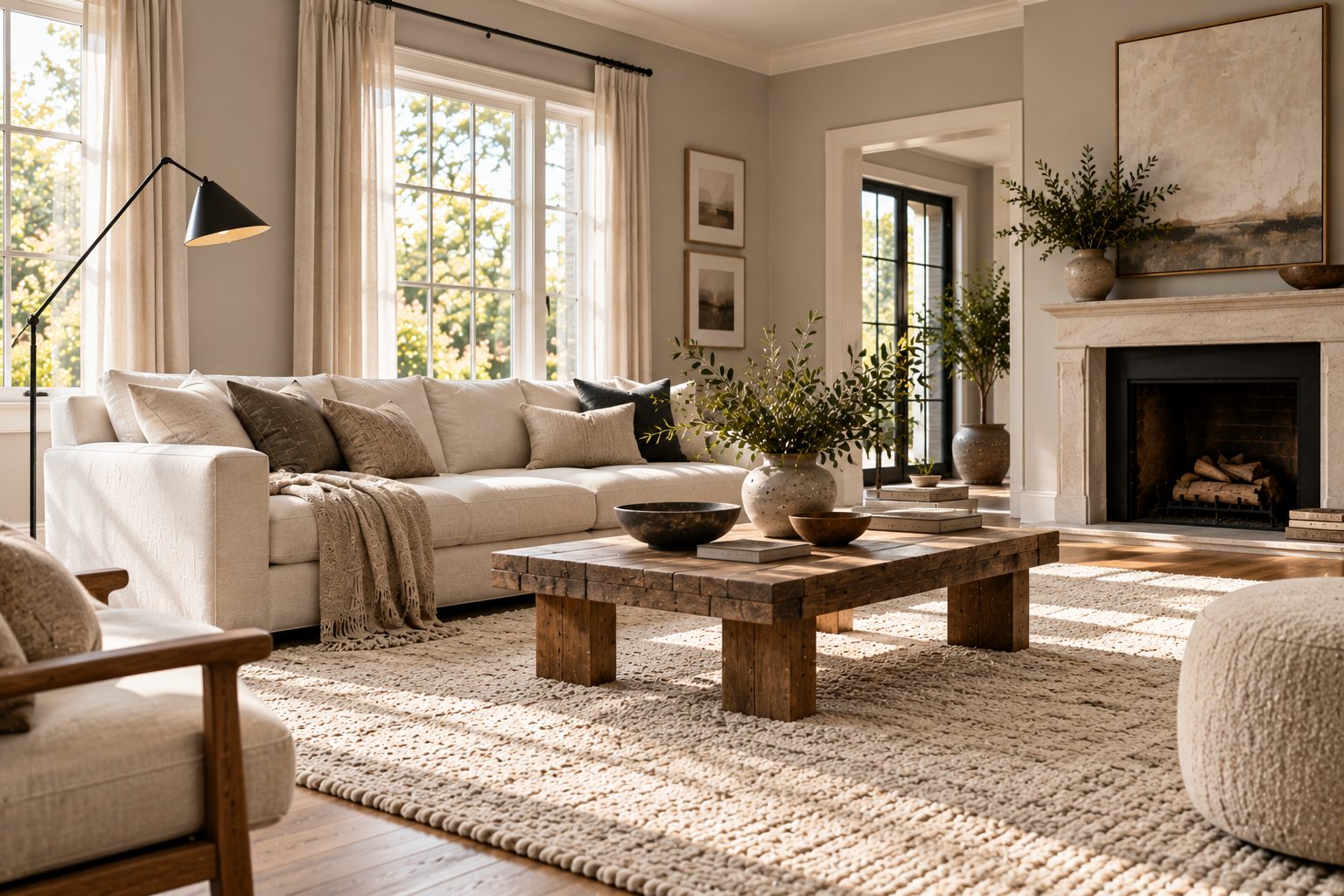
- Warm minimal: light beige walls, cream trim, pale oak, linen and one black metal accent.
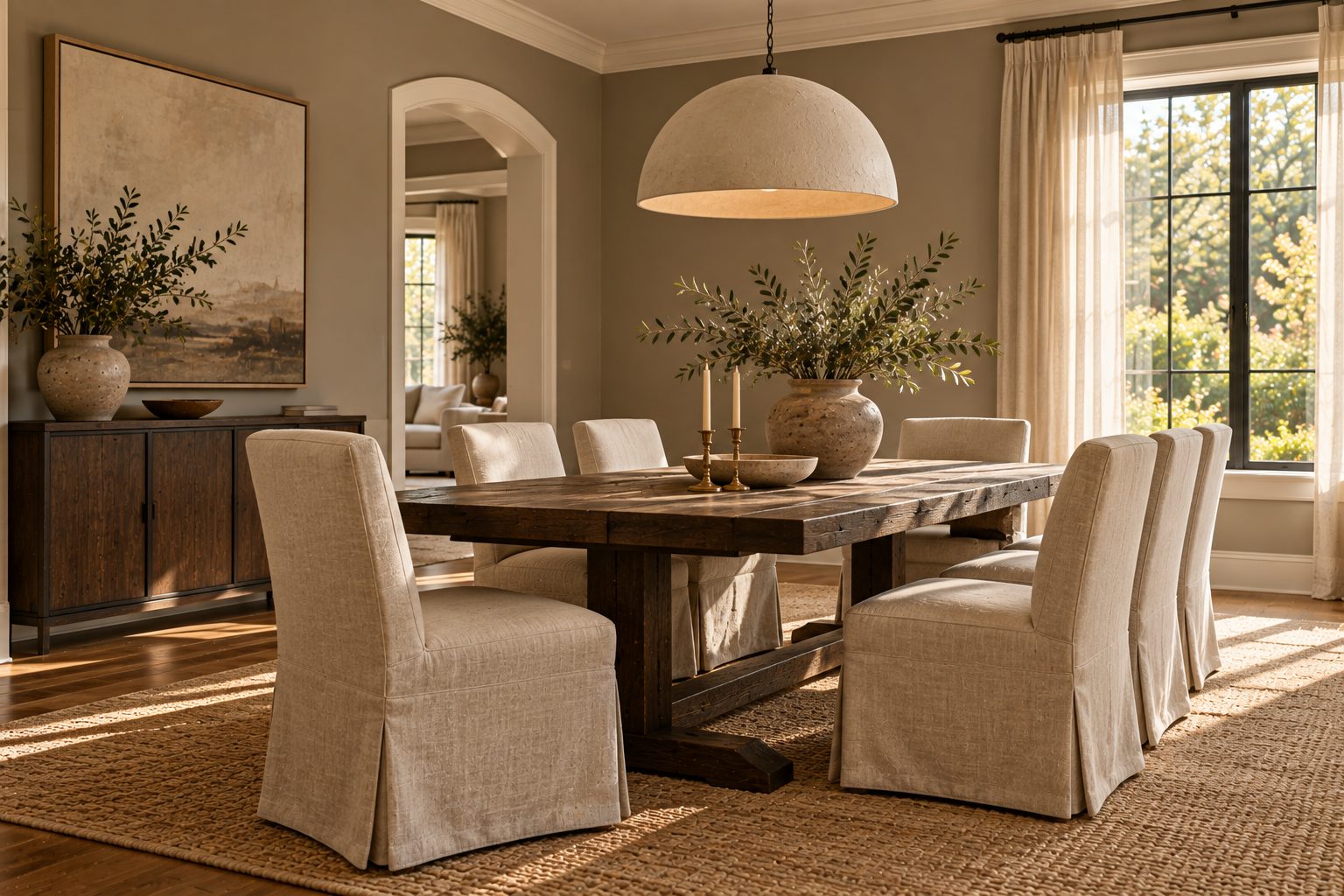
- Earthy: warm beige walls, terracotta and rust textiles, walnut, olive or deep sage on a cabinet.
- Soft contrast: beige walls with a navy or ink-blue sofa and brass lighting.
Beige is the base most green schemes need; see our sage green paint guide for how to pair the two without the room going flat.
Beige wall paint by room
Beige wall paint suits every room, but the best LRV and sheen change with the job: lighter, flatter beiges for living spaces and bedrooms, mid beiges in satin for kitchens and bathrooms.
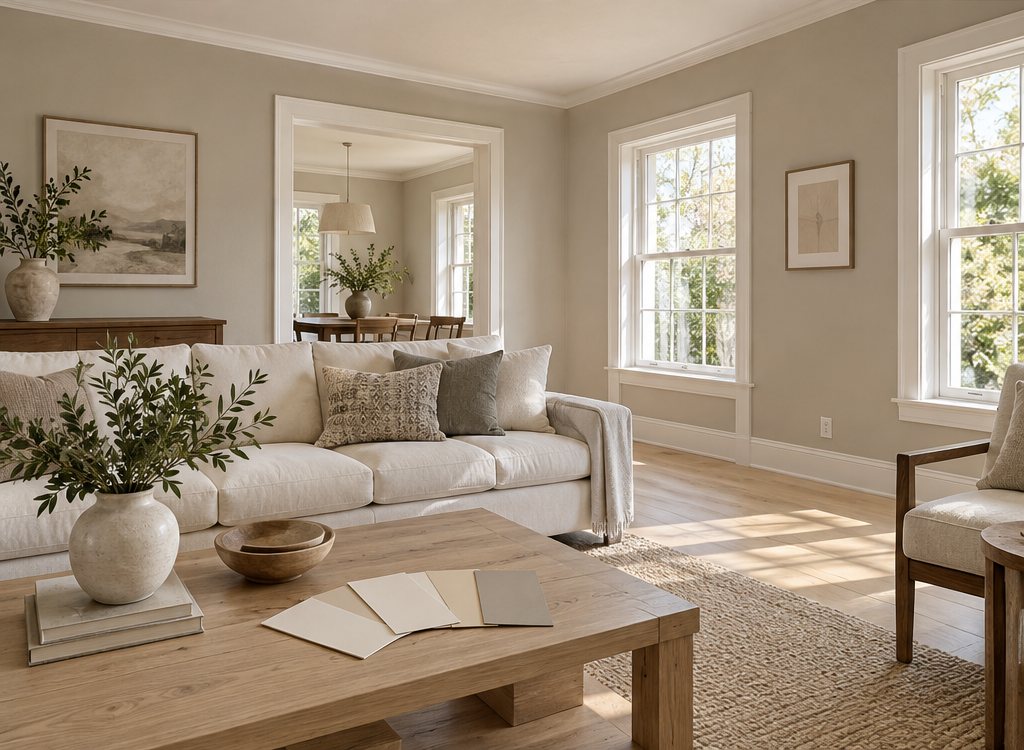
- Living room: warm beige at LRV 60–70 in matte, with warm white trim and 2700 K lamps.
- Bedroom: cream or light beige at LRV 70–80; a deeper sand on a headboard wall adds warmth.
- Kitchen: light beige walls with white, wood or green cabinets; use eggshell or satin for wipeability.
- Bathroom: beige pairs beautifully with travertine and limestone; use a moisture-resistant satin.
- Exterior: deep beige or sand at LRV 40–55 with cream trim; outdoors, beige looks lighter than on the chip.
Beige wall paint ideas beyond flat walls
Beige wall paint colors look their best when the surface has some depth. Three ideas we use often: limewash or mineral paint in a mid beige, brushed in crossing strokes for a soft cloudy texture; a two-tone wall with deep sand below a chair rail and light beige above; and color drenching, where walls, trim and ceiling all go the same light beige in different sheens for a calm, enveloping room. Each approach makes a single beige feel intentional rather than default.
Finish matters as much as color. Our paint sheen guide explains why a matte beige looks richer than the same color in satin.
How to test beige paint colors
Test beige paint colors on large sample boards next to white paper and your fixed finishes, because the undertone only reveals itself in comparison.
- Identify the undertone. Hold each chip against white paper: yellow, pink, peach or green will show at the edges.
- Check your fixed finishes. Wood floors, countertops and tile often carry pink or yellow that the beige must match.
- Shortlist three beiges. One warmer, one at your target LRV, one grayer.
- Paint boards at least 12 × 12 in (30 × 30 cm). Two coats, on white board, not on the old wall.
- Move them around for 48 hours. Check morning, afternoon and night, beside windows and in corners.
- Calculate and buy. Our paint calculator gives gallons by room; most beiges cover in two coats.
How we'd do it: beige without the 1990s
We would pick a warm beige at LRV 62–68 with a slight gray in it, run it through the main living spaces in matte, and use a matching warm white on trim and ceilings. Then we would add depth with texture rather than color: limewash on one wall, linen curtains, a wool rug and oiled oak. The mistake we see most is pairing beige with cool gray flooring or blue-white trim, which makes the beige look yellow and tired. The second is choosing a peachy beige for a south-facing room, where it turns salmon by late afternoon. We would also keep beige off ceilings in low rooms; a warm white at LRV 85 or higher keeps the ceiling lifting. Get the undertone right, and beige paint colors give you the warmest, most livable neutral there is.
Want beige palettes already matched to trim, wood and accent colors? Our 2027 palette pack includes tested beige and cream schemes with hex references and LRV notes for every room.
Free toolTile CalculatorWork out tiles, boxes, grout and adhesive with the right wastage.Shop & source the look
Buy it today — or have it made
Retail links are affiliate links: we may earn a commission at no extra cost to you (disclosure). “Get it made” sends the item to our sourcing desk for factory quotes in custom sizes and finishes.
Frequently asked questions
What is the best beige paint color for walls?
The best beige paint color for most walls is a warm beige at LRV 62–70 with a slight yellow-gray undertone. It reads warm but not orange, works in most light and pairs easily with white trim and wood floors. In north-facing rooms choose a slightly warmer beige; in very sunny rooms choose one with more gray.
What is the difference between beige and cream?
Cream is lighter and yellower than beige, usually at LRV 75–85, and reads as a soft warm white. Beige is slightly deeper and browner, typically LRV 55–75, and reads as a pale color. Cream suits bedrooms, trim and period houses; beige works as a whole-house wall color with more visible warmth.
What colors go with beige walls?
Warm white, cream, oak, walnut, olive and sage green, terracotta, rust, navy and black all go well with beige walls. Use a warm white on trim, add one darker anchor such as walnut or black metal, and bring in texture through linen, wool and stone. Avoid stark blue-whites and cool gray floors.
Is beige back in style for 2027?
Beige is back in style for 2027 as one of the leading warm neutrals, replacing the cool grays of the 2010s. The new beiges are softer and slightly grayer than older builder beiges, and they are often paired with limewash, travertine, oak and earthy accent colors such as olive and terracotta.
Why does my beige paint look yellow or pink?
Beige paint looks yellow or pink because its undertone is amplified by the room's light and surroundings. Warm south light pushes yellow beiges toward orange, and pink beiges turn peachy in morning sun. Cool white trim and gray floors also exaggerate the undertone. Test large samples and choose a grayer beige for sunny rooms.
Some links may be affiliate links. Regulations and specifications change — always confirm with suppliers and qualified professionals.