Lumens to Watts: LED Conversion Chart and Dimmable Bulb Guide
Lumens to watts in one line: 800 lumens equals an old 60 W bulb or an 8–10 W LED. This guide gives the full conversion chart, lumens per room and how to pick dimmable LED bulbs that do not flicker.
Part of our guide: How to Layer Lighting in a Room Like a Designer
Key takeaways
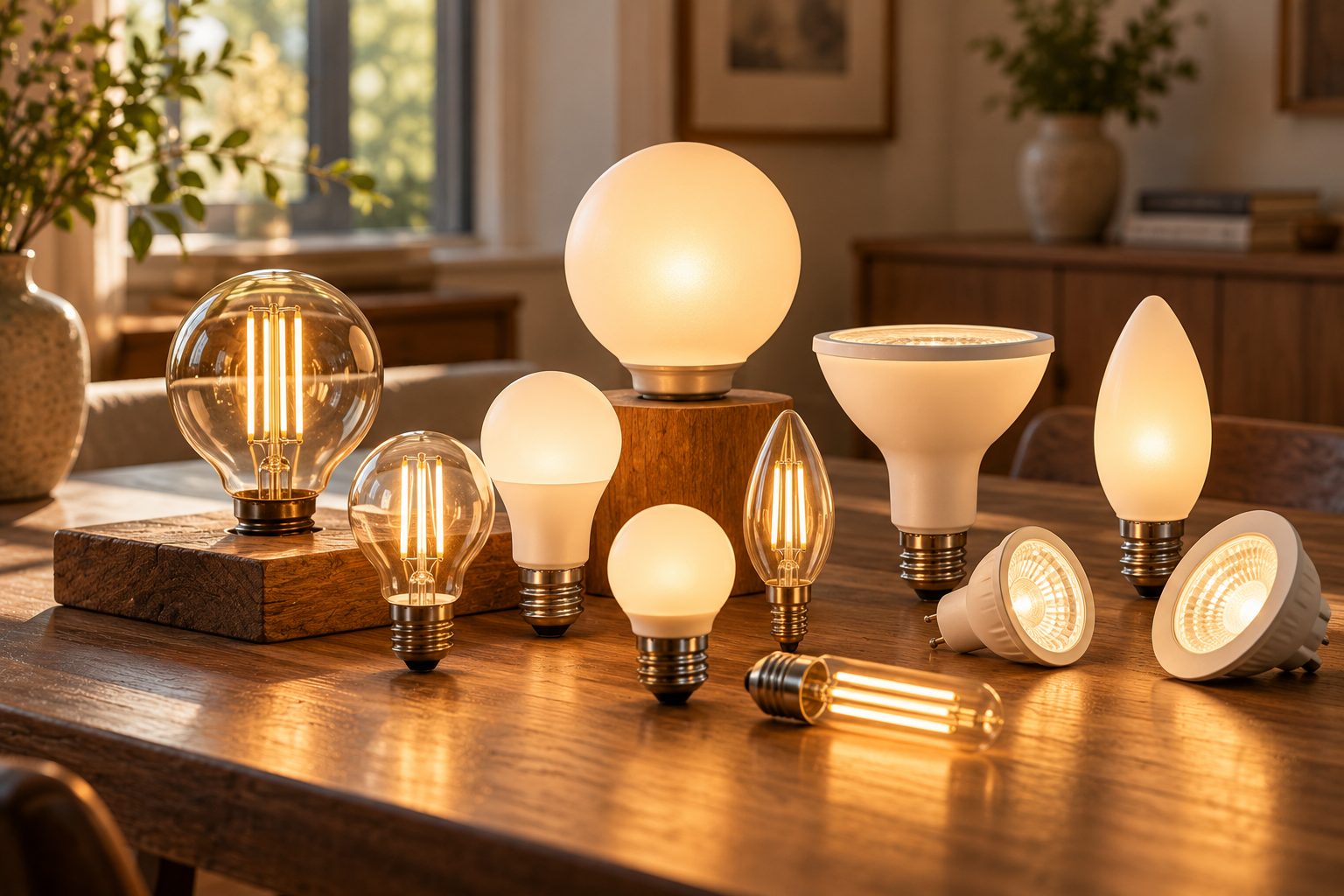
- Lumens measure light output and watts measure power use; modern LEDs give roughly 80–110 lumens per watt versus 13–17 for incandescent
- 800 lumens matches a 60 W incandescent and needs about 8–10 W LED; 1600 lumens matches 100 W and needs about 14–17 W LED
- Size a room by lumens per square foot: about 10–20 for living rooms and bedrooms, 30–50 for kitchens, offices and vanities
- Dimmable LED bulbs need an LED-rated dimmer, usually trailing-edge, and a total load above the dimmer's minimum
To convert lumens to watts, divide the lumens by the bulb's efficacy: about 15 lumens per watt for incandescent and 80–110 for LED. In practice, 800 lumens equals an old 60 W incandescent or an 8–10 W LED, and 1600 lumens equals a 100 W incandescent or a 14–17 W LED. Buy by lumens, not watts.
Watts tell you how much electricity a bulb uses; lumens tell you how much light it gives. Before LEDs the two moved together, so "a 60 watt bulb" was shorthand for brightness. That shorthand broke when a 9 W LED started producing the same light as a 60 W filament bulb. Getting the numbers right is the first step in our how to layer lighting method, because every layer is planned in lumens.
- Lumen (lm): the total visible light a bulb emits.
- Watt (W): the electrical power the bulb draws.
- Efficacy: lumens per watt; LED 80–110 lm/W, halogen 16–22, incandescent 13–17.
- Rule of thumb: LED watts ≈ incandescent watts ÷ 7 to ÷ 8.
Lumens vs watts: what is the difference?
Lumens measure brightness and watts measure energy use, so comparing lumens vs watts is like comparing miles traveled with gallons of fuel burned.
A lumen is a measure of luminous flux: the total light a source puts out in all directions, weighted to the sensitivity of the human eye. A watt is a unit of power. The link between them is efficacy, and it depends entirely on the technology. An incandescent filament wastes about 90 percent of its energy as heat, which is why it needs 60 W for 800 lumens. An LED converts far more of its power to light, so it needs only 8–10 W. The bulb's packaging in the US must show lumens, watts, estimated yearly cost and color temperature on a lighting facts label, so the information is always there; it is just rarely the biggest number on the box.
Two other numbers matter alongside lumens. Color temperature in Kelvin (2700K is warm, 4000K is neutral, 5000K is cool daylight) changes how bright a room feels: a 4000K bulb can seem brighter than a 2700K bulb with identical lumens. CRI, the color rendering index, tells you how naturally colors and skin tones look; choose CRI 90 or higher indoors.
Lumens to watts conversion chart
This lumens chart converts the common brightness levels to incandescent, halogen and LED wattage, using typical efficacy figures for bulbs sold in 2026.
| Lumens | Incandescent | Halogen | CFL | LED (typical) |
|---|---|---|---|---|
| 220–250 | 25 W | 18 W | 5–6 W | 2–3 W |
| 450 | 40 W | 29 W | 9–10 W | 4–6 W |
| 800 | 60 W | 43 W | 13–15 W | 8–10 W |
| 1,000 | about 70 W | 53 W | 16–18 W | 10–12 W |
| 1,100 | 75 W | 53–57 W | 18–20 W | 11–13 W |
| 1,600 | 100 W | 72 W | 23–26 W | 14–17 W |
| 2,600 | 150 W | 105–110 W | 40–42 W | 23–28 W |
LED ranges are wide because efficacy varies with color temperature, CRI and bulb shape: high-CRI and warm 2700K bulbs usually need a watt or two more than a 5000K bulb of the same brightness. Use the lumens column when shopping and treat the watt columns as a translation aid.
800 lumens to watts
800 lumens is the classic 60 W replacement. As an LED it draws 8–10 W; the most common led light bulb equivalent to 60 watt is an 8.5–9 W A19. That also answers the question of a 9 watt LED equivalent: a 9 W LED usually gives 800–850 lumens, the same as a 60 W incandescent. So how many watts is 800 lumens? 60 W old-style, about 9 W LED.
1000 lumens to watts
1000 lumens to watts works out to about 10–12 W in LED and roughly 70 W in incandescent terms, which sits between the old 60 W and 75 W bulbs. It is a good figure for a single floor lamp or a small flush mount in a bedroom.
1600 lumens to watts
1600 lumens converts to a 100 W incandescent, a 72 W halogen or a 14–17 W LED. It is bright enough for a kitchen ceiling fixture or a reading floor lamp on its own.
How many lumens is a 100 watt bulb?
A 100 watt incandescent bulb gives about 1,600–1,750 lumens, which is why LED packaging labels 1,600 lumens as "100 W equivalent."
Going the other way, watts to lumens for old filament bulbs is roughly watts × 14 to 17: a 40 W gives about 450–500 lumens, a 60 W about 800–860 and a 75 W about 1,100–1,200. Halogen gives a little more per watt, roughly 16–22 lumens. For LEDs, multiply by 80–110: a 5 W LED gives 400–550 lumens, a 12 W gives 1,000–1,300.
How bright is 20, 50, 80 or 1200 lumens?
Low lumen numbers are night-light and accent levels, while 1,200 lumens is a strong single-room source equal to roughly an 80 W incandescent.
- 20 lumens: a night-light or a step light; enough to find a door, not to read.
- 50 lumens: a small puck light or an LED picture light on a tiny canvas; a phone flashlight is in this range.
- 80 lumens: a path light, a cabinet-interior light or a bedside reading light on its lowest setting.
- 450 lumens: one candle-style chandelier bulb or a dim bedside lamp.
- 1,200 lumens: a bright floor lamp, a medium flush mount or an 80 W-equivalent bulb.
Three-way bulbs are a useful case: a common 50/100/150 W-equivalent LED steps through roughly 800, 1,600 and 2,600 lumens, which makes one reading lamp work as a dim mood light, a normal room light and a bright task light. They need a three-way socket, which most older floor lamps have.
For comparison, a single wax candle gives about 12 lumens. For under-cabinet strips the useful figure is lumens per foot: 200–400 lm/ft (650–1,300 lm/m) for task lighting.
How many lumens does a room need?
A room needs roughly 10–20 lumens per square foot for ambient light in living rooms and bedrooms and 30–50 lumens per square foot for kitchens, home offices and bathroom vanities.
| Room | Lumens per sq ft | Lumens per m² | Example: 150 sq ft (14 m²) room |
|---|---|---|---|
| Living room | 10–20 | 110–215 | 1,500–3,000 lm |
| Bedroom | 10–20 | 110–215 | 1,500–3,000 lm |
| Dining room | 30–40 over table | 320–430 | pendant 1,500–3,000 lm plus ambient |
| Kitchen | 30–50 | 320–540 | 4,500–7,500 lm |
| Bathroom | 40–60 | 430–650 | vanity 1,600–3,200 lm plus ceiling |
| Home office | 30–50 | 320–540 | 4,500–7,500 lm |
These are planning ranges, not codes. Dark walls, high ceilings and older eyes push the number up: add 20–30 percent for walls below LRV 30 or ceilings above 10 ft (3 m). Split the total across layers, never one fixture. Our free lighting calculator does the math for your room, and our types of light fixtures guide shows which fixture delivers each layer.
LED bulb wattage: how many watts does an LED bulb use?
Most household LED bulbs use between 4 and 17 watts, and LED wattage scales with brightness: about 1 W for every 80–110 lumens.
LED light bulb wattage matters for two practical reasons. First, fixture ratings: a lamp labeled "max 60 W" is rated for heat, so a 15 W LED giving 1,600 lumens is fine in it, which is how you safely get more light from an old lamp. Second, dimmer loads: dimmers are rated in LED watts, and too few bulbs on a circuit can fall below the dimmer's minimum and flicker. Enclosed fixtures are the exception to the swap rule; use bulbs marked for enclosed use, because trapped heat shortens LED life.
Wattage also tells you running cost. At a typical US rate of about 15–18 cents per kWh, a 9 W LED on for three hours a day costs roughly $1.50–1.80 a year; the 60 W incandescent it replaces costs $10–12.
Dimmable LED light bulbs and dimmers
Dimmable LED light bulbs dim smoothly only when they are paired with an LED-compatible dimmer and the circuit load sits within that dimmer's minimum and maximum ratings.
Not every LED dims. Light bulbs that are dimmable say so on the base and the box; a non-dimmable LED on a dimmer will buzz, flicker or fail early. When choosing dimmable LED bulbs and a dimmer lamp bulb for table lamps, follow this order:
- Check the bulb: marked "dimmable," ideally with a dimming range down to 5–10 percent.
- Check the dimmer type: older leading-edge dimmers were designed for incandescent loads; trailing-edge (ELV) dimmers usually dim LEDs more smoothly and quietly.
- Add up the load: keep the total LED watts above the dimmer minimum, often 10–25 W, and below its LED maximum, often 150–250 W for a standard dimmer.
- Set the low-end trim: many LED dimmers have a small adjustment to stop flicker at the bottom of the range.
- Do not mix brands on one circuit: different LED drivers respond differently and dim unevenly.
- Consider dim-to-warm: these bulbs shift from 2700K to about 1800–2200K as they dim, like an old filament.
Plug-in lamp dimmers work the same way: choose one rated for LED loads. Dimmable LED lights in strips and fixtures with integrated drivers need a dimmer matched to the driver type (TRIAC, ELV or 0–10V), which the fixture spec sheet will state. Dimmers and switches on household circuits should be installed by a licensed electrician.
Mistakes we see when people swap to LED
The most common mistake we see is buying LEDs by watt equivalence alone and ending up with harsh, cold, flickering light in a room that needed warm, dimmable light.
- Buying 5000K "daylight" bulbs for living spaces: they look blue at night; use 2700K in living rooms and bedrooms, 3000K in kitchens and baths.
- Ignoring CRI: CRI 80 bulbs make wood and skin look flat; pay a little more for CRI 90+.
- Over-lighting one fixture: a single 2,600-lumen ceiling bulb glares; three 800-lumen sources feel better.
- Keeping an incandescent dimmer: it is the root cause of most LED flicker complaints.
- Mismatched color across a room: 2700K lamps next to a 4000K ceiling light look like two rooms.
Our rule on real projects: specify every bulb by lumens, Kelvin and CRI, in that order, and only then check the watts for fixture and dimmer limits. If a lamp shade looks too dim or too hot, the shade may be the issue, not the bulb; our lamp shade sizes guide covers shade depth and bulb clearance.
Ready to work out how many lumens your room needs? Enter your room size and ceiling height into our free lighting calculator and it will suggest total lumens and fixture counts for each layer.
Free toolLighting CalculatorLumens, fixtures and color temperature for any room.Shop & source the look
Buy it today — or have it made
Retail links are affiliate links: we may earn a commission at no extra cost to you (disclosure). “Get it made” sends the item to our sourcing desk for factory quotes in custom sizes and finishes.
Frequently asked questions
How many watts is 800 lumens?
800 lumens is about 60 watts for an incandescent bulb, 43 watts for halogen and 8–10 watts for an LED. It is the standard brightness of a 60 W replacement A19 bulb. LED wattage varies slightly with color temperature and CRI, so warm, high-CRI bulbs may draw 9–10 W for the same 800 lumens.
How many lumens is a 100 watt bulb?
A 100 watt incandescent bulb produces about 1,600–1,750 lumens. LED packages label 1,600 lumens as a 100 W equivalent, and an LED reaches that brightness using roughly 14–17 W. A halogen bulb needs around 72 W for the same output, which is why halogens are now largely phased out for general lighting.
How many lumens is 60 watts?
A 60 watt incandescent bulb gives about 800–860 lumens. That is the most common household brightness level and the one LED makers call a 60 W equivalent. An 8.5–9 W LED usually matches it. For a bedside lamp 450–800 lumens is enough; a reading lamp benefits from 800–1,100 lumens.
How many watts does an LED bulb use?
Most household LED bulbs use between 4 and 17 watts. A 40 W-equivalent LED uses 4–6 W, a 60 W equivalent uses 8–10 W, a 75 W equivalent uses 11–13 W and a 100 W equivalent uses 14–17 W. Large floods and corn bulbs for garages can use 20–40 W.
Can you put a dimmable LED bulb on any dimmer?
No, a dimmable LED bulb works best on an LED-rated dimmer, usually a trailing-edge or ELV type. Old incandescent dimmers often cause flicker, buzzing or a limited dimming range. Keep the total LED wattage above the dimmer's minimum load, often 10–25 W, and use bulbs from one maker on each circuit.
Some links may be affiliate links. Regulations and specifications change — always confirm with suppliers and qualified professionals.