How to Layer Lighting Like a Designer
Ambient, task, accent and decorative light — plus colour temperature, CRI and fixture choices for residential and hospitality spaces.
Key takeaways
- Use several low, warm sources rather than one bright ceiling light.
- 2700K and CRI 90+ make materials and skin tones look their best.
- Put almost everything on dimmers — and check compatibility.
- Ask factories for lumens, CRI, CCT and market certification.
Lighting is the fastest way to make a room feel expensive — and the most common reason a beautiful room feels flat. The solution is layers: several low, warm sources instead of one bright ceiling light. This guide explains the four layers, how much light each room needs, how to choose color temperature and color rendering, and what to check when you buy or specify fixtures.
A single ceiling light spreads flat, even light that flattens texture, casts the shadows of people onto whatever they are doing, and gives a room one mood only. Layered lighting splits the job between several sources at different heights, each on its own switch or dimmer, so the same room can be bright and practical at breakfast and soft and intimate after dinner.
The four layers
| Layer | Purpose | Typical fixtures |
|---|---|---|
| Ambient | Overall, even light | Recessed downlights, cove lighting, ceiling pendants |
| Task | Reading, cooking, grooming | Under-cabinet strips, desk lamps, mirror sconces |
| Accent | Highlights art and texture | Picture lights, spotlights, wall washers |
| Decorative | Sculptural, sets the mood | Statement pendants, table lamps, candles |
Ambient light should be soft and indirect where possible — bounced off walls or ceilings with cove lighting or uplighters is more flattering than a grid of downlights. Task light must be positioned between the person and the work, not behind them. Accent light should be noticeably brighter than its surroundings to register; a common rule of thumb is around three times the ambient level on the highlighted object. Decorative fixtures are chosen for how they look, lit or unlit, and should not be expected to light the room on their own.
How much light each room needs
Light output is measured in lumens (lm). The amount of light that lands on a surface is measured in lux (lumens per square meter) or foot-candles (lumens per square foot; one foot-candle is about 10.76 lux). The table below gives typical residential and hospitality targets. Treat them as starting points: dark finishes absorb light and need more, pale finishes reflect it and need less. Our lighting calculator turns room size into a total lumen estimate.
| Room / zone | Ambient (lux) | Task (lux) | Approx. lumens per sq ft / per m² | Color temperature |
|---|---|---|---|---|
| Living room | 100–200 | 300–500 at reading chair | 10–20 / 100–200 | 2700K |
| Dining room | 100–200 | 200–300 on table | 10–20 / 100–200 plus pendant | 2700K |
| Kitchen | 200–300 | 300–500 on worktops | 30–40 / 300–400 incl. task | 2700–3000K |
| Bedroom | 50–150 | 200–300 at bedside | 10–20 / 100–200 | 2700K |
| Bathroom | 150–200 | 300–500 at mirror | 50–75 / 500–750 incl. mirror | 2700–3000K |
| Home office | 200–300 | 300–500 on desk | 30–50 / 300–500 incl. task | 3000K |
| Hallway & stairs | 50–150 | — | 5–10 / 50–100 | 2700K |
Remember that lumen figures on a lamp describe what the source emits, not what reaches the table. Shades, diffusers and dark interiors reduce useful light considerably, so a fabric pendant may need a brighter source than the numbers suggest. On stairs, prioritize even light on the treads over overall brightness for safety.
Color temperature
Color temperature, measured in kelvin (K), describes whether white light looks warm or cool. Most homes and hospitality spaces feel best at 2700K (warm white). Use 3000K for kitchens, bathrooms and home offices if you want slightly crisper light; avoid 4000K+ in living spaces, where it reads as institutional. Keep one temperature per room — mixing 2700K lamps with 4000K downlights makes both look wrong.
For restaurants, bars and bedrooms, consider warm-dim fittings, which shift from about 3000K toward 1800–2200K as they dim, imitating the glow of incandescent and candlelight. Tunable-white systems, which change color temperature through the day, are useful in offices and wellness spaces but add cost and control complexity; for most homes, a consistent 2700K on good dimmers is the better investment.
Color rendering (CRI)
CRI (color rendering index) measures how accurately light shows colors, on a scale up to 100, with daylight and incandescent lamps close to the top. Specify CRI 90+ for anywhere color matters — kitchens, bathrooms, dressing areas, and spaces with art, timber and textiles. Lower-CRI LEDs, often around 80, can make wood look flat, food look dull and skin look gray.
- Check R9: the headline CRI figure averages several test colors and does not include saturated red. Ask for the R9 value; a positive and reasonably high R9 (many specifiers look for 50 or more) keeps reds, skin tones and warm woods rich.
- Consider TM-30: some manufacturers publish TM-30 metrics (fidelity and gamut), which give a fuller picture than CRI alone.
- Match across fixtures: buy lamps and LED strips for one room from the same range where possible, so their color and rendering match.
Color rendering matters especially with the warm palettes popular now; browns, terracottas and oxblood look muddy under poor LEDs. See our 2027 color palettes for schemes and their recommended lighting.
Dimming and controls
Dimmers are the single most useful lighting upgrade. Check driver and dimmer compatibility before ordering LED fixtures: common systems include leading-edge and trailing-edge (TRIAC or phase-cut) dimming, 0–10V, and DALI for larger or commercial projects. An incompatible combination can cause flicker, buzzing or a poor dimming range. Ask the supplier for a compatibility list and the minimum dim level.
- Separate circuits: put each layer on its own switch or dimmer — ambient, task, accent and decorative — so you can build scenes.
- Switched sockets: in living rooms and bedrooms, wire floor-level sockets to a wall switch so table and floor lamps come on together from the door.
- Scenes for hospitality: preset scenes (arrival, work, relax, night) keep guest rooms simple to use; always include a single master switch by the door and bed.
- Flicker: ask for low-flicker drivers, especially for task lighting and spaces where people film or photograph.
Room by room
Living room
At least three light sources at different heights: a floor lamp, two table lamps and accent light on art or shelving. Add cove or wall lighting if the ceiling is plain, and position a reading light slightly behind and to one side of the main chair.
Dining
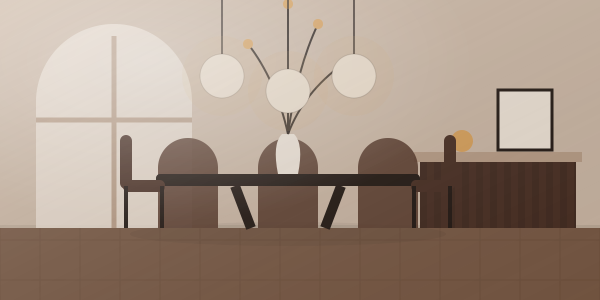
A pendant or linear light 28–34 in / 70–86 cm above the table, on a dimmer. As a guide, choose a pendant roughly half to two-thirds the width of the table, or a linear fixture about 12 in / 30 cm shorter than the table at each end. Add wall lights or candles for evening.
Kitchen
Under-cabinet or under-shelf strips for the worktops, ambient light positioned over the counter front rather than behind the cook, and pendants 30–36 in / 75–90 cm above an island. See kitchen trends 2027 for layouts.
Bedroom
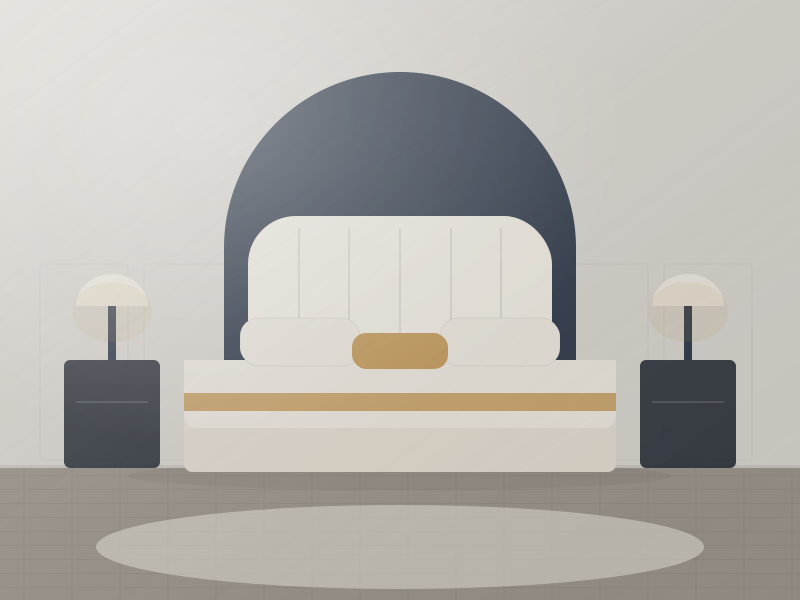
Bedside lamps or wall lights with individual switches, soft ambient light, and a low-level night light for hotels. Wall-mounted reading lights with a narrow, adjustable beam let one person read without disturbing the other.
Bathroom
Sconces on either side of the mirror at roughly face height, about 60–66 in / 150–170 cm from the floor, plus dimmable ambient light and niche or toe-kick lighting. Every fixture must suit its zone and IP rating.
Placement rules of thumb
- Downlights: keep them about 18–24 in / 45–60 cm from walls to wash them with light; closer creates harsh scallops, further leaves walls dark.
- Wall lights: mount at about 60–66 in / 150–170 cm above the floor in living areas and hallways, so the light source sits at or just above eye level without glare.
- Picture lights and spots: aim accent spots at art from about 30 degrees off vertical to avoid reflections on glass and shadows from frames.
- Table lamps: the bottom of the shade should sit roughly at eye level when seated, so the bulb is hidden.
- Beam angles: narrow beams (under about 25 degrees) for accent, medium to wide beams (36–60 degrees) for general light.
Common lighting mistakes
- Relying on downlights alone: a grid of recessed lights produces flat, even light and bright ceilings. Use fewer downlights and more lamps, wall lights and accent sources.
- Mixing color temperatures: a cool under-cabinet strip beside warm pendants looks like a mistake. Check the kelvin rating of every source in the room, including appliance and cabinet lights.
- Buying by watts: watts measure energy, not brightness. Compare lumens, and check the CRI and beam angle alongside them.
- Lighting from behind: ceiling lights placed behind a desk chair, a cook or a mirror user cast shadows over the task. Place task light in front or to the side.
- Forgetting glare: exposed bright sources at eye level are uncomfortable. Choose shaded, diffused or recessed sources for anything within the normal sightline, and look at pendants from the sofa as well as from standing height.
- No plan for switching: beautiful lamps that must be turned on one by one rarely get used. Decide circuits, switch positions and dimmers at the wiring stage, when changes are cheap.
Specifying lighting from factories
- Confirm voltage, plug type and certification for your market (e.g. CE/UKCA in Europe and the UK, UL/ETL in North America).
- Ask for lumen output, CRI (with R9), color temperature and beam angle — not just wattage.
- Confirm the driver type, dimming protocol and whether the light source is replaceable or integrated.
- For bathrooms and outdoor areas, specify the IP rating or wet/damp listing required.
- For custom pendants, approve a finish sample and a photometric test where needed, and check shade materials meet fire requirements for your project.
For how lighting fits into this year's wider directions, see our 2027 trends overview. If you would like a lighting plan drawn for your space, our online design service includes fixture schedules.
Free toolLighting CalculatorLumens, fixtures and color temperature for any room.Shop & source the look
Buy it today — or have it made
Retail links are affiliate links: we may earn a commission at no extra cost to you (disclosure). “Get it made” sends the item to our sourcing desk for factory quotes in custom sizes and finishes.
Frequently asked questions
What are the four layers of lighting?
Ambient light for overall illumination, task light for activities such as cooking and reading, accent light to highlight art and texture, and decorative light from statement fixtures that set the mood.
What color temperature is best for a living room?
2700K warm white suits most living rooms and bedrooms. Use 3000K for kitchens, bathrooms or offices if you prefer crisper light, and keep one temperature per room.
What CRI should I choose for home lighting?
Choose CRI 90 or higher wherever color matters, and check the R9 value for red rendering, so timber, food, skin and textiles look natural.
How many lumens does a kitchen need?
As a guide, a kitchen needs roughly 30–40 lumens per square foot (about 300–400 per square meter) including task lighting, with 300–500 lux on the worktops.
Some links may be affiliate links. Regulations and specifications change — always confirm with suppliers and qualified professionals.