Dining Table Pendant Light Guide: Height, Size & Bedroom Pendants
A dining table pendant light should hang 30–36 in (76–91 cm) above the table top, with a diameter of one-half to two-thirds of the table's width and 400–800 lumens on a dimmer. Bedside pendants hang 20–24 in above the nightstand; a big pendant lamp of 24–36 in suits tables over 72 in long.
Part of our guide: How to Layer Lighting in a Room Like a Designer
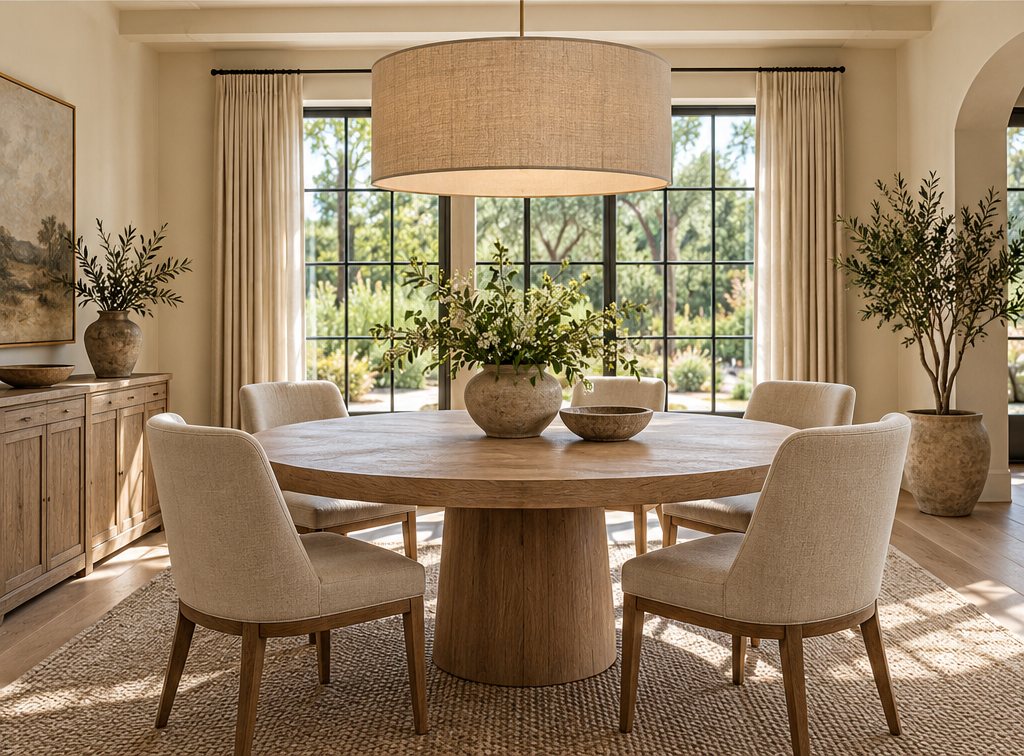
Key takeaways
- Hang a dining pendant so its bottom is 30–36 in (76–91 cm) above the table top, centered on the table rather than the room
- Size the pendant at one-half to two-thirds of the table width, and keep a round-table pendant at least 12 in smaller than the table
- Plan 400–800 lumens over a table for six at 2700 K on a dimmer, plus sconces or lamps so the walls are not dark
- Bedside pendants hang 20–24 in (51–61 cm) above the nightstand, 6–12 in in from the mattress edge, each on its own switch
- A pendant set suits long rectangular tables with pendants 24–30 in apart; a single big pendant lamp of 26–36 in suits round tables and 9 ft ceilings
A dining table pendant light hangs with its bottom 30–36 in (76–91 cm) above the table top, measures one-half to two-thirds of the table's width in diameter, so 24–30 in (61–76 cm) over a 42 in (107 cm) wide table, and gives 400–800 lumens at 2700 K on a dimmer. A pendant lamp over a dining table is centered on the table, not the room. Bedroom pendant lights used as bedside lamps hang 20–24 in (51–61 cm) above the nightstand, about 36–42 in (91–107 cm) from the floor.
The pendant is the one fixture that defines a dining room, and in 2027 it is also doing the job of bedside lamps, bar lights and reading lights, which is why the hanging height changes with every use. This guide gives the numbers for dining tables of every size and shape, bedside and bedroom pendants, island bar lighting, natural fiber pendants, oversized single fixtures and multi-light sets, as part of our guide to layering light. Kitchen islands have their own rules in kitchen island pendant lighting.
- Height over a dining table: 30–36 in (76–91 cm) from table top to fixture bottom; add 3 in (8 cm) per foot of ceiling over 8 ft (2.4 m).
- Diameter: one-half to two-thirds of the table width; for a round table, 12 in (30 cm) less than the table diameter is the upper limit.
- Length over a long table: a linear fixture or a row of pendants should cover one-half to three-quarters of the table length.
- Bedside pendants: 20–24 in (51–61 cm) above the nightstand, 6–12 in (15–30 cm) in from the mattress edge, on separate switches.
- Brightness: 400–800 lumens total over a table for six, 2700 K, CRI 90, on a dimmer; 300–450 lumens per bedside pendant.
How high should a pendant light hang above a dining table?
Hang a pendant so its lowest point is 30–36 in (76–91 cm) above the dining table, which with a standard 30 in (76 cm) table puts the fixture bottom at 60–66 in (152–168 cm) from the floor. That height keeps the light out of sightlines across the table while putting the pool of light on the plates and faces where it belongs. Go to the 30 in end with an opaque shade, a low 8 ft (2.4 m) ceiling or a small table; go to 36 in with a clear glass or open fixture, a 9 ft (2.7 m) or taller ceiling or a large table. For ceilings over 9 ft, add about 3 in (8 cm) per foot of extra height, up to a maximum of 40 in (102 cm) above the table.
The common mistake is hanging the fixture to the room rather than the table. A pendant that is beautifully centered under a ceiling rose but 8 in (20 cm) off the table's center looks wrong at every meal. If the ceiling box is off, use a canopy with a swag hook or a fixture with an offset canopy to bring the drop over the table center; the cord or chain can run 12–24 in (30–61 cm) at a shallow angle from the box to the hook without looking makeshift. Sit at the table before the final adjustment: a seated adult's eye level is about 46–48 in (117–122 cm), so the shade bottom at 60 in and above clears it with room to spare.
Height for an extendable or extra-long table
Over an extendable dining table, hang the fixture for the table in its everyday length, centered on that length, and accept that the extended leaf will sit slightly beyond the light; a second pendant or a linear fixture is the answer only if the table is extended more weeks than not.
What size pendant light for a dining table?
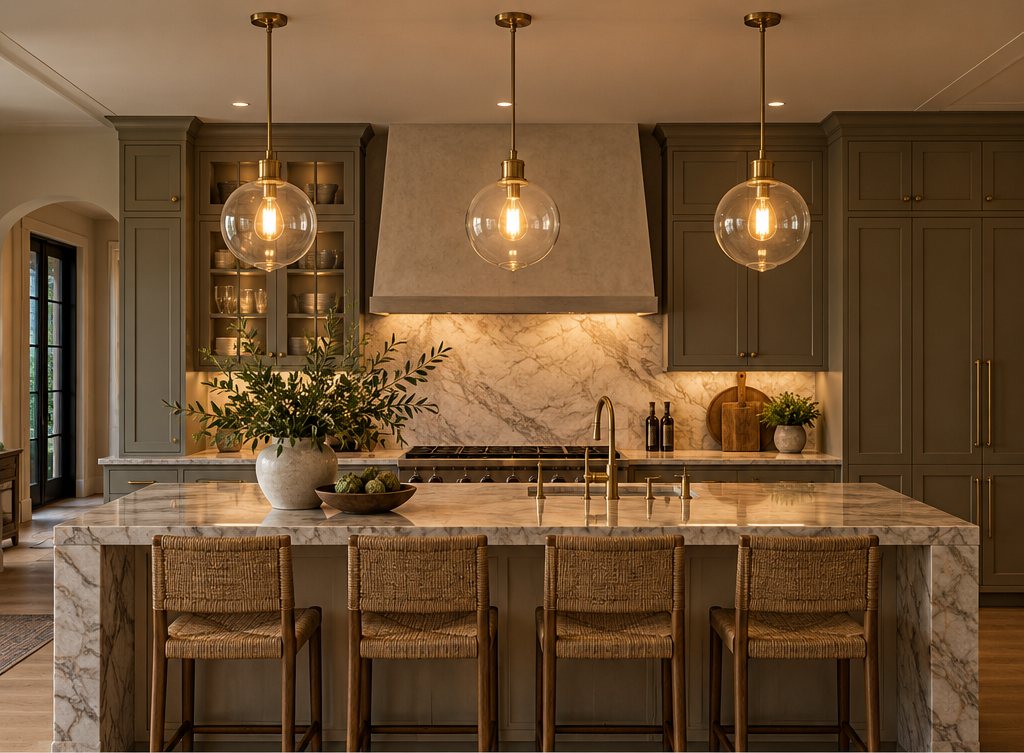
Choose a pendant with a diameter of one-half to two-thirds of the table width, which for the standard 36–42 in (91–107 cm) wide table means a fixture 18–28 in (46–71 cm) across; over a round table, the pendant should be at least 12 in (30 cm) smaller than the table diameter. A fixture that is too small is the most common failure; when in doubt, size up. The second rule covers length: over a rectangular or oval table, a linear fixture or a row of pendants should cover one-half to three-quarters of the table's length, leaving at least 12 in (30 cm) of table past each end of the light.
| Table size | Seats | Single pendant diameter | Multi-pendant or linear option | Total lumens |
|---|---|---|---|---|
| 36–42 in round (91–107 cm) | 4 | 18–24 in (46–61 cm) | Cluster of 3 small globes on one canopy | 400–600 |
| 48–54 in round (122–137 cm) | 5–6 | 24–30 in (61–76 cm) | Cluster of 3–5 pendants | 500–800 |
| 36x60 in (91x152 cm) | 4–6 | 20–26 in (51–66 cm) | Two 12–14 in pendants, 24 in apart | 500–800 |
| 40x72 in (102x183 cm) | 6 | 24–30 in (61–76 cm) | Linear 36–48 in (91–122 cm); three 10–12 in pendants | 600–900 |
| 42x84 in (107x213 cm) | 8 | 26–32 in (66–81 cm) big pendant lamp | Linear 48–60 in (122–152 cm); three 12–14 in pendants | 800–1,200 |
| 44x96 in+ (112x244 cm+) | 8–10 | Two 20–24 in pendants, 36–40 in apart | Linear 60–72 in (152–183 cm); four pendants | 1,000–1,500 |
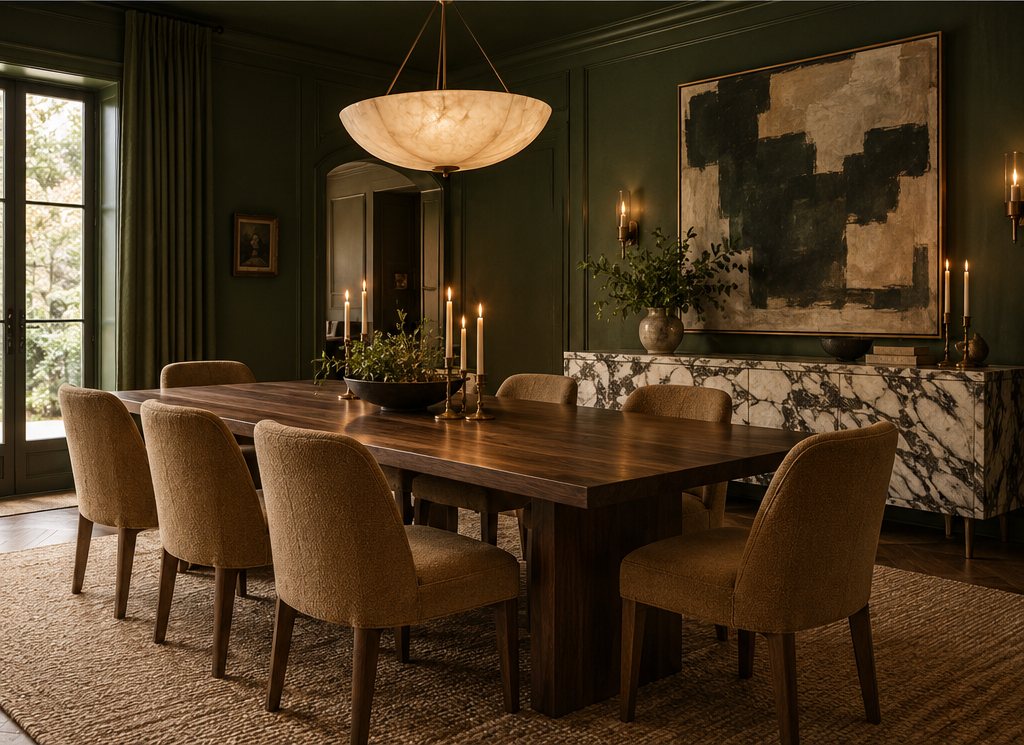
A big pendant lamp of 26–36 in (66–91 cm), a single oversized rattan dome, paper globe or open-wire drum, is the 2027 answer for tables over 72 in (183 cm) long in rooms with 9 ft (2.7 m) ceilings or more. It gives the table one strong form rather than a row of small ones, and because large shades are usually lightweight natural materials, they cost no more than three glass pendants. Over a 42 in (107 cm) wide table, keep an oversized pendant at 30 in (76 cm) or less in diameter so it does not overhang the place settings.
How bright should a dining room pendant be?
Plan on 400–800 lumens over a table for four to six and 800–1,500 over a table for eight to ten, at 2700 K, on a dimmer that goes down to 10 percent. That is lower than a kitchen island because dining light is for faces and plates, not for cutting onions; a dining room at full brightness feels like a cafeteria. The pendant should not be the only light in the room: pair it with wall sconces or a pair of lamps on a sideboard at 150–300 lumens each so the walls are not dark behind the diners. Run the whole room through the lighting calculator if you are specifying from scratch.
Bulb choice follows the shade. An open-bottom pendant where the bulb is visible from a seated position needs a frosted or an amber filament bulb under 450 lumens to avoid glare; a closed opal glass or fabric shade can take a plain 800 lumen bulb; an open-top shade throws useful light onto the ceiling, which makes a small dining room feel taller. Hanging lights above a dining table in a set of three should total the room's lumen target, not each meet it.
Where should bedroom pendant lights hang?
Bedroom pendants used as bedside lights hang with the bottom of the shade 20–24 in (51–61 cm) above the nightstand, roughly 36–42 in (91–107 cm) from the floor and 6–12 in (15–30 cm) in from the edge of the mattress, so the light falls on a book without the shade being in the way of sitting up. Each side goes on its own switch at the bed, ideally a dimmer, with 300–450 lumens per pendant at 2700 K or warmer. Master bedroom bedside pendant lights have replaced table lamps in a large share of new bedrooms because they clear the nightstand surface and let you use a narrower table; the trade-off is that their position is fixed, so the bed cannot move later without rewiring.
Bedside pendant placement
- Fix the bed position first. Pendants are wired to the bed's exact location, so settle the layout with our bedroom layout guide before the electrician arrives.
- Mark the centerline of each nightstand or, with no nightstand, a point 10–12 in (25–30 cm) in from the mattress edge.
- Set the drop so the shade bottom sits 20–24 in (51–61 cm) above a 24–26 in (61–66 cm) nightstand; for a pendant with no nightstand, 36–40 in (91–102 cm) from the floor.
- Choose a shade that blocks direct view of the bulb from a lying position: an opaque or opal shade, or a down-facing cone of 6–10 in (15–25 cm).
- Wire each pendant to a switch or dimmer at the bedside and a second switch at the door; a two-way circuit is standard.
- Add a central pendant or flush light for general light, hung at 7 ft (213 cm) minimum from the floor and at least 80 in (203 cm) over the foot of the bed.
A central bedroom pendant that is purely decorative, a large paper or rattan shade over the foot of the bed, follows the dining rule, 7 ft (213 cm) clear underneath, and is the move behind many of the calmer rooms in bedroom trends 2027. Keep it to 400–600 lumens on a dimmer; a bright central bedroom light is used twice a year.
Are natural fiber pendants a good choice over a table?
Yes, a rattan, bamboo, seagrass, linen or paper pendant is the most forgiving fixture over a dining table because the woven material diffuses light, hides the bulb, weighs little and can be sized large for the price of a small glass fixture. Natural light pendants, the trade shorthand for these woven and fiber shades, cost $80–400 for a 20–30 in (51–76 cm) dome, versus $300–900 for the same diameter in glass or metal. They suit organic modern, coastal and warm minimalist rooms and they are the shade most often chosen as a big pendant lamp over a long table.
Three practical notes. Open-weave rattan throws a patterned shadow on the walls and ceiling, which is attractive in a dining room and busy in a bedroom; choose a tighter weave or a lined shade for bedside pendants. Paper and linen shades yellow in direct sun over five to eight years and should be kept away from south-facing windows. And natural fiber pendants are not for over a cooktop or in a bathroom; the dining room and the bedroom are their rooms.
How do you light an island bar or a bar-height table?
Island bar lighting hangs 28–32 in (71–81 cm) above a 42 in (107 cm) bar top, which puts the fixture bottom at 70–74 in (178–188 cm) from the floor, with smaller shades of 6–10 in (15–25 cm) spaced 20–26 in (51–66 cm) apart because a bar is narrower than a table. A bar needs less light than a dining table, 200–350 lumens per pendant, and the warmest bulb in the house, 2200–2700 K, on a dimmer that goes to 10 percent. Where the bar is a raised section at the end of a kitchen island, match the pendant finish to the island pendants but step the size down, so a row of three 12 in (30 cm) pendants over the island becomes two 8 in (20 cm) ones over the bar.
Is a pendant lamp set better than one large fixture?
A pendant lamp set, two to five matching pendants on separate canopies or one long canopy, is better over a long rectangular table and a kitchen island; a single large pendant is better over a round or square table and in a room with a ceiling rose or a center box that cannot move. Sets give even light along a table and let you align the pendants with the seating; a single fixture gives the table a focal point and is simpler to install. The table below shows how the choice plays out.
| Option | Best table shape | Typical cost | Installation | Light pattern | Drawbacks |
|---|---|---|---|---|---|
| Single pendant, 18–24 in (46–61 cm) | Round or square, up to 48 in (122 cm) | $120–500 | One box, 1 hour | One pool, 36–48 in wide | Ends of a long table fall dark |
| Big pendant lamp, 26–36 in (66–91 cm) | Round 54 in+, rectangular to 84 in (213 cm) | $150–900 | One rated box, heavier fixtures need bracing | Wide, soft pool | Needs a 9 ft ceiling to read well |
| Set of 2–3 pendants on separate canopies | Rectangular 60–96 in (152–244 cm) | $200–900 total | Two or three boxes, half a day | Even along the table | Boxes must be centered precisely |
| Set of 3–5 on one linear canopy | Rectangular 60–96 in | $250–1,200 | One box, canopy 24–48 in long | Even along the table | Canopy must align with the table axis |
| Linear fixture, 36–60 in (91–152 cm) | Rectangular 72 in+ | $300–1,500 | One or two boxes | Continuous wash | Looks commercial if too thin or too bright |
| Cluster of 3–7 small globes | Round 42–60 in (107–152 cm) | $250–1,000 | One box | Soft, sparkling | Glare if bulbs are clear and bright |
With a set, spacing is what makes it look intentional. Space pendant centers 24–30 in (61–76 cm) apart over a table and keep the outer pendants at least 12 in (30 cm) inside the table ends; three pendants over a 72 in (183 cm) table sit at 18, 36 and 54 in along its length. Hang every pendant in the set at exactly the same height unless the design is deliberately staggered, in which case stagger by at least 6 in (15 cm) so it cannot be mistaken for an error.
How do you hang a pendant light over a dining table step by step?
Installing a hanging light in a dining room on an existing ceiling box takes an electrician about an hour and costs $100–250 in labor; running a new box and switch adds $200–500. The sequence that avoids a second visit is this.
- Place the table where it will live and mark its center on the floor with tape; measure from two walls so you can find the point again.
- Transfer the center to the ceiling with a plumb line or laser and compare it to the ceiling box. Up to 12 in (30 cm) off can be swagged; more than that, move the box.
- Measure the drop. From the ceiling to the table top, subtract 30–36 in (76–91 cm) to get the length from the ceiling to the fixture bottom, then subtract the fixture's own height to get the cord, chain or stem length.
- Check the box rating. Fixtures over 35 lb (16 kg) need a box rated for the weight, fixed to a joist or a brace; big rattan and paper pendants are light, cast metal and alabaster are not.
- Install a dimmer matched to the LED bulbs and, for a bedroom pendant, a two-way switch at the bed and the door.
- Hang, level and adjust. Fit the fixture, put the bulbs in, and look at it from the doorway and from a seat before cutting any excess cord; adjustable cords and chains can be shortened later, stems cannot be lengthened.
- Fit the rug and chairs last and confirm the pendant sits over the center of the dining room rug, since the eye reads the rug and the fixture as one composition.
Pendant light height is one of the few decisions in a room that is settled in a single afternoon and then lived with for a decade, so measure twice, hang once, and if you are between two heights, choose the lower.
Free toolRug Size CalculatorFind the right rug size for your room and furniture.Frequently asked questions
How high should a pendant light be above a dining table?
The bottom of the pendant should be 30–36 in (76–91 cm) above the table top, or 60–66 in (152–168 cm) from the floor over a standard 30 in table. Use 30 in for opaque shades, small tables and 8 ft ceilings, and 36 in for clear glass and ceilings of 9 ft or more, adding about 3 in per extra foot of ceiling up to 40 in.
What size pendant should go over a dining table?
A pendant with a diameter of one-half to two-thirds of the table width, so 18–28 in (46–71 cm) over a 36–42 in wide table. Over a round table, keep the pendant at least 12 in smaller than the table diameter. Over a long table, a linear fixture or a row of pendants should cover one-half to three-quarters of the table's length.
How high should bedside pendant lights hang?
Hang bedside pendants so the shade bottom is 20–24 in (51–61 cm) above the nightstand, about 36–42 in (91–107 cm) from the floor, and 6–12 in (15–30 cm) in from the mattress edge. Use an opaque or opal shade so the bulb is hidden when lying down, 300–450 lumens each, and a separate switch or dimmer for each side.
Should a dining room pendant be centered over the table or the room?
Over the table. The pendant marks the table, and an off-center fixture is visible at every meal. If the ceiling box is off by up to 12 in (30 cm), swag the cord from a hook or use an offset canopy; if it is further off, have the box moved. Center the rug on the table too so the three line up.
Are rattan or natural fiber pendants good over a dining table?
Yes. Woven rattan, seagrass, bamboo, linen and paper shades diffuse the light, hide the bulb, weigh little and cost $80–400 for a 20–30 in dome, far less than glass or metal at that size. Expect patterned shadows from open weaves, keep paper and linen away from direct sun, and do not use them over a cooktop or in a bathroom.
How many pendant lights over a dining table?
One pendant for a round or square table up to 48 in and for rectangular tables up to about 60 in long; two or three for tables 60–96 in long, spaced 24–30 in apart and at least 12 in inside the table ends; a 48–72 in linear fixture or four pendants for tables over 96 in. Hang all pendants in a set at the same height.
What is the best light bulb for a dining room pendant?
A 2700 K LED with a color rendering index of 90 or higher, on a dimmer that goes down to 10 percent. If the bulb is visible from a seated position, use a frosted or amber filament bulb under 450 lumens to avoid glare; inside a closed opal or fabric shade, a plain 800 lumen bulb is fine. Total 400–800 lumens over a table for six.
Some links may be affiliate links. Regulations and specifications change — always confirm with suppliers and qualified professionals.