Kitchen Island Pendant Lighting: Number, Size & Hang Height
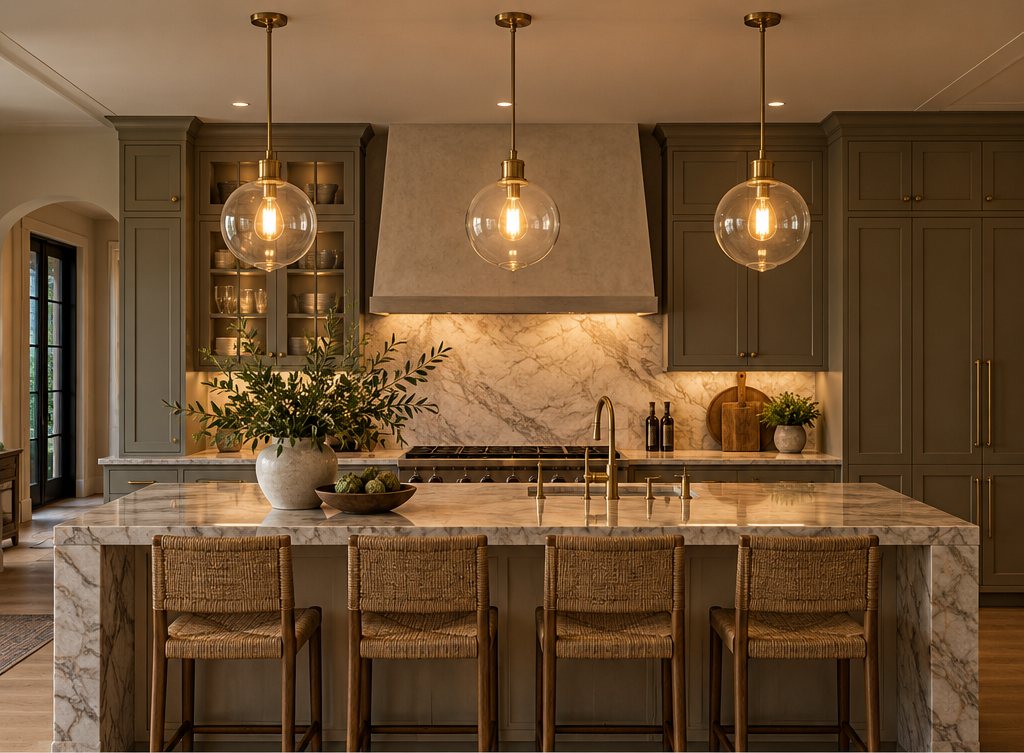
Kitchen island pendant lighting works when the bottom of each pendant hangs 30–36 in (76–91 cm) above the counter, pendants are spaced 24–30 in apart, and the fixtures together cover about two-thirds of the island's length. Two pendants suit a 5–6 ft island, three a 7–9 ft one.
Part of our guide: How to Layer Lighting in a Room Like a Designer
Key takeaways
- Hang the bottom of an island pendant 30–36 in (76–91 cm) above the counter, raising it about 3 in for each foot of ceiling over 8 ft
- Use two pendants for a 5–6 ft island, three for 7–9 ft, and let the row span about two-thirds of the island length with 24–30 in between centers
- Pendant diameter is island width divided by 2.5–3: a 42 in island takes 14–17 in shades
- Aim for 300–500 lumens per pendant at 2700–3000 K and CRI 90+, on a dimmer separate from the recessed lights
- Good glass or metal pendants cost $100–300 each; luxury cast brass or hand-blown glass runs $1,000–3,000 per fixture
Kitchen island pendant lighting is sized by three numbers: hang the bottom of the shade 30–36 in (76–91 cm) above the countertop, space pendants 24–30 in (61–76 cm) apart with at least 6 in (15 cm) from each island end, and let the row of fixtures span about two-thirds of the island length. Two island pendants of 10–14 in (25–36 cm) suit a 5–6 ft (1.5–1.8 m) island; three suit a 7–9 ft (2.1–2.7 m) one; a single linear fixture 36–48 in (91–122 cm) long replaces either.
Pendants over the island are the one lighting decision in a kitchen that everyone sees, and the one most often got wrong, usually by hanging fixtures too high, too small or too many. This guide gives the numbers, the glass, brass and luxury options, what each costs, and how to install and dim them, as part of our layered lighting guide. For dining tables and bedrooms, see dining table pendant lights.
- Hang height: 30–36 in (76–91 cm) from counter to the bottom of the pendant; 72 in (183 cm) minimum from floor to fixture bottom if people walk past.
- Spacing: 24–30 in (61–76 cm) between pendant centers; equal gaps at both ends.
- Diameter: island width in inches divided by 2.5 to 3 gives a sensible pendant diameter; a 42 in island takes 14–17 in pendants.
- Light output: 300–500 lumens per pendant for ambient, 500–800 for task; 2700–3000 K color temperature.
- Cost: $60–250 each for standard glass or metal; $300–900 for designer-grade; $1,000–3,000 for luxury pendant lights for a kitchen island.
How high should pendant lights hang above a kitchen island?
Hang kitchen island pendants so the bottom of the fixture sits 30–36 in (76–91 cm) above the counter, which with a standard 36 in (91 cm) counter puts the shade bottom at 66–72 in (168–183 cm) from the floor. The lower end, 30 in, suits shades that are opaque or down-facing and rooms with 8 ft (2.4 m) ceilings; the higher end, 36 in, suits clear glass that you look through and ceilings of 9 ft (2.7 m) and above. For every foot of ceiling height over 8 ft, raise the pendant about 3 in (8 cm), but never above 40 in (102 cm) over the counter or the island loses its pool of light.
Sightlines decide the fine adjustment. Stand at the sink or the range and look across the island: the shades should not cut through the face of a person sitting on the other side, and a 5 ft 10 in (178 cm) adult standing at the island should not have the shade at eye level. If the island is a walk-through route to a door, hold the bottom of the fixture at 72 in (183 cm) or above. Hanging lights for an island on a chain or cord can be shortened on site; rigid-stem pendants come in fixed lengths, so order the stem to the number, not to a guess.
How many pendants do you need over an island?
Use two pendants for an island 5–6 ft (1.5–1.8 m) long, three for 7–9 ft (2.1–2.7 m), and four or a linear fixture for 10 ft (3 m) and over; an odd number almost always looks better than an even one on a long island. The underlying rule is that the fixtures should occupy about two-thirds of the island's length, with equal gaps between them and equal, slightly smaller, gaps at the ends. A single large pendant of 24–30 in (61–76 cm) works over an island up to 4 ft (1.2 m) long or a square island.
| Island length | Number of pendants | Pendant diameter | Spacing (center to center) | Alternative |
|---|---|---|---|---|
| 4 ft (1.2 m) | 1 | 18–24 in (46–61 cm) | centered | Two small pendants at 8–10 in (20–25 cm) |
| 5–6 ft (1.5–1.8 m) | 2 | 12–16 in (30–41 cm) | 28–32 in (71–81 cm) | Linear fixture 30–36 in (76–91 cm) |
| 7–8 ft (2.1–2.4 m) | 3 | 10–14 in (25–36 cm) | 26–30 in (66–76 cm) | Linear fixture 42–48 in (107–122 cm) |
| 9–10 ft (2.7–3 m) | 3 large or 4 small | 14–18 in or 8–10 in | 30–34 in (76–86 cm) | Two linear fixtures or one 60 in (152 cm) |
| 12 ft+ (3.7 m+) | 4–5 | 12–16 in (30–41 cm) | 28–32 in (71–81 cm) | Two linear fixtures end to end |
Count the stools, too. Pendants look best when they do not line up directly over seats, so three pendants over four stools, or two over three, reads as a composed row rather than a one-light-per-person grid. If the island carries a cooktop or sink, keep pendants away from the cooktop zone by at least 12 in (30 cm) to stop grease settling on glass, and check the island size guide for the clearances that fix where the island sits in the first place.
What size should kitchen island pendants be?
Divide the island width in inches by 2.5 to 3 for a pendant diameter that is in proportion: a standard 36–42 in (91–107 cm) wide island takes pendants of 12–17 in (30–43 cm), and a 48 in (122 cm) island takes 16–20 in (41–51 cm). Then check the total: the combined width of all pendants should not exceed about half the island's length, or the row looks crowded. Small kitchen pendant lights of 6–9 in (15–23 cm) work in multiples over a narrow 24–30 in (61–76 cm) peninsula or a bar, where a two light pendant on a single canopy is also a neat solution when there is only one ceiling box.
Height of the shade matters as much as diameter. A tall, narrow cone 12 in (30 cm) high reads larger than a flat dome of the same diameter, and a cluster of three small globes on one canopy reads as one medium fixture. For ceilings under 8 ft (2.4 m), choose shades no taller than 10 in (25 cm) or a semi-flush island light.
Which pendant style suits which kitchen?
Glass pendants suit kitchens where you want light without visual weight; metal domes and cones suit kitchens that want a strong line; woven and fabric shades suit warm, organic schemes; and linear and chain fixtures suit long islands and traditional rooms. The style decision is partly about light quality: a clear glass shade throws light in every direction and shows the bulb, a frosted or opal glass diffuses it, and an opaque metal shade sends it straight down onto the counter.
| Style | Light quality | Typical cost each | Best for | Watch out for |
|---|---|---|---|---|
| Clear glass globe or bell | Omnidirectional, sparkly, shows bulb | $80–350 | Small kitchens, low ceilings, modern and transitional rooms | Glare with a bright clear bulb; fingerprints and grease |
| Frosted, opal or ribbed glass | Soft, diffused, no bulb visible | $100–400 | Ambient light, organic modern kitchens | Lower task light on the counter |
| Metal dome or cone | Direct downlight, dark above | $60–300 | Task light over prep areas, industrial and farmhouse | Can make the ceiling feel dark; add recessed lights |
| Brass or aged bronze with glass | Warm, mixed | $150–600 | Traditional kitchen lighting, warm palettes | Unlacquered brass patinas; lacquered does not |
| Woven rattan, linen or paper | Soft, patterned shadow | $90–350 | Coastal, organic modern, warm minimalist kitchens | Not over a cooktop; dust |
| Linear or chain-hung bar | Even wash along the island | $200–900 | Long islands, traditional and transitional rooms | Needs a centered box or a canopy that offsets |
| Luxury hand-blown glass, alabaster, cast metal | Sculptural; varies | $1,000–3,000+ | Statement islands, open-plan kitchens on view | Lead times of 8–16 weeks; weight needs a rated box |
Glass pendant lights for a kitchen island
Glass pendant lights for a kitchen island are the default for a reason: they add almost nothing visually, so the island, the stools and the backsplash stay the focus. Choose clear glass when the kitchen is small or the ceiling is low; choose seeded, ribbed or smoked glass when you want texture without weight; choose opal or frosted glass when the pendant is the main light source, since it diffuses the bulb and removes glare. A large glass pendant light of 16–20 in (41–51 cm) works as a single fixture over a short island or in a pair over a long one, and is the easiest way to make a glass pendant lamp read as substantial.
Brass, gold and mixed-metal pendants
Brass kitchen pendant lights are the strongest trend in island lighting for 2027, specifically unlacquered or satin brass with a clear or opal glass shade, matched to brass cabinet hardware and a black or nickel faucet. Island gold pendant lights and a brass island light fixture look best when the brass is one of two, at most three, metals in the room; the rules are in how to mix metals. A silver and gold pendant light, with a nickel stem and a brass shade or the reverse, is a legitimate way to bridge a kitchen that has both finishes already.
Modern, organic and traditional pendants
Modern island pendant lighting in 2027 leans toward large, matte, simple shapes: a 16 in (41 cm) opal globe, a shallow plaster dome, a ribbed glass cylinder. An organic modern pendant light brings in rattan, linen, paper or alabaster with a soft, irregular profile, and is the fixture most often paired with plaster hoods and oak islands. Traditional pendant lights, a lantern on a chain, a schoolhouse globe, a bell jar with a brass fitter, suit painted shaker kitchens and chain pendant lighting in general suits ceilings over 9 ft (2.7 m), where the chain length can be adjusted link by link. The broader directions are in lighting trends 2027 and kitchen trends 2027.
How bright should island pendants be, and what color temperature?
Each island pendant should deliver 300–500 lumens for ambient light or 500–800 lumens if the pendants are the only task light over a prep surface, at a color temperature of 2700–3000 K and a color rendering index of 90 or better so food and finishes look right. Three pendants at 450 lumens each give around 1,350 lumens, which is enough for an 8 ft (2.4 m) island on its own; in a kitchen with recessed downlights as well, pendants can drop to 250–350 lumens each and act as the decorative layer. Work out the whole room's lumens with the lighting calculator.
Always put island pendants on a dimmer, on their own switch, separate from recessed and under-cabinet lights. At full brightness they are a work light; at 30 percent they are the evening light over a bar. Choose bulbs that match the shade: a clear glass shade needs a decorative filament bulb at 2200–2700 K and no more than 450 lumens to avoid glare, an opal shade can take a plain 800 lumen bulb, and an opaque metal shade should have a bulb that sits fully inside it. Make sure the bulb and dimmer are compatible; mismatched pairs flicker at low levels.
How do you install pendant lights over a kitchen island?
Installing pendants over an island is a one-hour job per fixture for an electrician when ceiling boxes already exist and a half-day job when new boxes and a switch loop have to be run; budget $150–300 per pendant for labor plus $100–400 for new wiring. The sequence below is what a good installer follows, and it is the sequence to check against if you are doing the work yourself where local code allows.
- Locate the island centerline on the ceiling. Drop a plumb line or laser from the island's long centerline and mark it; pendants that are 2 in (5 cm) off center are visible from every doorway.
- Mark the pendant positions. Divide the island length by the number of pendants plus one for equal spacing, then adjust so the row covers about two-thirds of the island with end gaps a little smaller than the middle gaps.
- Fit rated ceiling boxes. Standard boxes hold up to 50 lb (23 kg); heavier luxury fixtures need a fan-rated or heavy-duty box fixed to a joist or a brace between joists.
- Run the switch loop and dimmer. Pendants get their own circuit leg and a dimmer compatible with the LED bulbs chosen; label it at the panel.
- Set the drop. Cut cord or chain so the shade bottom lands 30–36 in (76–91 cm) above the counter; for rigid stems, assemble the sections to the number. Hang one, check the sightline from the sink, then match the others.
- Level and align. Shades must hang at exactly the same height and in a straight line; a 0.5 in (1 cm) difference shows. Use a laser line at shade bottom height.
- Fit bulbs and test on the dimmer from full to minimum; replace any bulb that flickers or hums at low levels.
Where there is no ceiling box above the island and opening the ceiling is not an option, a plug-in pendant light swagged from a hook, or a track with pendant adapters run from an existing box, are the two practical workarounds.
What do good island pendants cost, and when is it worth paying for luxury?
A well-made island pendant light fixture in glass or metal costs $100–300 each, so a row of three is $300–900 installed on existing boxes; designer-grade pendants in hand-finished brass or mouth-blown glass run $300–900 each; and luxury kitchen island lighting, meaning cast brass, alabaster, hand-blown art glass or sculptural linear pieces, runs $1,000–3,000 per fixture or $3,000–8,000 for a linear statement. The premium buys weight, finish depth, better glass, serviceable sockets and the lead time to specify finish and drop exactly.
It is worth paying for luxury pendant lights for a kitchen island when the island is the focal point of an open-plan room, the ceiling is high enough to show the fixture off, and the rest of the kitchen is already at that level. It is not worth it over a cooktop, where grease and heat will age any finish, or in a kitchen with 8 ft (2.4 m) ceilings, where the fixture can never hang low enough to be seen as a form. Spend the money instead on three mid-range pendants in a finish that matches the hardware, and on a good dimmer.
Pendants for bars and other rooms
A bar pendant lamp follows the island rules at a higher counter: hang 28–32 in (71–81 cm) above a 42 in (107 cm) bar top, and use smaller shades of 6–10 in (15–25 cm) because the bar is usually narrower. Bar lights in a kitchen and pendant lighting for bars in a commercial setting both benefit from a warmer 2200–2700 K bulb and a dimmer that goes to 10 percent. A living room pendant light sits higher, with the fixture bottom at 7 ft (213 cm) minimum unless it is over a table, and office pendant lighting over a desk hangs 30–36 in (76–91 cm) above the desk surface like an island. Pendant lighting over a dining room table and a pendant light over a kitchen table hang at 30–36 in (76–91 cm) above the table top; the detail is in our dining table pendant guide.
Free toolPaint CalculatorWork out exactly how much paint to buy.Shop & source the look
Buy it today — or have it made
Retail links are affiliate links: we may earn a commission at no extra cost to you (disclosure). “Get it made” sends the item to our sourcing desk for factory quotes in custom sizes and finishes.
Frequently asked questions
How high should pendant lights hang above a kitchen island?
The bottom of the pendant should be 30–36 in (76–91 cm) above the countertop, which puts it at 66–72 in (168–183 cm) from the floor with a standard 36 in counter. Use the lower end for opaque shades and 8 ft ceilings, the higher end for clear glass and 9 ft or taller ceilings, and never go above 40 in over the counter.
How many pendant lights do I need over a 6 foot island?
Two pendants of 12–16 in (30–41 cm) diameter, spaced about 28–32 in (71–81 cm) apart and centered on the island, or a single linear fixture 30–36 in (91 cm) long. Three small pendants of 8–10 in can also work on a 6 ft island if the kitchen is modern and the pendants are simple shapes.
How far apart should pendants be over an island?
Space pendant centers 24–30 in (61–76 cm) apart, with slightly smaller gaps at the ends and at least 6 in (15 cm) from each end of the island. The row of pendants should cover about two-thirds of the island length. Divide the island length by the number of pendants plus one for a starting point, then adjust.
Are glass pendant lights good over a kitchen island?
Yes. Glass is the most forgiving island pendant because it adds light without visual weight, which suits small kitchens and low ceilings. Choose clear glass with a 2200–2700 K filament bulb under 450 lumens to avoid glare, opal or frosted glass for diffused ambient light, and keep glass pendants at least 12 in from a cooktop.
What size pendant for a kitchen island?
Divide the island width in inches by 2.5–3 for the pendant diameter: a 36–42 in wide island takes 12–17 in pendants, a 48 in island 16–20 in. The combined width of all the pendants should be no more than about half the island's length, and shades should be under 10 in tall if the ceiling is below 8 ft.
Should kitchen island pendants match the other lights?
They should coordinate, not match. Use the same metal finish as the cabinet hardware or faucet, two metals at most, and keep the color temperature at 2700–3000 K across all kitchen lights. A dining pendant in the same room can be a different shape in the same finish family; identical fixtures over the island and the table look like a set from a catalog.
Do island pendants need to be on a dimmer?
Yes. Pendants are a work light at full brightness and an evening light at 20–30 percent, so put them on their own dimmer separate from recessed and under-cabinet lighting. Check that the dimmer is rated for the LED bulbs you choose, since mismatched pairs flicker and hum at low levels.
Some links may be affiliate links. Regulations and specifications change — always confirm with suppliers and qualified professionals.