Under Cabinet Lighting: Types, Lumens, Color Temperature and Install
Under cabinet lighting puts 300–500 lumens per foot directly on the counter. Compare LED tape, linear bars and pucks, and get the right color temperature, CRI, placement and wiring.
Part of our guide: How to Layer Lighting in a Room Like a Designer
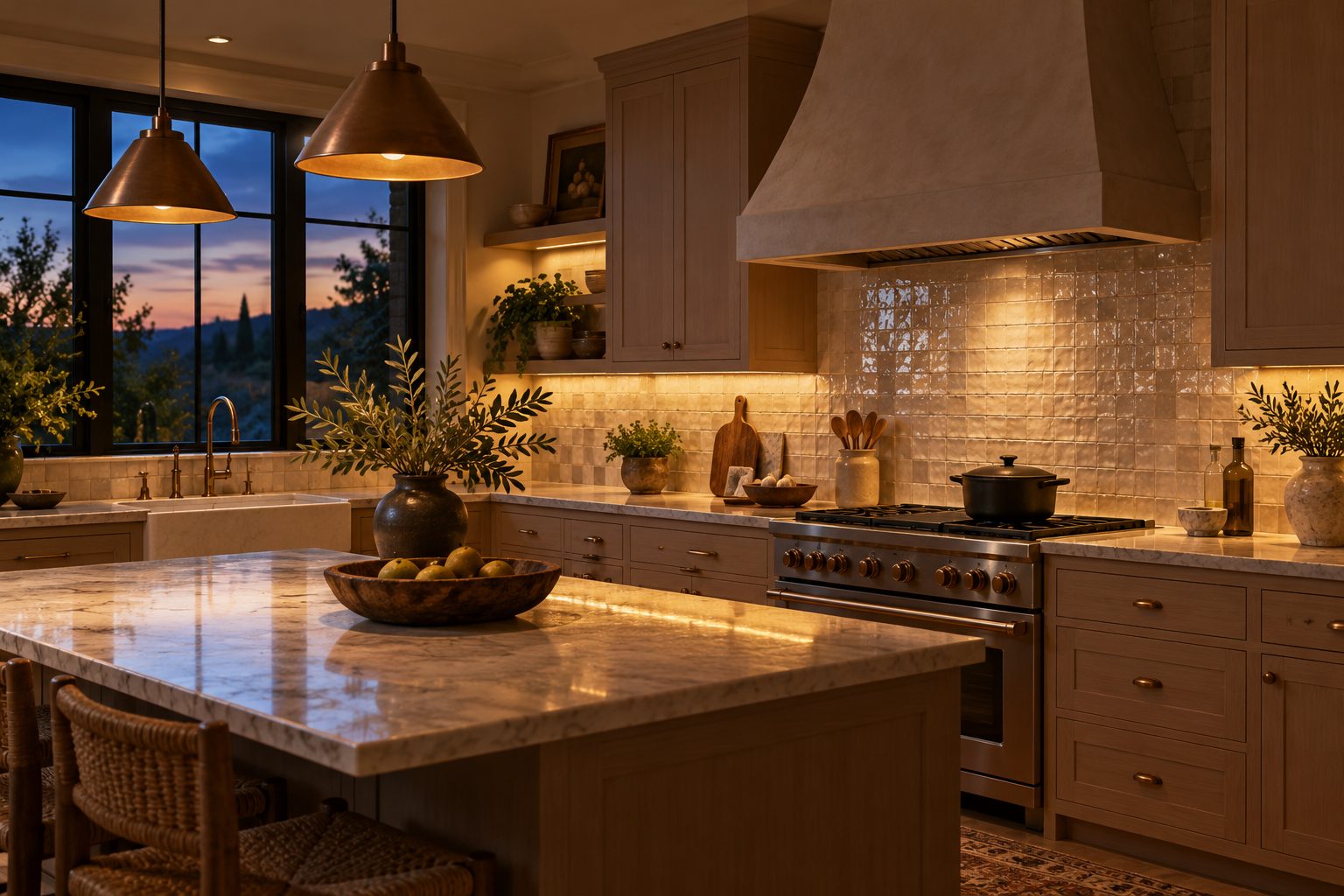
Key takeaways
- Under cabinet lighting is task light: aim for 300–500 lumens per linear foot (1,000–1,600 per meter) on kitchen counters
- Choose 2700–3000 K to match warm ceiling light and CRI 90 or higher so food and stone look true
- Mount the strip at the front third of the cabinet underside, angled back, to avoid glare and backsplash hot spots
- LED tape in an aluminum channel with a diffuser is the most even and low-profile option; pucks suit accent only
Under cabinet lighting is a strip or set of fixtures mounted beneath wall cabinets to light the counter directly. For kitchens, aim for 300–500 lumens per linear foot (1,000–1,600 lm/m) at 2700–3000 K with a CRI of 90 or higher. LED tape in an aluminum channel gives the most even, low-profile result; puck lights are for accent, not cooking.
Ceiling downlights behind you cast your own shadow onto the board, which is why lighting under counter-height cabinets is the single best upgrade most kitchens can make. It is the task layer in our guide on how to layer lighting, and it costs less than almost any other fix.
- Target brightness: 300–500 lumens per ft on kitchen counters, 150–250 for bars and display.
- Color temperature: 2700–3000 K in homes; 3500 K at most in very cool, white kitchens.
- Color rendering: CRI 90+, ideally with an R9 value above 50.
- Typical cost: $15–60 per linear ft for materials, $200–800 per kitchen for installation (US, 2026).
Which type of under cabinet lighting is best?
The best type of under cabinet lighting for most kitchens is LED tape in an aluminum channel with a frosted diffuser, because it gives continuous, dot-free light at under half an inch thick.
| Type | Profile depth | Typical output | Evenness | Typical cost (US 2026) | Best use |
|---|---|---|---|---|---|
| LED tape in channel | 0.4–0.6 in (10–15 mm) | 300–600 lm per ft | Excellent with diffuser | $15–40 per ft | Kitchen counters, cabinetry lighting |
| Linear LED bar | 0.6–1 in (15–25 mm) | 250–450 lm per ft | Very good | $30–80 per fixture | Retrofits, hardwired runs |
| LED puck | 0.4–0.8 in (10–20 mm) | 150–250 lm each | Poor, scalloped pools | $15–40 each | Display shelves, accent |
| Under cabinet track lighting | 1–1.5 in (25–38 mm) | Varies by head | Fair, adjustable | $60–200 per run | Workshops, flexible aiming |
| Battery or rechargeable bar | 0.8–1.2 in (20–30 mm) | 100–250 lm per ft | Fair | $20–50 each | Rentals, closets, no wiring |
Tape lighting for cabinets needs a channel: bare tape shows every diode as a dot on a glossy counter and runs hot. Linear bars are a good choice when you want plug-and-link fixtures without a separate driver. We avoid pucks on work counters because they create bright circles with dark gaps between.
How bright should countertop lighting be?
Countertop lighting should deliver roughly 300–500 lumens per linear foot, which gives 50–75 foot-candles (500–800 lux) on the work surface at a typical 18 in (46 cm) cabinet height.
Go to the upper end with dark counters, dark cabinets or older eyes; stay lower with white quartz and a white backsplash, which reflect much more light. Always fit a dimmer: full output for chopping, 20–30 percent for an evening glow. If you are converting from old halogen or fluorescent fixtures, our lumens to watts guide shows the equivalents, and the lighting calculator totals the lumens for a whole kitchen.
What color temperature is best for kitchen light under cabinets?
The best color temperature for kitchen light under cabinets is 2700–3000 K, matched to your ceiling lights so the counter does not glow a different color from the rest of the room.
Mixing a 4000 K strip with 2700 K downlights is the most common mistake we see; the counter looks clinical and the cabinets look gray. Tunable white tape (2700–5000 K) is available, but in a home it usually ends up parked at one setting. Specify CRI 90 or more: below that, wood looks flat, marble looks dirty and raw meat looks gray. Ask for the R9 value, which measures red rendering, and look for 50 or higher.
Where should under cabinet lights be placed?
Under cabinet lights should be placed at the front third of the cabinet underside, aimed slightly back toward the wall, so light washes the counter and the backsplash without shining in your eyes.
- Measure the cabinet underside. Most uppers are 12–13 in (30–33 cm) deep; the strip goes 2–3 in (5–8 cm) behind the front edge.
- Check for a light rail. A 1–1.5 in (25–38 mm) lip or valance on the front of the cabinet hides the fixture from seated eye level.
- Run the strip continuously. Leave no more than 2–3 in (5–8 cm) gaps at cabinet joints, or use corner connectors.
- Angle it. A 30–45 degree angled channel throws light back onto the wall and reduces glare on polished counters.
- Plan the driver location. Put the 24 V driver in an accessible cabinet or above the uppers, never sealed inside a wall.
- Choose the switch. A wall dimmer on the main kitchen circuit, a hidden sensor switch or a smart relay.
Mounting at the back of the cabinet is the instinctive choice and the wrong one for backsplash lighting: it creates hot stripes on glossy tile and leaves the front of the counter in shadow. The exception is textured zellige or handmade tile, where a rear-mounted strip grazes the surface on purpose; see our kitchen backsplash ideas for tile pairings.
Low profile under cabinet light vs hardwired: which should you install?
Install a hardwired low profile under cabinet light if you are remodeling or can reach a junction box; choose plug-in or rechargeable fixtures only for rentals or where opening walls is impractical.
Hardwired systems switch with the room, hide all cables and last the full 25,000–50,000 hour life of the LEDs. Plug-in linear bars are a good middle path when there is an outlet inside an upper cabinet or above the hood. Battery and rechargeable units are fine for a pantry, wardrobe or under cabinet desk light, but recharging a kitchen's worth every few weeks gets old quickly. In most US jurisdictions, new hardwired circuits need a licensed electrician and sometimes a permit.
For tape systems, choose 24 V over 12 V: it carries power farther with less voltage drop, so a 16 ft (5 m) run stays evenly bright end to end. Size the driver at about 120 percent of the total tape wattage, so 20 ft of 5 W per ft tape (100 W) needs a 120 W driver. Match the driver to the dimmer type, ELV, triac or 0–10 V, or you will get flicker at low levels. Hide feed wires through the back corner of the cabinet and keep every connection accessible for future repairs.
Can you use under cabinet lighting in bathrooms, desks and display cabinets?
Yes, under cabinet lighting works well beyond the kitchen, as long as you match the output and moisture rating to the space.
- Bathroom under cabinet lighting: a strip under a floating vanity or wall cabinet makes a soft night light; specify IP44 or higher near water and 2700 K at low output.
- Under cabinet desk light: 250–400 lumens per ft at 3000–3500 K under a shelf or hutch, with a dimmer to cut screen glare.
- Display and glass cabinets: 100–200 lumens per ft, often vertical tape at the front corners of each shelf.
- Butlers pantries and bars: the same spec as the kitchen; our butlers pantry guide covers the layout.
- Benchtop lighting in workshops: 4000 K and 500+ lumens per ft is acceptable where color warmth matters less than detail.
Mistakes we see with under cabinet lighting
The mistakes we see most often are bare LED tape without a diffuser, cool light that clashes with warm ceilings, and fixtures mounted too far back.
Others: no dimmer, so the strip is either blinding or off; cheap tape below CRI 80 that turns quartz yellow-green within a year; adhesive-only mounting that drops off in the heat above a range; and drivers buried where nobody can replace them. Budget tape typically lasts a few years; good 24 V tape in an aluminum channel, which acts as a heat sink, should last well over a decade. Spend the extra $5–10 per foot on the channel and diffuser; it is the difference between a professional install and a visible row of dots.
Our verdict on under cabinet lighting
Our verdict is simple: every kitchen with wall cabinets should have under cabinet lighting, and the spec to use is 24 V LED tape in an angled aluminum channel, 300–500 lumens per foot, 2700–3000 K, CRI 90+, on a dimmer. It costs a few hundred dollars and changes how a kitchen works more than new hardware or paint. To work out the lumens and the number of fixtures for your own counters, use our free lighting calculator.
Free toolTile CalculatorWork out tiles, boxes, grout and adhesive with the right wastage.Shop & source the look
Buy it today — or have it made
Retail links are affiliate links: we may earn a commission at no extra cost to you (disclosure). “Get it made” sends the item to our sourcing desk for factory quotes in custom sizes and finishes.
Frequently asked questions
What is the best under cabinet lighting?
The best under cabinet lighting for most kitchens is 24 V LED tape mounted in an aluminum channel with a frosted diffuser. It gives continuous, glare-free light at under half an inch deep. Specify 300–500 lumens per foot, 2700–3000 K and a CRI of 90 or higher, wired to a dimmer.
Should under cabinet lights be at the front or back?
Under cabinet lights should be mounted toward the front of the cabinet underside, about 2–3 in (5–8 cm) behind the edge, and angled back. That lights the whole counter and the backsplash evenly. Mounting at the back creates glare stripes on glossy tile and leaves the front of the counter in shadow.
What color temperature is best for under cabinet lighting?
2700–3000 K is the best color temperature for under cabinet lighting in homes, because it matches typical warm ceiling lights. Mixing a cooler 4000 K strip with warm downlights makes the counter look clinical. Choose CRI 90 or higher so food, wood and stone render naturally.
How much does under cabinet lighting cost?
Under cabinet lighting typically costs $15–60 per linear foot for LED tape, channels and drivers, plus $200–800 for professional installation in an average US kitchen in 2026. Plug-in linear bars cost less to install, and battery units are the cheapest but least practical over time.
Some links may be affiliate links. Regulations and specifications change — always confirm with suppliers and qualified professionals.