Quartz Countertops: Cost, Colors, Slab Sizes and Pros and Cons
Quartz countertops are engineered slabs of roughly 90 percent ground quartz bound with resin. They cost a typical $50–150 per sq ft installed, never need sealing and come in white, marble-look, black and matte finishes.
Part of our guide: Interior Design with Sustainable Materials: Travertine to Rattan
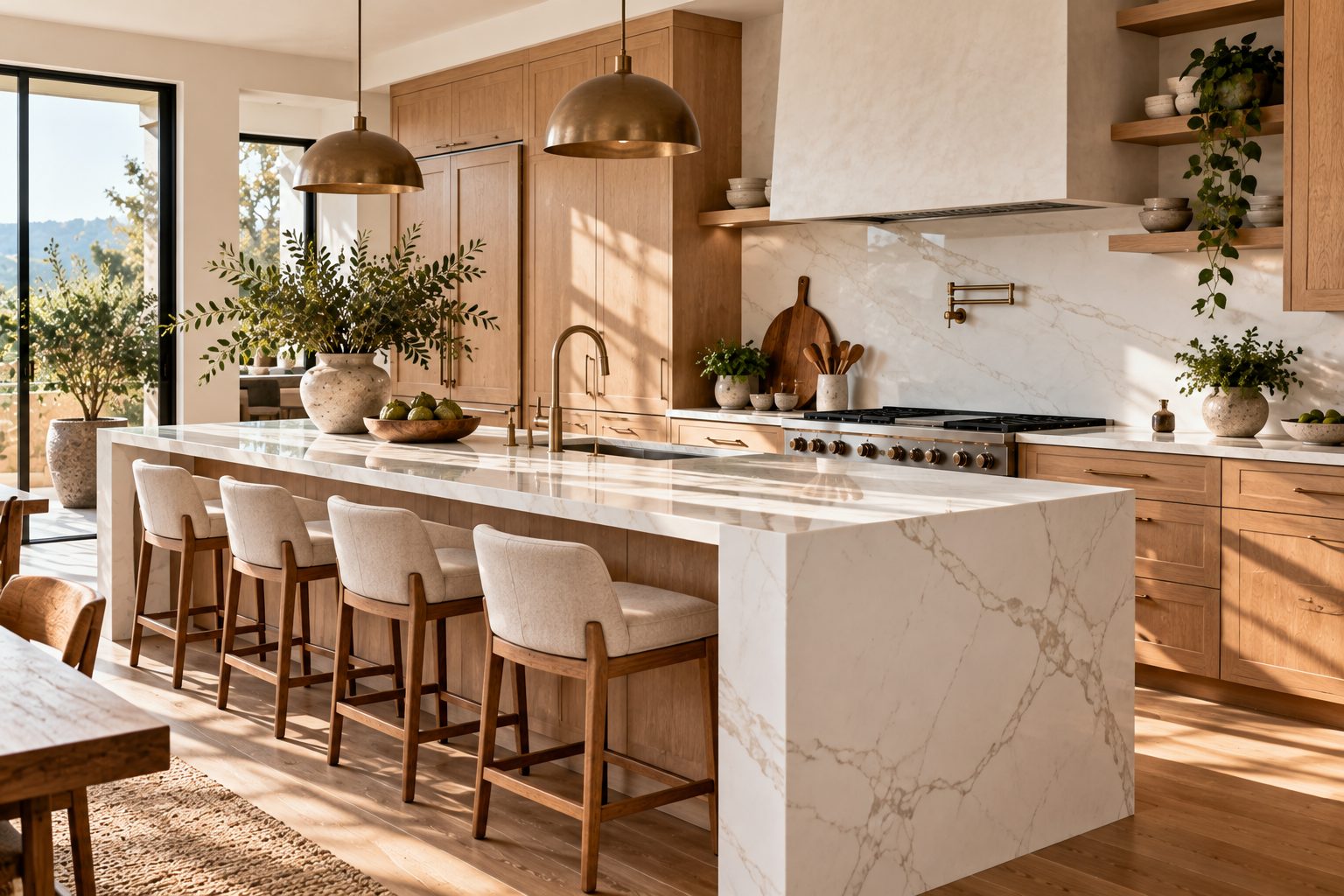
Key takeaways
- Quartz countertops are engineered stone: about 90–93 percent crushed quartz bound with 7–10 percent polymer resin and pigment
- Typical US 2026 installed cost is $50–150 per sq ft; entry-level solid whites sit at the bottom, bookmatched marble looks at the top
- Quartz is non-porous and never needs sealing, but resin scorches above about 300°F (150°C) and yellows in direct sun
- Standard slabs are about 120 × 55 in (305 × 140 cm) and jumbo slabs about 130 × 65 in (330 × 165 cm), in 2 cm and 3 cm thickness
Quartz countertops are engineered stone slabs made of about 90–93 percent crushed natural quartz bound with 7–10 percent polymer resin and pigments. They are non-porous, never need sealing and resist stains better than any natural stone, and they typically cost $50–150 per sq ft installed in the US in 2026, roughly $3,000–7,500 for an average kitchen.
Quartz has been the default for kitchen countertops for a decade, and it remains a core surface in our trending materials guide for 2027, even as natural stone and honed finishes pull attention. Here is what quartz is, what it costs, which colors are worth buying, how slabs are sized and where it falls short.
- Material: crushed quartz plus resin, pressed and cured into slabs; a man-made product, not quarried stone.
- Cost: typical $50–150 per sq ft installed; materials alone about $30–90 per sq ft.
- Sizes: standard about 120 × 55 in (305 × 140 cm); jumbo about 130 × 65 in (330 × 165 cm).
- Thickness: 2 cm (3/4 in) or 3 cm (1 1/4 in).
- Weak points: direct heat, outdoor UV and the silica dust created during fabrication.
What is quartz countertop material?
Quartz countertop material is a composite: natural quartz ground into sand and powder, mixed with polyester or acrylic resin, pigments and sometimes recycled glass, then vibro-compacted under vacuum and cured into a slab. So, are quartz countertops man made? Yes. The mineral is natural, but the slab is manufactured, which is why the industry calls it engineered quartz or engineered stone.
That manufacturing gives engineered quartz countertops their key traits. The resin fills every pore, so wine, oil and coffee cannot soak in. Color is consistent from slab to slab, so a sample matches the delivered countertop. The trade-off is heat and sunlight: resin softens and discolors where natural stone would not. Do not confuse quartz with quartzite, a natural metamorphic rock; our quartz vs quartzite comparison covers the difference in detail.
How much do quartz countertops cost?
Quartz countertops typically cost $50–150 per sq ft installed in the US in 2026, with most kitchens landing between $65 and $100 per sq ft. A typical 50–60 sq ft (4.6–5.6 m²) kitchen therefore runs about $3,000–7,500 before the sink and tile backsplash.
| Tier | Typical look | Material only | Installed (per sq ft) | 50 sq ft kitchen |
|---|---|---|---|---|
| Entry | Solid white, speckled, fine gray | $30–50 | $50–70 | $2,500–3,500 |
| Mid | Subtle veining, concrete looks, matte finishes | $45–70 | $70–100 | $3,500–5,000 |
| Premium | Bold marble-look veining, jumbo slabs | $65–90 | $100–150 | $5,000–7,500 |
| Add-ons | Mitered edge, waterfall end, full-height backsplash | $30–150 per linear ft, $1,000–3,000 per waterfall | Varies | |
These are typical installed ranges and include templating, fabrication, standard eased edges, sink and cooktop cutouts and installation. Removal of old tops, plumbing reconnection and fancy edge profiles are often extra.
How to find cheap quartz countertops without regret
Cheap quartz countertops come from three places: remnants for small runs such as vanities and laundry rooms, prefabricated 26 × 96 in (66 × 244 cm) or 26 × 108 in (66 × 274 cm) blanks with a finished front edge, and entry-tier solid colors. All three are fine. What we avoid is unbranded low-cost slab with uneven pigment, high resin content or visible pitting; check the back of the slab and ask for the resin percentage and a warranty in writing.
What are the most popular colors of quartz countertops?
The most popular colors of quartz countertops are white with soft gray or warm gold veining, solid warm white, greige concrete-look and black, with honed and matte finishes growing in 2027 alongside polished. White still dominates, but warmer bases have replaced the stark blue-white of a decade ago.
#F4F1EB#E9E5DE#C9C3B8#7E7B76#2B2A29Hex values are screen approximations; quartz always reads differently under kitchen lighting, so view full slabs or large samples under 2700–3000K light.
White quartz countertops and white quartz kitchen countertops
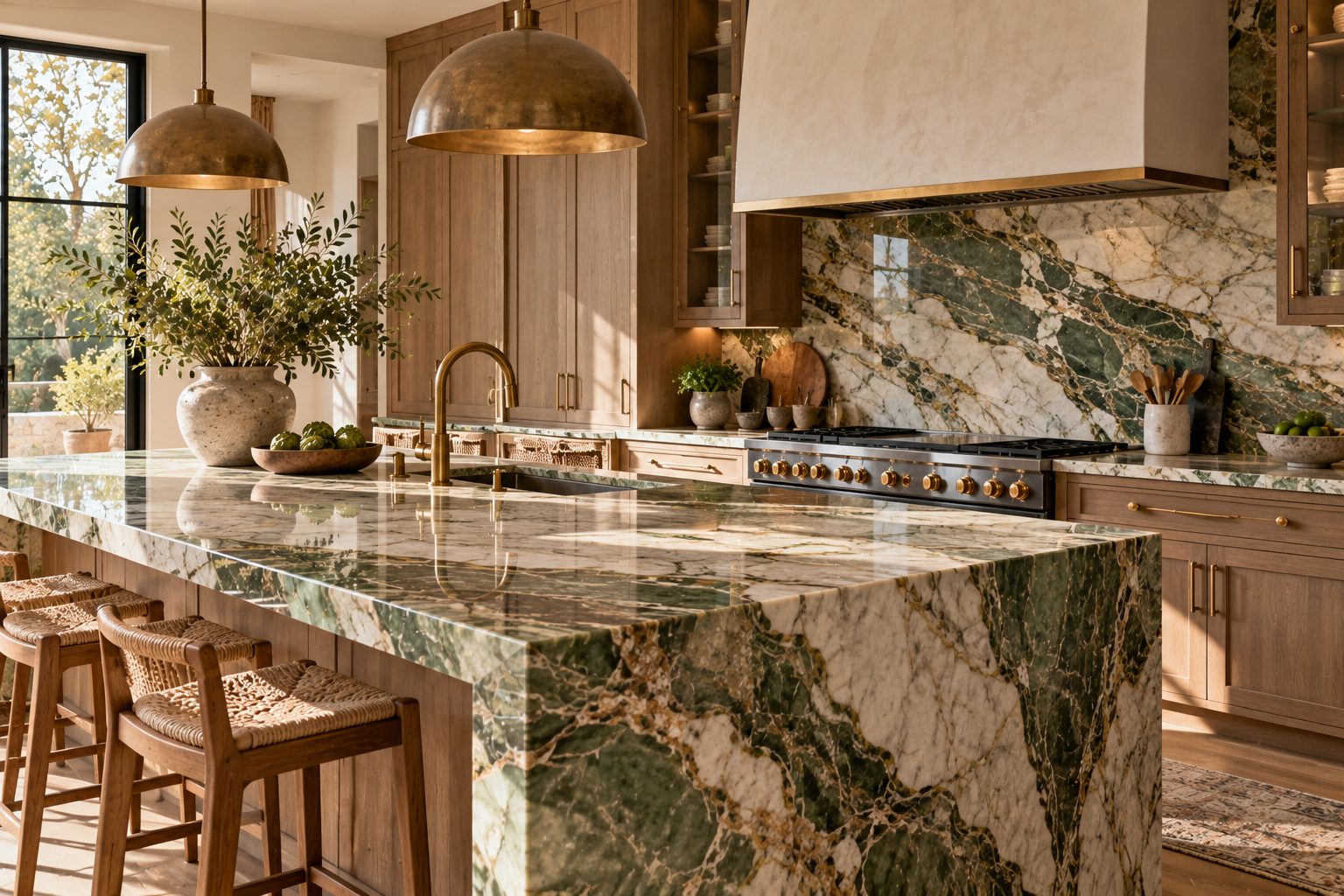
White quartz is the safest resale choice and the easiest to pair with any cabinet color. Within white quartz countertops colors, choose from three families: solid or fine-grain whites for modern and minimal kitchens, marble quartz with thin gray veins for a classic look, and bold book-matched veining for islands. A white quartz slab with a warm, creamy base suits wood and green cabinets; a cool, bright white suits navy, black and gray. If you are planning white quartz kitchen countertops in a white kitchen, add contrast through grain or veining so the room does not flatten out; our white kitchen ideas show how.
Black quartz countertops and dark quartz countertops
Black quartz countertops and other dark quartz countertops make a strong contrast with white oak or pale cabinets and hide stains completely. Polished black shows dust and water spots; matte black quartz countertops show fingerprints and oil marks from hands and pans. Ask the fabricator for a sample, rub cooking oil on it and wipe it off before you commit. Black and white quartz countertops, meaning a dark perimeter with a white island or the reverse, work best when the cabinets bridge the two, for example mid-tone wood.
What sizes and thicknesses does a quartz slab come in?
A standard quartz slab is about 120 × 55 in (305 × 140 cm) and a jumbo slab about 130 × 65 in (330 × 165 cm), in 2 cm or 3 cm thickness, though exact sizes vary by producer. Slab size decides how many seams your kitchen will have.
| Format | Typical size | Usable area | Best for |
|---|---|---|---|
| Standard slab | 120 × 55 in (305 × 140 cm) | about 45 sq ft (4.2 m²) | Perimeter runs, small islands |
| Jumbo slab | 130 × 65 in (330 × 165 cm) | about 58 sq ft (5.4 m²) | Seamless islands up to 10 ft (3 m) |
| 2 cm thickness | 3/4 in (20 mm) | Lighter, needs plywood subtop or mitered edge | Backsplashes, vanities, mitered looks |
| 3 cm thickness | 1 1/4 in (30 mm) | Self-supporting on cabinets | Kitchen tops, islands, overhangs up to 12 in (30 cm) |
Plan the island first, because it is usually the piece that needs a jumbo white quartz slab. A 3 cm top can overhang about 10–12 in (25–30 cm) without support; beyond that, add steel brackets or legs. Our kitchen island size guide gives seating overhangs and clearances, and our guide on how to calculate square footage helps you estimate countertop area before you request quotes. For the backsplash, the tile calculator works out tile quantities.
Quartz vs other stone countertops
Among stone countertops, quartz is the lowest-maintenance choice: tougher than marble, more stain-proof than granite and quartzite, but less heat- and UV-resistant than any natural stone. The table compares the common kitchen countertops quartz is shopped against.
| Material | Typical installed cost (US 2026) | Sealing | Heat | Stains and etching |
|---|---|---|---|---|
| Engineered quartz | $50–150 per sq ft | Never | Fair: use trivets | Excellent; no etching |
| Granite | $40–120 per sq ft | Every 1–3 years | Very good | Good when sealed |
| Quartzite | $70–200 per sq ft | Every 1–2 years | Very good | Good; true quartzite does not etch |
| Marble | $60–200 per sq ft | Every 6–12 months | Good | Poor; etches with acids |
| Solid surface | $40–90 per sq ft | Never | Poor | Good; scratches can be sanded out |
If you want natural stone, our quartzite countertops guide covers costs and colors, and our kitchen countertop ideas guide compares looks across every material.
What are the pros and cons of quartz countertops?
The pros of quartz countertops are stain resistance, no sealing, consistent color and a long warranty; the cons are heat sensitivity, unsuitability outdoors and a real silica health risk for the people who cut it.
- Pro, maintenance: wipe with warm water and mild dish soap; no sealer, ever.
- Pro, consistency: what you see in a sample is close to what arrives, unlike natural stone.
- Pro, strength: quartz itself rates about 7 on the Mohs scale, so the surface resists scratches from normal use.
- Con, heat: resin can scorch or discolor above about 300°F (150°C); always use trivets for pans and slow cookers.
- Con, sunlight: UV yellows resin, so quartz is not for outdoor kitchens or sun-baked windows.
- Con, chemicals: oven cleaner, bleach and solvents can dull or stain the surface.
Silica and fabrication safety
Engineered stone contains far more crystalline silica than most natural stone, and cutting it dry creates respirable dust linked to silicosis among fabrication workers. Australia banned engineered stone from July 2024, and US workplace rules require wet cutting, ventilation and respirators. As a buyer, choose a fabricator that cuts wet and follows those rules, and ask whether lower-silica or recycled-content slabs are available; several producers now offer them.
How to buy and install quartz countertops
Buy quartz countertops by choosing the slab in person, getting a fabricator to template the cabinets, and approving the seam layout before anything is cut. This is the sequence we follow for clients:
- Measure and estimate. Sketch runs and island, calculate square footage and add 10–15 percent for cutouts and waste.
- View full slabs. Samples hide veining direction and pigment clouds; reserve the actual slab.
- Install cabinets level. Cabinets must be within 1/8 in over 10 ft (3 mm over 3 m) for templating.
- Template on site. The fabricator measures with sink, faucet and cooktop specs in hand.
- Approve the seam layout. Ask for a digital layout on the slab photo; keep seams away from sinks and cooktops.
- Install and wait. Installation takes a day; let seam epoxy and silicone cure 24 hours before heavy use.
How we'd do it: our verdict on quartz countertops
For a busy family kitchen, rental or hospitality project, we still specify quartz countertops more than any other surface, because nothing else matches its stain resistance for the money. Our standard choice is a 3 cm warm white or soft-veined marble-look quartz on the perimeter, honed or polished to suit the cabinets, with a jumbo slab on the island so it stays seamless. We avoid matte black on the main prep zone, keep quartz out of full sun and always add a trivet drawer near the range. If the client cooks with cast iron at high heat or wants patina, we steer them to natural stone instead. For 2027 the shift we see is warmer whites, finer veining and more honed finishes, a calmer look that fits the wider kitchen direction for 2027.
Ordering quartz for several kitchens or a hospitality fit-out? Send dimensions and color preferences to our stone sourcing desk for factory slab quotes, sizes and lead times.
Free toolTile CalculatorWork out tiles, boxes, grout and adhesive with the right wastage.Shop & source the look
Buy it today — or have it made
Retail links are affiliate links: we may earn a commission at no extra cost to you (disclosure). “Get it made” sends the item to our sourcing desk for factory quotes in custom sizes and finishes.
Frequently asked questions
What are quartz countertops made of?
Quartz countertops are made of about 90–93 percent crushed natural quartz mixed with 7–10 percent polymer resin and pigments, then compacted under vacuum and cured into slabs. The resin binds the quartz and fills every pore, which is why quartz never needs sealing and resists stains better than natural stone.
Are quartz countertops man made?
Yes, quartz countertops are man made. The quartz mineral is mined, but it is ground up and bound with resin in a factory to form engineered stone slabs. That is the key difference from quartzite, which is a natural rock quarried and cut directly into slabs.
How much do quartz countertops cost?
Quartz countertops typically cost $50–150 per sq ft installed in the US in 2026, with most kitchens between $65 and $100 per sq ft. An average 50 sq ft (4.6 m²) kitchen runs about $3,000–7,500. Solid entry colors cost least; bold marble-look veining, jumbo slabs and waterfall ends cost most.
Can you put hot pans on quartz countertops?
No, you should not put hot pans directly on quartz countertops. The resin binder can scorch, discolor or crack from thermal shock above about 300°F (150°C). Always use a trivet or board for pans, baking sheets and appliances such as slow cookers and air fryers that heat their base.
Do white quartz countertops stain?
White quartz countertops resist staining very well because they are non-porous, so coffee, wine and oil wipe away. They can discolor from long contact with turmeric, permanent markers, bleach, oven cleaner or strong solvents, and from heat. Wipe spills promptly with mild soap and water and avoid harsh chemicals.
Is quartz better than granite for kitchen countertops?
Quartz is better than granite if you want zero maintenance and consistent color, because it never needs sealing and resists stains. Granite is better for heat resistance, outdoor use and one-of-a-kind natural patterns. Typical installed prices overlap, roughly $40–120 per sq ft for granite and $50–150 for quartz.
Some links may be affiliate links. Regulations and specifications change — always confirm with suppliers and qualified professionals.