Paver Patio Ideas: Designs, Materials, Sizes, Costs and Installation
The best paver patio ideas match material to climate and size to use: about 12 x 12 ft (3.7 x 3.7 m) for a table for four, typically $15–25 per sq ft installed in concrete, built on a 4–6 in (10–15 cm) compacted base.
Part of our guide: Travertine Pavers: Pool Decks, Patios & Cost Guide
Key takeaways
- Size the patio by use: about 12 x 12 ft (3.7 x 3.7 m) for dining for four, 16 x 16 ft (4.9 x 4.9 m) or more for dining plus lounge
- Concrete pavers are the value choice at typically $15–25 per sq ft installed; natural stone and porcelain run about $25–50
- The base does the work: 4–6 in (10–15 cm) of compacted gravel for patios, 8–12 in (20–30 cm) for driveways, sloped 1/8–1/4 in per ft away from the house
- Large pavers and simple patterns look most current for 2027; herringbone is the strongest pattern where cars drive
The paver patio ideas that last pair a paver suited to your climate with a size that fits its use: about 12 x 12 ft (3.7 x 3.7 m) for a table for four, 16 x 16 ft (4.9 x 4.9 m) for dining plus lounge seating. Concrete pavers typically cost $15–25 per sq ft installed and natural stone $25–50, on a 4–6 in (10–15 cm) gravel base.
We start with materials because they decide the look, the budget and the maintenance for twenty years. If you are drawn to natural stone, our travertine pavers guide covers grades, thicknesses and sealing in depth; this guide compares every common paver type, then moves to designs, sizing, pool decks, driveways and the build itself.
- Typical installed cost: $15–25 per sq ft for concrete pavers, $25–50 for natural stone or porcelain, 2026 US ranges.
- Base: 4–6 in (10–15 cm) compacted gravel plus 1 in (25 mm) bedding sand for patios.
- Slope: 1/8–1/4 in per ft (1–2 percent) away from the house.
- Thickness: 2 3/8 in (60 mm) for patios, 3 1/8 in (80 mm) for driveways.
- Waste: 5–10 percent for straight patterns, 10–15 percent for herringbone and curves.
What is a paver patio?
A paver patio is an outdoor floor made of individual units, concrete, clay, natural stone or porcelain, laid tightly on a compacted gravel and sand base with sand-filled joints and a fixed edge restraint. Because each unit can flex and move slightly, a well-built paver patio rides out frost heave and soil movement that would crack a poured concrete slab, and a damaged paver can be lifted and replaced in minutes.
The terms overlap. Patio pavers, paver stones and paving stones all mean the same thing in everyday use. Patio stones and patio blocks usually refer to cheaper, thinner square slabs of 12–24 in (30–60 cm) sold for DIY; they are fine for a simple seating pad but too thin for anything driven on.
Which patio pavers should you choose?
Concrete pavers are the best value for most patios, natural stone pavers give the richest look and porcelain is the lowest-maintenance option, while clay paver bricks suit traditional houses and borders. The table compares them with typical 2026 US prices.
| Paver type | Material cost | Installed cost | Freeze-thaw | Notes |
|---|---|---|---|---|
| Concrete pavers | $3–8 per sq ft | $15–25 per sq ft | Very good to ASTM C936 | Widest choice of colors and sizes; color can fade over 10–15 years |
| Clay paver bricks | $5–10 per sq ft | $18–30 per sq ft | Very good to ASTM C902 SX grade | Color fired through, does not fade; classic herringbone and basketweave |
| Travertine | $5–15 per sq ft | $22–40 per sq ft | Fair; use 1.25 in (30 mm) and seal in cold climates | Stays cool underfoot; first choice for pool decks in warm regions |
| Bluestone, limestone, sandstone | $6–15 per sq ft | $25–45 per sq ft | Good to very good depending on density | Dark bluestone gets hot in full sun |
| Granite or basalt | $8–20 per sq ft | $30–50 per sq ft | Excellent | Hardest wearing; flamed finish for grip |
| Porcelain, 20 mm | $6–14 per sq ft | $25–45 per sq ft | Excellent; absorbs under 0.5 percent water | Stain-proof, no sealing; needs precise base and spacers |
| Cement pavers and patio blocks | $1.50–4 per sq ft | $10–18 per sq ft | Fair to good | Budget DIY; thinner units for foot traffic only |
Concrete patio pavers should meet ASTM C936, which requires an average compressive strength of at least 8,000 psi and water absorption of no more than 5 percent; that is what makes them survive salt and frost. Cement pavers sold without that rating are fine in mild climates but tend to spall in cold ones. To estimate quantities and waste for any of these, our tile calculator works for pavers too.
What are the best paver patio designs for 2027?
The paver patio designs that look most current for 2027 use large pavers, few joints and one quiet contrast, rather than busy multicolor blends and circle kits. These are the backyard paver ideas we recommend most often.
Large-format slabs with tight joints
Large pavers of 24 x 24 in (60 x 60 cm) or 24 x 48 in (60 x 120 cm) in concrete or porcelain, set in a stack bond with 1/8–3/16 in (3–5 mm) joints, give the calm, architectural look of an indoor floor carried outside. They suit modern houses and small yards, where fewer joints make the space feel larger.
French pattern travertine
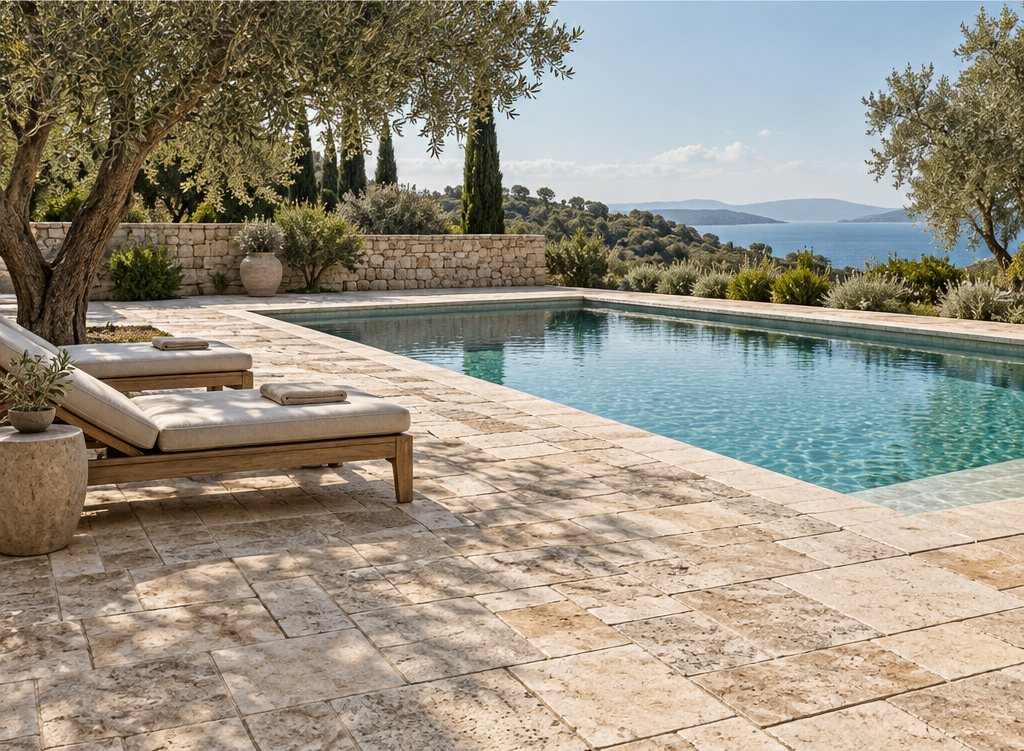
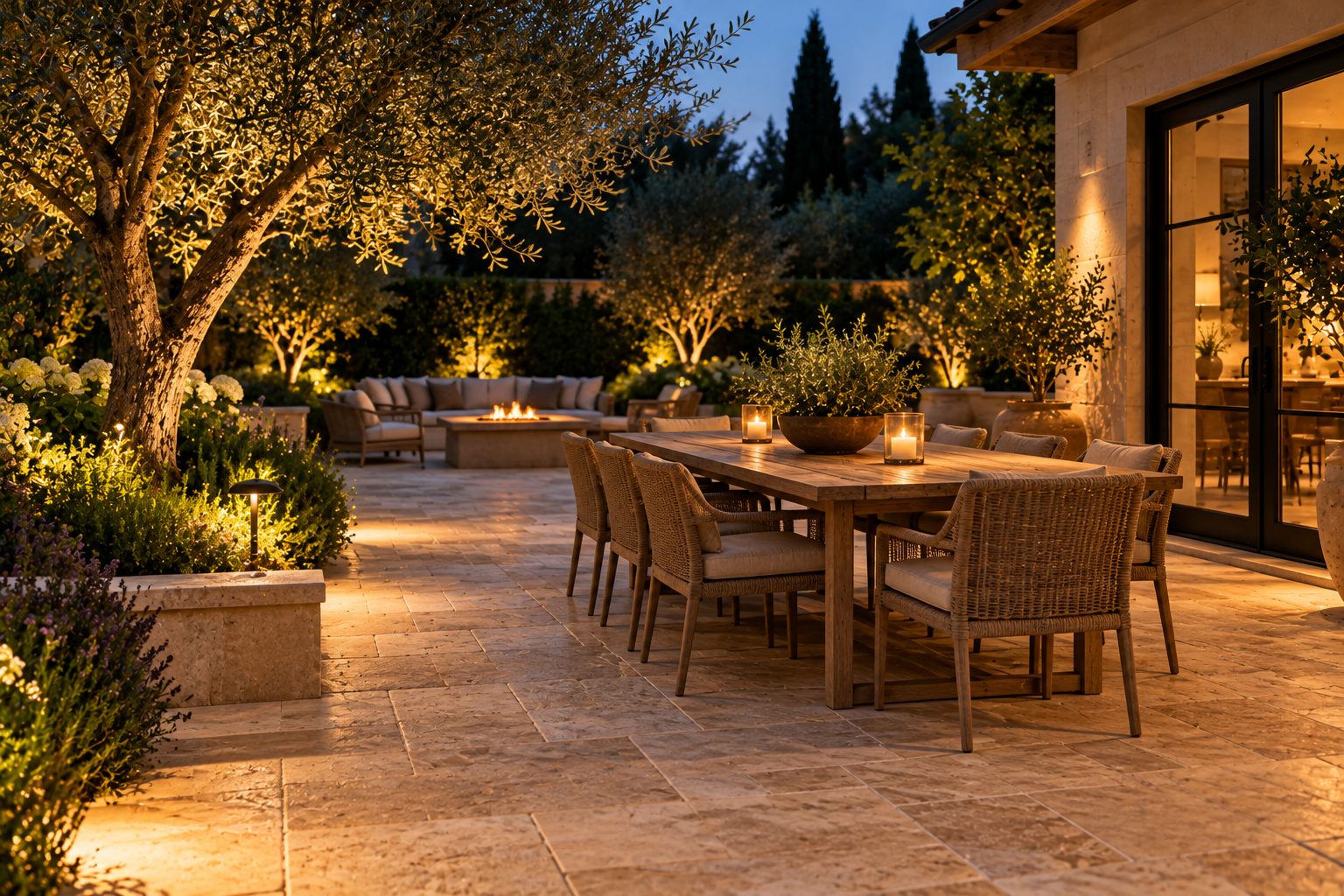
Four sizes of tumbled travertine laid in a repeating random-looking pattern is the classic Mediterranean patio. It hides minor level differences and looks right next to stucco, terracotta pots and olive trees.
Brick border with a stone field
A soldier course or two-row border of clay paver bricks around a stone or concrete field frames the patio and gives a strong edge where it meets lawn. It is one of the easiest ways to make inexpensive concrete pavers look custom.
Gravel and grass joints
Wide joints of 2–4 in (5–10 cm) filled with gravel, creeping thyme or grass let water soak in, which can matter where local codes cap impervious surface. Keep them away from dining areas, where chair legs catch.
Seat walls, steps and fire pits
A low seat wall 18–20 in (46–51 cm) high in matching wall blocks adds seating without furniture, and a sunken fire pit area two steps down creates a room within the yard. Allow 7 ft (213 cm) diameter of clear paving around a fire pit for chairs.
Color matters as much as pattern. Warm sand, buff and soft gray pavers read as natural stone and suit the earthy 2027 outdoor palette; uniform red and multicolor concrete blends look dated quickly.
#D8CBB4#B9A68A#8E8A82#4D4F52#9A5B3EHex values are approximate screen references; pavers change color when wet or sealed, so judge real samples outdoors in both conditions. Lay three or four pavers of each candidate on the site for a week, wet them with a hose and look at them morning and evening before you order. A wet-look or color-enhancing sealer deepens most stones by a shade or two and adds a slight sheen, which suits charcoal concrete and bluestone but can make travertine look plasticky; a natural-look penetrating sealer is the safer default. Whatever you choose, link it to the house: repeat the trim, roof or window frame color in either the field or the border so the patio reads as part of the architecture rather than an add-on.
Which paver pattern should you use?
Use running bond or stack bond for calm patios, herringbone wherever there is vehicle traffic and French or ashlar patterns for natural stone. Pattern also affects cost through cutting and waste.
- Stack bond: modern grid; needs very consistent pavers and a precise base, 5 percent waste.
- Running bond: offset by half a unit; forgiving and quick to lay, 5–7 percent waste.
- Herringbone at 45 or 90 degrees: interlocks strongly, the best pattern for driveways, 10–15 percent waste.
- Basketweave: traditional with clay bricks, 7–10 percent waste.
- French or ashlar: mixed rectangles and squares, 5–10 percent waste.
What size should a paver patio be?
A paver patio should be sized by its furniture plus clearance, not by the space left in the yard: 12 x 12 ft (3.7 x 3.7 m) is the minimum for a dining table for four with chairs pulled out. Allow 36 in (91 cm) behind each dining chair and 30–36 in (76–91 cm) for walkways.
- Bistro set for two: 8 x 8 ft (2.4 x 2.4 m).
- Dining for four: 12 x 12 ft (3.7 x 3.7 m).
- Dining for six to eight: 14 x 16 ft (4.3 x 4.9 m).
- Lounge set with sofa and two chairs: 12 x 14 ft (3.7 x 4.3 m).
- Dining plus lounge: 16 x 20 ft (4.9 x 6.1 m) or two connected areas.
Our outdoor dining furniture guide gives exact table and chair sizes, and our patio shade ideas show how to fit a pergola or umbrella footprint into the plan.
What are the best pool deck pavers?
The best pool deck pavers are light-colored, slip-resistant and cool underfoot, which makes tumbled or brushed travertine, light concrete and textured porcelain the leading choices. Dark stones such as charcoal concrete or bluestone can become uncomfortably hot to walk on barefoot in summer sun.
Look for a wet DCOF of 0.42 or higher, and more for steps and coping; tumbled and brushed finishes beat honed or polished ones. Chlorine and salt water can etch soft stones, so seal travertine and limestone with a penetrating sealer and rinse the deck regularly. Our how to clean travertine guide covers the products that will not damage it. Allow at least 4 ft (1.2 m) of deck on the main sides of the pool, more where loungers go.
Are driveway pavers different from patio pavers?
Yes, driveway pavers must be thicker and sit on a deeper base: 3 1/8 in (80 mm) units in herringbone on 8–12 in (20–30 cm) of compacted gravel, versus 2 3/8 in (60 mm) units on 4–6 in for a patio. Using patio-grade units for a paver driveway is the most common reason for rutting and cracked pavers within a few seasons.
A paver driveway typically costs $18–40 per sq ft installed in 2026, against roughly $8–15 for poured concrete paving. The premium buys repairability and a better-looking approach to the house. For driveway paving, choose concrete or clay rated for vehicular use, set a herringbone pattern, and insist on a concrete or heavy-duty edge restraint, because spikes alone let the edges spread under car tires.
How to build a paver patio
A DIY paver patio of about 200 sq ft (19 m²) takes two people three to five days; most of the time goes into digging and compacting the base, not laying pavers. These are the steps for a pedestrian patio; professional patio installation follows the same sequence.
- Call to mark utilities before you dig (811 in the US) and check local permit and drainage rules.
- Lay out and excavate to 7–9 in (18–23 cm) below finished height: paver thickness plus 1 in of sand plus 4–6 in of base, extending 6–12 in (15–30 cm) beyond the patio edge.
- Set the slope with string lines at 1/8–1/4 in per ft (1–2 percent) away from the house.
- Lay geotextile fabric on clay or soft soils to keep the base from mixing with the subsoil.
- Install the base of crushed, angular gravel in 2 in (5 cm) lifts, compacting each with a plate compactor.
- Screed 1 in (25 mm) of coarse concrete sand over pipes used as rails; do not walk on it.
- Lay the pavers from a straight edge or corner, pulling from several pallets to blend color, and keep joints consistent.
- Cut, edge and fill: fit edge restraints, compact the pavers, then sweep in polymeric sand, compact again and mist it to set.
The same base rules apply when you install patio stones or larger slabs. Porcelain and large stone are often laid on a thin mortar bed over a concrete slab instead, which needs a pro and adds $5–10 per sq ft.
Mistakes we see with paver patios
Nearly every failed paver patio we are asked to fix failed in the base, not the pavers: too little gravel, no compaction, sand used as the base or no slope away from the house. The result is sinking corners, puddles against the foundation and pavers rocking within two winters. The second mistake is a patio sized to the leftover lawn rather than the furniture, so chairs fall off the edge. Third, choosing a dark paver for a sunny pool deck.
How we would do it: buy the best base you can and a mid-priced paver, choose large units in one warm neutral, frame them with a single border, and slope everything correctly. A patio built that way outlasts a premium paver laid on a thin base. Then light it gently with shielded outdoor wall lights so it works after dark. Good paver patio ideas are mostly good engineering with one design decision on top.
Planning a large patio, pool deck or a multi-unit hardscape project? Send your area, preferred stone and climate to our stone sourcing desk for factory-direct quotes on travertine, granite, porcelain and concrete pavers.
Free toolTile CalculatorWork out tiles, boxes, grout and adhesive with the right wastage.Shop & source the look
Buy it today — or have it made
Retail links are affiliate links: we may earn a commission at no extra cost to you (disclosure). “Get it made” sends the item to our sourcing desk for factory quotes in custom sizes and finishes.
Frequently asked questions
How do you build a paver patio?
Excavate 7–9 in (18–23 cm) deep, slope the ground 1/8–1/4 in per ft away from the house, compact 4–6 in (10–15 cm) of crushed gravel in layers, screed 1 in of sand, lay the pavers, fit edge restraints and sweep in polymeric sand. Thorough compaction of the base is what keeps the patio level.
How much does a paver patio cost?
A paver patio typically costs $15–25 per sq ft installed with concrete pavers and $25–50 with natural stone or porcelain, based on 2026 US ranges. A 200 sq ft (19 m²) concrete paver patio therefore runs roughly $3,000–5,000. DIY cuts costs by half or more but takes several days of heavy work.
How thick should the gravel base be under pavers?
Use 4–6 in (10–15 cm) of compacted crushed gravel under a patio and 8–12 in (20–30 cm) under a driveway, plus a 1 in (25 mm) layer of bedding sand. Increase the base by 2–4 in on clay soil or in cold climates with deep frost, and lay geotextile fabric underneath.
Are pavers better than a concrete patio?
Pavers are usually better for longevity and repairs, while poured concrete is cheaper upfront. Pavers flex with frost and soil movement instead of cracking, and single damaged units can be replaced. Concrete costs roughly $8–15 per sq ft installed against $15–25 for concrete pavers, but cracks are permanent and hard to patch invisibly.
What size pavers look best on a patio?
Large pavers of 24 x 24 in (60 x 60 cm) or bigger look best on most modern patios because fewer joints make the space feel larger and calmer. Smaller units such as 4 x 8 in (10 x 20 cm) bricks suit traditional houses, curves and driveways, where their interlock spreads loads better.
Some links may be affiliate links. Regulations and specifications change — always confirm with suppliers and qualified professionals.