Best Outdoor Furniture Material: 8 Materials Compared for 2027
The best outdoor furniture material for most patios is powder-coated aluminum: rust-free, light and 15–25 years of life. Here is how it compares with iron, steel, resin wicker, HDPE, teak and acacia on cost and upkeep.
Part of our guide: Teak Outdoor Furniture: Grades, Care & Is It Worth the Price?
Key takeaways
- Powder-coated aluminum is the best outdoor furniture material for most patios: it cannot rust, weighs little and lasts 15–25 years
- Choose cast aluminum, wrought iron or HDPE where wind is a problem; all three resist tipping because of their weight
- Resin wicker must be HDPE strand over an aluminum frame; PVC strand cracks and fades within a few summers
- Teak is the only wood that needs no treatment to last decades; acacia and eucalyptus need oil every season
The best outdoor furniture material for most patios is powder-coated aluminum: it cannot rust, a dining chair weighs only 9–14 lb (4–6 kg), and a well-welded frame lasts 15–25 years with nothing more than soap and water. Choose cast aluminum, wrought iron or solid HDPE where wind is strong, and teak if you want wood that ages without treatment.
No single material wins every yard. Coastal air, desert UV, freeze-thaw winters and a windy rooftop each punish a different weakness, and the right answer also depends on whether you will store or cover furniture in the off-season. If wood is your preference, our teak outdoor furniture guide covers grades, oiling and the silver patina in depth; this page compares all eight common materials side by side.
- Lowest maintenance: powder-coated aluminum and solid HDPE lumber, which need only washing.
- Best in wind: cast aluminum, wrought iron and HDPE, all heavy enough to stay put.
- Best for coastal homes: marine-grade aluminum, HDPE and teak; avoid plain steel and iron.
- Longest life: teak, cast aluminum and HDPE, commonly 20 years or more.
- Cheapest upfront: powder-coated steel and acacia, but both are shorter-lived.
What is the best outdoor furniture material?
Powder-coated aluminum is the best outdoor furniture material overall, because it balances weight, rust resistance, cost and lifespan better than any alternative. The table compares the eight materials we specify most often, using typical US 2026 retail ranges for a single dining chair so the numbers are comparable.
| Material | Dining chair weight | Typical life | Upkeep | Typical price per dining chair |
|---|---|---|---|---|
| Extruded aluminum, powder-coated | 9–14 lb (4–6 kg) | 15–25 years | Wash twice a year | $120–450 |
| Cast aluminum | 18–35 lb (8–16 kg) | 20–30+ years | Wash, touch up chips | $250–700 |
| Wrought iron | 25–45 lb (11–20 kg) | 20+ years if repainted | Sand and repaint rust spots yearly | $150–500 |
| Powder-coated steel | 12–20 lb (5–9 kg) | 5–12 years | Seal chips quickly | $80–300 |
| Resin wicker (HDPE strand) | 10–18 lb (5–8 kg) | 8–15 years | Hose and soft brush | $150–600 |
| Solid HDPE lumber | 25–45 lb (11–20 kg) | 20+ years | Wash only | $250–700 |
| Teak, grade A | 15–25 lb (7–11 kg) | 25+ years | Optional oil or cleaner | $300–900 |
| Acacia or eucalyptus | 12–20 lb (5–9 kg) | 4–10 years | Oil every season, store in winter | $80–250 |
Weights and prices are typical ranges, not quotes; armchairs, lounge chairs and contract-grade pieces run higher. Lifespans assume normal care and at least partial winter cover in cold climates.
Is aluminum patio furniture worth it?
Aluminum patio furniture is worth it for almost every climate, because aluminum forms a protective oxide skin instead of red rust and keeps its strength for decades. Light weight makes it easy to rearrange and clean, and the price spread is wide enough to suit most budgets.
Extruded versus cast aluminum patio furniture
Extruded aluminum outdoor furniture is made from hollow tubes bent and welded together. It is the lightest option and the most common in modern sets. Cast aluminum patio furniture is poured into molds, which produces solid, ornate or sculpted shapes and roughly double the weight. That weight is useful: a cast aluminum chair at 25 lb (11 kg) stays put on a breezy deck where a 10 lb (4.5 kg) extruded chair can slide or tip.
What to check before you buy
- Welds: look for continuous, fully welded joints rather than bolted or tack-welded ones, which loosen.
- Wall thickness: tube walls of about 1.2–2 mm feel solid; thinner tubes dent and flex.
- Powder coat: a polyester powder coat of roughly 60–80 microns, applied after a chemical pretreatment, resists chalking and chipping far better than wet paint.
- Fixings and feet: stainless steel screws and replaceable nylon glides; steel screws leave rust streaks on aluminum.
An aluminum outdoor table is the easiest dining table to live with outdoors: a 60 in (152 cm) round seats six, the top can be slatted for drainage or solid with a ceramic or stone inlay, and it can be lifted by two people. Our outdoor dining furniture guide covers table sizes and chair clearances.
Is wrought iron patio furniture still a good choice?
Wrought iron patio furniture is a good choice where wind, weight and a traditional look matter more than low maintenance, because it is the heaviest metal option and will rust wherever the coating breaks. Expect to sand and touch up small rust spots every spring.
Most furniture sold as wrought iron today is hot-formed mild steel bar, not historic wrought iron, and that is fine as long as it is hot-dip galvanized or zinc-primed before the topcoat. Ask which it is: galvanized iron furniture can last decades, while painted-only iron starts weeping rust at the welds in two or three humid summers.
A wrought iron outdoor table setting suits cottage gardens, Mediterranean courtyards and French-style terraces. A garden table wrought iron base with a mosaic, stone or glass top is the classic version; a 42 in (107 cm) bistro round seats four. Put cushions on iron chairs, because the mesh and scroll seats are hard, and add felt or plastic glides so the legs do not scratch stone or rust-stain concrete.
Metal patio furniture compared: aluminum, steel, iron and stainless
Among metal patio furniture, aluminum lasts longest for the money, iron is the heaviest, stainless steel suits modern design budgets, and powder-coated steel is the cheapest but shortest-lived. The difference comes down to how each metal behaves once the finish is scratched.
- Aluminum: a scratch turns dull gray but does not spread; it is the safest metal outdoor table frame near the sea.
- Powder-coated steel: strong and inexpensive, but rust creeps under the coating from any chip. Fine for covered porches, poor for open lawns.
- Wrought iron: heavy and repairable; rust is cosmetic at first and can be sanded out.
- Stainless steel: grade 304 is fine inland; specify grade 316 within a few miles of salt water, or expect tea-colored staining.
For metal chairs outdoor, the deciding factor is often comfort rather than metal type: sling seats in PVC-coated polyester mesh drain instantly and stay cooler than solid metal seats, which can get uncomfortably hot in direct sun. If you are pairing an outdoor furniture metal table with chairs from another set, keep the finish family consistent; our how to mix metals guide gives the rules we use indoors and out. A patio furniture metal table in dark bronze or charcoal hides scratches and pollen best; white shows both.
Resin wicker vs rattan outdoor furniture
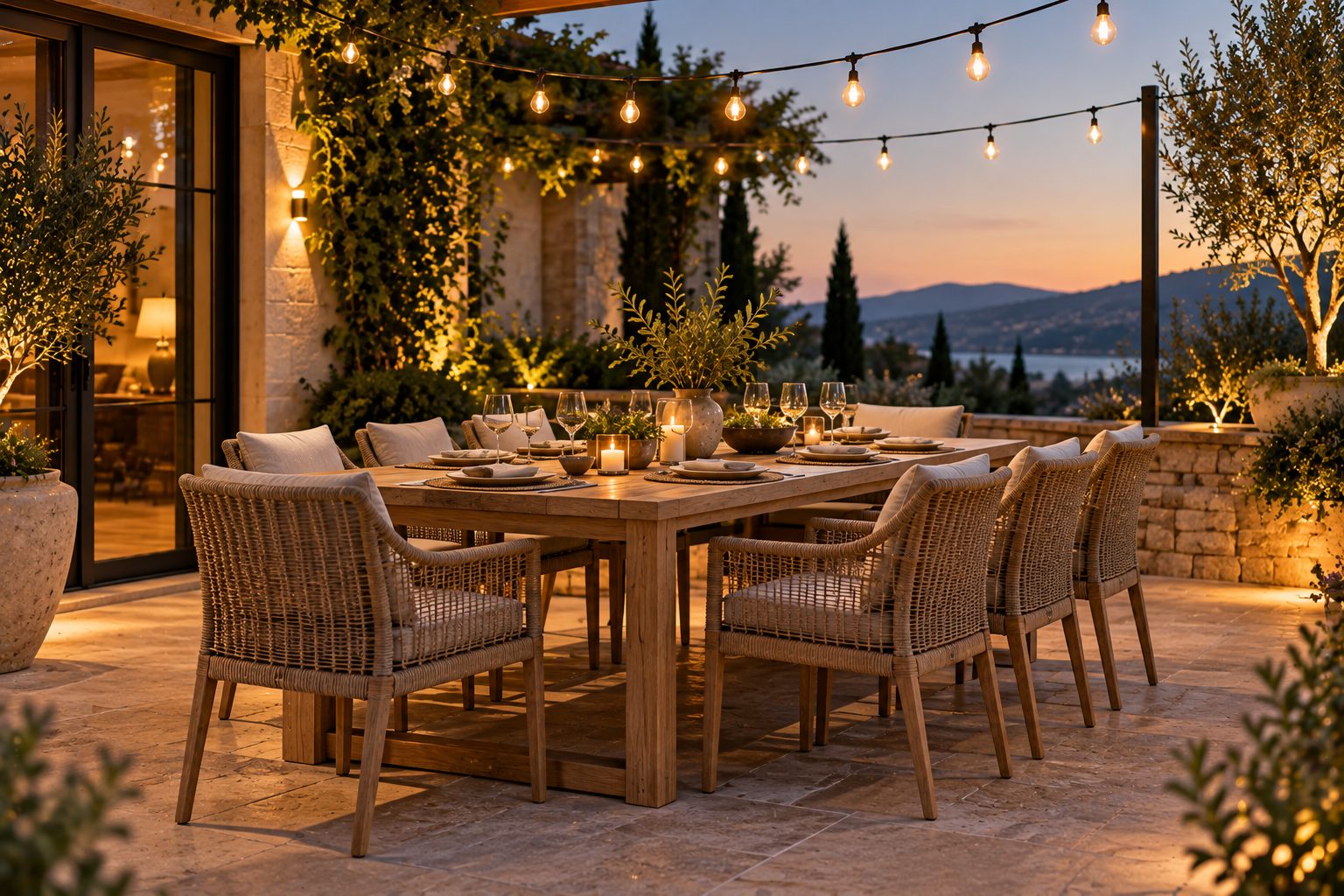
Resin wicker made from HDPE strand is the right choice for exposed patios, while natural rattan outdoor furniture belongs only on covered porches and in sunrooms, because real rattan swells, molds and splits when it stays wet.
Resin wicker patio furniture is a synthetic strand woven over a frame. The quality range is enormous, and two specifications decide it:
- The strand: high-density polyethylene with UV inhibitors stays flexible for many years. Cheaper PVC strand turns brittle, cracks and fades in two to four summers.
- The frame: powder-coated aluminum underneath; a steel frame inside wicker rusts unseen and stains the weave orange.
Flat, wide strands of 1.5–2 mm thickness feel more like woven furniture; round strands look more like traditional wicker. Resin wicker outdoor furniture is light, so add cushion weight or choose deeper frames on windy sites. The same pieces are often sold as resin wicker garden furniture or resin wicker lawn furniture; the name changes, the specification should not.
White wicker outdoor furniture
White wicker outdoor furniture is the classic porch look and is having a quiet return in 2027 alongside coastal and cottage styles. Buy it in HDPE strand with the color mixed through, not painted on, and expect to hose it down every few weeks in pollen season. White wicker patio furniture also reflects heat, so it stays cooler to touch than dark brown or gray weaves in full sun.
HDPE and composite outdoor furniture
Solid HDPE patio furniture is the most maintenance-free outdoor furniture you can buy: the color runs all the way through, it does not rot, splinter or need paint, and it is heavy enough to sit through strong wind.
HDPE lumber, often made from recycled plastic containers, is milled into boards 0.75–1 in (19–25 mm) thick and assembled with stainless hardware. It suits Adirondack chairs, rockers, dining sets and benches. The trade-offs are weight, which makes moving it a two-person job, and a slightly plastic surface sheen up close. Good HDPE carries UV stabilizers; ask whether the boards are through-colored and whether the warranty covers fading.
Composite outdoor furniture is a looser term. It can mean HDPE lumber, a wood-plastic composite of wood fiber and polymer, polystyrene boards made to look like painted wood, or fiber-reinforced cement and resin tables. Wood-plastic composites can stain and mildew more than solid HDPE; fiber-cement tops are heavy, cool and modern but can chip on the edges. Ask for the exact composition rather than buying on the word composite.
Wood outdoor furniture: teak, acacia and eucalyptus
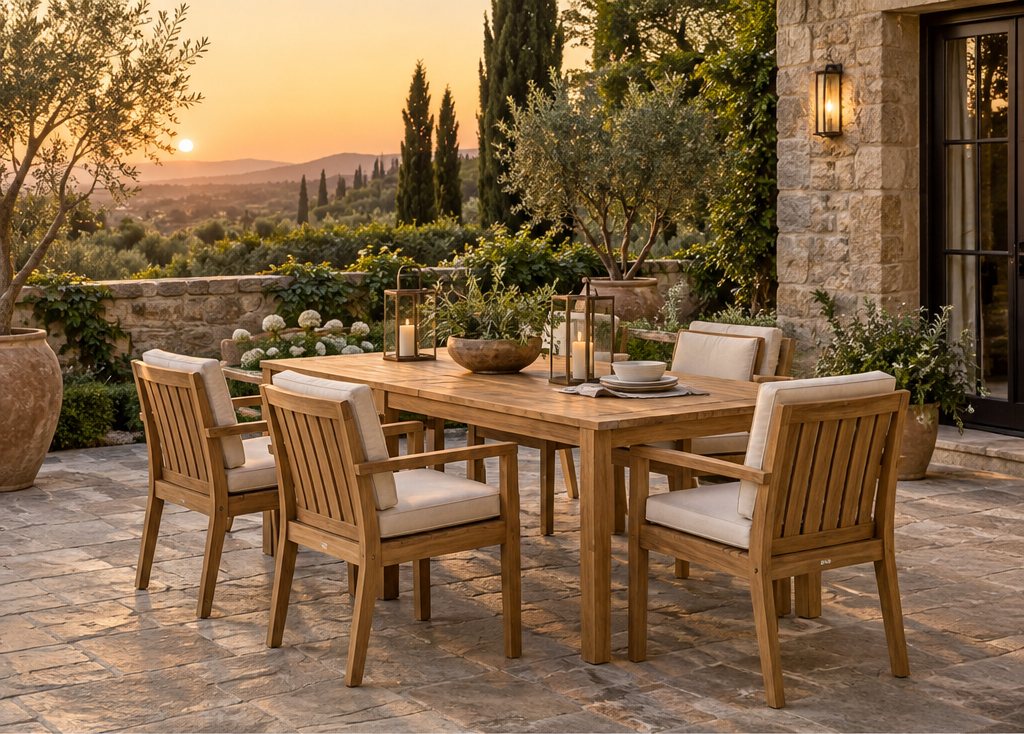
Teak is the only wood outdoor furniture that lasts decades with no treatment, because its natural oils and tight grain resist rot and insects; acacia and eucalyptus look similar when new but need oil every season.
Grade A teak from heartwood turns an even silver-gray in six to twelve months if left alone, or keeps its honey tone with a teak cleaner and sealer once or twice a year. Acacia and eucalyptus are hard, attractive and far cheaper, but they check and gray unevenly and should be stored indoors or covered over winter. Shorea and ipe are durable alternatives used mainly in benches and decking-grade furniture. Whatever the species, look for mortise-and-tenon joints, stainless or brass fixings and slatted seats with drainage gaps of about 0.25 in (6 mm).
Wood shines in mixed sets: a teak table with aluminum or wicker chairs gives warmth without making every piece high-maintenance. Cushions matter too; our outdoor cushion covers guide explains solution-dyed acrylic, quick-dry foam and covers that survive UV.
Which outdoor furniture material suits your climate and color plan?
Match the material to your worst weather, not your average day: salt air rules out plain steel, strong wind rules out light aluminum and wicker, and freeze-thaw winters rule out leaving acacia or iron uncovered.
| Climate or site | Best materials | Avoid |
|---|---|---|
| Coastal, within 5 miles (8 km) of salt water | Marine-grade aluminum, HDPE, teak, 316 stainless | Powder-coated steel, unprotected iron, 304 stainless |
| Windy rooftop or open plains | Cast aluminum, wrought iron, HDPE lumber | Light extruded aluminum, resin wicker without weight |
| Hot desert sun | Light-colored aluminum, sling seats, teak, HDPE | Dark metal seats, PVC wicker, unstabilized plastics |
| Cold, snowy winters | HDPE, cast aluminum, teak | Acacia left outdoors, glass tops left out in frost |
| Humid, rainy summers | Aluminum, HDPE, teak with drainage gaps | Natural rattan, steel inside wicker, solid wood seats |
Color affects heat and wear as much as looks. Pale finishes stay cooler in sun but show grime; dark bronze and charcoal hide scratches but get hot. For 2027 we see the most requests for warm earthy powder coats over the stark black and white of recent years.
#3B3631#5E6B62#C4BBAA#F1EEE7#9A7B5BThe hex values are screen approximations; always check a physical finish chip in daylight before ordering a large set.
How to choose an outdoor furniture material
Choose outdoor furniture material by working from site conditions to budget, in this order:
- Rate your exposure. Note salt air, wind, full sun hours and whether the space is covered.
- Decide on winter storage. If nothing will be stored or covered, limit the shortlist to aluminum, HDPE and teak.
- Check weight against wind. On rooftops and exposed decks choose pieces over about 20 lb (9 kg) per chair or plan to anchor them.
- Test comfort. Sit for ten minutes; sling and woven seats suit dining, deep cushioned frames suit lounging.
- Read the specification. Ask for frame alloy, coating thickness, strand type, wood grade and hardware grade.
- Compare cost per year. A $400 chair that lasts 20 years beats a $150 chair replaced every five.
Mistakes we see with outdoor furniture materials
The mistake we see most often is buying on looks in a showroom and discovering the site conditions later, usually a windy deck that sends light chairs into the pool or a sea view that rusts a steel set within a year.
- Steel hidden under wicker: cheap sets disguise a steel frame; a magnet test settles it, because aluminum is not magnetic.
- Glass tops in frost and sun: tempered glass is safe but shows every water spot; choose stone, ceramic or slatted tops for low effort.
- Ignoring cushions: a premium frame with polyester cushions looks tired in one season. Budget for solution-dyed acrylic.
- Mixing too many materials: two materials per set reads as designed; four reads as accidental.
Our verdict after specifying patios from desert courtyards to coastal decks: buy powder-coated aluminum for chairs, add one heavier piece such as a teak or cast aluminum table, and use HDPE for anything that will live outside year-round. For full patio layouts see our outdoor sofa guide and, for cooking zones, our outdoor kitchen ideas.
Furnishing a hotel terrace, restaurant patio or several rental units? Send your quantities and site conditions to our outdoor furniture sourcing desk and we will match you with factories that publish coating specs, salt-spray results and realistic lead times.
Free toolPaint CalculatorWork out exactly how much paint to buy.Shop & source the look
Buy it today — or have it made
Retail links are affiliate links: we may earn a commission at no extra cost to you (disclosure). “Get it made” sends the item to our sourcing desk for factory quotes in custom sizes and finishes.
Frequently asked questions
What is the most durable outdoor furniture material?
Teak, cast aluminum and solid HDPE lumber are the most durable outdoor furniture materials, each commonly lasting 20 years or more. Teak resists rot through its natural oils, cast aluminum cannot rust and is heavy enough for wind, and HDPE is colored all the way through, so it never needs painting, sealing or sanding.
Is aluminum or wrought iron better for patio furniture?
Aluminum is better for most patios because it cannot rust, weighs a third as much and needs only washing. Wrought iron is better on windy sites and for traditional gardens, since its weight keeps it in place, but it needs rust spots sanded and repainted every year or two, especially near the coast.
Does resin wicker furniture last outside?
Resin wicker made from UV-stabilized HDPE strand over an aluminum frame lasts roughly 8–15 years outside. Cheaper PVC strand becomes brittle and cracks within two to four summers, and steel frames rust inside the weave. Ask for the strand material and frame metal before buying, and cover or store wicker in snowy winters.
What outdoor furniture can stay outside all year?
Powder-coated aluminum, cast aluminum, solid HDPE lumber and grade A teak can stay outside all year in most climates. Covers or storage still extend their life and keep cushions clean. Acacia, eucalyptus, natural rattan, powder-coated steel and glass-topped tables should be stored or covered through winter and wet seasons.
What is composite outdoor furniture made of?
Composite outdoor furniture is usually made of HDPE plastic lumber, a wood-plastic blend of wood fiber and polymer, or polystyrene boards shaped to look like painted wood. Solid HDPE is the most weather-resistant of the three. Some tables also use fiber-reinforced cement or resin, which is heavy and durable but can chip at the edges.
Some links may be affiliate links. Regulations and specifications change — always confirm with suppliers and qualified professionals.