Quartz vs Quartzite: Countertop Cost, Hardness and Upkeep Compared
Quartz vs quartzite comes down to this: quartz is about 90 percent ground stone bound with resin and never needs sealing, while quartzite is natural rock that takes heat but needs sealing every 1–2 years.
Part of our guide: Quartzite Countertops: Cost per Square Foot, Colors and Care
Key takeaways
- Quartz is engineered from roughly 90–93 percent crushed quartz and 7–10 percent resin; quartzite is a natural metamorphic rock cut from a quarry
- Quartz never needs sealing but scorches under hot pans; quartzite handles heat and UV but needs sealing every 1–2 years
- Typical US 2026 installed cost: quartz $55–150, quartzite $70–200, granite $40–100 per sq ft
- Test any quartzite sample with glass and lemon juice before you buy: soft marble is often sold under the name
Quartz vs quartzite in one sentence: quartz is an engineered slab of about 90 percent crushed quartz bound with resin, nonporous and maintenance-free but vulnerable to heat; quartzite is a natural metamorphic rock that shrugs off hot pans and sunlight but must be sealed every one to two years. Quartzite usually costs 15–40 percent more installed.
- Origin: quartz is made in a factory; quartzite is quarried sandstone that heat and pressure have fused.
- Hardness: both sit around 7 on the Mohs scale, harder than granite at 6–6.5.
- Typical installed cost (US 2026): quartz $55–150, quartzite $70–200, granite $40–100 per sq ft.
- Care: quartz needs no sealing; quartzite and granite need an impregnating sealer.
This comparison sits under our full quartzite countertops guide, which covers slab grading, edge profiles and fabrication in more depth. Here we keep to the decision itself, and bring granite in, because most people choosing between quartz or quartzite have a granite quote on the table too.
What is the difference between quartz and quartzite?
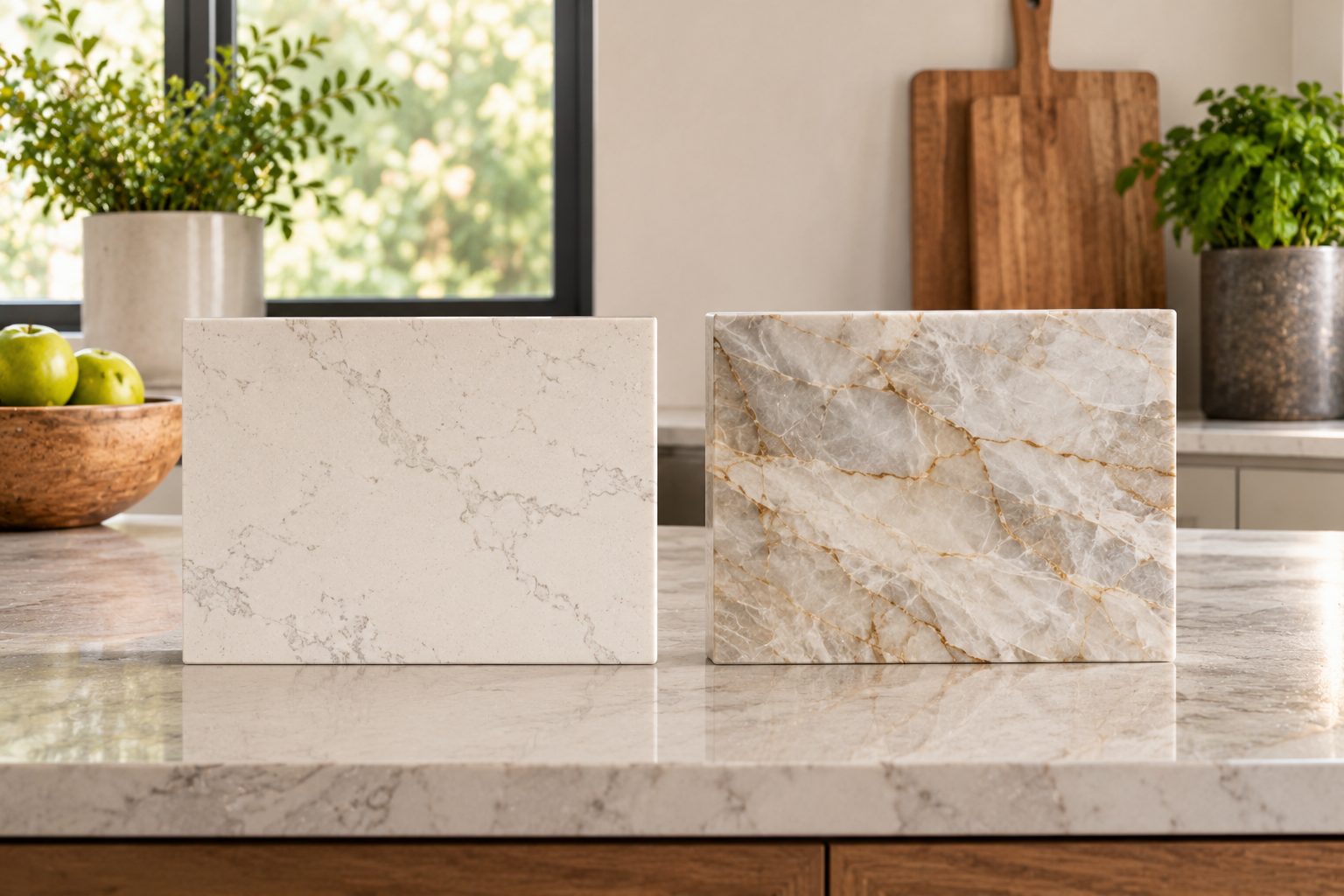
The difference between quartz and quartzite is manufacture: quartz is a man-made composite of ground mineral and polymer resin, while quartzite is a solid natural stone with no binder at all.
Engineered quartz is roughly 90–93 percent quartz aggregate mixed with 7–10 percent polyester or similar resin plus pigments, vibro-compressed under vacuum and cured into slabs. That recipe gives consistent color, a nonporous surface and the ability to imitate marble veining on demand. Quartzite starts life as quartz-rich sandstone; heat and pressure recrystallize the grains until they interlock, producing a dense rock with natural veins, crystal sparkle and color drift from slab to slab.
So is quartzite the same as quartz? No. They share a mineral, but one is a product and the other is geology, and that changes how each behaves on a kitchen counter.
Quartz vs quartzite countertops: how do they compare side by side?
Quartz vs quartzite countertops trade off like this: quartz wins on stain resistance and predictability, quartzite wins on heat, UV stability and natural depth, and granite undercuts both on price.
| Property | Engineered quartz | Quartzite | Granite |
|---|---|---|---|
| Material | 90–93% quartz + 7–10% resin | Natural metamorphic rock | Natural igneous rock |
| Mohs hardness | About 7 (resin is softer) | About 7 | 6–6.5 |
| Porosity | Nonporous | Low to moderate, varies by slab | Low to moderate, varies by slab |
| Sealing | Never | Every 1–2 years | Every 1–3 years |
| Heat | Resin can scorch above about 300°F (150°C) | Very heat tolerant | Very heat tolerant |
| Outdoor / UV | Not recommended, yellows | Yes | Yes |
| Etching from acids | No | True quartzite no; dolomite look-alikes yes | Rarely |
| Typical installed cost | $55–150 per sq ft | $70–200 per sq ft | $40–100 per sq ft |
| Slab size (typical) | Up to 130 × 65 in (330 × 165 cm) | Varies, often 110–125 × 65–75 in | Varies, often 110–120 × 65–72 in |
Price ranges are typical US 2026 installed figures for 3 cm (1 1/4 in) material with standard edges and one undermount sink cutout. Exotic quartzites with heavy blue, green or gold veining sit at the top of the range and beyond.
Is quartzite more expensive than quartz?
Yes, quartzite is usually more expensive than quartz, typically by 15–40 percent installed, because each slab is quarried, its fabrication is slower and offcuts are harder to reuse.
Quartzite is hard on saw blades and polishing pads, so shops charge more per cut and per edge. Entry-level white quartzites can overlap the price of premium designer quartz, so do not assume the gap is fixed. A 45 sq ft (4.2 m²) kitchen typically lands around $3,000–6,500 in quartz and $3,500–9,000 in quartzite, before backsplash and plumbing.
Is quartzite more expensive than granite?
Quartzite is more expensive than granite in most markets. On cost of quartzite versus granite, expect quartzite at $70–200 per sq ft against granite at $40–100, so is quartzite cheaper than granite? Only when you compare a common quartzite with a rare, exotic granite. Quartzite vs granite price differences narrow at the luxury end, where both are priced by the individual slab.
Quartzite vs granite: which is the better countertop?
For a white or soft-gray marble look with real durability, quartzite beats granite; for the lowest price per square foot in a hard-wearing natural stone, granite still wins.
The difference between granite and quartzite starts underground. Granite is an igneous rock of feldspar, quartz and mica, which gives it its speckled, granular look. Quartzite is almost pure quartz, so it reads cleaner and more veined, closer to marble. That is why quartzite vs granite kitchen countertops is mostly a style question: speckle or vein.
Is quartzite harder than granite?
Yes, quartzite is harder than granite: around 7 on the Mohs scale against 6–6.5, so it resists scratching from knives and grit slightly better. In practice both are hard enough that a knife will dull before either surface scratches. Granite vs quartz vs quartzite on hardness is close; the real differences are porosity, heat and look.
Is quartzite porous, and how do you care for each?
Quartzite is mildly porous and needs an impregnating sealer every one to two years, whereas quartz is nonporous and only needs warm water and pH-neutral soap.
Porosity varies by slab, so ask the yard for a water test: drip water on an unsealed offcut and time how long it takes to darken. Under five minutes means seal on installation and again annually; over 30 minutes means every two years is enough. Granite behaves the same way.
- Daily: wipe with warm water and a few drops of pH-neutral dish soap on a microfiber cloth, for all three stones.
- Spills: blot wine, oil and turmeric quickly on quartzite and granite; quartz can wait.
- Heat: always use a trivet on quartz; quartzite and granite tolerate a hot pan, though repeated thermal shock can still crack a thin section near a cutout.
- Sealing: on quartzite and granite, clean, dry for 24 hours, apply a penetrating sealer, wipe off the excess after 5–15 minutes and keep it dry for a day.
- Avoid: bleach, oven cleaner and abrasive powders on quartz resin; acidic cleaners on any stone you have not etch-tested.
Mistakes we see: soft quartzite and the wrong stone for the job
The most expensive mistake we see is buying marble or dolomite labeled as quartzite, then watching lemon juice etch dull rings into it within a month.
Trade names are not geology. Some popular white "quartzites" are partly dolomitic marble, which is softer and reacts to acid. Before you sign, take a sample and run two checks: drag the edge of a glass tile across it (true quartzite scratches the glass, marble does not) and leave a drop of lemon juice for 10 minutes (true quartzite stays unchanged). Do this on the actual slab offcut, not a showroom chip.
The second mistake is putting quartz where it does not belong: beside a range with no landing zone, on an outdoor kitchen, or in a sunroom with full afternoon sun, where the resin can yellow. And the third is ignoring fabrication safety. Quartz has a very high crystalline silica content, so insist on a shop that cuts wet with dust extraction; any reputable fabricator will.
What color cabinets go with Taj Mahal quartzite?
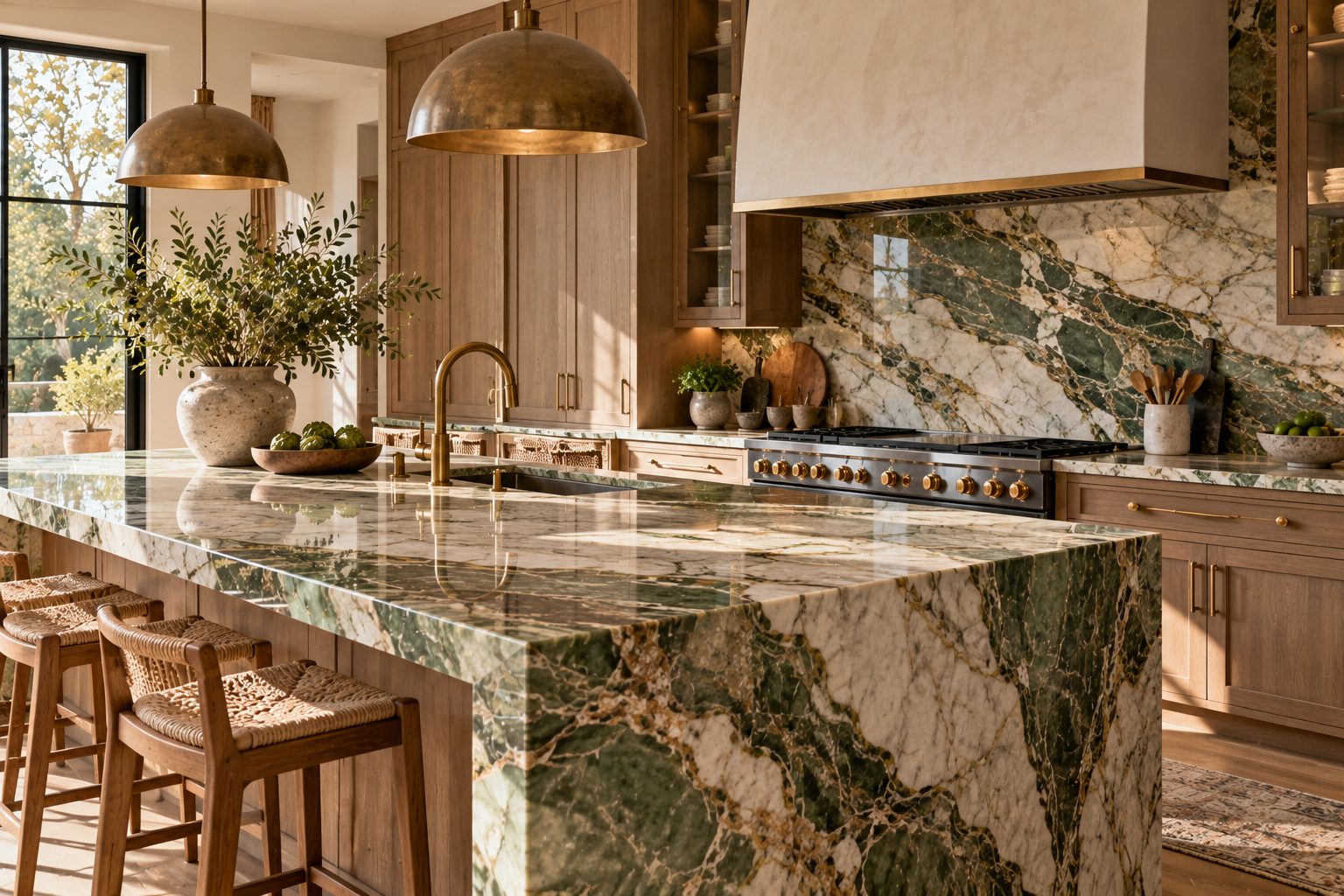
Warm whites, creamy greige, sage and olive greens, mid-tone white oak and deep navy all go with Taj Mahal quartzite, because its cream ground and soft gold veining sit on the warm side.
The same logic applies to any warm quartzite: avoid stark blue-whites and cool grays, which make the stone look dingy by comparison. Brushed brass or unlacquered hardware picks up the gold veins. Cool white quartzites pair better with crisp whites, charcoal and black-stained wood. See our kitchen cabinet colors 2027 guide for full cabinet palettes.
#EFE8DA#CFC4B0#9AA58B#B38A5E#2E3A4FOur verdict: quartz or quartzite?
Choose quartz for a busy family kitchen where nobody will seal anything; choose quartzite when you want real stone, cook hot and will reseal once a year.
Is quartzite better than quartz? Not universally. In rentals, kids' bathrooms and baking-heavy kitchens we specify quartz for its forgiving surface and repeatable color. For a statement island, an outdoor kitchen or a client who wants the slab to be one of a kind, we specify quartzite and budget the extra 15–40 percent. Is quartzite better than granite? For a veined, marble-like look, yes; for value, granite remains the honest workhorse. If the countertop is also your backsplash, read our kitchen countertop ideas and quartz countertops guides before you pick colors. The quartz vs quartzite choice is less about strength than about how much care you want to give a surface you will use every day.
Ready to price slabs? Send your countertop drawing and preferred finish to our stone sourcing desk for quartz, quartzite and granite quotes from vetted fabricators and quarries.
Free toolTile CalculatorWork out tiles, boxes, grout and adhesive with the right wastage.Shop & source the look
Buy it today — or have it made
Retail links are affiliate links: we may earn a commission at no extra cost to you (disclosure). “Get it made” sends the item to our sourcing desk for factory quotes in custom sizes and finishes.
Frequently asked questions
Is quartzite the same as quartz?
No, quartzite is not the same as quartz. Quartzite is a natural metamorphic rock quarried in blocks and cut into slabs, while quartz countertops are engineered from roughly 90 percent crushed quartz bound with resin. They share a mineral, but quartzite needs sealing and handles heat, while quartz never needs sealing and can scorch.
Is quartzite harder than granite?
Yes, quartzite is harder than granite. It rates about 7 on the Mohs scale against 6 to 6.5 for granite, so it resists scratches from grit and knives slightly better. Both are hard enough for daily kitchen use; the bigger practical differences are look, porosity and price, with quartzite usually costing more.
Is quartzite more expensive than quartz?
Quartzite is usually more expensive than quartz, typically 15 to 40 percent more installed. Typical US 2026 ranges are $70–200 per sq ft for quartzite and $55–150 for quartz. The hardness of quartzite slows fabrication and wears tooling, and every slab is unique, which pushes exotic colors well above the range.
Is quartzite porous?
Yes, quartzite is mildly porous, though the degree varies by slab. Seal it with a penetrating sealer at installation and every one to two years after. Test with water on an unsealed offcut: if it darkens within five minutes, seal annually; if it resists for 30 minutes or more, every two years is enough.
Is quartzite better than quartz?
Quartzite is better than quartz for heat, sunlight and natural veining, while quartz is better for stain resistance and zero maintenance. Choose quartzite for statement islands, outdoor kitchens and cooks who set hot pans down. Choose quartz for busy family kitchens, rentals and anyone who will not reseal a countertop.
Some links may be affiliate links. Regulations and specifications change — always confirm with suppliers and qualified professionals.