Lime Plaster: Mix Ratios, Interior Walls, Cost and How to Apply
Lime plaster is a breathable wall finish of lime and sand that hardens back into limestone. Mix it about 1 part lime to 3 parts sand for base coats, cure it slowly and expect $8–25 per sq ft installed.
Part of our guide: Plaster Walls: Types, Decorative Finishes & Cost per Sq Ft
Key takeaways
- Lime plaster is lime and sand that cures by absorbing carbon dioxide, slowly turning back into calcium carbonate, the mineral in limestone
- Use about 1 part lime to 2.5–3 parts sharp sand for base coats and 1:1 to 1:2 with fine sand or marble dust for the finish coat
- Over drywall, apply a sanded bonding primer first and build a 1/16–1/8 in (2–3 mm) finish; over masonry, go three coats
- Typical installed cost in the US in 2026 runs $8–25 per sq ft, with polished finishes at the top of that band
Lime plaster is a wall finish made of slaked lime and sand (or marble dust) that hardens by absorbing carbon dioxide from the air, slowly turning back into limestone. It stays vapor-open, resists mold thanks to its high alkalinity and gives a soft, cloudy matte surface. Expect about $8–25 per sq ft installed and a few weeks of careful curing.
Lime is the oldest of the finishes in our plaster walls guide and, in 2027, the one most designers reach for when they want walls that look handmade without the shine of polished Venetian work. Below: what the material is, which lime to buy, a working lime plaster mix, how to apply it over drywall and masonry, and what it costs.
- What it is: calcium hydroxide binder plus aggregate, troweled on in one to three coats.
- How it sets: by carbonation, not by drying; full hardness takes weeks to months.
- Thickness: 1/16–1/8 in (2–3 mm) as a finish over board; 5/8–7/8 in (16–22 mm) as a full three-coat system.
- pH: about 12 when fresh, which is why it discourages mold and why you wear gloves and goggles.
- Typical cost: $8–25 per sq ft installed in the US in 2026.
What is lime plaster made of?
Lime plaster is made of lime, aggregate and water, sometimes with fibers or a small amount of pozzolan; there is no cement and, in the traditional form, no gypsum. The lime starts as limestone burned in a kiln to quicklime, which is then slaked with water to become calcium hydroxide. Once the plaster is on the wall, that calcium hydroxide reacts with carbon dioxide and reverts to calcium carbonate. That cycle is why sellers market "limestone plaster" and "limestone plaster walls": the cured surface is chemically close to the stone it came from.
Aggregate decides the texture. Sharp, well-graded sand gives the body of a lime sand plaster base coat; fine silica sand or marble dust gives the smooth, chalky finish people photograph. Natural fibers such as hemp or animal hair were added to base coats for crack resistance, and modern bagged lime based plaster often includes synthetic fibers for the same reason.
Which lime should you use: hydrated lime, putty or hydraulic?
Use lime putty or a bagged lime finish plaster for fine interior finish coats, natural hydraulic lime for damp walls and base coats, and Type S hydrated lime mainly for mortar and stucco base coats. All three are sold as "lime," and the wrong choice is the usual reason a first attempt cracks or stays soft.
| Lime type | Sets by | Best use | Working notes | Typical price (US 2026) |
|---|---|---|---|---|
| Lime putty (aged slaked lime) | Carbonation only | Finish coats, fine interior work, restoration | Most workable; aged 3+ months; slow to harden | $40–90 per 5-gal tub |
| Type S hydrated lime (dry powder) | Carbonation; usually gauged with cement or gypsum | Mortar, stucco base coats, masonry lime work | Soak overnight before use; less plastic than putty | $15–30 per 50 lb (23 kg) bag |
| Type N hydrated lime | Carbonation | Garden, masonry blends | Not pressure-hydrated; less consistent for plaster | $12–25 per 50 lb bag |
| Natural hydraulic lime (NHL 2, 3.5, 5) | Water and carbonation | Base coats, damp masonry, exterior lime stucco | Sets in days; higher number = harder, less breathable | $35–70 per 55 lb (25 kg) bag |
| Premixed lime finish plaster | Carbonation | DIY and decorative interior finishes | Ready to trowel; tinted options; consistent | $60–150 per bucket covering 60–120 sq ft |
Prices are typical US 2026 ranges and vary by region and bag size. Type S hydrated lime, often stocked as builders lime, construction lime or masonry lime, is pressure-hydrated to ASTM C207, which makes it consistent and reliable as hydrated lime for mortar. It can be used straight for plaster if you soak it into a putty for at least 24 hours, but it never becomes as creamy as true aged putty.
What is the right lime plaster mix ratio?
The standard lime plaster mix is 1 part lime putty to 2.5–3 parts sharp sand by volume for base coats and 1 part lime to 1–2 parts fine sand or marble dust for the finish. Measure by volume with the same bucket every time; batch-to-batch consistency matters more than the exact ratio.
- Scratch coat: 1:3 lime to coarse sharp sand, plus a handful of fiber per bucket, 3/8 in (10 mm) thick.
- Brown (float) coat: 1:2.5–3, slightly finer sand, 3/8 in (10 mm), floated flat.
- Finish coat: 1:1 to 1:2 with fine sand or marble dust, 1/16–1/8 in (2–3 mm), troweled tight.
- Hydraulic version: NHL 3.5 at 1:2.5 with sharp sand for walls that see moisture.
How to make lime plaster
To make lime plaster, slake or soak the lime into a putty, beat in washed sand at the ratio above, then let the mix rest and re-knock it before use. This is the process we follow for a small batch:
- Protect yourself. Wear goggles, nitrile gloves and long sleeves; wet lime burns skin and eyes. Keep clean water nearby to rinse.
- Make the putty. If using hydrated lime, add it to water, not water to lime, until it is like thick yogurt. Cover and leave at least 24 hours; a week is better.
- Add the sand. Measure 1 part putty to 2.5–3 parts damp sand for base coats. Mix in a paddle mixer or mortar mixer for 10–15 minutes; lime gets more workable the longer it is beaten.
- Rest and re-knock. Leave the mix covered for an hour or overnight, then re-mix without adding much water. Stiff is better than sloppy.
- Test a board. Trowel a 2 × 2 ft (60 × 60 cm) sample and let it cure for a week. Fine crazing means too much water or too little sand.
How do you apply lime plaster for interior walls?
Lime plaster for interior walls goes on in thin coats over a damp, keyed or primed surface, each coat applied when the last is firm but not dry. Rushing coats or letting a coat dry out is what causes delamination.
Over masonry and old lime plaster
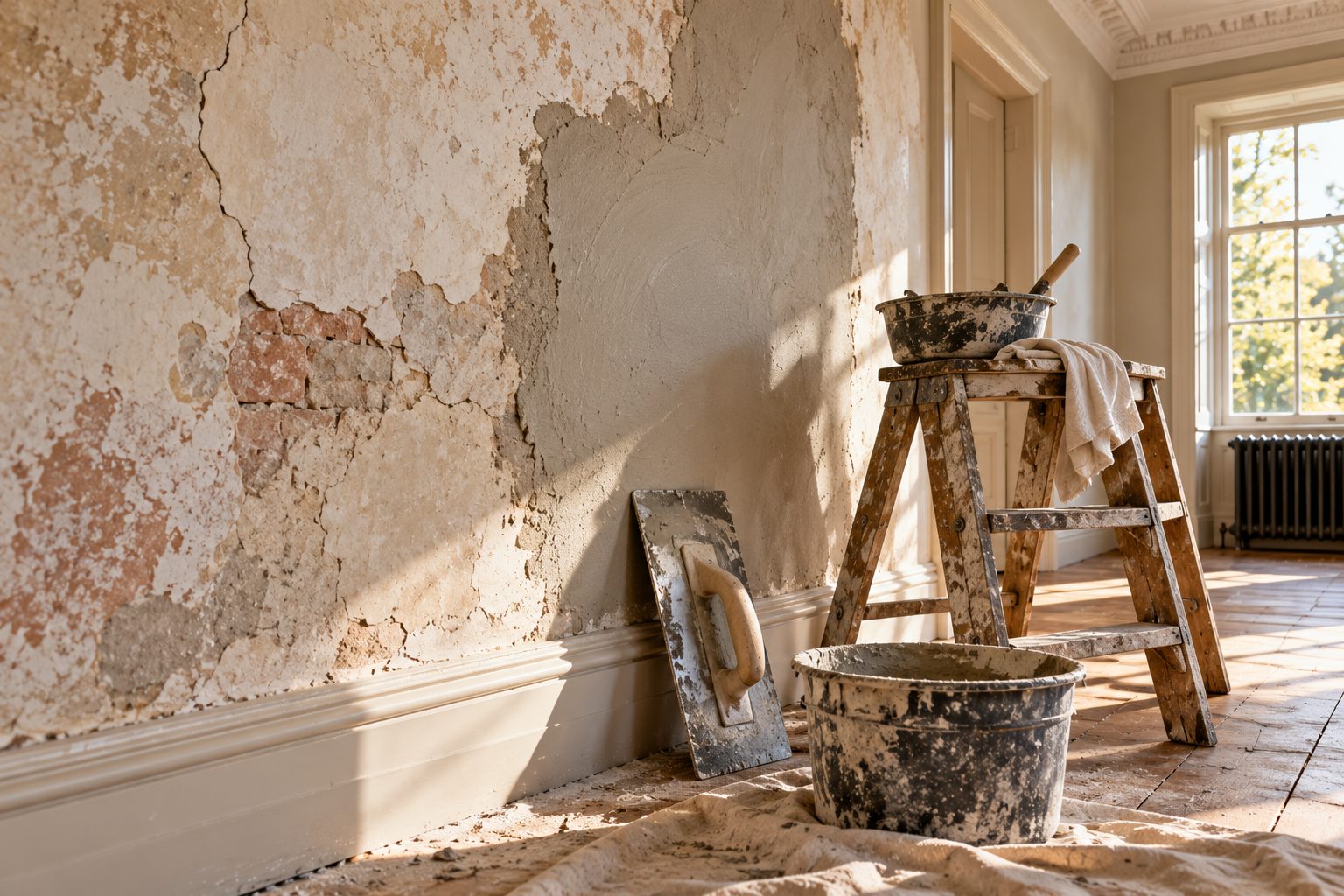
Brush down loose material, wet the wall until it stops darkening, then apply the scratch coat and score it with a comb. After 2–5 days, depending on temperature, apply the brown coat and float it flat. The finish coat follows once the brown coat is firm, often within a week. Mist each coat morning and evening for three to seven days.
Over drywall and lime plasterboard
Drywall gives lime nothing to grip and absorbs water too fast. Seal joints and screws, then roll a sanded mineral or acrylic bonding primer. Two finish coats at about 1/16 in (1.5 mm) each are enough. Boards marketed as lime plasterboard or mineral board are a better substrate for wet rooms, but they still need the manufacturer's primer. If your current walls are heavily textured, flatten them first; our guide to smoothing textured walls explains how.
Curing rules
Work between 41 and 86°F (5–30°C), keep sun, drafts and heaters off fresh work and never let lime freeze within the first week. Lime needs humidity and air at the same time, which is why we mist rather than seal. Full carbonation of a thick coat can take months, so wait four to six weeks before applying limewash, mineral paint or wax.
Lime stucco vs interior lime plaster
Lime stucco is the exterior version: the same chemistry in a thicker, tougher three-coat system, usually built with natural hydraulic lime or gauged hydrated lime. A natural lime stucco runs 3/4–7/8 in (19–22 mm) total over lath or masonry, compared with 1/16–1/8 in (2–3 mm) for an interior finish over board. It lets old brick and stone dry outward, which cement stucco does not, and that is why preservation contractors insist on it for pre-1930s masonry. Exterior lime plastering needs mild, frost-free weather for at least two weeks after application.
What colors and finishes does lime plaster come in?
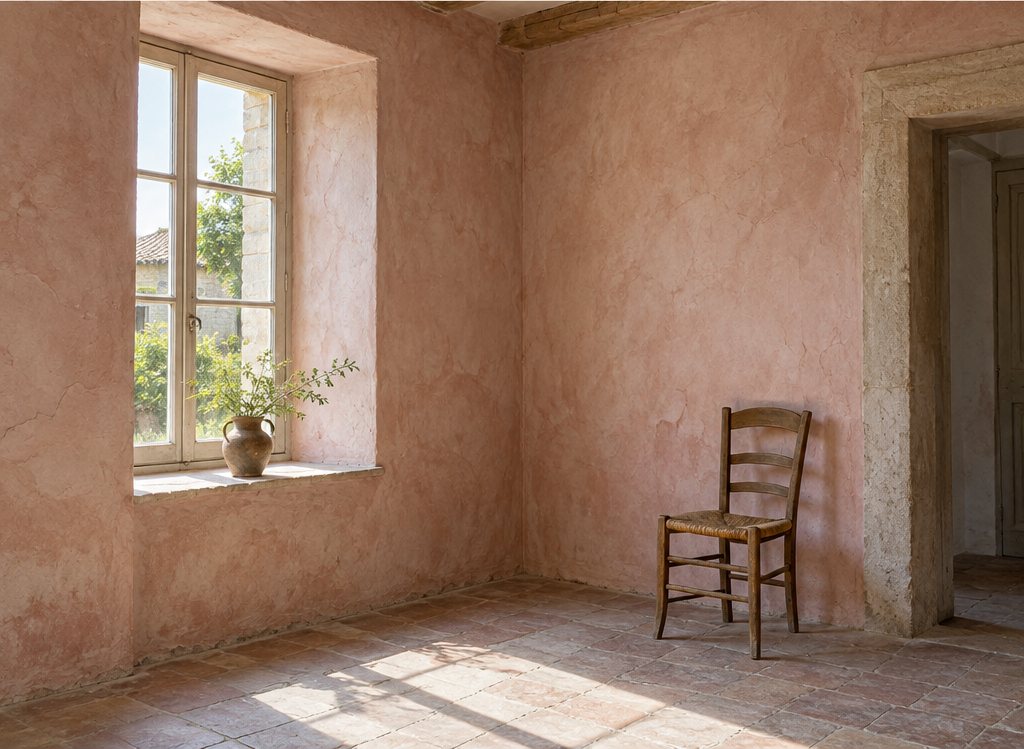
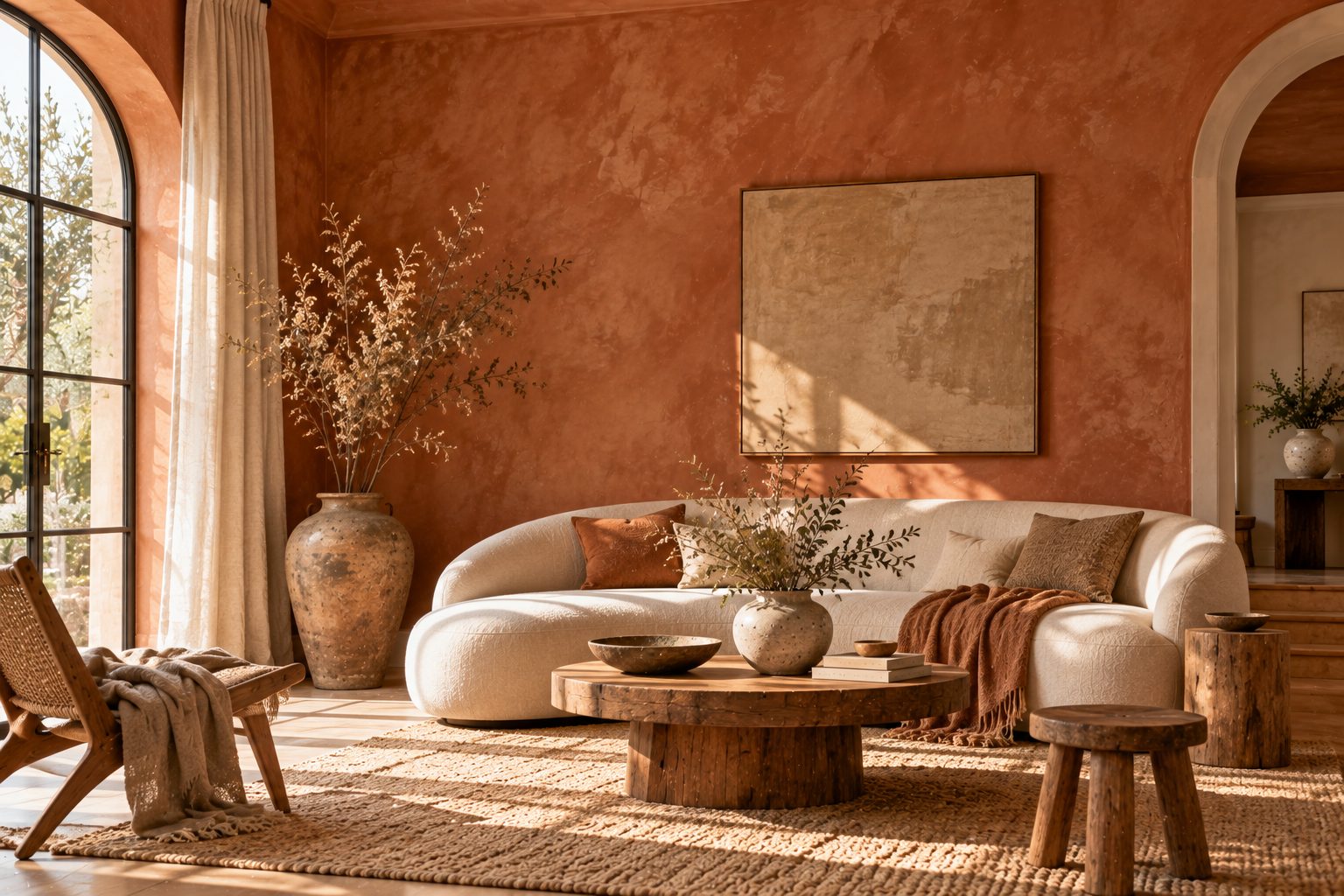
Lime plaster comes in its natural warm white or is tinted with lime-safe mineral oxide pigments, typically at up to 5–10 percent of the lime by weight. Earth pigments work best; bright synthetic organic colors fade in lime's alkalinity. The finish ranges from sanded and matte to burnished, where the trowel compresses the surface into a soft sheen.
#EFE9DF#DCCDB6#C9A98A#A88A73#8C8A7AHex values are screen approximations. Lime dries several shades lighter than it looks wet, so always judge a sample board after a week. Lime finishes also suit color-drenched rooms; see our limewash paint guide if you want the look for less, or tadelakt for the waterproof, polished cousin used in showers.
How much do lime plaster walls cost?
Lime plaster walls typically cost $8–25 per sq ft installed in the US in 2026, with a one-coat finish over primed drywall at the low end and three-coat or polished work at the top. DIY materials run about $1–3 per sq ft for a finish coat.
| System | Total thickness | Typical installed cost | Time on site |
|---|---|---|---|
| Two-coat finish over primed drywall | 1/16–1/8 in (2–3 mm) | $8–14 per sq ft | 2–4 days per room |
| Burnished or polished lime finish | 1/16–1/8 in (2–3 mm) | $12–25 per sq ft | 3–6 days per room |
| Three-coat over masonry or lath | 5/8–7/8 in (16–22 mm) | $14–25 per sq ft | 2–3 weeks including cure |
| Exterior lime stucco | 3/4–7/8 in (19–22 mm) | $10–20 per sq ft | 2–4 weeks including cure |
Mistakes we see with lime plaster
The mistake we see most often is treating lime like gypsum: mixing it wet, applying it thick in one pass and blasting it dry with a heater, which guarantees cracks. A close second is sealing fresh lime with acrylic paint, which traps moisture and defeats the point of a breathable plaster wall coating. We also see people use cement-based patching on old lime walls; it is harder than the surrounding plaster and pushes failure to the edges. Our view is simple: on old masonry use lime everywhere, on new drywall use a premixed lime finish and a proper primer, and budget a week of patience for each room.
Want lime walls specified and sourced properly? Send us your wall areas and substrate through our decor and finishes sourcing desk, and use the paint calculator to get your square footage first.
Free toolPaint CalculatorWork out exactly how much paint to buy.Shop & source the look
Buy it today — or have it made
Retail links are affiliate links: we may earn a commission at no extra cost to you (disclosure). “Get it made” sends the item to our sourcing desk for factory quotes in custom sizes and finishes.
Frequently asked questions
How do you make lime plaster?
Make lime plaster by soaking lime into a putty, then mixing 1 part putty with 2.5–3 parts sharp sand for base coats, or 1–2 parts fine sand or marble dust for a finish. Beat it for 10–15 minutes, let it rest, re-mix without much extra water and test a sample board before plastering a wall.
Is Type S hydrated lime good for plaster?
Type S hydrated lime can be used for plaster, but it works best for mortar and stucco base coats. Soak it into a putty for at least 24 hours before adding sand. For fine interior finish coats, aged lime putty or a premixed lime finish plaster is creamier, easier to trowel and less likely to craze.
Can you put lime plaster over drywall?
Yes, lime plaster can go over drywall if you first seal the joints and roll on a sanded bonding primer. The primer gives the lime grip and stops the board absorbing water too fast. Apply two thin finish coats of about 1/16 in (1.5 mm) each and mist them lightly while they cure.
How long does lime plaster take to cure?
Lime plaster is firm in one to three days but takes weeks to months to fully carbonate. Mist each coat for three to seven days, keep it between 41 and 86°F (5–30°C), and wait four to six weeks before applying limewash, mineral paint or wax over a thick coat.
Is lime plaster better than gypsum plaster?
Lime plaster is better for old masonry and for anyone who wants a breathable, mold-resistant, handmade-looking wall. Gypsum plaster is better for speed, because it sets in about an hour and can be painted within days. On new drywall in a dry room, either works; on historic brick or stone, choose lime.
Some links may be affiliate links. Regulations and specifications change — always confirm with suppliers and qualified professionals.