Tadelakt: Moroccan Waterproof Plaster for Showers and Bathrooms
Tadelakt is a Moroccan lime plaster compressed with a stone and sealed with olive-oil soap, making it water-repellent enough for showers. It costs about $40–120 per sq ft installed and needs a skilled applicator.
Part of our guide: Venetian Plaster Walls: Finishes, Cost per Sq Ft & Application
Key takeaways
- Tadelakt is a lime plaster from Morocco, polished with a hard stone and black olive soap until it repels water
- It works on shower walls, tub surrounds and sinks when applied 3–8 mm thick over a proper waterproofed substrate
- Expect $40–120 per sq ft ($430–1,300 per m²) installed in the US, two to four times the cost of tile
- It needs a skilled applicator, gentle pH-neutral cleaning and a soap or wax re-treatment every 6–12 months in wet zones
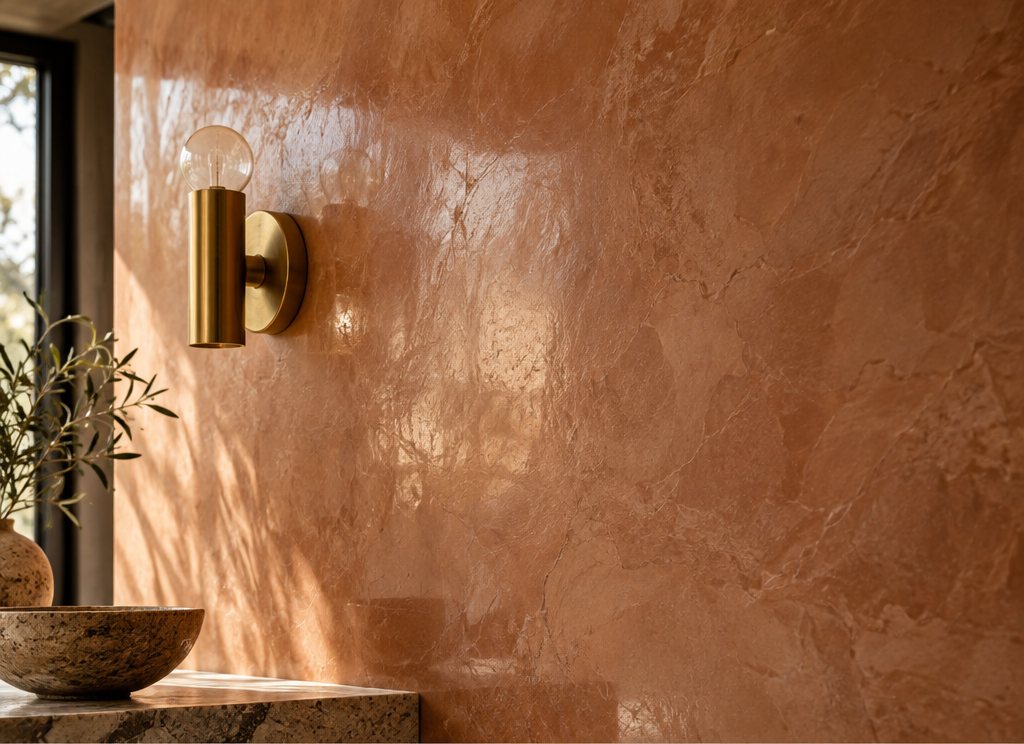
Tadelakt is a traditional Moroccan lime plaster that is troweled on, compressed with a polishing stone and sealed with black olive-oil soap until it becomes smooth, slightly glossy and water-repellent. It can line showers, tubs and sinks without tile, and typically costs $40–120 per sq ft ($430–1,300 per m²) installed in the US.
- What it is: lime plaster, usually 3–8 mm (1/8–5/16 in) thick, from the Marrakech region.
- How it repels water: stone compression closes the pores; soap reacts with lime to form insoluble calcium soap.
- Where it works: shower walls, tub surrounds, vanity tops, basins, hammams, feature walls.
- Weak points: floors, sharp impacts, acidic cleaners and standing water.
- Lifespan: decades with care; re-soap or wax wet areas every 6–12 months.
Tadelakt belongs to the same family as the polished finishes in our venetian plaster guide, but Venetian plaster is built for dry walls, while tadelakt is the lime finish made for water. That difference drives everything about how it is applied and maintained.
Is tadelakt waterproof?
Tadelakt is water-resistant and water-repellent rather than fully waterproof, so in a shower it must sit on a waterproofed substrate and be maintained with soap or wax to keep shedding water.
Polished tadelakt makes water bead and run off, but lime is still a porous mineral. Over time, constant spray, soap scum and hard water wear the protective layer. The plaster itself is also breathable, which is part of its appeal: it buffers humidity and resists mold better than painted drywall. Treat tadelakt waterproof plaster as the finish layer and a cement board plus membrane behind it as the actual waterproofing, just as you would behind grouted tile.
Waterproof plaster for bathroom walls outside the shower
Outside the spray zone, the demands drop sharply. Walls around a vanity, behind a freestanding tub or in a powder room see splashes and steam rather than running water, so tadelakt there needs less frequent re-soaping, often once a year. Some homeowners choose a cheaper sealed lime plaster or a marmorino for these dry-ish walls and reserve true tadelakt for the shower itself; the two can be tinted to match closely. If you are comparing waterproof plaster for bathroom walls, ask what the product does under direct spray, not just in humid air: many lime finishes marketed as moisture-resistant are fine for steam but not for a shower. Our plaster walls guide compares the main lime and gypsum options for dry rooms.
Can you use tadelakt in a shower?
Yes, a tadelakt shower is the traditional use of the material, and tadelakt shower walls perform well for decades when the substrate is waterproofed, the floor is tiled or stone and the walls are re-soaped regularly.
A plaster shower appeals because it is seamless: no grout lines, curved corners and a soft, stony surface. Plaster shower walls in tadelakt suit walk-in showers and wet rooms with good ventilation. For more layouts, see our sibling article on walk-in shower ideas. We recommend keeping the shower floor in stone, microcement or tile, because tadelakt underfoot wears and can be slippery.
| Wet-area finish | Water resistance | Seams | Maintenance | Installed cost (US 2026, typical) |
|---|---|---|---|---|
| Tadelakt | High when polished and soaped | Seamless | Re-soap or wax every 6–12 months | $40–120 per sq ft |
| Microcement | High with polyurethane sealer | Seamless | Reseal every 3–5 years | $20–45 per sq ft |
| Porcelain tile | Very high, under 0.5% absorption | Grout lines | Clean and reseal grout | $15–35 per sq ft |
| Zellige tile | High; grout is the weak point | Wide grout lines | Seal tile and grout | $35–70 per sq ft |
| Lime plaster with sealer | Low to moderate | Seamless | Not for direct spray | $12–25 per sq ft |
Costs are typical US installed ranges for small bathrooms and vary widely by region and applicator. Our microcement cost and zellige tile guides cover the main alternatives.
How much does tadelakt plaster cost?
Tadelakt plaster costs about $40–120 per sq ft installed in the US, with material alone around $4–10 per sq ft; the rest is skilled labor, which takes two to four days for a typical shower.
A 60 sq ft (5.6 m²) shower enclosure therefore runs roughly $2,400–7,200, plus substrate and waterproofing. Price rises for curved niches, integrated benches, basins and ceilings, and in cities with few trained applicators. Ready-mixed tadelakt bags are sold online, but the material is the cheap part: buying tadelakt products saves little if the application fails. Ask any applicator for photos of showers they finished more than three years ago, not just fresh work.
How is tadelakt applied?
Tadelakt is applied in two thin coats over a rough, absorbent base, then compressed with a trowel and polishing stones as it cures and finally rubbed with black soap, all in one continuous session per wall.
- Prepare the substrate. Cement board or a lime-cement render, waterproofed behind, with a rough key and corners rounded where wanted.
- Dampen the base. Lightly mist so the base does not pull water too fast from the plaster.
- Apply the first coat. About 2–4 mm (1/16–1/8 in), troweled firm.
- Apply the second coat. Another 2–4 mm while the first is still green, for a total of 3–8 mm.
- Compress with a trowel. As the plaster firms, tighten the surface to close pores.
- Polish with stones. Work small circles with a hard, smooth stone for hours until the surface turns dense and slightly glossy.
- Apply black soap. Brush on diluted olive-oil soap and polish again with the stone; the soap reacts with the lime.
- Cure and wax. Leave 2–4 weeks before heavy use, then apply a natural wax to wet zones.
Each wall must be finished in one go, so large showers often need two applicators working together. This is why it is not a beginner DIY project.
What does a Moroccan tadelakt bathroom look like?
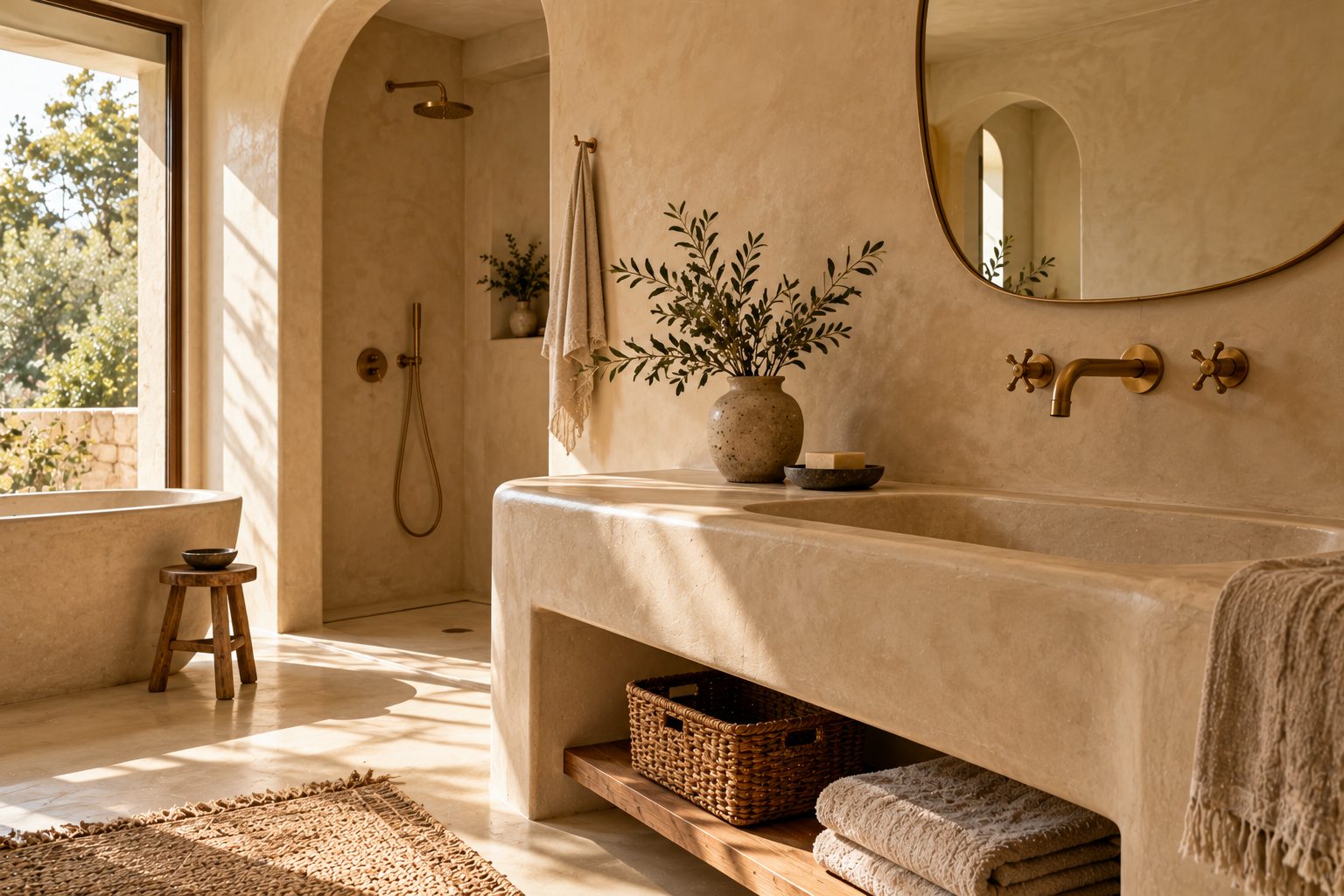
A Moroccan tadelakt bathroom has softly rounded edges, seamless walls in earth tones and a satin sheen that changes with light, often paired with brass fittings, zellige accents and carved niches.
Traditional tadelakt is pigmented with natural oxides: terracotta, ochre, warm white and deep indigo. In 2027 interiors the Moroccan plaster bathroom is being reinterpreted in pale clay and warm stone tones, pairing well with oak vanities and unlacquered brass. See our bathroom trends 2027 report for the wider direction.
#E8DCCB#D3B595#B9785A#8D7A62#2F3E54Swatches are approximate; lime finishes vary with pigment dose, polishing and age, so ask for a sample board in your light.
How do you clean and maintain tadelakt?
Clean tadelakt with warm water and diluted black soap or a pH-neutral cleaner, dry it after showers and re-treat wet areas with soap or wax every 6–12 months.
- Daily: squeegee or towel off after showering to stop limescale.
- Weekly: wipe with diluted black soap on a soft cloth.
- Never: vinegar, citric acid, bleach, limescale removers or abrasive pads; acids dissolve lime.
- Twice a year: apply a thin coat of soap or natural wax to areas that take direct spray.
- Repairs: hairline cracks are normal; chips can be patched and repolished, though color may vary slightly.
The same no-acid rule applies to marble, limestone, travertine and every other calcium-based surface in the bathroom.
Mistakes we see with tadelakt bathrooms
The mistakes we see most are tadelakt on shower floors, no waterproofing behind the plaster, acidic cleaners that etch the surface within weeks and applicators with dry-wall experience only.
Tadelakt over plain drywall or gypsum plaster fails because the base softens with moisture. Poor ventilation leaves soap scum and mold on any surface, and tadelakt is no exception; specify an extract fan of at least 50–80 CFM. Expect slight color variation, hairline crazing and patina: that is the material, not a defect. If you want a uniform, perfectly flat finish, tile or microcement will satisfy you more.
Our verdict: is tadelakt worth it?
Tadelakt is worth it if you want a seamless, handmade shower or bathroom with a soft patina and you accept ongoing care. We would use it on shower walls, a tub surround and perhaps a built-in basin, with a stone or tile floor and good ventilation, and we would only hire an applicator with photographed wet-area work several years old. For a family bathroom where nobody will re-soap the walls, or a rental, we would choose porcelain or microcement instead. In a guest bath or a primary suite that is cared for, few finishes feel better to touch.
Planning a tadelakt, lime plaster or natural stone bathroom? Send your wall areas and samples to our stone sourcing desk for supplier and applicator quotes, typical lead times and material specs.
Free toolTile CalculatorWork out tiles, boxes, grout and adhesive with the right wastage.Shop & source the look
Buy it today — or have it made
Retail links are affiliate links: we may earn a commission at no extra cost to you (disclosure). “Get it made” sends the item to our sourcing desk for factory quotes in custom sizes and finishes.
Frequently asked questions
What is tadelakt?
Tadelakt is a traditional Moroccan lime plaster that is troweled on, compressed with smooth stones and sealed with black olive-oil soap. The soap reacts with the lime to form a water-repellent surface, so tadelakt can be used in showers, hammams, tubs and sinks. It is seamless, breathable and naturally pigmented with earth oxides.
Is tadelakt good for showers?
Yes, tadelakt is good for shower walls when applied by a skilled plasterer over a waterproofed cement board or render. It repels water and resists mold, but it is not fully waterproof on its own. Keep floors in tile or stone, dry the walls after use and re-treat with soap or wax every 6–12 months.
How much does tadelakt cost?
Tadelakt typically costs $40–120 per sq ft ($430–1,300 per m²) installed in the US in 2026. Material is only about $4–10 per sq ft; most of the price is skilled labor, which takes two to four days for a typical shower. Curved niches, benches, ceilings and basins increase the cost.
Can you DIY tadelakt?
You can DIY tadelakt on a small dry surface such as a niche or a lamp base, but a shower is not a good first project. Each wall must be applied and stone-polished in one continuous session at the right moisture stage, and mistakes cause cracks or leaks. Practice on boards first or hire a specialist.
How do you clean tadelakt?
Clean tadelakt with warm water and diluted black olive-oil soap or a pH-neutral cleaner on a soft cloth. Squeegee after each shower to prevent limescale. Never use vinegar, citric acid, bleach or limescale removers, because acids dissolve lime. Re-apply soap or natural wax to wet zones every 6–12 months.
Some links may be affiliate links. Regulations and specifications change — always confirm with suppliers and qualified professionals.