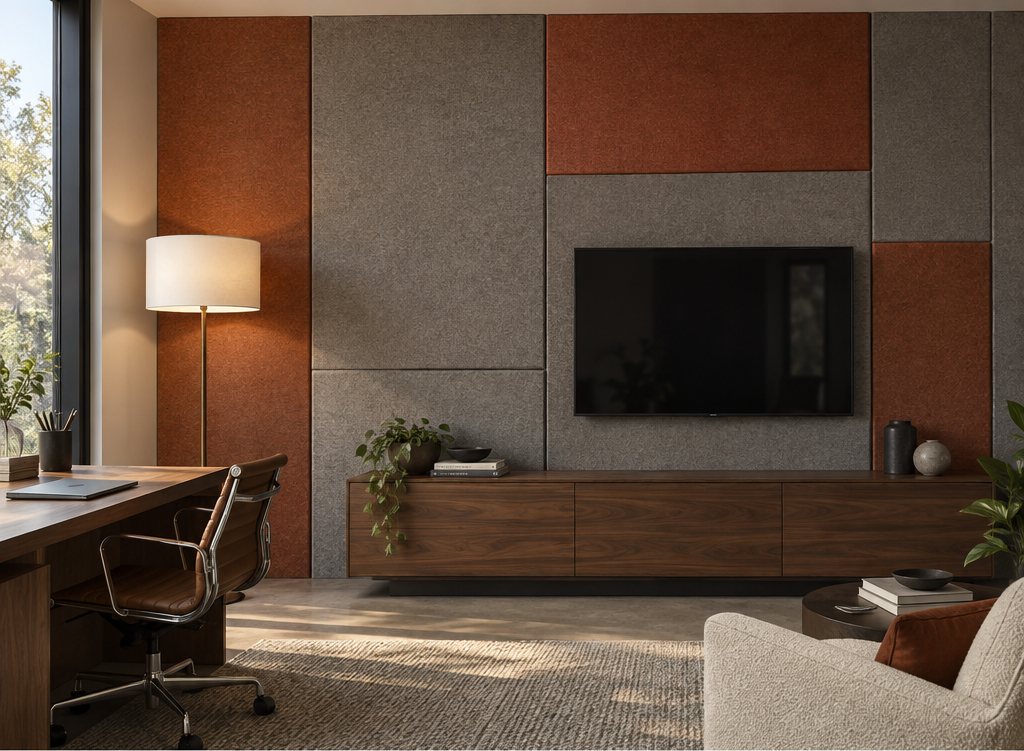
How to Soundproof a Room: Walls, Doors, Windows and DIY Panels
To soundproof a room, seal air gaps, add mass and decouple the wall, which can lift a typical stud wall from about STC 33 to STC 50 or more. Here is what each material does, what it costs and how to build DIY acoustic panels.
Part of our guide: Acoustic Panels for Home: Decorative Sound Dampening That Looks Good
Key takeaways
- Soundproofing blocks sound (mass, airtightness, decoupling); acoustic treatment absorbs echo inside the room. Most rooms need both
- Seal gaps first: a 1 percent air gap can let through close to half the sound energy a wall would otherwise stop
- A standard stud wall rates about STC 33–35; insulation, a second damped drywall layer and resilient clips can reach STC 50–60
- Acoustic foam and DIY panels cut echo and reverb, not neighbor noise: use 2–4 in (5–10 cm) mineral wool panels at NRC 0.8–1.0
To soundproof a room, seal every air gap first, then add mass and decouple the wall so vibration cannot pass straight through. Those three steps can take a typical stud wall from about STC 33 to STC 50 or more. Acoustic foam and panels do something different: they absorb echo inside the room but barely stop noise from the neighbors.
Learning how to soundproof a room starts with one distinction. Soundproofing a room is a mix of construction and furnishing. Construction stops sound getting in or out; furnishing tames how sound behaves once inside. If your problem is echo on calls or a boomy living room, start with our acoustic panels guide. If it is a neighbor's TV, traffic or footsteps, this is how to soundproof a room properly.
- STC (Sound Transmission Class): how well a wall, door or window blocks airborne sound; higher is better.
- NRC (Noise Reduction Coefficient): how much sound a surface absorbs, from 0 (reflects all) to 1 (absorbs nearly all).
- Typical stud wall: STC 33–35; loud speech is clearly audible.
- Target for a bedroom or office: STC 45–50; loud speech becomes faint or inaudible.
Soundproofing vs sound absorption: what is the difference?
Soundproofing blocks sound traveling between rooms using mass, airtightness and decoupling; sound absorption reduces echo within a room using soft, porous materials.
This is the most common confusion in soundproofing material shopping. Acoustic foam panels, audio foam and fabric panels are absorbers. They make a room sound less hollow and help video calls, music and home theaters, but a wall covered in foam still lets most neighbor noise through, because foam is light and porous. Noise proof material that genuinely blocks sound is heavy and airtight: drywall, mass-loaded vinyl, solid-core doors, laminated glass. If you want to know how to reduce sound in a room that is merely loud and echoey, absorb. If you want to stop sound passing through the wall, block.
| Material | What it does | Key rating | Typical 2026 US cost |
|---|---|---|---|
| Acoustical sealant and gaskets | Seals air gaps | Can recover 5–10+ STC lost to gaps | $10–30 per room |
| Mineral wool or fiberglass batts | Fills stud cavity, damps resonance | Adds about 3–6 STC | $0.80–2 per sq ft |
| Extra 5/8 in (16 mm) drywall layer | Adds mass | Adds about 3–5 STC | $2–4 per sq ft installed |
| Damping compound between drywall layers | Converts vibration to heat | Adds about 5–10 STC with second layer | $1–2 per sq ft |
| Sound-resistant sheetrock (laminated, damped) | Mass plus damping in one board | STC 50+ in rated assemblies | $40–90 per 4 × 8 sheet |
| Resilient clips and hat channel | Decouples drywall from studs | Reaches STC 50–60 in assemblies | $3–6 per sq ft |
| Mass-loaded vinyl, 1 lb/sq ft (4.9 kg/m²) | Adds limp mass | About STC 25–27 alone | $1.50–3 per sq ft |
| Acoustic foam, 2 in (5 cm) | Absorbs mid and high frequencies | NRC 0.5–0.8 | $1–4 per sq ft |
| Mineral wool panel, 2–4 in (5–10 cm) | Absorbs broadband sound | NRC 0.8–1.0+ | $2–6 per sq ft DIY |
STC gains are approximate and depend on the full assembly, the frequency of the noise and the quality of installation; manufacturers test complete wall builds, not single products in isolation.
How to soundproof a room in order: the five principles
Soundproof a room in this order: seal air gaps, add mass, add damping, decouple surfaces and fill cavities with absorption. Skipping the first step wastes the rest.
- Seal. Sound behaves like water: if air gets through, sound does. Caulk perimeter gaps at floors and ceilings with non-hardening acoustical sealant, add putty pads behind outlets and seal pipe and duct penetrations.
- Add mass. Heavier walls vibrate less. A second layer of 5/8 in (16 mm) drywall is the cheapest mass upgrade.
- Damp. A viscoelastic damping compound between two drywall layers turns vibration into heat, especially in the speech range.
- Decouple. Resilient clips with hat channel, staggered studs or a double stud wall break the direct path for vibration through the framing.
- Absorb inside the cavity. Acoustic insulation such as mineral wool stops the air inside the wall resonating like a drum.
Then treat the room itself: rugs, curtains, upholstered furniture and a few panels reduce reflected sound so remaining noise feels less intrusive.
Sound insulation for walls: how to build a sound resistant wall
The most effective sound insulation for walls combines mineral wool in the cavity with two layers of drywall and a damping compound, ideally on resilient clips; that assembly typically reaches STC 50–55.
If you are opening a wall anyway, this is the upgrade we specify most. Mineral wool is denser than standard fiberglass, roughly 2.5 lb/ft³ (40 kg/m³) for acoustic batts, and it is non-combustible. Sound insulation on its own adds only a few STC points, so insulation sound dampening works best as part of the assembly, never as the whole answer. Leave a 1/4 in (6 mm) gap at the edges of each drywall layer and fill it with acoustical sealant rather than tight-butting to the floor and ceiling.
Soundproof drywall and sound resistant sheetrock
Soundproof drywall, also sold as sound resistant sheetrock, is a laminated gypsum board with a damping layer built in. One layer can perform close to two layers of standard drywall with damping compound, which saves wall thickness, about 5/8 in (16 mm) instead of 1.25 in (32 mm). It costs several times more per sheet than regular drywall, so it makes most sense where depth is tight, such as a narrow hallway or a closet wall shared with a bedroom.
Wall sound reduction without demolition
For wall sound reduction without opening the wall, screw a second layer of 5/8 in drywall over the existing one with damping compound between them, then re-tape and paint. Expect to lose about 3/4 in (19 mm) of room depth and to extend outlet boxes. A tall, heavy bookcase full of books against the shared wall helps a little too, mostly by adding mass and breaking reflections.
How to soundproof doors and windows
Doors and windows are usually the weakest part of a room, so an STC 50 wall with a hollow-core door performs closer to the door's STC 20 than to the wall's rating.
| Element | Typical STC | Upgrade | Typical STC after | Typical 2026 US cost |
|---|---|---|---|---|
| Hollow-core interior door | About 20 | Solid-core door, 1.75 in (44 mm) | About 28–32 | $250–700 installed |
| Solid-core door, no seals | About 28 | Perimeter gaskets plus automatic door bottom | About 32–38 | $80–300 |
| Single-pane window | About 26–28 | Interior acoustic window insert | About 40–48 | $300–900 per window |
| Standard double-pane window | About 28–32 | Laminated, asymmetric double glazing | About 35–45 | $700–2,000 per window |
Sound absorbing windows is a slightly misleading term: glass does not absorb, it blocks. The two things that help most are laminated glass, which has a damping interlayer, and a wide air space between panes. A secondary interior insert set 2–4 in (5–10 cm) inside the existing window is usually the best value. Heavy, lined curtains at 1.5–2 times the window width add absorption and a little blocking; our curtain size guide covers widths and lengths, and the curtain size calculator does the math.
How to make acoustic panels: DIY sound absorbing panels
To make acoustic panels, build a simple wood frame, fill it with 2–4 in (5–10 cm) of rigid mineral wool or fiberglass board, and wrap it in breathable fabric; each 24 × 48 in panel costs roughly $25–60 to make.
DIY acoustic panels outperform most thin acoustic foam panels because mineral wool absorbs lower frequencies and is non-combustible. This is how to make sound absorbing panels that look finished:
- Buy the core. Rigid mineral wool or fiberglass board, 2 in (5 cm) thick at about 6–8 lb/ft³ (96–128 kg/m³), in 24 × 48 in (61 × 122 cm) sheets.
- Build the frame. Cut 1 × 3 in (19 × 64 mm) or 1 × 4 in (19 × 89 mm) pine to a 24 × 48 in outside dimension and screw or glue the corners.
- Insert the core. Wear gloves, a dust mask and long sleeves; press the board into the frame.
- Wrap in fabric. Use a breathable fabric you can blow through easily, such as open-weave polyester, linen or burlap. Staple it to the back, pulling evenly, and fold the corners like a gift.
- Add a backing. Staple breathable landscape fabric or thin cloth across the back to contain fibers.
- Hang with a gap. Use Z-clips or picture wire, and leave a 1–4 in (2.5–10 cm) air gap behind the panel to boost low-frequency absorption.
Place the first panels at the first reflection points: the spots on side walls where a mirror would show the speakers or your face from the listening or speaking position. Covering 15–25 percent of the wall area usually tames a typical bedroom or office. Wood slat panels on felt are a more architectural option and also work as a feature wall; see our wood slat wall panels guide, or our accent wall ideas for upholstered walls.
How to dampen sound in a room with furnishings
To dampen sound in a room without building work, add soft, thick, porous surfaces: a dense rug and pad, lined curtains, upholstered furniture, full bookcases and a few absorptive panels.
- Rugs: a wool rug with a 0.25–0.4 in (6–10 mm) felt pad absorbs footfall and reduces echo; cover at least 50–60 percent of a hard floor.
- Curtains: lined, interlined velvet or wool, floor to ceiling.
- Upholstery: a fabric sofa and an upholstered headboard absorb more than leather or wood.
- Bookcases: irregular book spines diffuse sound.
- Sound dampening blanket: heavy moving blankets, roughly NRC 0.3–0.6, are a cheap temporary fix for a podcast corner, not a wall solution.
For a home office, those changes alone often make video calls sound professional; our home office design ideas show where to put them.
Mistakes we see when soundproofing a room
The mistake we see most often is buying acoustic foam to stop neighbor noise, which improves echo but barely changes what comes through the wall.
Others: insulating the wall but leaving outlet boxes back to back and unsealed; upgrading the wall to STC 50 and keeping a hollow-core door with a 3/4 in (19 mm) gap underneath; screwing drywall straight through resilient channel into the studs, which short-circuits the decoupling; and ignoring flanking paths, such as shared ducts, floor joists and ceiling cavities. Low-frequency sound such as bass and footsteps is the hardest to stop and needs mass and decoupling, not foam. Our verdict: spend the first $50 on sealant, gaskets and a door bottom, the next few hundred on a solid-core door and window inserts, and only then open walls. Room noise insulation is a system; a single product rarely fixes it, and knowing how to soundproof a room in the right order saves most of the money.
Need fabric-wrapped panels, slat walls or acoustic textiles for a home, office or hospitality project? Send us dimensions and quantities through our decor sourcing desk and we will match you with vetted makers and tested NRC ratings.
Free toolCurtain Size CalculatorRod length, panel size, ready-made match and yardage.Shop & source the look
Buy it today — or have it made
Retail links are affiliate links: we may earn a commission at no extra cost to you (disclosure). “Get it made” sends the item to our sourcing desk for factory quotes in custom sizes and finishes.
Frequently asked questions
How do you soundproof a room cheaply?
Soundproof a room cheaply by sealing gaps first: acoustical caulk at baseboards and outlets, weatherstripping and a door sweep or automatic door bottom cost $50–150 and often make the biggest difference. Then add heavy lined curtains, a thick rug with a felt pad and full bookcases on the shared wall. These reduce noise noticeably but will not match a rebuilt wall.
Does acoustic foam soundproof a room?
No, acoustic foam does not soundproof a room; it absorbs echo inside the room. Foam is light and porous, so most noise passes through it and the wall behind. Use foam or mineral wool panels to improve call and music quality, and use mass, damping, sealing and decoupling to stop sound traveling to or from neighbors.
What is the best material for soundproofing walls?
The best material for soundproofing walls is a combination rather than one product: mineral wool insulation in the cavity, two layers of 5/8 in (16 mm) drywall with a damping compound between them, and resilient clips with hat channel. That assembly typically reaches STC 50–55. Laminated sound-resistant drywall can replace the double layer where wall depth is limited.
How do you make sound absorbing panels?
Make sound absorbing panels by framing a 24 × 48 in (61 × 122 cm) rectangle in 1 × 3 or 1 × 4 pine, filling it with 2 in (5 cm) rigid mineral wool, and wrapping it in breathable fabric. Hang each panel with a 1–4 in (2.5–10 cm) air gap behind it. Each panel typically costs $25–60 and reaches NRC 0.8–1.0.
How do you deaden sound in a room?
Deaden sound in a room by adding soft, porous surfaces: a dense wool rug on a felt pad, lined floor-to-ceiling curtains, upholstered furniture and absorptive panels at the first reflection points on the walls. Covering 15–25 percent of wall area with panels usually cuts echo sharply. This improves the sound inside the room but does not block outside noise.
Some links may be affiliate links. Regulations and specifications change — always confirm with suppliers and qualified professionals.