Fluted Wall Panels: Sizes, Materials, Costs and Where to Use Them
Fluted wall panels are vertical reeded boards, usually 4–24 in wide with flutes 3/8–1 in apart, in solid wood, MDF, WPC or PVC. Here are sizes, costs, TV wall and room divider uses and install steps.
Part of our guide: Wood Slat Wall Panels: Wood Panel Wall Ideas, Costs & DIY Install
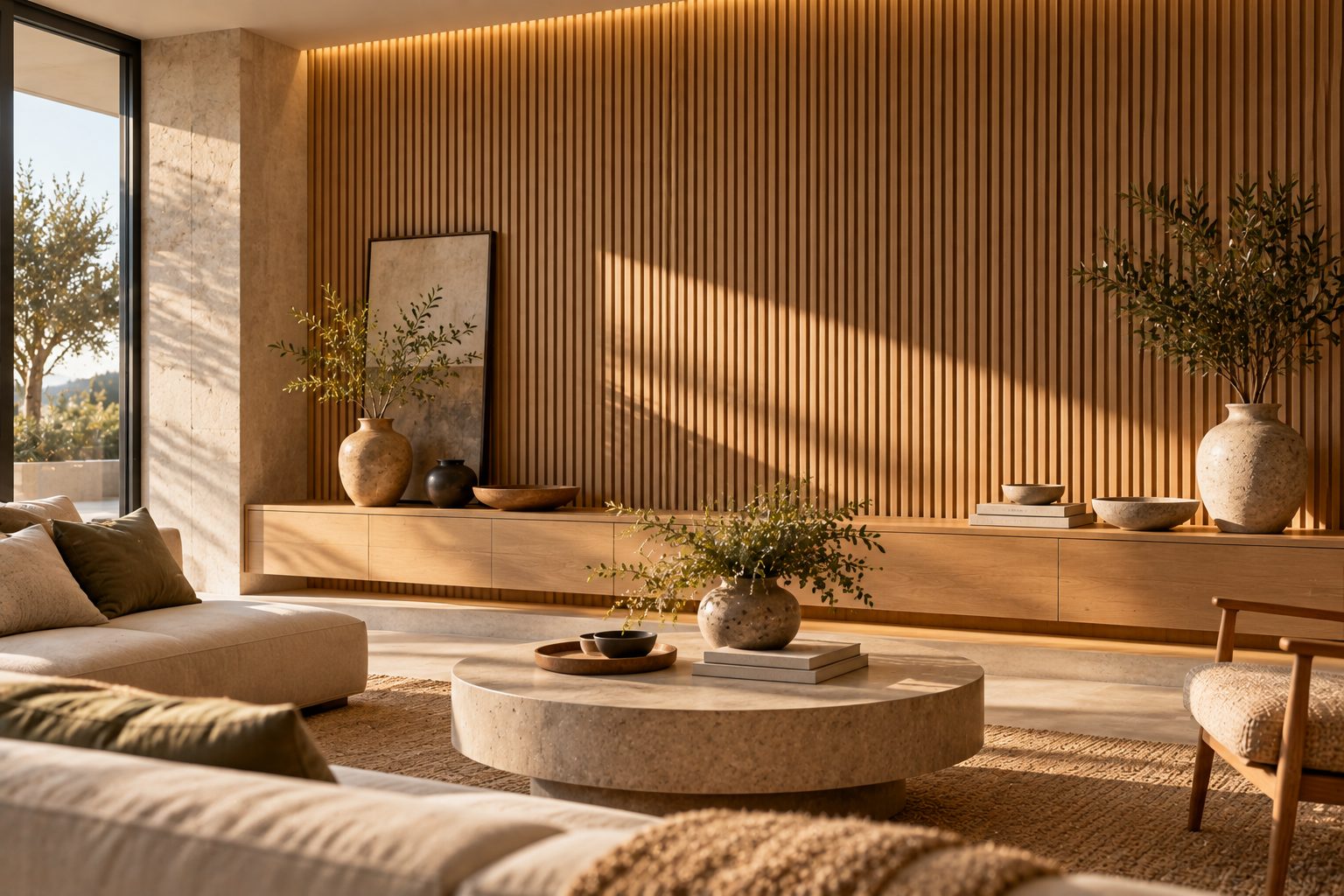
Key takeaways
- Fluted wall panels are boards with rounded vertical grooves; the most common flute pitch is 3/4–1 in (19–25 mm)
- Veneered MDF is the best value indoors, solid wood the most repairable and WPC or PVC the right choice for bathrooms and exteriors
- Expect $8–20 per sq ft installed for MDF and PVC and $25–60 for solid hardwood or custom curved work
- Use fluting on one wall, a TV wall, a kitchen island or a room divider, not on every surface
Fluted wall panels are boards or sheets with a repeating pattern of rounded vertical grooves, typically 3/8–1 in (10–25 mm) apart, made in solid wood, veneered MDF, wood-plastic composite (WPC) or PVC. Installed, they cost about $8–20 per sq ft ($85–215 per m²) in MDF or PVC and $25–60 per sq ft in solid hardwood.
- Definition: fluted means concave grooves; reeded means convex ribs, though retailers use both words for either.
- Panel sizes: boards 4–8 in (10–20 cm) wide or sheets 24–48 in (61–122 cm) wide, 8–10 ft (244–305 cm) tall.
- Thickness: 1/2–1 in (12–25 mm) for most interior panels.
- Best uses: TV walls, headboard walls, kitchen islands, reception desks and room dividers.
Fluting is the softer, more classical cousin of the open slat wall in our wood slat wall panels guide: the profile is cut into a solid face rather than spaced on felt, so it reads quieter and is easier to clean.
What are fluted wall panels made of?
Fluted wall panels are made of four main materials: solid wood, veneered or paint-grade MDF, wood-plastic composite and PVC or polystyrene, and the right one depends on moisture, budget and how close people will look.
| Material | Typical panel | Moisture | Repairability | Installed cost (US 2026, typical) |
|---|---|---|---|---|
| Solid wood (oak, ash, walnut) | 4–6 in (10–15 cm) boards, 3/4 in (19 mm) thick | Dry rooms only | Sand and re-oil | $25–60 per sq ft |
| Veneered MDF | 24–48 in (61–122 cm) sheets, 5/8–3/4 in (16–19 mm) | Dry rooms; MR-grade core for kitchens | Touch-up only | $14–30 per sq ft |
| Paint-grade MDF | 24–48 in sheets | Dry rooms | Repaint | $8–18 per sq ft |
| WPC (wood-plastic composite) | 6–8 in (15–20 cm) boards | Bathrooms, covered exteriors | Replace board | $10–22 per sq ft |
| PVC or polystyrene | 4–24 in boards, lightweight | Wet areas, rentals | Replace board | $8–16 per sq ft |
Ranges are typical US installed costs for a flat wall; curved walls, mitred corners and integrated lighting add 30–80 percent.
Fluted wood panels in solid timber look and age best, but they move with humidity, so they need tongue and groove edges and an expansion gap. Fluted wood wall panels in oak veneer over MDF are the value sweet spot for living rooms and bedrooms. For bathrooms and covered porches, WPC and PVC fluted panels survive water that would swell MDF. See our PVC wall panels article for the plastic options in detail.
What flute size and spacing should you choose?
Choose a flute pitch of 3/4–1 in (19–25 mm) for most walls, finer 3/8–1/2 in (10–12 mm) flutes for furniture and close-up surfaces, and bold 1.5–2 in (38–50 mm) flutes for large lobbies and double-height walls.
Scale matters more than material. Fine flutes on a 20 ft (6 m) wall disappear into a gray blur from across the room; coarse flutes on a bedside cabinet look clumsy. Match the depth to the pitch: a flute 1/4–3/8 in (6–10 mm) deep on a 1 in pitch casts a clear shadow under directional light. A fluted wall shows best with a wall-washer or a linear LED at the top, which turns the grooves into soft stripes of light and shadow; aim for 2700–3000 K and a CRI of 90 or higher so wood stays warm.
Where do fluted panels work best?
Fluted panels work best on a single feature surface, such as a TV wall, a headboard wall, a kitchen island front or a reception desk, where the texture can be seen up close and lit from above.
Wood panel TV wall
A wood panel TV wall in fluted oak hides cables in a chase behind the panel and frames the screen. Recess a channel 2–3 in (5–8 cm) deep behind the TV position, or fix the panels to battens so cables run in the gap. Our decorate around a TV guide covers sizing and placement.
Headboard and bedroom walls
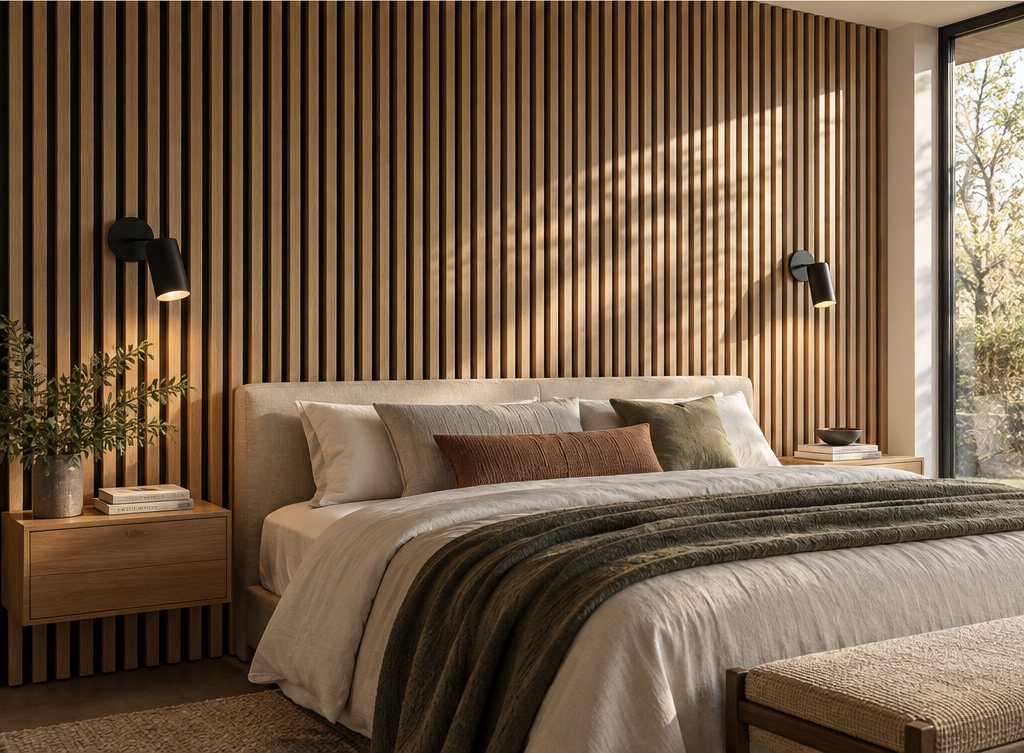
Run fluting floor to ceiling behind the bed, 12–24 in (30–61 cm) wider than the bed on each side, to make a built-in headboard without bulk.
Kitchen islands and furniture
Fluted island fronts and sideboard doors are one of the strongest 2027 kitchen details. Use paint-grade MDF with a moisture-resistant core and a durable two-pack or catalyzed paint.
Decorative wood panels for walls with shelves
Some fluted systems take aluminum rails or slot-in brackets for floating shelves. Check the load rating, often 20–45 lb (9–20 kg) per shelf, and fix into studs, not just panel.
Can you use fluted or slatted wood as a room divider?
Yes, a fluted or slatted wooden room divider is one of the best ways to zone an open plan without losing light, because it screens views at an angle while letting daylight and air through.
A wood slat room divider uses spaced vertical battens, usually 1.5 × 1.5 in (38 × 38 mm) with 1.5–2 in (38–50 mm) gaps, fixed floor to ceiling. A solid fluted panel makes a full wooden room partition that blocks sight and some sound. Lighter options include a freestanding wooden room divider screen or a ceiling-hung slatted room divider on a track. For a fixed wood room divider wall, anchor top and bottom into joists or blocking; a freestanding wood panel room divider over 6 ft (183 cm) tall needs a wide base or wall tie so it cannot tip. Our open concept living article explains where dividers help most.
How do you install fluted wall panels?
Install fluted wall panels by fixing them to a flat wall or battens with construction adhesive plus pin nails or concealed clips, starting from a plumb line at the center of the feature so the flutes land symmetrically.
- Acclimate the panels. Leave them flat in the room for 48–72 hours, longer for solid wood.
- Check the wall. Flatten bumps over 1/8 in (3 mm) in 6 ft (183 cm) or fix 1 × 2 in (19 × 38 mm) battens at 16 in (41 cm) centers.
- Plan the layout. Center a flute or panel joint on the TV, bed or wall center so the edges finish evenly.
- Snap a plumb line. One leaning panel makes every flute after it lean.
- Glue and pin. Use a panel adhesive suited to the core plus 18-gauge pin nails in the bottom of a groove, where they disappear.
- Cut outlets and finish edges. Mark sockets with the panel in place; finish exposed ends with a matching edge strip or an outside-corner profile.
- Seal or oil. Finish raw MDF and solid wood on site; pre-finished panels need only touch-ups.
Are fluted walls a passing trend?
Fluted walls are a trend at their peak in 2026, but reeding has been used in classical columns, Art Deco joinery and mid-century furniture for centuries, so a well-made wood version is unlikely to look dated quickly.
What will date is cheap 3d wood wall panels in gray-washed foil, glossy plastic fluting and fluting on every cabinet, wall and lamp in one room. Keep it to one or two surfaces, use real wood or a good veneer, and pair it with plain plaster or paint. Our modern wall panels roundup compares fluting with other wall profiles if you want a less trend-led option.
#E4D3BA#B88B5F#6F4C35#3A3430#CFC8BCMistakes we see with fluted panels
The mistakes we see most are fluting installed out of plumb, visible panel joints in the middle of a wall, raw MDF edges at outside corners and panels fixed straight to uneven plaster.
Solid wood fixed without expansion gaps buckles in its first humid summer. Foil-wrapped panels peel at cut ends near radiators. And exterior wood wall panels need a species or composite rated for UV and rain, plus a ventilated cavity behind; interior fluted MDF fails outdoors within one season. Finally, a fluted wall lit from straight on looks flat: light it from the top or side.
Our verdict: what we'd specify
For a living room or bedroom feature we would specify oak-veneered MDF fluted panels with a 3/4 in (19 mm) pitch, finished matte, fixed to battens with a concealed cable chase and a warm linear LED at the top. It costs a third of solid timber and looks nearly identical from 3 ft (1 m) away. For a kitchen island or reception desk, which people touch and scuff daily, we would pay for solid oak or ash fluted wood so it can be sanded and re-oiled. In bathrooms we would use WPC.
Specifying fluted panels or slatted dividers for a whole project? Send your wall areas and finish samples to our decor sourcing desk for factory quotes, MOQs and lead times.
Free toolPaint CalculatorWork out exactly how much paint to buy.Shop & source the look
Buy it today — or have it made
Retail links are affiliate links: we may earn a commission at no extra cost to you (disclosure). “Get it made” sends the item to our sourcing desk for factory quotes in custom sizes and finishes.
Frequently asked questions
Are fluted wall panels expensive?
Fluted wall panels cost about $8–20 per sq ft installed in PVC or paint-grade MDF, $14–30 in veneered MDF and $25–60 in solid hardwood in the US in 2026. A 10 × 8 ft (3 × 2.4 m) feature wall therefore runs roughly $640–4,800. Curved walls, integrated lighting and custom profiles add more.
What is the difference between fluted and reeded panels?
Fluted panels have concave, scooped-out grooves, while reeded panels have convex, rounded ribs that stand proud of the surface. Retailers often use the two words interchangeably. Fluting reads softer and slightly more classical; reeding casts stronger highlights. Both come in similar sizes, materials and price bands.
Can fluted panels be used in a bathroom?
Yes, fluted panels can be used in a bathroom if they are WPC, PVC or sealed solid cedar or thermally modified wood, not standard MDF. Keep them out of direct shower spray unless the product is rated for wet zones, seal all cut edges and run an extract fan so humidity stays below about 60 percent.
Do fluted wall panels go out of style?
Fluted wall panels may fade as a headline trend after 2027, but reeded and fluted profiles have appeared in architecture and furniture for centuries, so quality wood versions age well. Cheap foil or glossy plastic fluting dates fastest. Limit fluting to one or two surfaces and use real wood or a good veneer.
Some links may be affiliate links. Regulations and specifications change — always confirm with suppliers and qualified professionals.