Modern Wall Panels: Contemporary Paneling Ideas, Types & Costs
Modern wall panels are slatted, fluted, flat-reveal or 3D panels in MDF, veneer, PVC or stone-look sheet, installed on one wall in one color. The eight contemporary types cost $4–40 per sq ft installed; slat and fluted panels lead in 2027.
Part of our guide: Wall Treatments Guide: 14 Wall Finishes & Covering Ideas
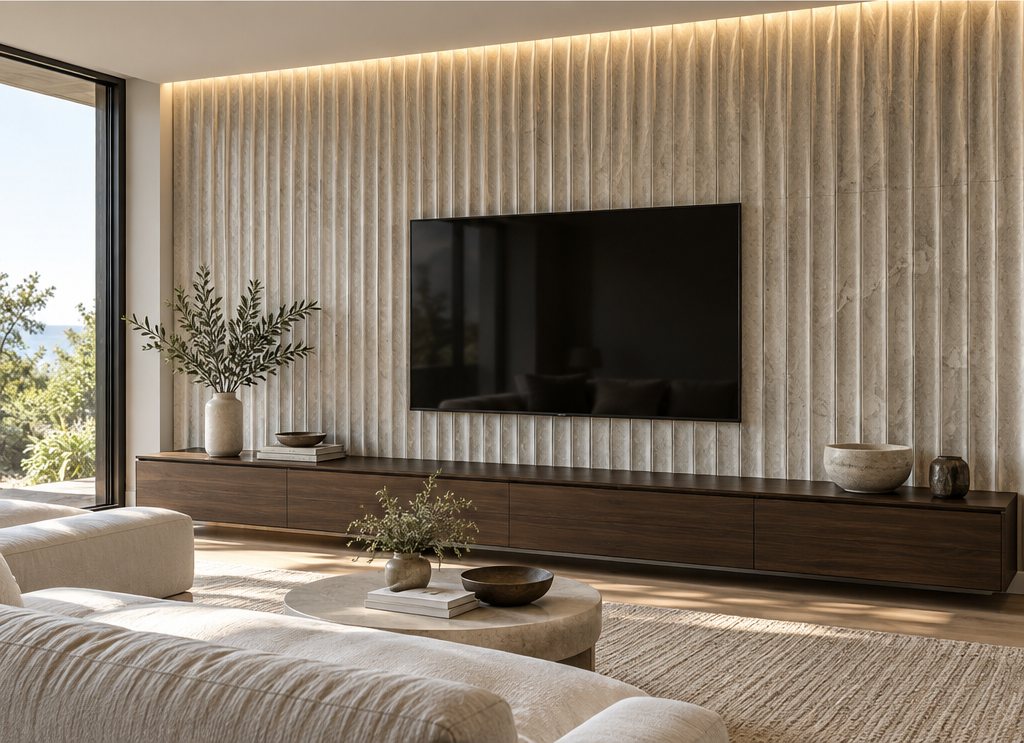
Key takeaways
- Modern wall panels use one repeated element, slats, flutes, flat reveals or 3D relief, in one color, on one wall, lit from the side
- Fluted MDF at $14–24 per sq ft installed and felt-backed veneer slats at $15–30 are the two most used contemporary paneling types in 2027
- In a living room, run the panel floor to ceiling behind the sofa or TV, extend it 12 in past each sofa arm or 1.5–2 times the screen width
- Check core, facing, fixing method, fire rating, edge finish and box coverage before buying; walls must be flat to 1/8 in over 8 ft
Modern wall panels are wall coverings with a clean, repeating geometry, such as vertical slats, fluted ribs, flat grids or sculpted 3D relief, made in MDF, wood veneer, PVC, polyurethane or large-format sheet, and installed on one or two walls rather than throughout a room. The eight contemporary paneling types cost $4–40 per sq ft ($43–430 per m²) installed, and the look that defines 2027 is a slatted or fluted panel in warm oak or a single deep color, lit from the side.
What separates modern paneling from the traditional kind is restraint. Traditional wainscoting and raised panels add profiles, mitered frames and two-tone paint; contemporary panels add rhythm and shadow with a single repeated element and almost no trim. The result is a wall that reads as architecture rather than decoration. This guide covers the types with real costs, wall paneling ideas for living rooms and other spaces, large-format wall sheet designs, how the panels are installed, and what to check before you buy.
- Most used types in 2027: vertical slat, fluted, flat grid and large-format stone-look sheet.
- Cost range: $4–12 per sq ft for MDF and PVC panels in materials; $12–40 per sq ft installed for veneer, solid wood and stone-look sheet.
- Standard panel sizes: 24 × 94–96 in (61 × 240 cm) slat panels; 4 × 8 ft (122 × 244 cm) sheets; 20 × 20 in (50 × 50 cm) 3D tiles.
- Acoustic bonus: felt-backed slat panels absorb 40–60 percent of mid-frequency sound.
- Rule of thumb: panel one wall, keep the others matte, light the panel from the side.
What are contemporary wall panels?
Contemporary wall panels are decorative wall coverings whose pattern comes from repeated geometry and shadow rather than from moulding profiles; the common forms are slats on a backer, fluted or ribbed boards, flat panels with reveals, geometric 3D relief tiles and large seamless sheets that imitate stone, concrete or plaster. They are sold as finished modules that fix to the wall with adhesive, clips or screws, which is why most of them can be installed in a day.
The category grew out of three design currents: the Scandinavian and Japanese preference for exposed timber rhythm, the acoustic needs of open-plan homes, and the warm minimalism that replaced flat white walls. If you are unsure which style your room leans toward, the style quiz is a quick check; Japandi, organic modern and quiet luxury rooms all lean on these panels.
What types of modern paneling are there and what do they cost?
There are eight types of modern paneling in common use, from flat MDF board and batten at $4–8 per sq ft in materials to solid-wood slat panels and large-format sintered stone sheets at $25–40 per sq ft installed. The table ranks them by cost and shows the look each produces.
| Type | Material cost per sq ft | Installed cost per sq ft | Look | Difficulty | Best rooms |
|---|---|---|---|---|---|
| Flat board and batten (MDF) | $2–5 ($22–54 per m²) | $8–15 | Vertical bars, 16–24 in bays, one color | Easy | Bedrooms, halls, dining |
| Flat panel with reveals | $4–8 | $12–20 | Large smooth panels separated by 1/4 in shadow gaps | Moderate | Living rooms, offices, media walls |
| Fluted or ribbed MDF | $6–12 | $14–24 | Continuous half-round ribs, 1–2 in pitch | Easy | Living rooms, kitchen islands, headboards |
| Veneer slat on felt | $8–15 | $15–30 | Wood slats on black or grey felt, acoustic | Easy | Living rooms, media rooms, offices |
| Solid wood slat, site-built | $10–20 | $25–40 | Real timber slats on battens, any spacing | Hard | Feature walls, stairs, ceilings |
| 3D relief tiles (PU, gypsum, PVC) | $3–10 | $10–20 | Geometric waves, facets, pyramids | Easy | Entries, powder rooms, commercial |
| Large-format sheet (stone, concrete, plaster look) | $6–20 | $15–35 | Seamless 4 × 8 or 4 × 10 ft panels | Moderate | Fireplace walls, bathrooms, kitchens |
| Metal or perforated panels | $12–30 | $25–40 | Brass, bronze, blackened steel; mesh or solid | Hard | Bars, feature niches, commercial |
Two of these dominate residential work. Fluted MDF is the cheapest way to get a sculptural surface and takes paint beautifully. Felt-backed veneer slat panels are the all-rounder, giving warmth, acoustics and a finished edge in one product; our dedicated wood slat wall panels guide has spacing, species and the DIY version. For heavier sound control, pair them with acoustic panels that are designed to look like art.
What are the best wall paneling ideas for a living room?
The best wall paneling ideas for a living room put a single paneled wall behind the sofa or the TV, run it floor to ceiling, keep it in one tone, and leave the remaining walls in a matte paint that matches or quietly contrasts. The panel becomes the room's anchor, so it should align with the main piece of furniture and be lit deliberately.
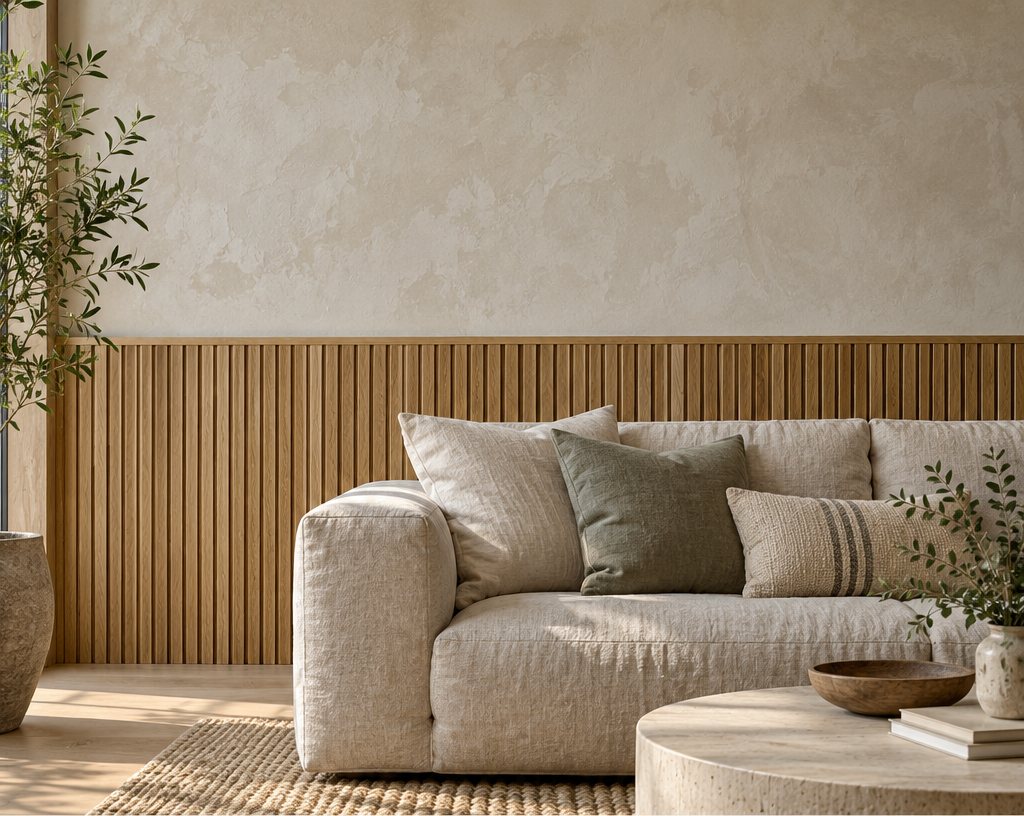
- Slat wall behind the sofa: oak or walnut veneer slats on black felt, the full width of the wall, with a pair of sconces at 60–66 in (152–168 cm) to the center. The felt soaks up echo in an open-plan room. Keep the sofa 2–4 in (5–10 cm) off the slats so they do not get scuffed.
- Fluted TV wall: fluted MDF panels painted a deep tone, with the TV flush on a bracket and a 12–16 in (30–41 cm) deep plinth below for the media gear. The ribs hide the cable chase and make the screen disappear when off.
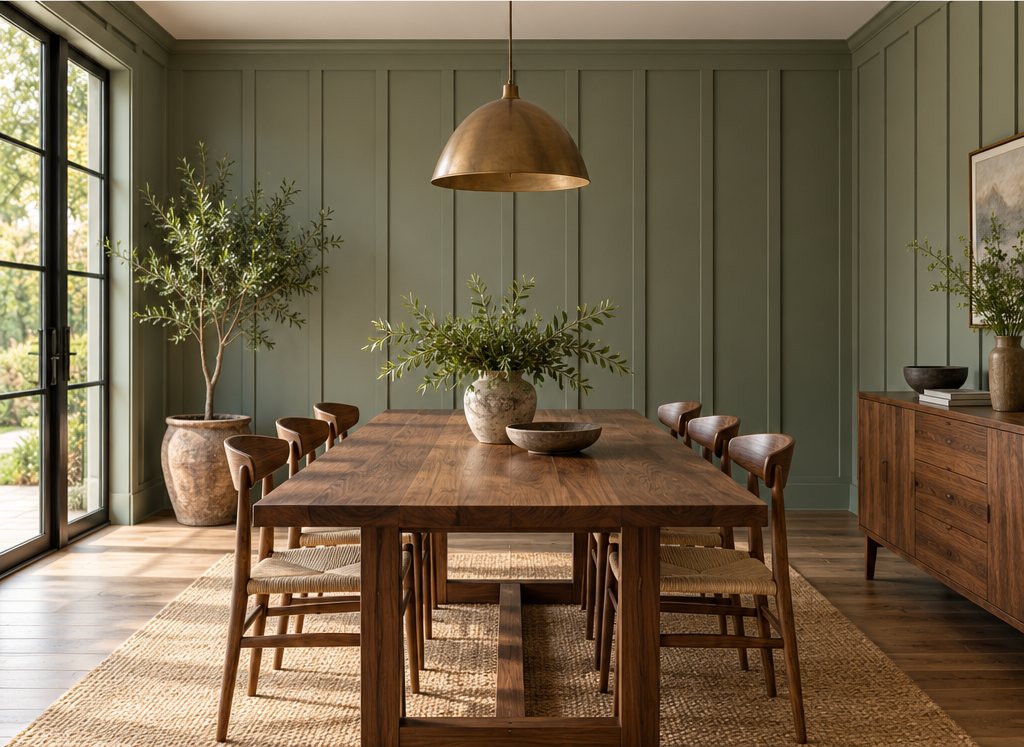
- Flat panels with shadow gaps: 4 × 8 ft MDF sheets with 1/4 in (6 mm) reveals, painted the wall color in a satin finish; the most architectural option and the quietest. Suits quiet luxury rooms.
- Stone-look sheet fireplace: a single 4 × 10 ft (122 × 305 cm) travertine- or limestone-look sheet on the chimney breast, floor to ceiling, with a flush plaster surround. For materials, see trending materials.
- Half-height modern wainscot: fluted or flat panels to 36–40 in (91–102 cm) on all four walls, finished with a flat ledge, with matte paint above. For the half-wall rules, see wainscoting ideas.
- Panel plus plaster: slats on one wall and a hand-troweled plaster texture on the others, the pairing boutique hotels have made standard.
Scale the panel to the furniture. A sofa wall panel should extend at least 12 in (30 cm) past each sofa arm; a TV wall panel should be 1.5–2 times the screen width. Use the living room layout guide to fix the sofa position first and the panel second, never the other way round.
What decorative wall treatments work in other rooms?
Decorative wall treatments beyond the living room follow the same principle, one wall, one material, side light, but the material changes with the room's use. Here is what we specify most often.
| Room | Treatment | Height / extent | Finish | Why |
|---|---|---|---|---|
| Bedroom | Vertical slat or fluted panel behind bed | Bed width + 18 in each side, floor to ceiling | Natural oak or deep green | Replaces a headboard; see bedroom trends |
| Dining | Flat panels with reveals or fluted wainscot | Full height on sideboard wall | Satin in wall color | Formal without moulding |
| Entry | 3D relief tiles or slats | One wall, 6–8 ft (1.8–2.4 m) wide | Painted stone tone | First impression, hides scuffs |
| Home office | Felt slat panel | Behind desk, 6–8 ft wide | Walnut on charcoal felt | Acoustic, good on camera |
| Bathroom | Fluted PVC or large-format stone sheet | Vanity wall or shower surround | Waterproof | Seamless, no grout |
| Kitchen | Fluted island panel; stone-look sheet splashback | Island sides; counter to cabinets | Paint or laminate | Ties into 2027 fluted kitchens |
| Stair and hall | Flat board and batten | 36–40 in (91–102 cm) following the rake | Scrubbable satin | Durable, cheap, modern |
What is wall sheet design and when should you use large-format panels?
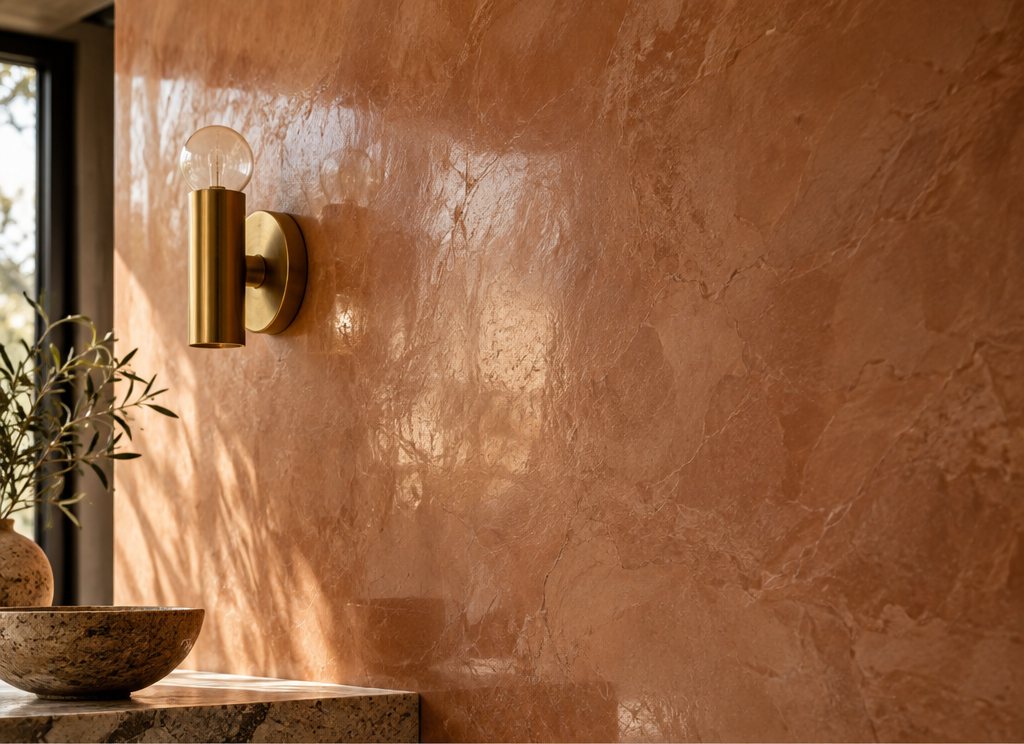
Wall sheet design uses single large panels, typically 4 × 8 ft (122 × 244 cm) to 4 × 10 ft (122 × 305 cm) and in some products 5 × 10 ft (152 × 305 cm), to cover a wall with as few joints as possible, so the surface reads as a slab of stone, concrete, plaster or metal. Use it where you want a seamless, monolithic surface: fireplace walls, bathroom walls, kitchen splashbacks and feature walls in rooms with strong, even light.
The materials are laminate at $3–6 per sq ft, PVC and acrylic sheet at $4–8, cement-fiber and compact laminate at $8–15, and sintered stone or porcelain slab at $15–30 per sq ft in materials. All are 1/8–1/2 in (3–12 mm) thick and glued to a flat substrate, and the joints are either butted with a color-matched sealant or separated by a deliberate 1/4 in (6 mm) reveal strip in black or brass. Two warnings: the wall must be flat to within 1/8 in over 8 ft (3 mm over 2.4 m) or the sheet will show every hollow, and a 4 × 10 ft stone slab weighs 120–200 lb (55–90 kg) and needs two people and mechanical fixings, not just adhesive. If a true mineral surface appeals, microcement gives the same seamless result troweled in place.
How are modern wall panels installed?
Modern wall panels are installed over flat, primed drywall or a batten frame using construction adhesive plus hidden fixings, working from a level line and a centered layout so that cut panels land at the edges, then finished with a flat trim or a reveal at the perimeter. A 12 ft (3.7 m) wall of slat or fluted panels takes a competent DIYer a day; flat panels with reveals and large-format sheet take longer and reward a carpenter.
- Prepare the wall. Fill, sand and prime. Check flatness with a 6–8 ft (1.8–2.4 m) straightedge; shim or skim hollows over 1/8 in (3 mm). Panels telegraph every bump.
- Acclimate the panels. Unpack and stand them in the room for 48 hours; MDF and veneer move with humidity.
- Plan the layout. Measure the wall width, divide by the panel width, and center the layout so equal cut panels sit at both ends, or start full from the most visible corner and let the cut land behind a door. Mark outlets and switches; order box extenders for any panel over 1/4 in (6 mm).
- Snap reference lines. Mark a level line at the top of the first row and a plumb line for the first panel; walls and floors are rarely true.
- Fix the first panel. Apply construction adhesive in a serpentine bead, press the panel to the lines, and secure with 18-gauge brads through the felt or the groove of a slat panel, into studs where possible. Fluted MDF is nailed in the valleys so the holes vanish under paint.
- Continue, checking plumb every third panel. Errors accumulate; a 1/16 in (1.5 mm) drift per panel is 1/2 in (12 mm) across eight panels.
- Cut around obstacles. Use a jigsaw for outlets and a fine-tooth miter saw for ends; mask the cut line on veneer. Cut slat panels between slats where you can so the edge stays clean.
- Finish the edges. Fit a flat 1 × 2 in (19 × 38 mm) trim, an aluminum end profile or a reveal at the perimeter; paint fluted and flat panels with two coats of satin or matte enamel using a roller and a brush for the valleys; leave veneer natural with an oil or clear coat.
For paint quantities on a fluted wall, count the surface area at about 1.6 times the flat wall area, which the paint calculator can take as an allowance. If you are starting from a textured wall, skim it first; our smoothing guide explains why adhesive on texture is a false economy.
How do you light and color a paneled wall?
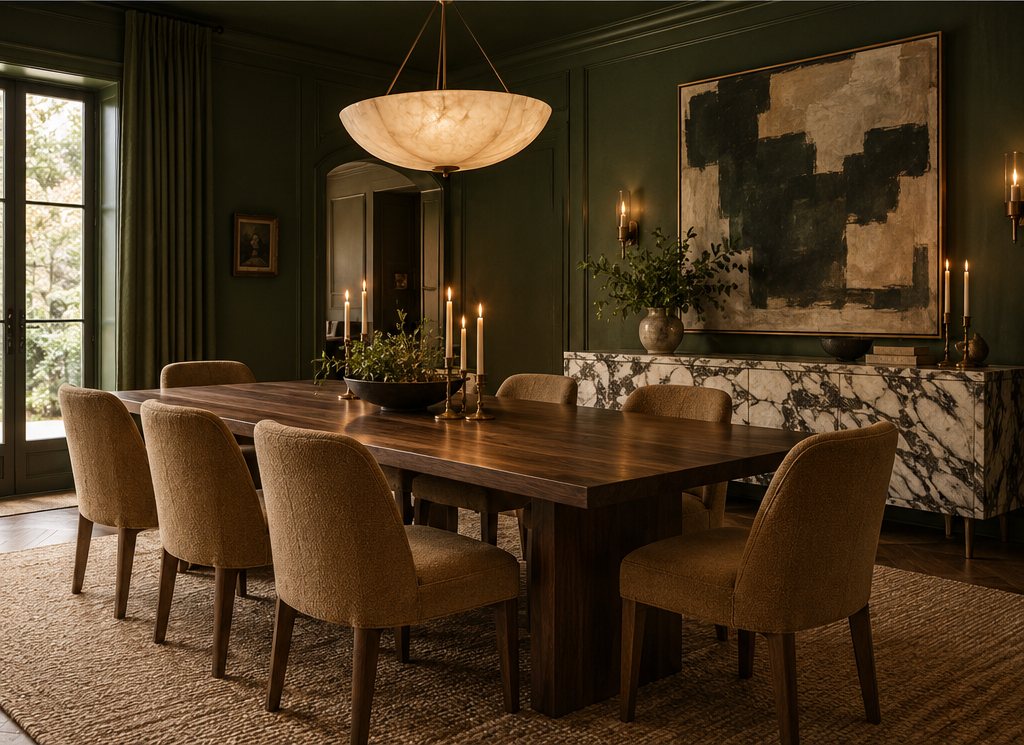
Light a paneled wall from the side or from above at a grazing angle, and keep the panel in one color or one natural wood tone, so the geometry and its shadows do the work. A recessed wall washer 12–18 in (30–46 cm) from the wall, an LED strip in a ceiling cove, or a pair of sconces will make a fluted or slatted panel read in three dimensions; a center ceiling light flattens it to stripes. For color, the 2027 direction is warm oak and walnut for wood, and deep green, ink, clay and oxblood for painted panels, drawn from our 2027 color palettes. Painting the panel the same color as the adjacent walls is the subtlest version and the hardest to get wrong; see color drenching for the sheen logic.
What should you check before buying contemporary wall panels?
Before buying contemporary wall panels, check the core material, the facing, the fixing method, the fire rating, the edge finish and the box coverage; these six items explain nearly every disappointment we hear about. A cheap panel with a sealed edge and an honest coverage figure will outperform an expensive one that arrives with chipped veneer and a 15 percent shortfall.
- Core: moisture-resistant MDF for dry rooms; PVC, PU or compact laminate for wet rooms; plywood for anything that will be screwed into.
- Facing: real veneer 0.5–0.6 mm thick with a lacquer or oil finish, or a printed foil for budget slat panels; ask which. Printed foil on fluted panels looks fine painted and poor left as wood-look.
- Fixing: adhesive only for panels under 1 lb per sq ft (5 kg per m²); adhesive plus brads or clips above that; mechanical fixings for stone sheet.
- Fire rating: for commercial spaces and most multi-family buildings, a class A or B flame-spread rating; ask for the test certificate, not a claim.
- Edges: factory-finished long edges on slat panels, matching end trims available, and a stated tolerance of 1/32 in (1 mm) on width so panels butt without steps.
- Coverage and lead time: coverage per box stated in square feet including gaps; stock items ship in 1–2 weeks, made-to-order in 4–8 weeks, factory orders in 8–14 weeks plus freight.
For a single room, buy from a retailer that will send a sample and take back a surplus box. For a multi-unit project, a hotel, or a developer's spec, factory-direct panels cut the cost per square foot by 40–60 percent; our sourcing desk handles the quotes, samples and inspection, and the wall treatments guide compares panels with every other finish on the wall.
Free toolTile CalculatorWork out tiles, boxes, grout and adhesive with the right wastage.Shop & source the look
Buy it today — or have it made
Retail links are affiliate links: we may earn a commission at no extra cost to you (disclosure). “Get it made” sends the item to our sourcing desk for factory quotes in custom sizes and finishes.
Frequently asked questions
What are contemporary wall panels?
Contemporary wall panels are decorative wall coverings whose pattern comes from repeated geometry rather than moulding profiles: vertical slats on felt, fluted or ribbed boards, flat panels with shadow-gap reveals, 3D relief tiles and large seamless stone- or plaster-look sheets. They are sold as finished modules in MDF, veneer, PVC, polyurethane or laminate and fix to the wall with adhesive, clips or brads.
What are good wall paneling ideas for a living room?
Run a single panel floor to ceiling behind the sofa or TV: oak slats on felt behind the sofa with sconces either side, a fluted panel in a deep color around a flush-mounted TV, flat MDF panels with 1/4 in reveals for a quiet architectural look, or one stone-look sheet on the fireplace wall. Keep the other walls matte and light the panel from the side.
How much do modern wall panels cost?
Materials run $2–5 per sq ft for flat MDF board and batten, $6–12 for fluted MDF, $8–15 for felt-backed veneer slats, $3–10 for 3D relief tiles and $6–20 for large-format sheet. Installed, expect $8–15 per sq ft for board and batten, $14–30 for fluted and slat panels and $25–40 for solid-wood slats, stone sheet or metal.
Is modern paneling easy to install yourself?
Slat, fluted and 3D panels are DIY-friendly: a 12 ft wall takes a day with construction adhesive, an 18-gauge brad nailer, a miter saw and a level. The wall must be flat to 1/8 in over 8 ft and primed. Flat panels with precise reveals and large-format stone sheets are better left to a carpenter, because errors in alignment and weight handling show immediately.
What decorative wall treatments are trending in 2027?
Fluted and slatted panels in warm oak or deep painted tones, flat panels with shadow-gap reveals, hand-troweled plaster textures, large-format stone-look sheets on fireplace walls and color-drenched rooms where the panel matches the wall. The common thread is one material, one color and side lighting, with traditional two-tone moulding falling away.
What is wall sheet design?
Wall sheet design covers a wall with a few large panels, typically 4 × 8 to 4 × 10 ft, in laminate, PVC, cement-fiber, compact laminate or sintered stone, so the surface reads as a seamless slab. It suits fireplace walls, bathrooms and splashbacks. The wall must be flat, joints are sealed or expressed as reveals, and stone slabs over 120 lb need mechanical fixings and two installers.
Some links may be affiliate links. Regulations and specifications change — always confirm with suppliers and qualified professionals.