How to Decorate Around a TV: Wall Ideas, Heights and Layouts
To decorate around a TV, mount it with the screen center near 42 in (107 cm), size it to your seat distance, then frame it with built-ins, a gallery wall or paneling. Heights, sizes and wall ideas, measured.
Part of our guide: Living Room Layout Ideas: 10 Furniture Arrangements That Work
Key takeaways
- Mount the TV with the screen center at about 42 in (107 cm), roughly seated eye level, not at the height of the old fireplace or a standing eye line
- Pick the screen size from the seat distance: viewing distance should be 1.5–2.5 times the diagonal
- Treat the TV as one block inside a larger composition, built-ins, a gallery grid or a paneled wall, so it stops being a lone black rectangle
- Dark walls, slat paneling and art-mode screens make the TV recede; bright walls and tiny decor make it dominate
To decorate around a TV, first mount it correctly, screen center at about 42 in (107 cm) from the floor and sized so your seat sits 1.5–2.5 times the diagonal away, then make it part of a larger composition: built-in shelving, a tight gallery grid, wood slat paneling or a dark painted wall that lets the screen recede. Decor should frame the TV, not compete with it.
The TV is the largest object on most living room walls, and it is a black rectangle that does not go with anything. The trick is to stop treating it as something to hide and start treating it as one element of a designed wall. This article is part of our living room layout ideas guide and covers the measurements first, then the wall ideas, then what goes above, beside and below the screen.
- Mounting height: screen center at 40–44 in (102–112 cm) for sofa seating, roughly seated eye level.
- Viewing distance: 1.5–2.5 × the screen diagonal; a 65 in TV suits 8–13.5 ft (2.5–4.1 m).
- Media console: at least as wide as the TV, ideally 6–12 in (15–30 cm) wider on each side.
- TV-to-wall proportion: the screen should take one-third to one-half of the wall width for a balanced media wall.
- Gap to decor: 4–8 in (10–20 cm) between the screen and surrounding frames or shelves.
How high should a TV be mounted?
A TV should be mounted so the center of the screen sits about 42 in (107 cm) from the floor, which is the eye level of an adult seated on a standard 17–18 in (43–46 cm) sofa seat. That puts the bottom edge of a 65 in TV at around 26 in (66 cm), just above a typical media console.
Most TVs in homes are mounted too high, usually because they are hung where a picture would go or above a fireplace. Looking up more than about 15 degrees for two hours is uncomfortable; looking slightly down is not. Adjust for the room:
- Low lounge seating (15–16 in / 38–41 cm seats): drop the center to 38–40 in (97–102 cm).
- Bedrooms, watched from bed: raise the center to 48–60 in (122–152 cm) and tilt the mount down 5–10 degrees.
- Above a fireplace: use a pull-down mount or accept a compromise; see our guide to living room layouts with a fireplace for the alternatives.
- Kitchens and bars, watched standing: a center around 60–65 in (152–165 cm) works.
Mark the center height with painter's tape and sit on the sofa for five minutes before anyone drills. It is the cheapest test in interior design.
What size TV fits your wall and seating distance?
The right TV size is the one whose diagonal is 40–65 percent of your viewing distance, in other words a seat 1.5–2.5 times the diagonal away. Closer suits 4K screens and cinema-style watching; further suits mixed use and smaller rooms.
| Screen diagonal | Approx. screen width | Viewing distance | Minimum console width | Wall width for a balanced media wall |
|---|---|---|---|---|
| 43 in | 38 in (97 cm) | 5.5–9 ft (1.6–2.7 m) | 48 in (122 cm) | 7–10 ft (2.1–3 m) |
| 55 in | 48 in (122 cm) | 7–11.5 ft (2.1–3.5 m) | 60 in (152 cm) | 8–12 ft (2.4–3.7 m) |
| 65 in | 57 in (145 cm) | 8–13.5 ft (2.5–4.1 m) | 66–72 in (168–183 cm) | 10–14 ft (3–4.3 m) |
| 75 in | 66 in (168 cm) | 9.5–15.5 ft (2.9–4.8 m) | 78–84 in (198–213 cm) | 11–16 ft (3.4–4.9 m) |
| 85 in | 74 in (188 cm) | 10.5–17.5 ft (3.2–5.4 m) | 84–96 in (213–244 cm) | 13–18 ft (4–5.5 m) |
If the wall is much wider than the last column, you have a large wall to fill and the ideas in the next section matter more. If it is narrower, the screen will dominate whatever you do, so keep the surround simple and dark.
How do you decorate around a TV on a large wall?
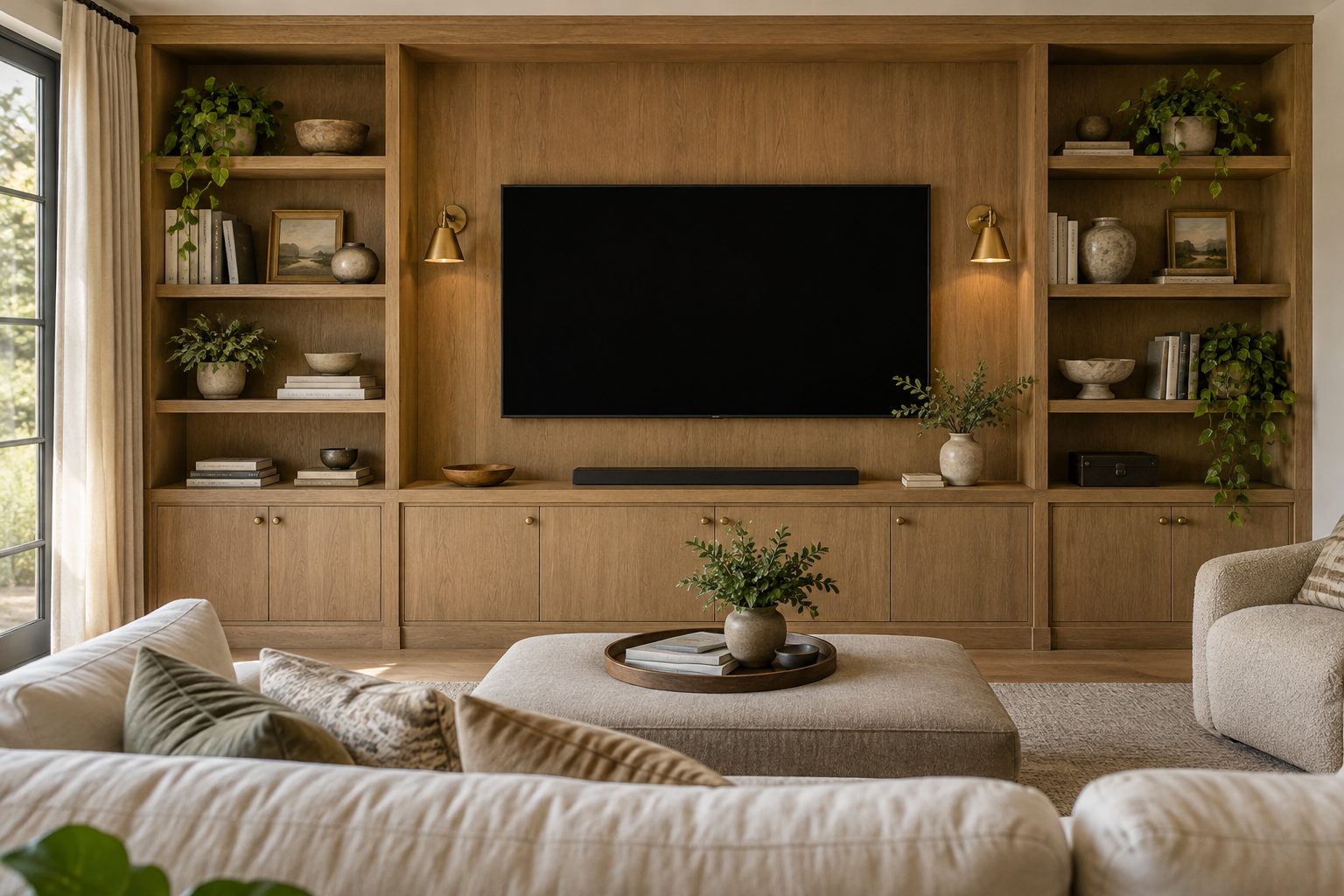
On a large wall, decorate around the TV by building a composition at least twice the screen's width, using built-in shelving, paneling, a gallery grid or flanking sconces, so the screen becomes the center of a designed wall rather than a lonely object in the middle of paint. These are the tv wall ideas we use most.
Built-ins and a media wall
Floor-to-ceiling cabinets on both sides with open shelves above closed doors, and the TV centered in a recessed or paneled bay, is the most effective option. Base cabinets 16–20 in (41–51 cm) deep and 24–30 in (61–76 cm) high hide equipment; shelves above should be 10–12 in (25–30 cm) deep. Keep shelf styling sparse, roughly one-third books, one-third objects and one-third empty.
Wood slat or fluted paneling
A run of vertical slats behind the TV, either the full wall or a panel 1.5–2 times the screen width, adds texture and hides cables in the gaps. Dark oak or walnut slats make a black screen almost disappear. See our guide to wood slat wall panels for spacing, acoustic backing and installation.
Gallery wall around the TV
Arrange frames in a tight grid or a loose arrangement that wraps the TV, keeping a consistent 2–3 in (5–8 cm) between frames and 4–8 in (10–20 cm) between the frames and the screen. Black frames and dark-matted prints help the TV blend in. Our guide on how to hang a gallery wall covers layouts and templates.
Painted and plaster walls
Painting the TV wall a deep color, charcoal, ink blue, olive or chocolate, is the cheapest television wall decoration and among the most effective. Limewash or plaster adds movement without pattern. Use a matte or eggshell finish rather than satin, because sheen reflects lamps and windows right next to the screen, and carry the same color onto any shelving or trim on that wall so the whole surface reads as one plane. A deep wall also flatters a room in the evening, which is when most people watch.
Lighting the TV wall
Plan light around the screen, not just on it. A dim bias light behind the TV, sconces on either side and a lamp at one end of the console reduce the glare of a bright screen in a dark room and keep the wall attractive when the TV is off. Keep any fixture out of the screen's reflection from the main seat.
#22262B#2F3B45#4B4A3A#4A362C#8A7A68What should you put above a TV?
Above a TV, put something low and horizontal, a long narrow artwork, a single floating shelf or a pair of sconces, or leave the wall bare; avoid tall pieces that pull the eye upward and make the wall feel stacked. Keep a gap of 6–12 in (15–30 cm) between the top of the screen and anything above it.
- Long horizontal art about the width of the TV, hung 8–10 in (20–25 cm) above it.
- A slim floating shelf 6–8 in (15–20 cm) deep with three or four low objects, spanning slightly wider than the screen.
- Picture lights or a linear wall light washing the wall above, which also reduces eye strain in the evening.
- Nothing: on walls under 9 ft (2.7 m) tall, the space above a 65 in TV is often too shallow for decor, and empty wall is the better choice.
How do you decorate the wall behind a TV stand?
To decorate the wall behind a TV stand, use the stand as the base of a layered vignette: the TV centered, a lamp or tall vase at one end, a low stack of books or a bowl at the other, and wall decor behind the screen that is wider than the stand. The stand, screen and wall should read as one grouping.
- Size the stand. Choose a console 6–12 in (15–30 cm) wider than the TV on each side and 16–24 in (41–61 cm) high.
- Center the TV on the stand, mounted or on its feet, with the bottom edge 4–8 in (10–20 cm) above the top.
- Anchor one end tall. A table lamp or a vase with branches at one end, rising to about the top third of the screen.
- Balance the other end low. Books with a small object on top, a bowl or a small plant.
- Treat the wall behind. Paint, paneling, a large textile or art leaning on the stand partly behind the screen.
- Hide every cable. Run them in the wall or in a paintable raceway; a single visible cable undoes the whole wall.
What should you put next to a TV stand?
Next to a TV stand, put tall, narrow pieces that balance the screen's width: floor plants, a pair of tall bookcases, floor lamps, or wall sconces mounted level with the top third of the screen. Symmetry on both sides suits traditional rooms; one tall plant on one side and a lamp on the other suits modern ones.
- Floor plants 4–6 ft (1.2–1.8 m) tall in heavy planters, set 6–12 in (15–30 cm) from the stand.
- Wall sconces at 60–66 in (152–168 cm) to center, 12–18 in (30–46 cm) out from the screen edges. Our plug-in wall sconces guide covers options that need no electrician.
- Narrow bookcases 12–14 in (30–36 cm) deep, which effectively turn a stand into a media wall.
- Speakers on stands at ear height, 36–42 in (91–107 cm), if you use them, in a finish that matches the stand.
Which TV wall decor ideas make the screen disappear?
The TV wall decor ideas that make a screen disappear all reduce contrast: dark walls, dark wood, art-mode screens, cabinet doors that slide over the TV, and frames of black-and-white art around it. A black screen on a white wall is the highest-contrast object in a room; a black screen on charcoal paneling is barely there.
- Art-mode screens display artwork when off and usually come with a picture-frame bezel.
- Sliding or pocket doors on a built-in close over the TV completely.
- A recess the depth of the TV and mount, about 3–4 in (8–10 cm), sets the screen flush with the wall.
- Dark slat or limewash walls absorb the screen visually.
- Black or dark-framed art around the TV turns it into one frame among several.
Our verdict on the best TV wall
If budget allows one move, we would build a simple media wall: base cabinets the full width, open shelves either side and a dark slat panel behind the screen. It hides equipment, gives styling space and makes a 75 in TV look intended. On a rental or tight budget, paint the TV wall a deep color, hang a pair of plug-in sconces and lower the screen to 42 in center; that combination changes the room for under $500.
For 2027, expect fewer floating TVs on white walls and more integrated media walls in warm woods, fluted fronts and plaster, alongside art-mode screens in living rooms that double as formal sitting rooms. Lowering the TV is still the single best improvement in most homes we visit.
Planning a custom media console or built-in wall unit? Send your wall and TV dimensions to our furniture sourcing desk for factory quotes with shop drawings and finish samples.
Free toolPaint CalculatorWork out exactly how much paint to buy.Shop & source the look
Buy it today — or have it made
Retail links are affiliate links: we may earn a commission at no extra cost to you (disclosure). “Get it made” sends the item to our sourcing desk for factory quotes in custom sizes and finishes.
Frequently asked questions
How to decorate around a TV on a large wall?
Build a composition at least twice the TV's width so the screen becomes the center of a designed wall: floor-to-ceiling built-ins either side, vertical wood slat paneling behind, a tight gallery grid with 4–8 in clearance to the screen, or flanking sconces. A deep wall color helps the black screen recede. Keep shelf styling sparse, about one-third empty.
What to put above a TV?
Put something low and horizontal above a TV, such as a long artwork about the width of the screen hung 8–10 in above it, a slim floating shelf with a few low objects, or picture lights washing the wall. On walls under 9 ft tall, leave the space empty. Avoid tall pieces that stack the wall upward and draw attention to the screen.
How to decorate the wall behind a TV stand?
Treat the stand, the TV and the wall as one grouping. Choose a console 6–12 in wider than the TV each side, center the screen 4–8 in above it, place a tall lamp or vase at one end and a low stack of books at the other, then paint or panel the wall behind. Hide every cable in the wall or a raceway.
How high should a TV be mounted?
Mount a TV so the screen center is about 42 in (107 cm) from the floor, the eye level of an adult on a standard sofa. For a 65 in TV that puts the bottom edge near 26 in. Drop to 38–40 in for low lounge seating, raise to 48–60 in with a downward tilt in bedrooms, and avoid mounting high above fireplaces without a pull-down mount.
What to put next to a TV stand?
Put tall, narrow pieces next to a TV stand to balance the screen's width: 4–6 ft floor plants, narrow bookcases 12–14 in deep, floor lamps, or wall sconces mounted 60–66 in to center and 12–18 in out from the screen edges. Use matching pairs in a traditional room and an asymmetric plant-and-lamp pairing in a modern one.
Some links may be affiliate links. Regulations and specifications change — always confirm with suppliers and qualified professionals.