Tile Countertop Ideas and Cheap Backsplash Ideas That Look Expensive
The best tile countertop ideas use large porcelain with narrow epoxy grout, and the same tile logic gives cheap backsplash ideas from about $8 per sq ft installed. Budget picks, sizes and what to avoid.
Part of our guide: Kitchen Trends 2027: Kitchen Wall Colors, Plaster Hoods and Brass
Key takeaways
- Tile countertops work best with large porcelain tiles, 24 × 24 in or bigger, narrow 1/16 in joints and epoxy grout
- The cheapest good-looking backsplash is 3 × 6 in ceramic subway tile at about $8–20 per sq ft installed
- In small kitchens, a full-height backsplash on one wall costs little more and looks far more finished than a 4 in strip
- With busy granite countertops, choose a plain backsplash in a color pulled from the stone
The best tile countertop ideas use large porcelain tiles, 24 × 24 in (60 × 60 cm) or bigger, with 1/16 in (1.5 mm) joints and stain-proof epoxy grout, so the counter reads almost like a slab at roughly $25–60 per sq ft installed. For backsplashes, ceramic subway or handmade-look tile gives the best result for the least money, typically $8–30 per sq ft installed.
Tile on counters and walls is the budget route to a kitchen that looks considered. This guide pairs with our kitchen trends 2027 report and covers tile countertops first, then the cheap backsplash ideas that suit them, with real costs and the details that stop tile looking cheap.
- Tile countertop sweet spot: 24 × 48 in (60 × 120 cm) porcelain, fewest joints.
- Grout: epoxy on counters, high-performance cementitious on walls.
- Cheapest backsplash tile: 3 × 6 in (7.5 × 15 cm) ceramic subway from about $1 per sq ft.
- Backsplash height: 18 in (46 cm) between counter and upper cabinets in most US kitchens.
- DIY-friendly area: a 30 sq ft (2.8 m²) backsplash takes a weekend.
Are tile countertops a good idea?
Tile countertops are a good idea when you choose large porcelain with narrow epoxy-grouted joints; small tile with wide cement grout is what gave them a bad reputation.
A tile countertop is a counter surface made of tile bonded to a plywood and cement board base, finished with a front edge piece. Porcelain resists heat, scratches and stains as well as most stone, and repairs are local: a chipped tile can be replaced without changing the whole counter. The trade-offs are joints that collect crumbs, a less seamless look than quartz, and front edges that need careful detailing. If you want a slab look with no joints, compare with our quartz countertops guide.
Tile countertop ideas that look like slab
The tile countertop ideas that look most expensive are the ones with the fewest joints and a solid-looking front edge.
Large porcelain with mitered edges
Thin porcelain panels of 24 × 48 in (60 × 120 cm) or larger, 9–12 mm thick, laid on a 3/4 in (19 mm) plywood base with 1/2 in (13 mm) cement board. Miter the front edge at 45 degrees and build it to 1.5 in (38 mm) so it reads like a stone slab.
Zellige or handmade tile with a wood edge
Small 4 × 4 in (10 × 10 cm) handmade tile suits a coffee station or bar counter rather than a main prep surface. Finish the edge in oiled oak and use epoxy grout tinted to the glaze.
Square tile in a grid
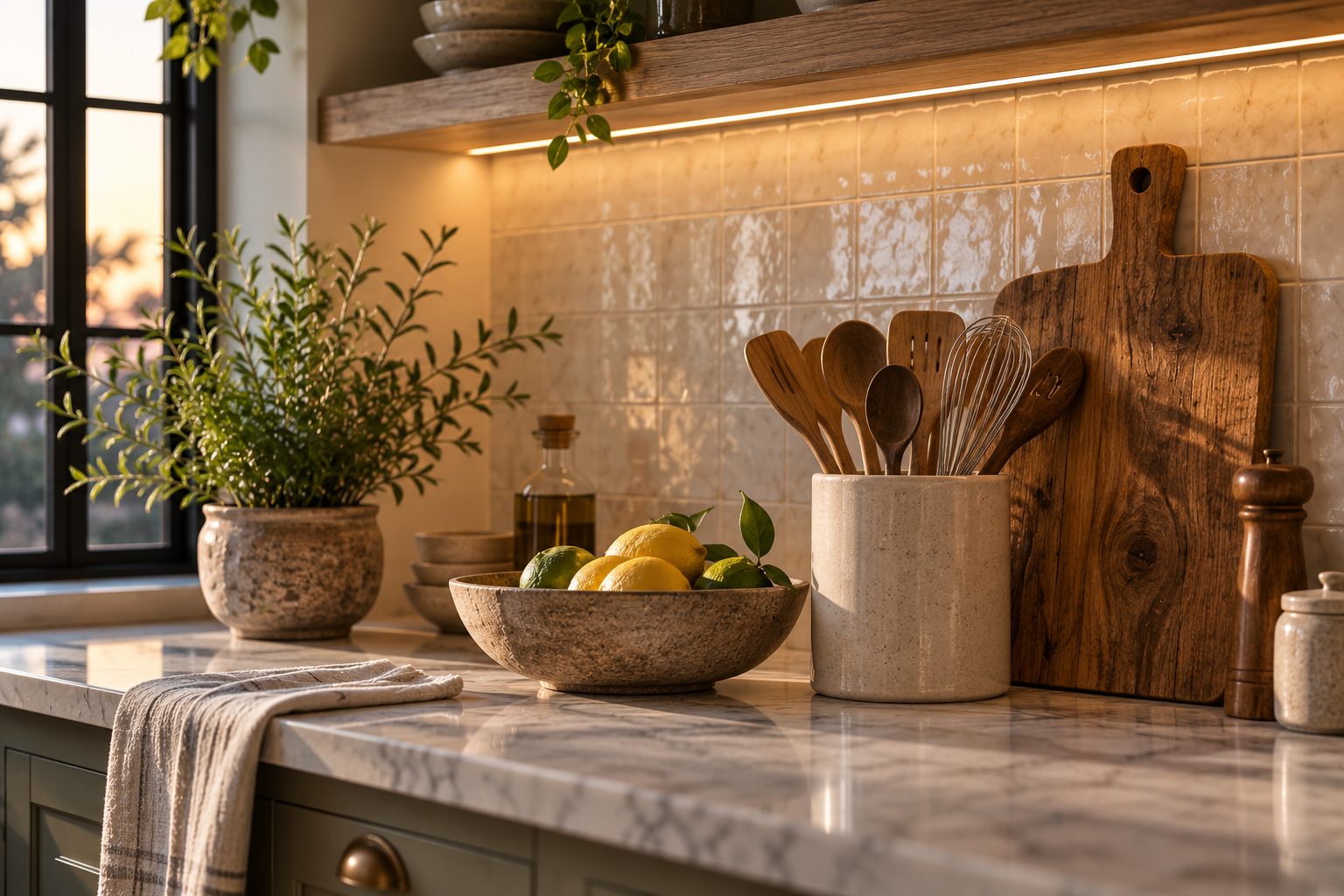
A 6 × 6 in (15 × 15 cm) glazed tile in a straight grid with a matching bullnose edge is the honest retro option, best on an island or butler's pantry counter. Glossy handmade glazes in green, cream or white suit this look best.
Cheap backsplash ideas: costs compared
Cheap backsplash ideas start at about $3 per sq ft for paint or peel-and-stick and rise to $8–20 per sq ft installed for ceramic subway tile, which is the best value for most kitchens.
| Backsplash option | Typical installed cost (per sq ft) | Lifespan | DIY difficulty |
|---|---|---|---|
| Scrubbable paint, satin or semi-gloss | $2–5 | 3–5 years | Easy |
| Peel-and-stick tile | $4–10 | 2–6 years | Easy |
| Ceramic subway tile, 3 × 6 in | $8–20 | 25+ years | Moderate |
| Square or stacked porcelain | $10–25 | 30+ years | Moderate |
| Handmade-look ceramic | $15–35 | 25+ years | Moderate |
| Countertop material run up the wall | $40–120 | Life of counter | Professional |
Ranges are typical US 2026 figures. A standard backsplash is 25–40 sq ft (2.3–3.7 m²), so ceramic subway usually lands at $600–1,500 installed, with many installers charging a $300–800 minimum. Our tile installation cost guide breaks down labor.
Inexpensive kitchen backsplash ideas that do not look cheap
The inexpensive kitchen backsplash ideas that look best use cheap tile laid in a deliberate way: a better pattern, a better grout color or more height.
- Vertical stacked subway: the same low-cost 3 × 6 in tile, set vertically in a straight stack, looks contemporary.
- Color-matched grout: a grout one shade off the tile makes inexpensive tile read as one surface.
- Full-height on one wall: tile to the ceiling behind the range only, paint elsewhere.
- Square tile with a ledge: a 4 × 4 in (10 × 10 cm) grid plus a 4–6 in (10–15 cm) stone ledge for oil and salt.
- Satin glaze over gloss: softer, hides waviness on older walls.
Low cost kitchen backsplash ideas also include mixing materials: tile only the 30 in (76 cm) zone behind the range and sink, then finish the rest of the wall in scrubbable paint that matches the grout. Economical backsplash ideas like this cut tile area by half without looking unfinished, provided the tile ends at a cabinet edge or a corner rather than mid-wall.
Easy backsplash options for renters include peel-and-stick tile over a primed wall and washable paint with a ceramic shelf. Both are reversible, but neither survives heat close to a gas burner, so keep a 6 in (15 cm) gap or a real tile panel behind the range. For more styles and kitchen backsplash pictures by look, see our main kitchen backsplash ideas guide.
Small kitchen backsplash ideas
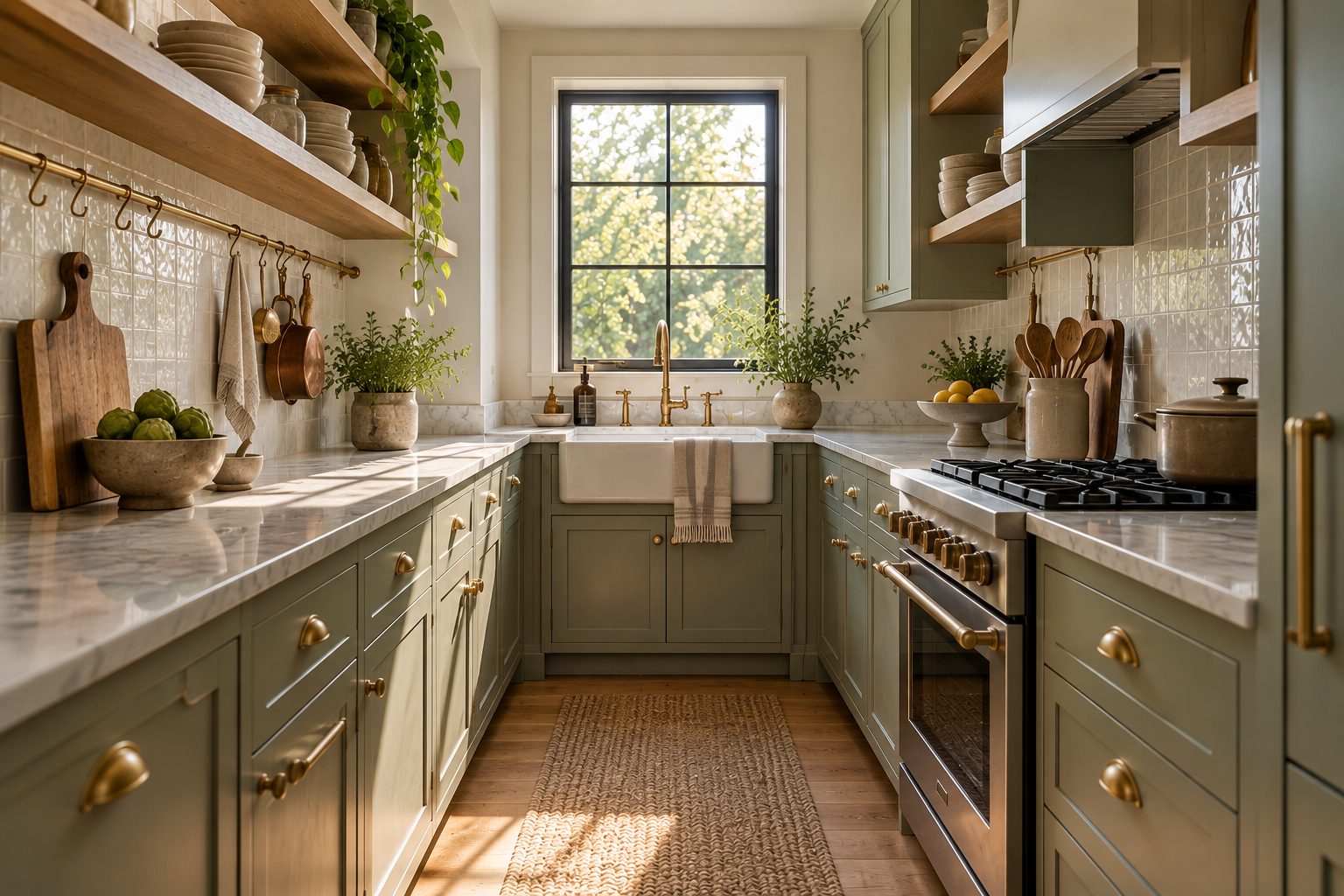
Small kitchen backsplash ideas work best with light, slightly glossy tile run full height, because reflective vertical surfaces make a compact room feel taller.
In a small kitchen the backsplash may be only 15–25 sq ft (1.4–2.3 m²), so you can afford a better tile than the budget suggests. Backsplash designs for small kitchen walls should avoid busy mosaics and dark grout; a single color in a 2.5 × 8 in (6.5 × 20 cm) format or a simple subway keeps the eye moving. Our small kitchen ideas guide covers layout and storage alongside the finishes.
#F3EFE6#D8CDBB#9DAA94#7B8C99#A35F3EThese hex values approximate common glaze colors. Warm whites and pale sands with an LRV above 70 bounce the most light in a small kitchen; sage and clay add color without crowding it.
Backsplash ideas for white cabinets and granite countertops
With white cabinets and granite countertops, the backsplash should be plain and take one color from the granite, so the stone stays the pattern.
Look at the granite closely and pick the mid-tone fleck: a warm beige, a soft gray or a cream. Plain subway or a 2 × 8 in (5 × 20 cm) tile in that shade, with matching grout, ties the white cabinets to the stone. Avoid patterned cement tile and busy marble mosaics, which fight speckled granite. If the granite is very dark, a white or cream tile with a satin glaze keeps the kitchen bright; a soft white rather than a stark one avoids a clinical contrast with the stone.
How to install an easy tile backsplash
An easy tile backsplash of 25–40 sq ft is a realistic weekend DIY job with basic tools and ceramic subway tile.
- Measure and order. Multiply height by width, subtract windows and add 10 percent waste; our tile calculator does it for you.
- Prepare the wall. Turn off power, remove outlet covers, degrease and sand glossy paint.
- Set a level line. Start from a level batten, not the countertop, which is rarely perfectly level.
- Spread and set. Use premixed or modified thinset with a 3/16 in (5 mm) V-notch trowel and 1/16 in spacers.
- Grout after 24 hours. Use unsanded or high-performance grout, wipe twice, then buff off the haze.
- Caulk the joint at the counter. Use flexible silicone there, never grout, because the counter and wall move.
Mistakes we see on budget backsplashes and tile counters
The mistake we see most often is stopping the backsplash at an awkward height or at the edge of the upper cabinet instead of a natural endpoint such as a wall corner or window.
Other common errors: white grout on counters that stains within weeks; tile counters with a cheap bullnose edge that chips; outlets left sunk behind the tile instead of fitted with box extenders; and buying the cheapest tile without checking the edges, so lines wander. Our verdict on tile countertop ideas is simple: use them on islands, bars and pantries where the look matters, choose large porcelain with epoxy grout, and spend the savings on a solid backsplash tile laid with care. That combination costs a fraction of a stone kitchen and looks intentional for years.
Comparing stone slabs and countertop tile for your kitchen? Send your measurements to our stone sourcing desk for quotes from vetted fabricators and factories.
Free toolTile CalculatorWork out tiles, boxes, grout and adhesive with the right wastage.Shop & source the look
Buy it today — or have it made
Retail links are affiliate links: we may earn a commission at no extra cost to you (disclosure). “Get it made” sends the item to our sourcing desk for factory quotes in custom sizes and finishes.
Frequently asked questions
Are tile countertops outdated?
Tile countertops with small tiles and wide cement grout look dated, but large porcelain counters with narrow epoxy-grouted joints are a current, budget-friendly alternative to slab. They suit islands, bars, pantries and outdoor kitchens. A mitered front edge 1.5 in (38 mm) thick makes porcelain tile read almost like stone.
What is the cheapest backsplash option?
The cheapest backsplash option is scrubbable satin or semi-gloss paint at about $2–5 per sq ft, followed by peel-and-stick tile at $4–10. The cheapest long-lasting option is ceramic subway tile at roughly $8–20 per sq ft installed, which lasts 25 years or more and adds real value.
What backsplash goes with white cabinets and granite countertops?
A plain tile in one mid-tone color pulled from the granite goes best with white cabinets and granite countertops. Subway or 2 × 8 in tile in beige, soft gray or cream with matching grout lets the granite stay the pattern. Avoid busy mosaics or patterned tile, which compete with speckled stone.
Can I install a tile backsplash myself?
Yes, a tile backsplash is one of the easiest DIY tile jobs, usually a weekend for 25–40 sq ft. Use ceramic subway tile, modified thinset, a level starting batten and 1/16 in spacers. Fit outlet box extenders, grout after 24 hours and use silicone, not grout, where the tile meets the counter.
What grout is best for a tile countertop?
Epoxy grout is best for a tile countertop because it is non-porous, resists stains from oil, wine and coffee, and never needs sealing. Use narrow joints of about 1/16 in (1.5 mm) with rectified porcelain. Cementitious grout is fine on backsplashes but stains quickly on a working counter.
Some links may be affiliate links. Regulations and specifications change — always confirm with suppliers and qualified professionals.