Quartzite Countertops: Cost per Square Foot, Colors and Care
Quartzite countertops are natural metamorphic stone, harder than granite, that typically cost $70–200 per sq ft installed. Here are slab prices, the most popular colors, how to spot soft fakes and how to seal and care for them.
Part of our guide: Interior Design with Sustainable Materials: Travertine to Rattan
Key takeaways
- Quartzite is a natural rock: sandstone recrystallized under heat and pressure into dense, glassy quartz, about 7 on the Mohs scale
- Typical installed cost is $70–200 per sq ft in 2026, and a single slab often costs $1,500–6,000+ before fabrication
- Quartzite is usually pricier than quartz; white and gray are the most popular colors, blue the rarest and most expensive
- Test every slab with glass and lemon juice: some stone sold as quartzite is actually softer dolomite or marble that etches
Quartzite countertops are slabs of natural quartzite, a metamorphic rock formed when quartz sandstone recrystallizes under heat and pressure. They are harder than granite, resist heat and UV, and need sealing every one to two years. Expect a typical $70–200 per sq ft installed in the US in 2026, about $4,000–10,000 for an average kitchen.
Quartzite is one of the natural stones driving the warmer, more textured surfaces in our trending materials guide for 2027, especially in kitchens moving away from uniform engineered tops. This guide covers what quartzite stone is, what it costs, the colors worth buying, how to avoid soft imitations and how to look after it.
- Material: natural quartz-rich rock, quarried and cut into slabs; no resin.
- Hardness: about 7 on the Mohs scale, versus 6–6.5 for granite and 3–4 for marble.
- Cost: typical $70–200 per sq ft installed; slabs $1,500–6,000+ each.
- Care: pH-neutral cleaner; reseal every 1–2 years depending on porosity.
- Watch out for: "soft quartzite," usually dolomite or marble, which etches with acids.
What is quartzite stone, and what does quartzite look like?
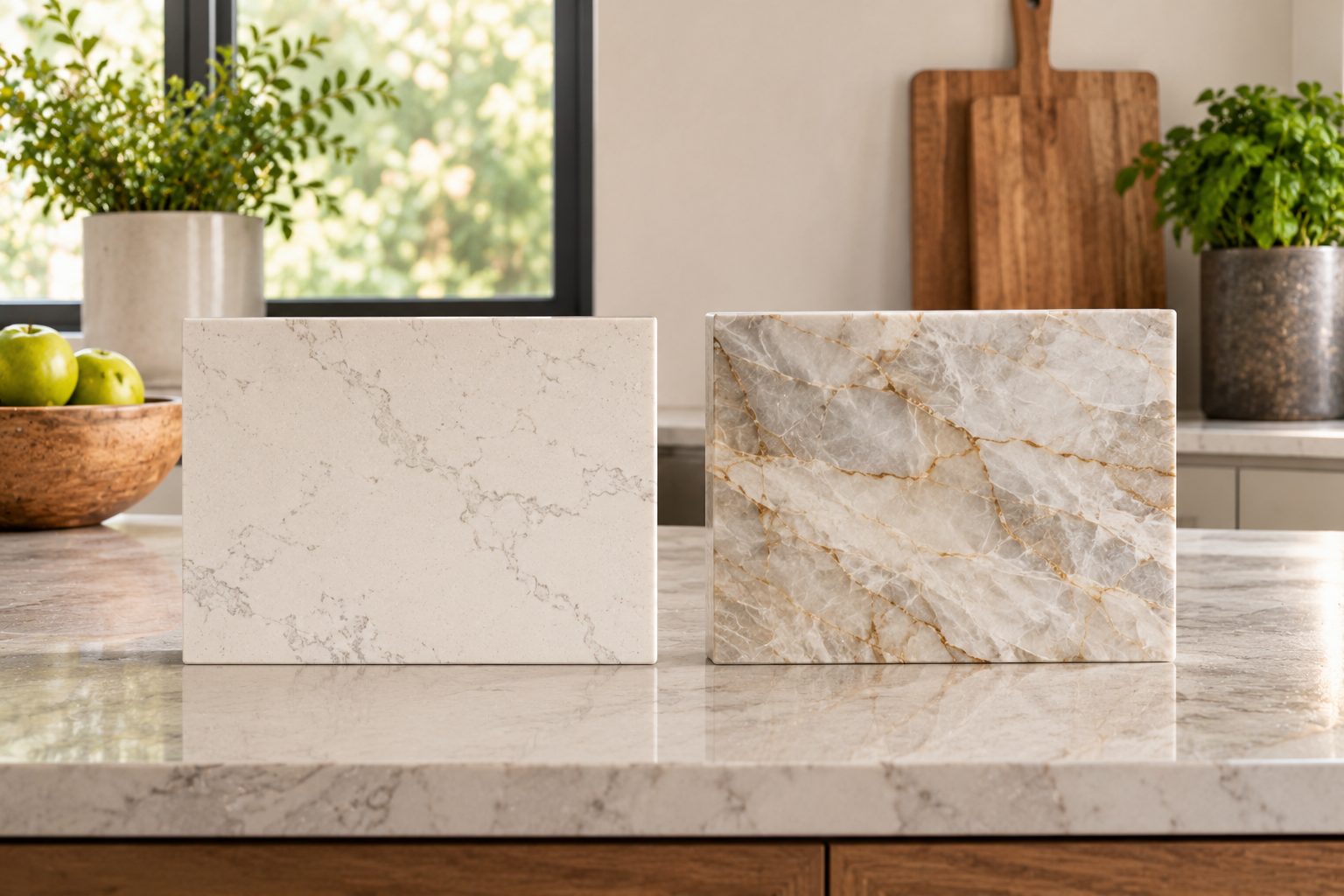
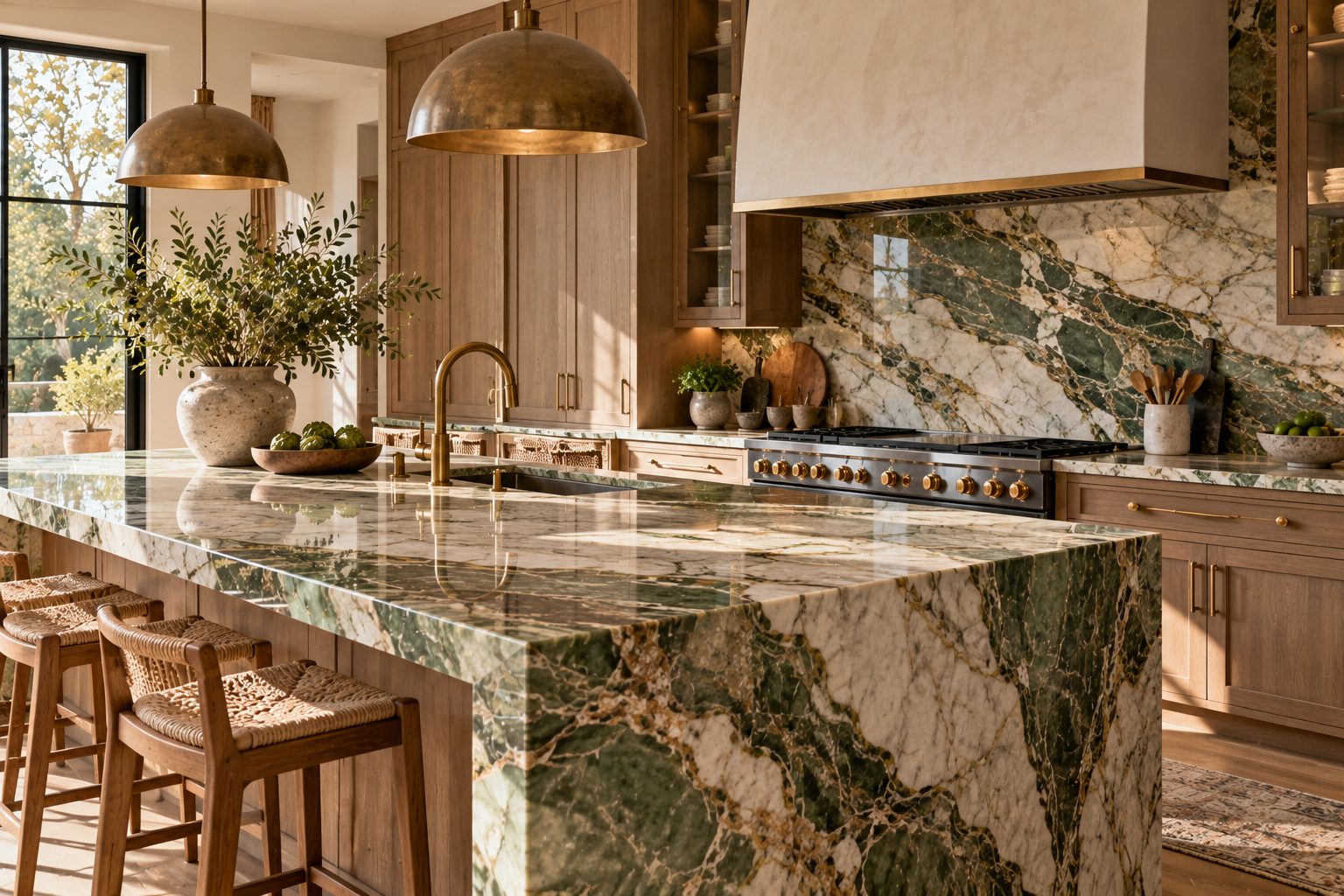
Quartzite stone is a natural rock made almost entirely of fused quartz grains, and it looks like marble with more depth: a white, gray, taupe or blue-green base with soft veining and a glassy, crystalline sparkle in raking light. Because the quartz grains have fused rather than simply cemented together, the stone is dense, hard and resistant to heat and acids.
Many people searching what does quartzite look like are comparing it with marble. Side by side, quartzite usually has broader, more watercolor-like movement and a slightly translucent surface; marble tends to be softer and more chalky. Quartzite is also completely different from quartz, which is an engineered product; our quartz countertops guide explains that material, and quartz vs quartzite puts the two side by side.
How much are quartzite countertops?
Quartzite countertops cost a typical $70–200 per sq ft installed in the US in 2026, with most kitchens between $90 and $140 per sq ft. That puts quartzite countertops cost at roughly $4,000–10,000 for a 50 sq ft (4.6 m²) kitchen, with exotic blues and bookmatched islands far above that.
| Grade | Typical colors | Slab cost (each) | Installed, per sq ft | 50 sq ft kitchen |
|---|---|---|---|---|
| Commercial | Plain white, light gray, beige | $1,500–2,500 | $70–100 | $3,500–5,000 |
| Standard | White with taupe or gray veining, gray quartzite | $2,500–4,000 | $90–140 | $4,500–7,000 |
| Premium | Bold veining, green, rose, bookmatched pairs | $4,000–6,000 | $130–180 | $6,500–9,000 |
| Exotic | Blue, translucent, rare patterns | $6,000–15,000+ | $180–300+ | $9,000–15,000+ |
Prices are typical ranges and move with origin, slab size, freight and fabricator. Quartzite is slower to cut than granite, so fabrication itself often runs $30–60 per sq ft, which is why quartzite price quotes vary so much for the same slab.
How much is a slab of quartzite?
A single quartzite slab typically costs $1,500–6,000 at a stone yard, roughly $40–120 per sq ft of slab before cutting. Slabs are commonly about 120 × 70–80 in (305 × 178–203 cm), around 55–65 sq ft (5–6 m²) each, though natural blocks vary. An average kitchen with an island uses two or three quartzite countertop slabs, so the quartzite slab cost alone can reach $5,000–15,000 for premium material.
Is quartzite cheaper than quartz?
No, quartzite is usually not cheaper than quartz; installed quartzite typically costs $70–200 per sq ft against $50–150 for quartz. The ranges overlap at the middle, so a plain commercial quartzite can match a premium marble-look quartz on price.
The quartz vs quartzite cost gap has three causes. Quartzite slabs are quarried, shipped and selected one by one; quartzite is harder, so cutting and polishing take longer and wear tools faster; and waste is higher because natural fissures and veining dictate where you can cut. On the quartz vs quartzite price question, choose quartzite when you want natural stone with real heat resistance and character, and quartz when you want lower maintenance and a predictable budget.
What are the most popular quartzite colors?
The most popular quartzite colors are white and warm white with taupe or gray veining, followed by gray, then green and blue, with rose and gold as niche statements. White quartzite countertops dominate kitchens because they give the look of marble with far better durability.
#ECE8E2#D8CFC2#A7A8A5#6E8590#7D8B76Hex values are approximations; stone varies across a single slab, so always choose from the actual slab.
White quartzite countertops
White and warm white quartzite countertops suit almost every cabinet color, from white oak to deep green. Honed or leathered finishes look softer and hide water spots; polished brings out the crystalline glow. Ask the yard for cool versus warm undertones and compare them with your cabinet door under 2700–3000K lighting.
Gray quartzite countertops
Gray quartzite countertops, from silver to charcoal, are the practical pick for heavy-use kitchens because they hide crumbs and marks better than white. Grey quartzite countertops with white veining pair well with black or brass hardware.
Blue quartzite countertops
Blue quartzite countertops are the rarest and most expensive of the quartzite countertops colors, often over $180 per sq ft installed. Use them on an island or bar where they can be the room's single statement.
Are quartzite countertops good for kitchens?
Yes, quartzite countertops for kitchen use are excellent: true quartzite resists scratches, heat and acidic food better than marble and granite, provided it is sealed and genuinely quartzite. Its main weaknesses are edges that can chip if knocked with heavy pots, and staining if the sealer is neglected on more porous slabs.
| Property | Quartzite | Quartz | Granite | Marble |
|---|---|---|---|---|
| Mohs hardness | about 7 | about 7 (quartz grains) | 6–6.5 | 3–4 |
| Heat resistance | Very good | Fair | Very good | Good |
| Etching from acids | No (true quartzite) | No | Rarely | Yes |
| Sealing | Every 1–2 years | Never | Every 1–3 years | Every 6–12 months |
| UV and outdoor use | Yes | No | Yes | Limited |
How to tell real quartzite from soft imitations
Test the actual slab with a glass scratch test and an acid drop test: real quartzite scratches glass and does not etch, while dolomite and marble sold as quartzite fail one or both. This is the single most important step before you pay a deposit.
- Ask for an offcut. A corner or remnant from the same block is fine; do not test the show face.
- Do the glass test. Press a sharp edge of the stone firmly across a glass tile. Quartzite leaves a scratch in the glass; soft stone leaves a powdery mark on it.
- Do the acid test. Leave a few drops of lemon juice or vinegar on the polished surface for 10 minutes, then wipe. A dull ring means it etches.
- Do the water test. A drop of water that darkens the stone within 5 minutes means it is porous and needs a good sealer.
- Get it in writing. Ask the yard to confirm the stone's classification on your invoice.
How to care for quartzite countertops
To care for quartzite countertops, clean daily with a pH-neutral stone cleaner or mild dish soap, wipe acidic and oily spills quickly, and reseal whenever water stops beading, typically every one to two years. Avoid vinegar, citrus, bleach and abrasive powders; even true quartzite's sealer breaks down faster with them. Use a penetrating, impregnating sealer rather than a topical coating, apply it to clean dry stone, and wipe off the excess after 5–15 minutes. Cutting boards protect your knives more than the stone, and trivets are wise for cast iron because sudden heat can stress resin-filled fissures some slabs contain.
Mistakes we see with quartzite countertops
The mistake we see most often is buying a slab on its name alone. Trade names are not geological classifications, and we have seen "quartzite" etch on day one because it was dolomite. Test it. The second is choosing from a 4 in (10 cm) sample: quartzite movement only makes sense across the whole slab, so tag your slabs in person. Third, homeowners skip the seam plan and end up with a joint through the busiest veining; insist on a digital layout. Our verdict: true quartzite is the best natural stone for a hard-working kitchen if you budget around $100 per sq ft or more, test it and reseal it on schedule. If the budget is tight, a good quartz is a better buy than a cheap, soft "quartzite."
Pricing quartzite for a kitchen, several units or a hospitality project? Send us your layout and preferred colors through our stone sourcing desk, and use the tile calculator to size a matching backsplash.
Free toolTile CalculatorWork out tiles, boxes, grout and adhesive with the right wastage.Shop & source the look
Buy it today — or have it made
Retail links are affiliate links: we may earn a commission at no extra cost to you (disclosure). “Get it made” sends the item to our sourcing desk for factory quotes in custom sizes and finishes.
In this guide
Frequently asked questions
How much is a quartzite countertop?
A quartzite countertop typically costs $70–200 per sq ft installed in the US in 2026, with most kitchens between $90 and $140 per sq ft. That works out to about $4,000–10,000 for a 50 sq ft (4.6 m²) kitchen. Blue, bookmatched and rare slabs can push the total well above $15,000.
Is quartzite cheaper than quartz?
Quartzite is usually more expensive than quartz. Installed quartzite typically runs $70–200 per sq ft, while quartz runs $50–150. Quartzite costs more because each slab is quarried and chosen individually, the hard stone is slower to cut and polish, and natural fissures create more waste during fabrication.
How much is quartzite per square foot?
Quartzite slab material typically costs $40–120 per sq ft at a stone yard, and finished, installed quartzite countertops typically cost $70–200 per sq ft. The difference covers templating, cutting, edge profiles, sink cutouts and installation, and fabrication alone often adds $30–60 per sq ft for this hard stone.
Is quartzite good for kitchen countertops?
Yes, quartzite is very good for kitchen countertops when it is genuine quartzite and properly sealed. It is harder than granite, does not etch from lemon or vinegar, tolerates heat and UV, and lasts for decades. Test the slab for softness first, protect edges from heavy knocks and reseal every one to two years.
How do you take care of quartzite countertops?
Take care of quartzite countertops by cleaning with a pH-neutral stone cleaner or mild soapy water, wiping spills promptly and resealing with a penetrating sealer every one to two years. Do a water-drop test: if water darkens the stone within a few minutes, it is time to reseal. Avoid bleach, vinegar and abrasive cleaners.
Some links may be affiliate links. Regulations and specifications change — always confirm with suppliers and qualified professionals.