Large Format Tile: Sizes, Installation Rules and Costs for 2027
Large format tile means any tile with at least one side of 15 in (38 cm) or longer, from 24 × 24 in floors to 5 × 10 ft porcelain panels. Here are the sizes, flatness rules, mortar specs and typical 2026 costs.
Part of our guide: Tile Trends 2027: Zellige, Large-Format Porcelain and Warm Grout
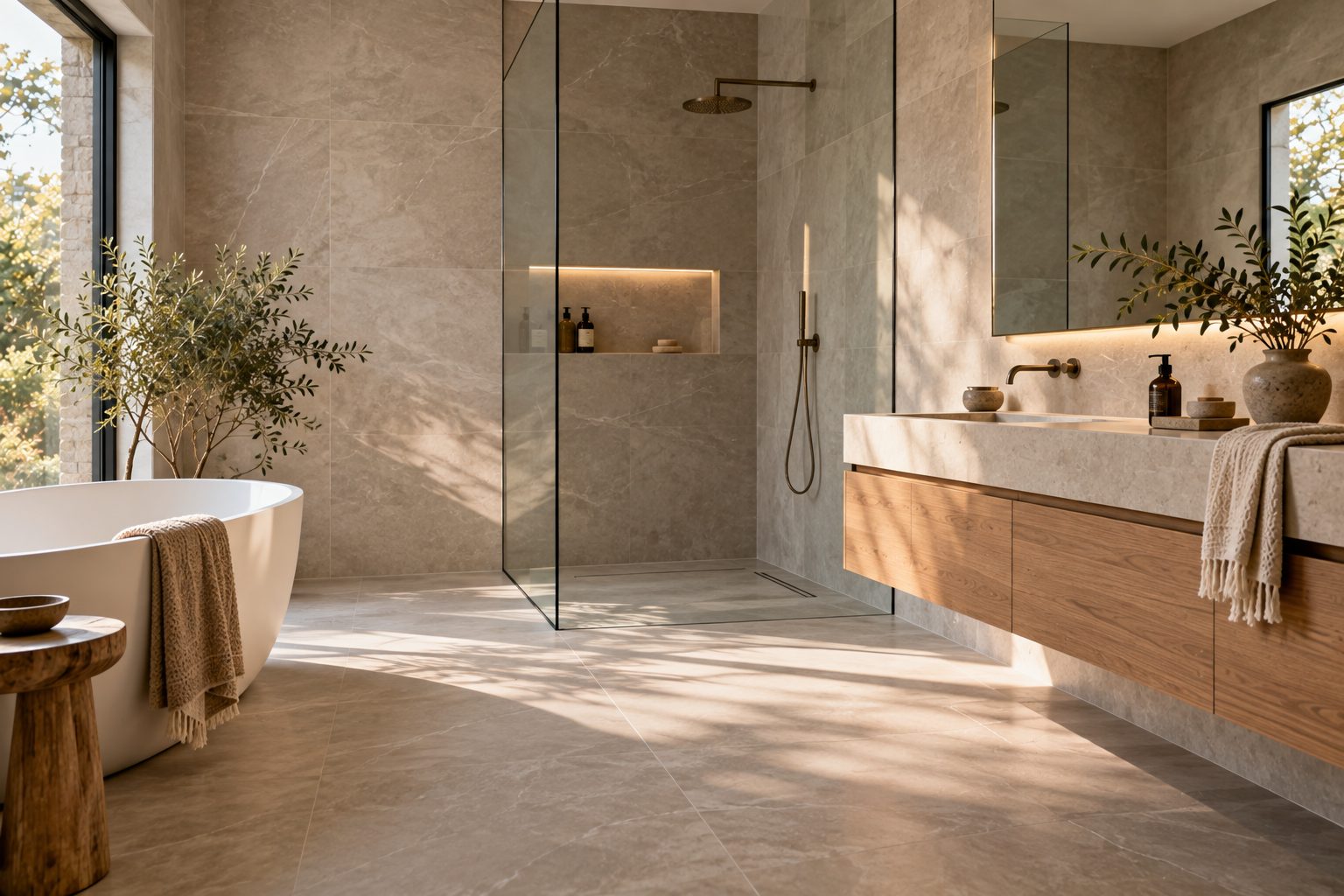
Key takeaways
- Large format tile is any tile with an edge of 15 in (38 cm) or more; the trade uses 24 × 48 in (60 × 120 cm) as the everyday large size
- The floor must be flat to 1/8 in in 10 ft (3 mm in 3 m), and offsets should stay at 33 percent or less to limit lippage
- Use large-and-heavy-tile mortar and aim for 95 percent coverage in showers and kitchens, 80 percent minimum in dry rooms
- Typical US 2026 installed cost is $14–35 per sq ft for porcelain tile and $30–60 for thin porcelain panels
Large format tile is any tile with at least one edge 15 in (38 cm) or longer, per the tile industry's installation standards. In practice the everyday sizes are 24 × 24 in (60 × 60 cm) and 24 × 48 in (60 × 120 cm), rising to porcelain panels of 5 × 10 ft (1.6 × 3.2 m) that cover a shower wall with no grout at all.
- Definition: one side 15 in (38 cm) or longer counts as large format.
- Common sizes: 12 × 24, 24 × 24, 24 × 48, 32 × 32, 48 × 48 in, plus thin panels up to 63 × 126 in.
- Flatness: substrate within 1/8 in in 10 ft (3 mm in 3 m) and 1/16 in in 24 in (1.5 mm in 60 cm).
- Typical installed cost (US 2026): $14–35 per sq ft for porcelain tile, $30–60 for panels.
- Material: nearly always porcelain, because ceramic bodies warp at these sizes.
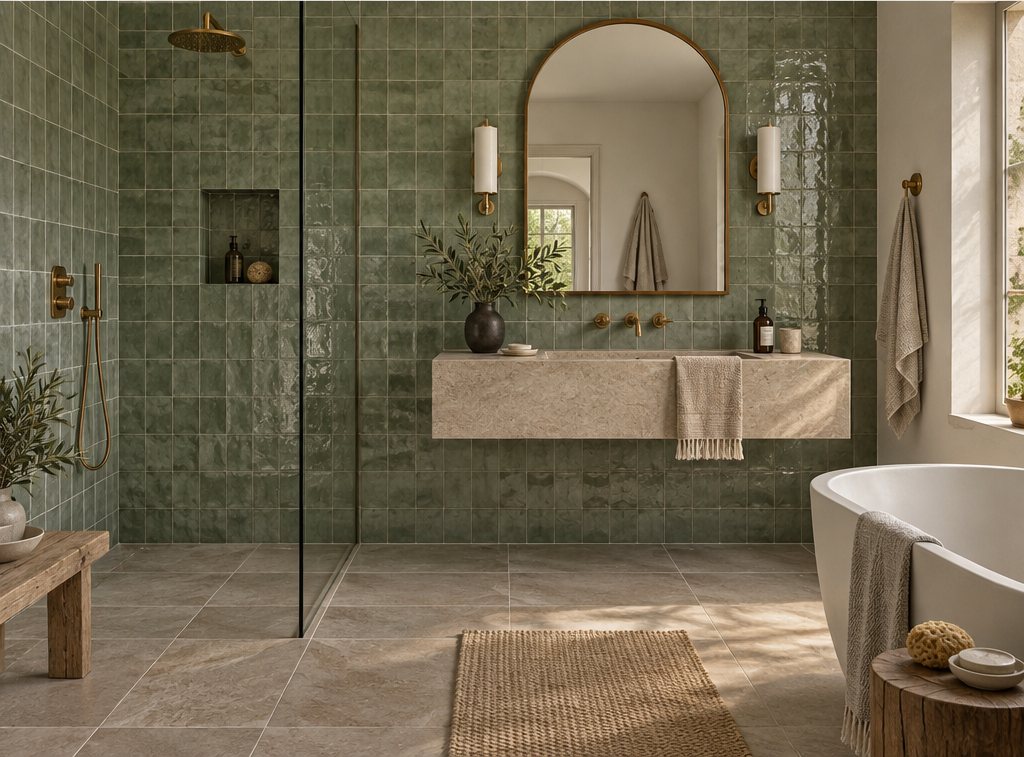
Oversized porcelain is one of the defining surfaces in our tile trends 2027 report: fewer grout lines, stone and concrete looks, and the same tile running from floor to wall. This guide explains how to choose and install it without the lippage, cracking and hollow spots that give large tiles a bad name.
What sizes does large format tile come in?
Large format tile runs from 12 × 24 in (30 × 60 cm) at the small end to porcelain slabs of 63 × 126 in (160 × 320 cm), and the right size depends on the room, the doors and the installer.
| Size | Thickness | Approx. weight per tile | Best use | Typical material cost |
|---|---|---|---|---|
| 12 × 24 in (30 × 60 cm) | 8–10 mm | 9–10 lb (4–4.5 kg) | Small bathrooms, shower walls, kitchens | $2–7 per sq ft |
| 24 × 24 in (60 × 60 cm) | 9–10 mm | 18–20 lb (8–9 kg) | Kitchen and living floors | $3–9 per sq ft |
| 24 × 48 in (60 × 120 cm) | 9–11 mm | 36–42 lb (16–19 kg) | Open-plan floors, feature walls, showers | $4–12 per sq ft |
| 32 × 32 in (80 × 80 cm) | 10–11 mm | 32–36 lb (14.5–16 kg) | Large rooms, minimal grout floors | $5–12 per sq ft |
| 48 × 48 in (120 × 120 cm) | 9–11 mm | 70–80 lb (32–36 kg) | Lobbies, big living areas | $7–15 per sq ft |
| 48 × 96 to 63 × 126 in panels | 3–6 mm (gauged) | 45–150 lb (20–68 kg) | Shower walls, vanity walls, fireplaces | $12–30 per sq ft |
Weights assume porcelain at about 2.3 kg per m² per mm of thickness, so treat them as close estimates. Thin gauged porcelain panels are a different product with their own installation standard and usually need a two-person crew with suction frames.
Huge porcelain tiles look spectacular in a showroom, but every tile must pass through your front door, turn the stairs and fit the elevator. For a 48 × 96 in panel, measure the route before you order.
Is large format porcelain tile better than ceramic?
Large format porcelain tile is better than ceramic at these sizes, because the dense, low-absorption body (0.5 percent or less) stays flat in the kiln and resists cracking under point loads.
Ceramic tile in kitchen and bathroom walls is fine at 12 × 24 in or smaller, and a ceramic kitchen floor tile rated PEI 3 handles light residential traffic. Above that, ceramic bodies tend to bow, which shows up as lippage at every joint. For big floor tiles specify rectified porcelain (machine-squared edges, so joints can shrink to 1/16 in), PEI 4 for kitchens and entries, and a wet DCOF of at least 0.42. Through-body or color-body porcelain hides chips better than glazed porcelain on heavy-use floors.
What are the best floor tiles for kitchen spaces?
The best floor tiles for kitchen spaces are rectified porcelain in 24 × 24 in or 24 × 48 in, matte or lightly textured, with a mid-tone color that hides crumbs and a grout two shades darker than white.
Kitchen floor tiles design trends for 2027 lean toward honed limestone, warm terrazzo and soft concrete looks rather than glossy marble prints, which show every smear. Large floor tiles make a small kitchen read bigger, because the eye counts grout lines, not square feet. Run the tile under the cabinets so a future layout change does not leave a hole. For more tile floors for kitchens, including wood-look plank and patterned options, see our kitchen flooring ideas.
Large floor tiles in open plans
In open plans, keep one tile and one direction through kitchen, dining and living, and lay the long side of a 24 × 48 in tile parallel to the longest wall or main sightline. A 32 × 32 in or 48 × 48 in square suits rooms wider than about 14 ft (4.3 m); in a narrow galley it feels like a chessboard.
Can you use large format tile in a shower?
Yes, large format tile works very well on shower walls, and on the floor too if the floor is sloped in one plane toward a linear drain rather than toward a center drain.
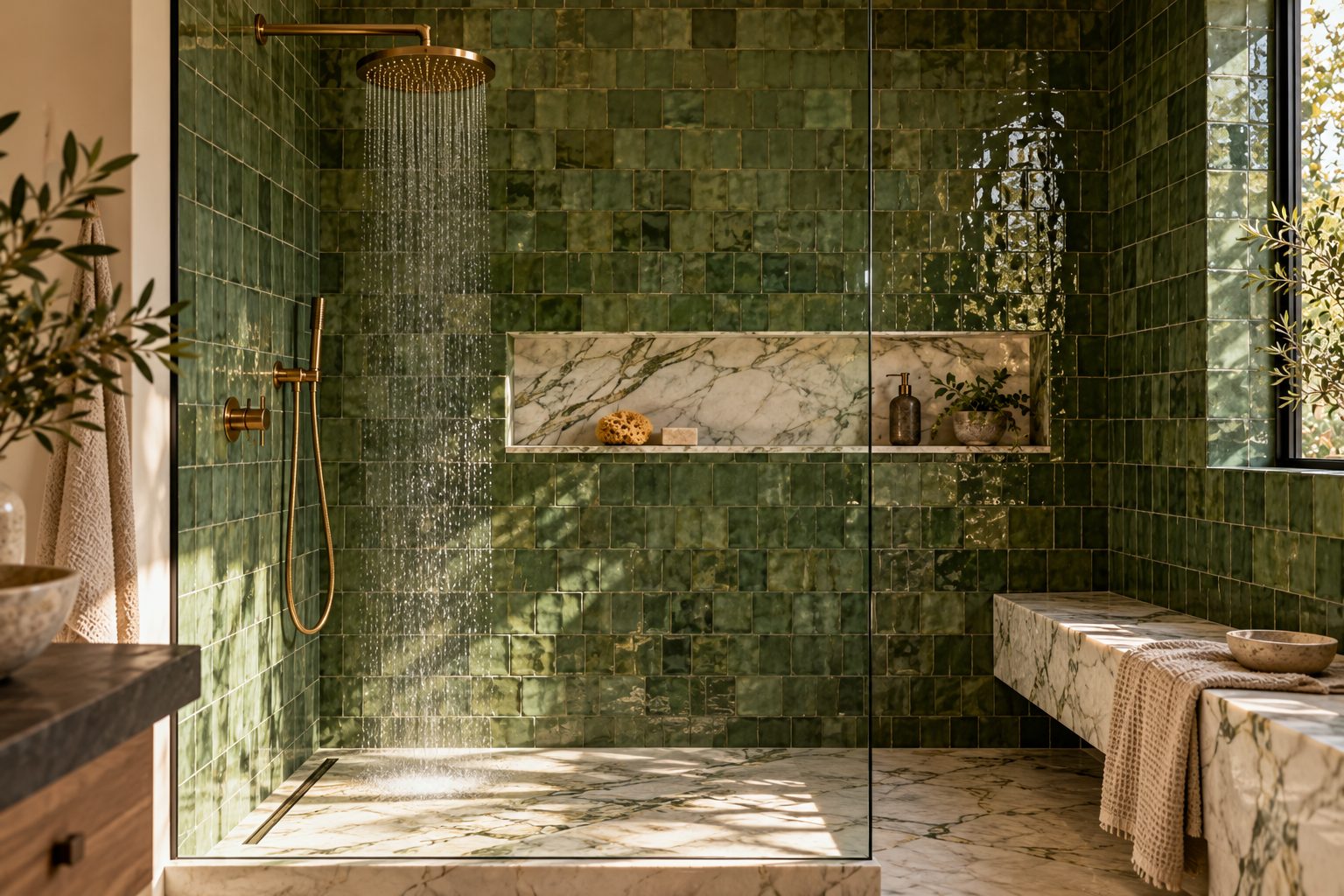
Large tiles for shower walls mean fewer grout lines to clean and less chance of mold. Large porcelain tiles for shower walls go up fastest in 24 × 48 in or as full-height panels, and a large tile shower with panel walls can have just four vertical joints. The floor is the tricky part. A center drain needs four sloping planes, and a large rigid tile cannot bend to follow them, so it rocks or cracks. The fix is a linear drain at the back or entry wall, with the whole floor pitched at 1/4 in per foot (2 percent) toward it. In a large format tile shower floor, aim for a wet DCOF well above 0.42, ideally a textured or grip finish.
Behind every large format tile bathroom wall goes a bonded waterproofing membrane, then large-and-heavy-tile mortar with full coverage. Our walk-in shower ideas guide covers curbless entries, glass and niches in detail.
How do you install large format tile without lippage?
Large format tile installs flat when the floor is flattened first, the mortar is back-buttered for full coverage, and a leveling system holds each edge in line while the mortar cures.
- Check flatness. Run a 10 ft (3 m) straightedge across the floor; fix any dip over 1/8 in (3 mm) with self-leveling underlayment, and grind high spots.
- Plan the layout. Dry-lay a row to avoid slivers under 1/3 of a tile at walls and doorways, and keep offsets at 33 percent or less of tile length.
- Use the right mortar. Choose a large-and-heavy-tile (LHT) polymer-modified mortar and a 1/2 in (12 mm) square or slant-notch trowel.
- Back-butter every tile. Skim the back, comb the floor in straight parallel lines, then slide the tile across the ridges to collapse them.
- Check coverage. Lift a tile early on: you want 95 percent contact in wet areas and exteriors, 80 percent minimum indoors and full support at corners.
- Level the edges. Fit clips and wedges or caps at each joint and remove them after the mortar cures, usually after 24 hours.
- Leave movement joints. Keep a 1/4 in (6 mm) gap at walls and add soft joints every 20–25 ft (6–8 m) in interiors, closer in sunny rooms.
- Grout tight. Grout joints of 1/16–1/8 in (1.5–3 mm) for rectified tile; never butt-joint tile with no joint at all.
Run the numbers with our tile calculator, which adds waste for the layout pattern. Large tiles typically need 10 percent overage for straight lay, more for offsets and diagonal layouts.
What does large format tile cost to install?
Large format tile typically costs $14–35 per sq ft installed in the US in 2026, with labor making up half or more of the total because of floor prep, heavy handling and slower setting.
- Tile: $3–12 per sq ft for 24 × 24 to 24 × 48 in porcelain; $12–30 for thin panels.
- Labor: $8–20 per sq ft for large tiles, $15–30 for panels with a two-person crew.
- Prep: $2–6 per sq ft for self-leveling underlayment where floors are out of flat.
- Mortar, membrane and leveling system: $1.50–4 per sq ft.
These are typical ranges; city labor rates, access and demolition move them. Our tile installation cost guide breaks down quotes line by line.
Wall tiles: when does large format beat small tile?
Large format wall tiles win on bathroom, shower and fireplace walls where you want calm and easy cleaning, while small tiles win on curves, sloped floors and anywhere you want handmade texture.
Most wall tiles sold today are 3 × 12 in (7.5 × 30 cm) to 12 × 24 in (30 × 60 cm). Going bigger on the wall needs a wall flat to 1/8 in in 10 ft, which old plaster rarely is, so budget for skim coating or new backer board. Large bathroom tiles also limit you around niches, window returns and pipe penetrations: every cut on a 24 × 48 in tile is expensive. Big bathroom tiles in a small room usually look better than people expect, because the room reads as one plane. Kitchen bathroom tile combinations, with the same porcelain on floor and wall, give a seamless spa feel.
Mistakes we see with large format tile bathroom and kitchen floors
The mistake we see most is a 50 percent offset on long rectangular tiles, which lines up the slight bow at the middle of one tile with the raised edge of the next and makes lippage unavoidable.
Others follow close behind. Installers spot-bonding large tiles with dabs of mortar, which leaves hollow corners that crack under a dropped pot. Homeowners choosing polished large bath tiles for a bathroom floor, which turn slippery when wet. Grout joints set narrower than the tile's caliber variation allows. And ordering from two production lots, so the shades differ by a visible step. Large porcelain tile is forgiving once installed, but not during installation; hire a setter who can show you finished large-format jobs.
Planning a floor or shower? Measure your room in our tile calculator to get the box count and waste allowance before you request quotes.
Free toolTile CalculatorWork out tiles, boxes, grout and adhesive with the right wastage.Shop & source the look
Buy it today — or have it made
Retail links are affiliate links: we may earn a commission at no extra cost to you (disclosure). “Get it made” sends the item to our sourcing desk for factory quotes in custom sizes and finishes.
Frequently asked questions
What is considered large format tile?
Large format tile is any tile with at least one edge 15 in (38 cm) or longer, according to the North American installation standards. That includes 12 × 24 in planks, 24 × 24 in squares and porcelain panels up to 5 × 10 ft. Tiles of this size need a flatter substrate, special mortar and more careful setting than small tiles.
Does large format tile make a small bathroom look bigger?
Yes, large format tile usually makes a small bathroom look bigger, because fewer grout lines let the floor and walls read as continuous planes. Choose 12 × 24 in or 24 × 24 in on the floor and up to 24 × 48 in on walls, in a light, matte color with grout matched closely to the tile.
What trowel size do you use for large format tile?
For 24 × 24 in or 24 × 48 in tile, most installers start with a 1/2 in (12 mm) square-notch or slant-notch trowel and large-and-heavy-tile mortar, then back-butter each tile. Lift a tile to check coverage: aim for 95 percent in showers and kitchens, 80 percent minimum in dry rooms.
What offset should you use for 12 × 24 tile?
Use an offset of 33 percent or less for 12 × 24 in tile, often called a one-third offset. Long porcelain tiles bow slightly in the middle, so a 50 percent offset lines up the high center of one tile with the edges of the next and causes lippage. Check the tile box for the maker's recommended maximum.
Is large format tile more expensive to install?
Yes, large format tile is typically more expensive to install, often $8–20 per sq ft for labor versus $5–12 for standard tile. Floors may need self-leveling underlayment, tiles are heavy and must be back-buttered, and panels need two installers. Fewer grout lines and faster cleaning offset some of that long term.
Some links may be affiliate links. Regulations and specifications change — always confirm with suppliers and qualified professionals.