Shower Tile Ideas: 14 Wall and Floor Designs, Sizes and Real Costs
The best shower tile ideas pair large porcelain wall tile with small slip-resistant floor mosaics. See 14 designs, the right sizes, DCOF ratings and typical costs of $1,500–6,000 to tile a standard shower.
Part of our guide: Tile Trends 2027: Zellige, Large-Format Porcelain and Warm Grout
Key takeaways
- Use porcelain for shower walls and floors: it absorbs 0.5 percent water or less and needs no sealing
- Shower floors need small tiles or a linear drain, and a wet DCOF of 0.42 or higher
- A standard 60 x 32 in (152 x 81 cm) alcove needs about 80–90 sq ft of wall tile plus 10–15 percent waste
- Budget a typical $1,500–6,000 to tile a standard shower and $4,000–12,000 for a large walk-in
The shower tile ideas that work best combine large porcelain tile on the walls, 12 x 24 in (30 x 60 cm) or bigger, with small slip-resistant mosaics or a matching textured tile on the floor, plus one feature: a niche, a contrast wall or a pattern. Tiling a standard shower typically costs $1,500–6,000 installed, and the waterproofing behind the tile matters more than the tile itself.
This guide covers walls, floors, sizes, quantities and costs, then our own picks. It sits inside our tile trends 2027 guide, which explains the wider shift toward textured glazes, warm neutrals and bigger formats that these shower tile designs draw on.
- Best material: porcelain, at 0.5 percent water absorption or less, for walls and floors.
- Floor safety: a wet DCOF of 0.42 or higher, and tiles small enough to follow the slope.
- Wall size: 12 x 24 in (30 x 60 cm) to 24 x 48 in (60 x 120 cm) for fewer grout lines.
- Quantity: measure every wall to the tiled height and add 10–15 percent waste.
- Typical cost: $1,500–6,000 for a standard alcove, $4,000–12,000 for a large walk-in.
What is the best tile for a shower?
The best tile for a shower is porcelain, because it absorbs almost no water, resists staining and needs no sealer, while matching porcelain is available in wall and floor versions.
Porcelain shower tile is a dense, kiln-fired clay body with water absorption of 0.5 percent or less. Glazed ceramic is fine on shower walls and costs less, but it is softer and rarely suitable on a shower floor. Natural stone, glass and handmade tile are all possible, each with a trade-off the table makes clear.
| Material | Water absorption | Shower walls | Shower floor | Typical material cost | Upkeep |
|---|---|---|---|---|---|
| Porcelain | 0.5% or less | Excellent | Excellent in small formats or textured finish | $3–15 per sq ft | Low, no sealing |
| Glazed ceramic | 3–7% (body) | Very good | Only if rated for wet floors | $2–10 per sq ft | Low |
| Marble or limestone | 0.2–5%, varies | Good | Honed mosaics only | $10–40 per sq ft | Seal yearly, pH-neutral cleaner |
| Glass mosaic | Near 0% | Good as accent | Poor, slippery unless textured | $15–40 per sq ft | Low, shows water spots |
| Zellige or handmade | Higher, varies | Good, with sealing | Not recommended | $15–45 per sq ft | Seal, accepts variation |
Prices are typical US 2026 ranges for material only. If you love the look of glazed handmade tile, read our zellige tile guide before you put it in a heavily used shower.
What size tile for shower walls?
For shower walls, 12 x 24 in (30 x 60 cm) is the safest all-round size, and 24 x 48 in (60 x 120 cm) or larger gives the cleanest, most modern look with the fewest grout lines.
- Small showers: large tile makes a 36 x 36 in (91 x 91 cm) stall feel bigger because the wall reads as one surface.
- Classic look: 3 x 12 in (7.5 x 30 cm) or 4 x 12 in (10 x 30 cm) subway in a stacked or offset pattern.
- Handmade texture: 2.5 x 8 in (6.5 x 20 cm) or 4 x 4 in (10 x 10 cm) glazed tile, which needs more grout and more care.
- Slab-like walls: panels of 48 x 96 in (120 x 240 cm) or more need two installers and a flat substrate within 1/8 in over 10 ft (3 mm over 3 m).
Tiles longer than 18 in (46 cm) should be offset by no more than one third to avoid lippage from slight bow in the tile. Our large-format tile guide covers substrate flatness, thinset and handling in detail.
Shower floor tile ideas that stay safe
Shower floor tile must slope to a drain and grip when wet, so choose small mosaics or a textured porcelain with a wet DCOF of at least 0.42.
A traditional center drain needs the floor to slope in four directions at about 1/4 in per foot (2 percent), which only small tiles can follow. That is why most shower floor tile ideas use 2 x 2 in (5 x 5 cm) squares, 1 to 2 in (2.5 to 5 cm) hexagons, penny rounds or pebble sheets. The extra grout lines also add grip.
A linear drain against one wall turns the floor into a single sloped plane, so 12 x 24 in (30 x 60 cm) tiles can run continuously from the bathroom into a curbless shower. Specify a matte or textured finish and check the wet DCOF on the spec sheet.
- Decide the drain first. Center drain for small tiles; linear drain for large tiles or curbless entries.
- Check the slip rating. Wet DCOF 0.42 or higher; unglazed porcelain mosaics often exceed it.
- Pick the grout. Epoxy or high-performance grout resists staining and mildew on floors.
- Match or contrast. The same tile in mosaic form looks calm; a darker floor hides soap marks.
Walk in shower tile ideas
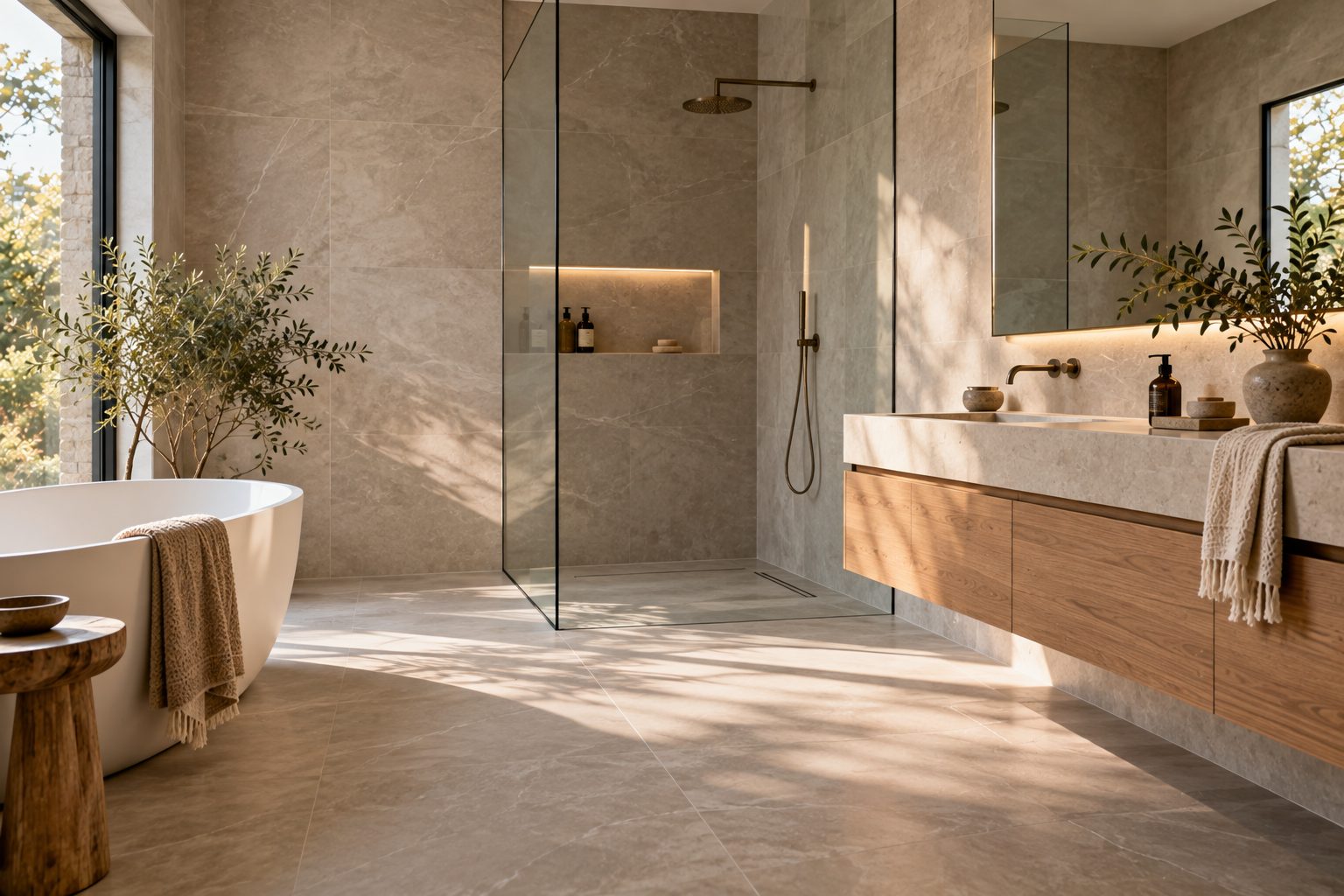
Walk-in showers look best with one continuous wall tile, a floor that flows from the bathroom and one carefully placed accent, because there is no curb or door frame to break the design.
Tile designs for walk in showers
- Floor-to-ceiling large format: 24 x 48 in (60 x 120 cm) porcelain on every wet wall, ceiling optional in steam showers.
- Feature back wall: a vertical stacked tile or a stone-look porcelain on the back wall only, with plain side walls.
- Wraparound mosaic band: a 6–12 in (15–30 cm) band at shoulder height in a contrasting mosaic.
- Continuous floor: the bathroom floor tile running into the shower with a linear drain and no curb.
Small walk in shower tile ideas
In a small walk-in, around 36 x 48 in (91 x 122 cm), keep to one or two tiles, run them floor to ceiling and set the niche on the side wall where it will not be seen from the door. A pale wall tile with a slightly darker floor makes the space feel deeper. Our walk-in shower ideas guide covers sizes, glass panels and drain layouts for these walk in tiled shower designs.
14 shower tile designs worth copying
The shower tile designs that age best rely on one strong idea per shower, whether a pattern, a color or a texture, with everything else kept quiet.
- Vertical stacked subway: 2.5 x 8 in (6.5 x 20 cm) tile set vertically to make a low ceiling feel taller.
- Herringbone back wall: 3 x 12 in (7.5 x 30 cm) tile on the back wall only.
- Stone-look slab porcelain: 24 x 48 in (60 x 120 cm) or bigger, bookmatched where possible.
- Zellige-look glaze: porcelain with a rippled glaze for texture without handmade maintenance.
- Two-tone split: darker tile to 48 in (122 cm), lighter above.
- Penny round floor: classic, grippy and inexpensive.
- Terrazzo-look floor and walls: one speckled tile throughout; see our terrazzo tile guide.
- Fluted or 3D tile: one textured wall, kept away from direct spray where soap builds up.
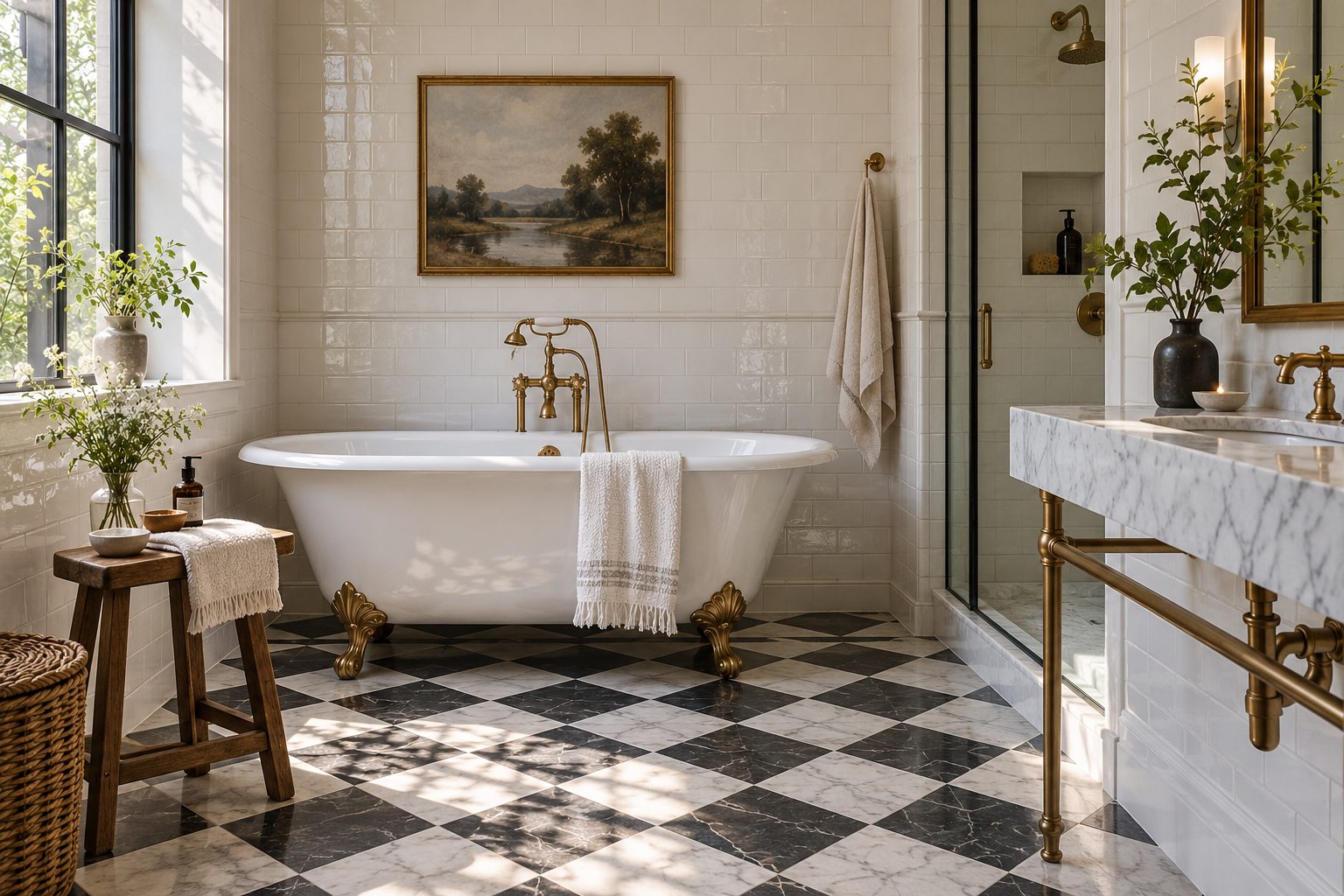
- Checkerboard floor: 4 x 4 in (10 x 10 cm) or 6 x 6 in (15 x 15 cm) in two close tones.
- Colored grout: warm gray or sand grout to soften white tile and hide discoloration.
- Tiled bench and niche: the same tile wrapped around, with a sloped top so water drains.
- Glass mosaic accent: limited to the niche back.
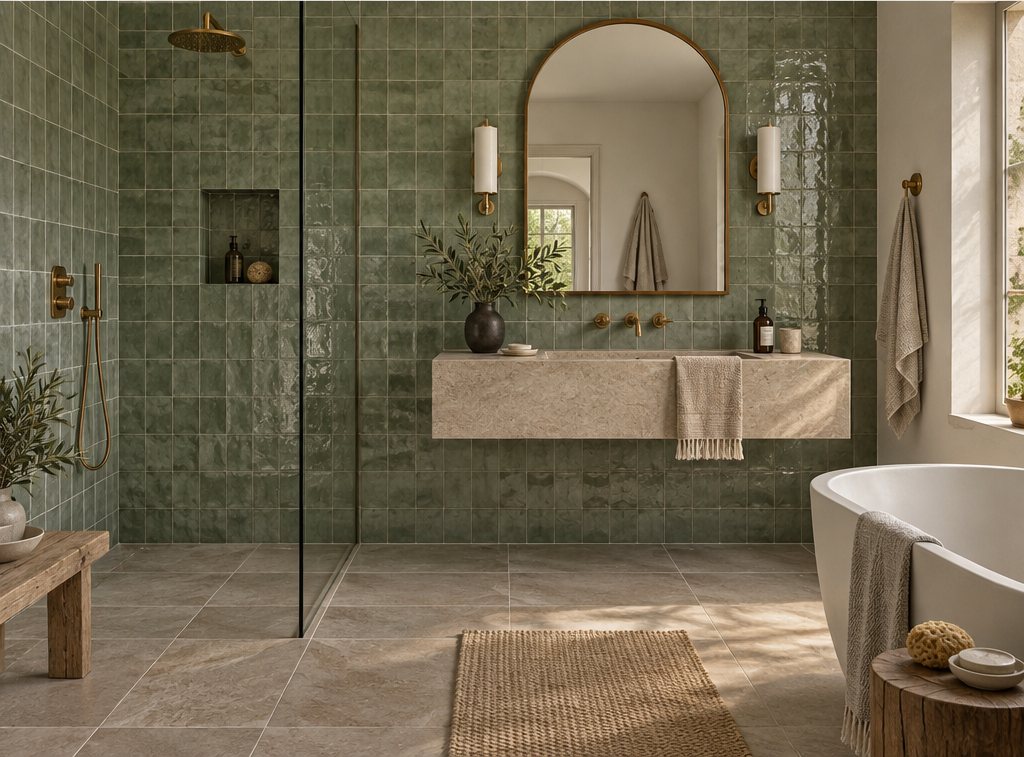
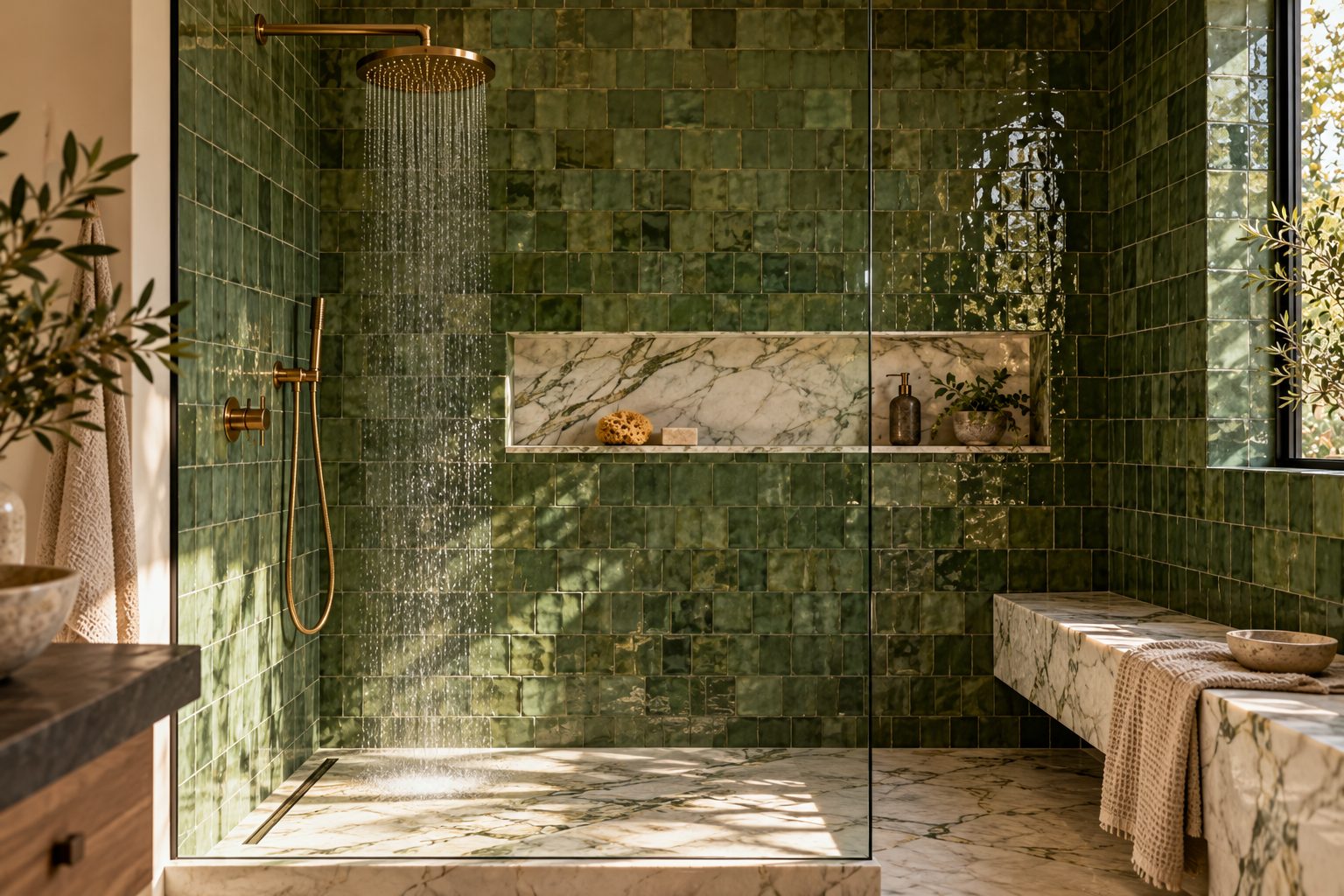
- Dark matte shower: charcoal or deep green porcelain with a pale grout line.
- Warm terracotta-look: glazed porcelain in clay tones, a 2027 favorite.
Modern shower tile ideas and colors for 2027
Modern shower tile ideas for 2027 favor warm whites, soft clay, sage and stone tones in matte or gently glazed finishes, replacing the stark white and cool gray of the last decade.
#EDE6DA#C9B8A2#A9B5A6#B5734F#3F4744The hex values are approximate screen references; glazes shift a lot with light, so order two or three full tiles, not chips, and look at them in your bathroom in daylight and at night under 2700–3000K bulbs. Modern bathroom tiles now lean on texture rather than gloss, so a satin or matte glaze reads more current than high shine.
How much tile do I need for my shower?
To work out how much tile you need for a shower, multiply the width by the tiled height of each wall, add the floor, subtract nothing for small niches and add 10–15 percent waste.
Here is how to measure tile for a shower and figure the quantity:
- Measure each wet wall in inches: width times tiled height, usually to the ceiling or 84–96 in (213–244 cm).
- Divide by 144 to convert square inches to square feet.
- Measure the floor the same way and keep it as a separate order.
- Add waste: 10 percent for straight lay, 15 percent for offset or large format, 15–20 percent for herringbone or diagonal.
- Round up to full boxes and buy from one production lot so the shade matches.
| Shower size | Wall tile (to 96 in / 244 cm) | Floor tile | Order with 15% waste |
|---|---|---|---|
| Tub-shower alcove, 60 x 32 in (152 x 81 cm) | about 83 sq ft (7.7 m²) | none (tub) | about 96 sq ft wall |
| Stall, 36 x 36 in (91 x 91 cm) | about 72 sq ft (6.7 m²), 3 walls | 9 sq ft (0.8 m²) | 83 sq ft wall, 11 sq ft floor |
| Walk-in, 36 x 60 in (91 x 152 cm) | about 88 sq ft (8.2 m²), 3 walls | 15 sq ft (1.4 m²) | 101 sq ft wall, 18 sq ft floor |
| Large walk-in, 48 x 72 in (122 x 183 cm) | about 112 sq ft (10.4 m²), 3 walls | 24 sq ft (2.2 m²) | 129 sq ft wall, 28 sq ft floor |
Niches, benches and window returns add small cut-heavy areas, so round generously there. For multi-surface jobs, the tile calculator linked at the end of this guide handles the waste factor and box count for you.
How much does it cost to tile a shower?
Tiling a standard shower typically costs $1,500–6,000 including waterproofing, tile and labor, and a large custom walk-in runs $4,000–12,000 or more.
Labor is usually the bigger share: $10–25 per sq ft for walls and more for mosaics, niches, benches and large-format panels. Waterproofing with a bonded sheet or liquid membrane adds $3–8 per sq ft, and it is the step you should never value-engineer. Our tile installation cost guide breaks the numbers down by job. All figures are typical US 2026 ranges and vary by region.
How we'd do it: choosing shower tile
When clients ask how to choose shower tile, we start with the floor, because slip resistance and drain layout narrow the options fast, then pick a wall tile that suits it.
Our default spec for tile showers is matte porcelain at 12 x 24 in (30 x 60 cm) on the walls, a 2 in (5 cm) unglazed porcelain mosaic in a close tone on the floor, warm gray grout and one tiled niche of 12 x 24 in (30 x 60 cm). It costs less than stone, needs no sealing and still looks considered in ten years. The mistake we see most is a beautiful glossy floor tile that is lethal when wet, followed closely by a niche placed on the wall facing the door, where every shampoo bottle is on display. When you pick shower tile, also look at it next to the vanity, the faucet finish and the paint, because a shower is rarely seen alone.
Ready to order? Measure your walls and floor and run them through the tile calculator to get square footage, waste and box counts before you buy.
Free toolTile CalculatorWork out tiles, boxes, grout and adhesive with the right wastage.Shop & source the look
Buy it today — or have it made
Retail links are affiliate links: we may earn a commission at no extra cost to you (disclosure). “Get it made” sends the item to our sourcing desk for factory quotes in custom sizes and finishes.
Frequently asked questions
What is the best tile for a shower?
Porcelain is the best tile for a shower because it absorbs 0.5 percent water or less, resists stains and needs no sealing. Use large porcelain on the walls and small porcelain mosaics or a textured porcelain with a wet DCOF of 0.42 or higher on the floor. Ceramic works on walls; stone needs regular sealing.
What size tile for shower walls?
A 12 x 24 in (30 x 60 cm) tile suits most shower walls, and 24 x 48 in (60 x 120 cm) gives a cleaner modern look with fewer grout lines. Classic subway at 3 x 12 in (7.5 x 30 cm) also works well. Offset long tiles by no more than one third to avoid uneven edges.
How much tile do I need for my shower?
Multiply width by tiled height for each wall, add the floor area separately, then add 10–15 percent for waste. A 60 x 32 in tub-shower alcove tiled to 96 in needs about 83 sq ft of wall tile, roughly 96 sq ft once waste is added. Buy full boxes from one production lot.
How much would it cost to tile a shower?
Tiling a standard shower typically costs $1,500–6,000, including waterproofing, tile and labor, while a large custom walk-in can run $4,000–12,000 or more. Labor is usually $10–25 per sq ft, and mosaics, niches, benches and large-format panels push the price toward the top of the range.
How do you pick shower tile?
Pick shower tile by starting with the floor: choose a slip-resistant tile that suits your drain type, then a wall tile that complements it in tone and finish. Favor porcelain, check the wet DCOF and water absorption, and view full sample tiles in your bathroom under its own lighting.
Some links may be affiliate links. Regulations and specifications change — always confirm with suppliers and qualified professionals.