Outdoor Restaurant Furniture: Materials, Sizes and Real Costs
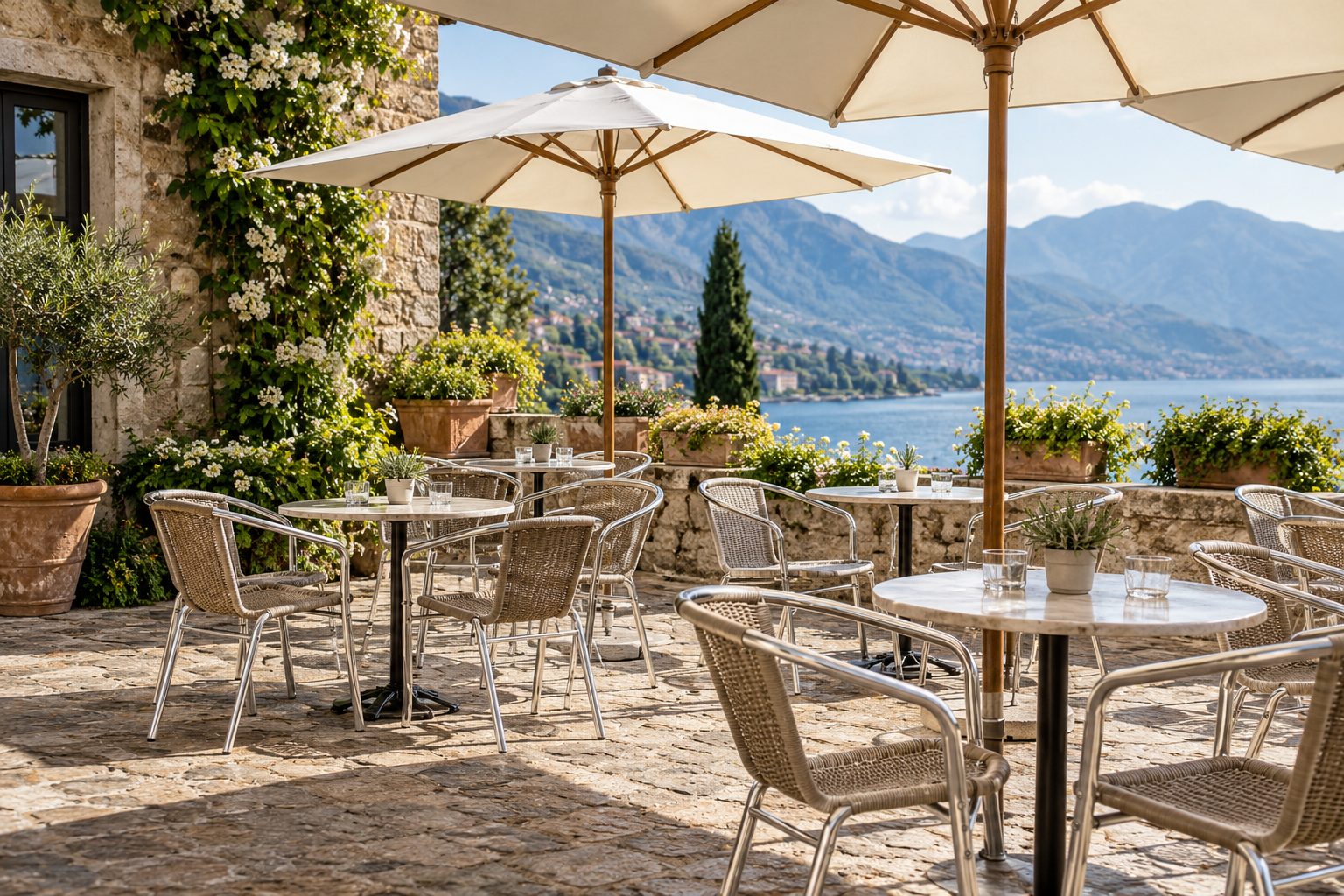
Outdoor restaurant furniture should be commercial grade: powder-coated aluminum, teak or resin, planned at 15–20 sq ft per seat. Here are materials, table sizes, ratings, typical costs and how to source a patio fit-out.
Part of our guide: Restaurant Furniture Buying Guide: Chairs, Tables & Commercial-Grade Specs
Key takeaways
- Plan outdoor restaurant seating at 15–20 sq ft (1.4–1.9 m²) per seat, with 18 in (46 cm) between chair backs and 36–44 in (91–112 cm) service aisles
- Powder-coated aluminum is the best all-round commercial outdoor furniture material: light, rustproof and stackable
- Budget roughly $250–700 per outdoor seat for commercial grade tables and chairs, typical 2026 US pricing
- Ask for BIFMA-style load testing, UV-stabilized finishes, 316 stainless fixings and wind-rated table bases before you buy
Outdoor restaurant furniture should be commercial grade: powder-coated aluminum, plantation teak or UV-stabilized resin, with stainless fixings and weighted or anchored table bases. Plan 15–20 sq ft (1.4–1.9 m²) per seat and budget roughly $250–700 per seat for tables and chairs. Residential patio sets fade, rust and fail within one or two seasons of daily commercial use.
- Space per seat: 15–20 sq ft (1.4–1.9 m²) for casual dining, 12–15 sq ft (1.1–1.4 m²) for bar and café seating.
- Best all-round material: powder-coated aluminum, rustproof and light enough to stack and store.
- Typical cost: $120–400 per chair and $250–900 per table in commercial grade, US 2026 ranges.
- Lifespan: 5–10 years for commercial outdoor furniture against 1–3 seasons for residential.
- Lead time: 2–6 weeks from stock; 8–14 weeks for factory or custom finishes.
This page extends our restaurant furniture guide, which covers the dining room, booths and back of house. Here we deal only with the terrace, patio, sidewalk and rooftop, where sun, rain, wind and constant stacking change every specification.
What is commercial grade outdoor furniture?
Commercial grade outdoor furniture is furniture built and tested for daily public use outdoors: heavier frames, UV-stabilized finishes, corrosion-resistant fixings and load ratings well above residential pieces. The label is not regulated, so ask what it means for each item.
In practice we look for four things. First, a load test: chairs tested to a commercial seating standard, typically a static seat load of 250–300 lb (113–136 kg) with a safety margin, plus cycle tests on the back. Second, a finish rated for UV exposure, such as polyester powder coat of 60–80 microns, or resin with UV inhibitors. Third, 304 or, near the coast, 316 stainless steel fixings. Fourth, a written warranty of three to five years on the frame. Residential patio furniture rarely gives any of these in writing.
Fire rules matter on covered terraces and enclosed winter patios. Cushions and upholstery in public spaces may need to meet local flammability codes; check with your fire marshal before specifying padded seats under a canopy.
Which material is best for restaurant patio furniture?
Powder-coated aluminum is the best material for most restaurant patio furniture, with teak the premium warm option and resin or polypropylene the budget workhorse. The comparison below uses typical 2026 US commercial prices.
| Material | Chair price (typical) | Weight per chair | Upkeep | Lifespan | Best for |
|---|---|---|---|---|---|
| Powder-coated aluminum | $150–400 | 11–15 lb (5–7 kg) | Wash; touch up chips | 8–12 years | All-round patios, stacking, rooftops with ballast |
| Plantation teak | $250–600 | 15–22 lb (7–10 kg) | Clean twice a year; oil optional | 15–25 years | Upscale terraces, hotel restaurants |
| Resin or glass-fiber polypropylene | $60–180 | 9–13 lb (4–6 kg) | Wash only | 4–7 years | Cafés, high turnover, budget fit-outs |
| All-weather synthetic wicker on aluminum | $200–500 | 13–20 lb (6–9 kg) | Hose down; check weave | 5–8 years | Lounge and resort dining |
| Steel, galvanized and powder-coated | $120–300 | 18–26 lb (8–12 kg) | Treat rust at chips promptly | 6–10 years | Windy sites, bistro styling |
| Recycled HDPE lumber | $200–450 | 25–40 lb (11–18 kg) | Wash only | 15–20 years | Picnic-style and family venues |
Aluminum wins because it does not rust, it is light enough for staff to stack 8–10 high at closing, and the powder coat can be matched to brand colors. Teak is heavier and pricier but improves with age; our teak outdoor furniture guide explains grades and how it weathers. For a deeper comparison across residential and commercial uses, see outdoor furniture materials.
Restaurant patio tables and tabletops
Restaurant patio tables fail at the top and the base, rarely the legs. Compact high-pressure laminate at 10–12 mm is the most durable tabletop: UV, frost and scratch resistant, at $80–250 per top. Wood restaurant tables in teak or thermally modified ash look warmest but need cleaning and periodic oiling. Avoid glass, which is a hazard in wind, and untreated stone, which stains from oil and wine.
How much space does outdoor restaurant seating need?
Outdoor restaurant seating needs 15–20 sq ft (1.4–1.9 m²) per diner, slightly more than indoors, because outdoor chairs are larger and servers need wider paths around planters, heaters and umbrella poles. Use these working dimensions:
| Table | Size | Seats | Footprint with chairs |
|---|---|---|---|
| Square two-top | 24–30 in (61–76 cm) | 2 | 60 × 60 in (152 × 152 cm) |
| Round café table | 24–30 in (61–76 cm) diameter | 2 | 60 in (152 cm) circle |
| Square four-top | 36 in (91 cm) | 4 | 84 × 84 in (213 × 213 cm) |
| Rectangular four-top | 30 × 48 in (76 × 122 cm) | 4 | 66 × 84 in (168 × 213 cm) |
| Round six-top | 48 in (122 cm) diameter | 5–6 | 96 in (244 cm) circle |
| Bar-height poseur | 24–30 in (61–76 cm), 40–42 in (102–107 cm) high | 2–4 standing or on stools | 54–60 in (137–152 cm) circle |
Keep 18 in (46 cm) between chair backs at adjacent tables, a 36 in (91 cm) minimum service aisle and 44 in (112 cm) for main routes and accessible paths. At least 5 percent of seats, and at minimum one table, should be accessible: a knee clearance of 27 in (69 cm) high and a top between 28 and 34 in (71–86 cm). Sidewalk cafés also need to leave a clear pedestrian path set by the city, often 5–6 ft (1.5–1.8 m); check your permit drawing before ordering.
What are the best restaurant chairs for outdoor use?
The best restaurant chairs for outdoors are stackable, armless or low-arm side chairs in aluminum or resin, 17.5–18.5 in (44–47 cm) seat height and 18–21 in (46–53 cm) wide. Stacking is the deciding feature: patios are cleared, stored or chained up every night or every storm.
- Armless side chairs: the densest layouts and fastest table turns.
- Armchairs: 22–25 in (56–64 cm) wide; better for lingering dinners, but plan one fewer seat per 10 ft (3 m) of banquette or table run.
- Slat or mesh seats: drain and dry in minutes after rain. Solid seats hold puddles.
- Glides: nylon or rubber feet on pavers, never bare metal on stone or decking.
Commercial dining chairs for terraces should come without fixed cushions. If you want comfort, use quick-dry seat pads in solution-dyed acrylic that staff bring in at night. Pair those covers with open-cell reticulated foam, which drains through and dries within hours after rain.
How do you choose commercial bar furniture for a patio?
Commercial bar furniture outdoors needs a 10–12 in (25–30 cm) gap between seat and counter, heavy or anchored bases, and footrests in stainless steel or powder-coated aluminum. A bar height table and stools works well along rails and patio edges where a dining table would block the aisle.
Bar-height tables stand 40–42 in (102–107 cm) with 30 in (76 cm) stools; counter-height pairs are 36 in (91 cm) with 24–26 in (61–66 cm) stools. Allow 24–28 in (61–71 cm) of counter length per stool. For a pub-style bar table and chairs grouping, a 30 in (76 cm) round top seats two to three comfortably, a 30 × 60 in (76 × 152 cm) rectangle seats four to six. Our bar stool height guide has the full counter-to-seat chart. Backless stools tuck under and drain fastest; low-back stools suit longer stays.
Shade is part of the furniture plan. A 9–11 ft (2.7–3.4 m) umbrella covers a four-top; larger cantilever umbrellas cover several tables but need a 150–250 lb (68–113 kg) base. See our patio umbrella size guide for canopy-to-table sizing.
How do you buy wholesale restaurant tables and chairs?
Buy wholesale restaurant tables and chairs from a commercial dealer for stock items under 50 seats, and from a factory or sourcing agent for larger, branded or custom-finish orders. Whichever route you take, follow the same steps:
- Draw the plan first. Mark the permit boundary, aisles, accessible tables, heaters and drains, then count seats.
- Fix the mix. Typically 60–70 percent two-tops that combine into fours, plus a few rounds and bar-height tables.
- Write the spec. Frame material and wall thickness, finish and micron rating, fixing grade, seat height, stack height, tabletop material and base weight.
- Order samples. One chair and one table, used outdoors for two to four weeks by staff, before any bulk order.
- Compare landed prices. Factory quotes exclude freight, duty and delivery; add 25–40 percent before comparing with a dealer.
- Order 5–10 percent spare. Chairs break, tops get chipped, and the same color batch may not be available next year.
- Plan storage. Measure the store room or covers for off-season; stacked aluminum chairs need about 2 sq ft (0.2 m²) per stack of eight.
Factory orders usually carry MOQs of 50–200 chairs per model and 45–60 days of production. If you need site-specific benches or planters built to fit, our custom furniture guide covers drawings and lead times.
Which colors work for commercial outdoor dining furniture?
Mid-tone and dark colors work best for commercial outdoor dining furniture, because they hide dirt and fade more gracefully than white or bright primaries. White aluminum shows every scuff; black can get hot enough in summer sun to be uncomfortable.
#5C6650#7A6A58#3F4448#B0703F#D8CFC0The values are approximate. Olive, bronze and graphite are the safest frame colors; terracotta and sand suit tabletops, cushions and umbrellas. Request a powder-coat sample panel and view it outdoors at midday and dusk before approving.
Mistakes we see on restaurant patios
The mistakes we see most often are buying residential sets, underestimating wind and forgetting about nightly storage. All three show up within the first season.
- Residential furniture: thin tubing cracks at welds and finishes chalk within months of full sun.
- Light tables in wind: a 30 in top on a 20 lb (9 kg) base will tip with an umbrella open; add weight or bolt down.
- Non-stacking chairs: staff spend 30–45 minutes every night moving them.
- Too many seats: squeezing below 15 sq ft per diner slows service and fails accessible-route checks.
- Mixed fixings: zinc-plated screws in aluminum or teak rust and stain within a season; insist on stainless.
Our verdict on outdoor restaurant furniture
For most patios we would specify powder-coated aluminum stacking chairs in a dark, warm color, compact laminate tabletops on weighted cast aluminum bases, and a handful of teak pieces where guests linger. That combination gives five to ten years of service, fast nightly clearing and a look that suits 2027's warmer, natural outdoor direction. Spend extra on bases, fixings and shade, not on decorative chairs; those are what decide whether outdoor restaurant furniture still looks good in year three.
Fitting out a terrace, rooftop or sidewalk café? Send your plan and seat count to our FF&E sourcing desk and we will return typical prices, MOQs and lead times from vetted commercial furniture factories.
Free toolStyle QuizNot sure which style is yours? Find out in two minutes.Shop & source the look
Buy it today — or have it made
Retail links are affiliate links: we may earn a commission at no extra cost to you (disclosure). “Get it made” sends the item to our sourcing desk for factory quotes in custom sizes and finishes.
Frequently asked questions
Where can I buy wholesale restaurant tables and chairs?
You can buy wholesale restaurant tables and chairs from commercial furniture dealers, restaurant supply distributors or directly from factories. Dealers suit smaller orders from stock, typically shipping in 2–6 weeks. Factories and sourcing agents suit 50 or more seats or custom finishes, with MOQs of 50–200 chairs per model and 45–60 days of production plus freight.
What is the best material for outdoor restaurant furniture?
Powder-coated aluminum is the best material for most outdoor restaurant furniture because it does not rust, weighs 11–15 lb (5–7 kg) per chair and stacks for storage. Teak is the premium choice for upscale terraces and lasts 15–25 years. Resin is the low-cost option for cafés, though it fades sooner.
How much space do you need per seat on a restaurant patio?
You need roughly 15–20 sq ft (1.4–1.9 m²) per seat on a restaurant patio, or 12–15 sq ft (1.1–1.4 m²) for café and bar seating. Allow 18 in (46 cm) between chair backs, 36 in (91 cm) service aisles and 44 in (112 cm) main and accessible routes, plus any clear sidewalk width your permit requires.
How much does commercial outdoor furniture cost?
Commercial outdoor furniture typically costs $120–400 per chair and $250–900 per table in the US in 2026, or about $250–700 per seat overall. Resin sits at the low end, aluminum in the middle and teak at the top. Factory-direct orders can cut those figures substantially but add freight, duty and longer lead times.
Can you leave restaurant patio furniture outside all year?
You can leave commercial grade aluminum, teak and HDPE restaurant patio furniture outside all year, but it lasts longer stacked, covered or stored in winter. Remove cushions and umbrellas nightly, chain or store stacks in high wind, and wash frames monthly in season, especially near the coast where salt attacks finishes.
Some links may be affiliate links. Regulations and specifications change — always confirm with suppliers and qualified professionals.