Patio Umbrella Sizes: Size Chart, Base Weights and Table Fit
Patio umbrella sizes follow one rule: the canopy should be 4–5 ft (1.2–1.5 m) wider than the table. A 48 in table takes a 9 ft umbrella, a 60 in table an 11 ft one, each on a base of the right weight.
Part of our guide: Cantilever Umbrellas: Sizes, Bases & Wind Safety
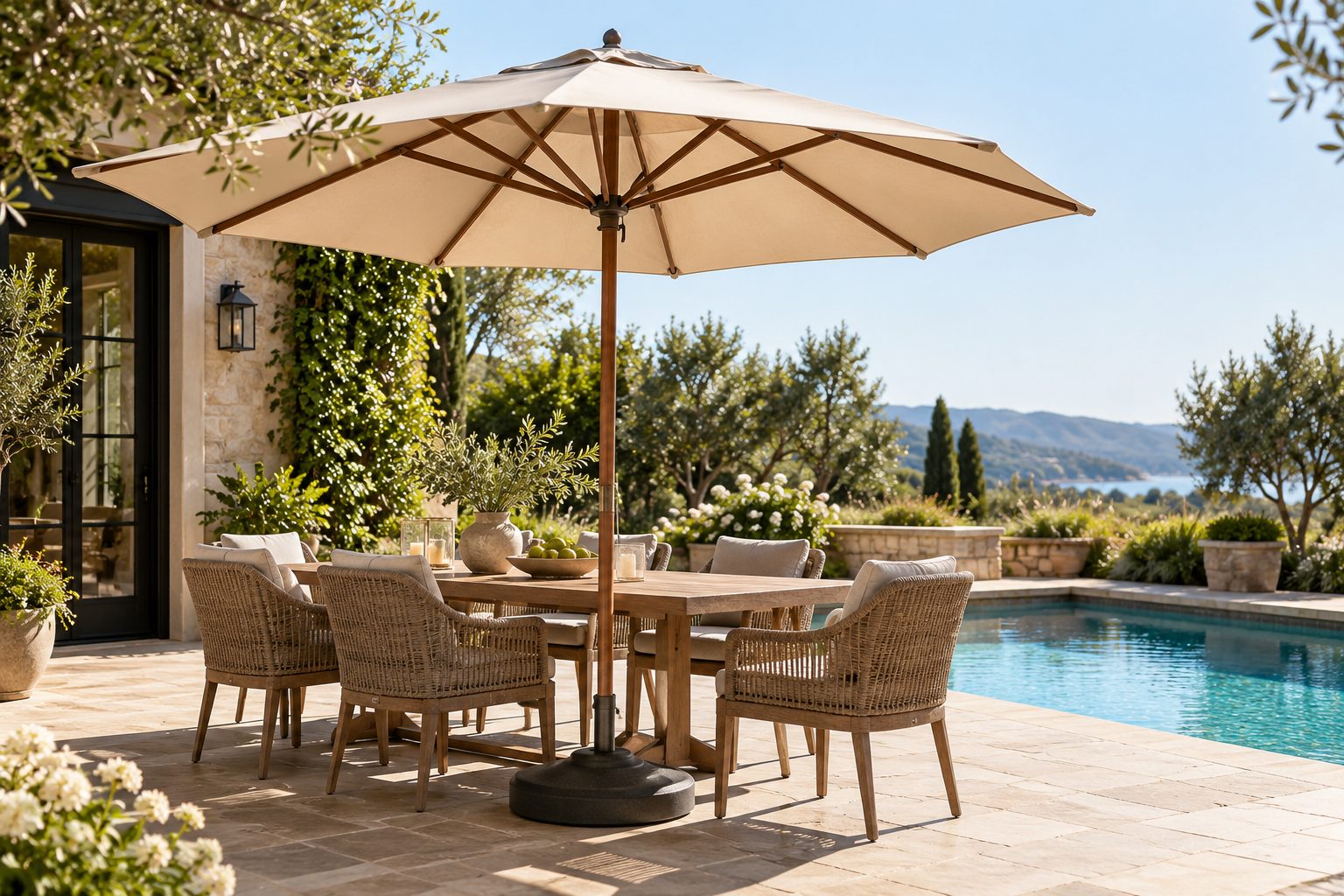
Key takeaways
- Choose a canopy 4–5 ft (1.2–1.5 m) wider than the table, so it overhangs by about 2 ft (60 cm) on every side
- Base weight scales with canopy size and with whether a table steadies the pole: 30–50 lb through a table, 50–100 lb freestanding, 150–250 lb or more for a cantilever
- Rectangular umbrellas belong over rectangular tables; a round canopy over a long table leaves the ends in sun
- Close any umbrella when wind passes about 15–20 mph, whatever the base weighs
To choose patio umbrella sizes, add 4–5 ft (1.2–1.5 m) to the width of your table: a 30 in bistro table takes a 6.5–7.5 ft umbrella, a 48 in round table a 9 ft one, a 60 in table a 10–11 ft one, and a 72–84 in rectangular table a 6.5 × 10 ft rectangular canopy. Then match the base: heavier as the canopy grows.
- Overhang: aim for about 2 ft (60 cm) of canopy beyond the table edge on every side.
- Clearance: keep the lowest edge of the canopy at least 6.5–7 ft (2–2.1 m) above the patio.
- Table hole: most outdoor tables have a 2 in (50 mm) hole for a 1.5 in (38 mm) pole.
- Base: 30–50 lb through a table, 50–100 lb freestanding, 150–250 lb or more for cantilevers.
- Wind: close the umbrella above about 15–20 mph, regardless of base weight.
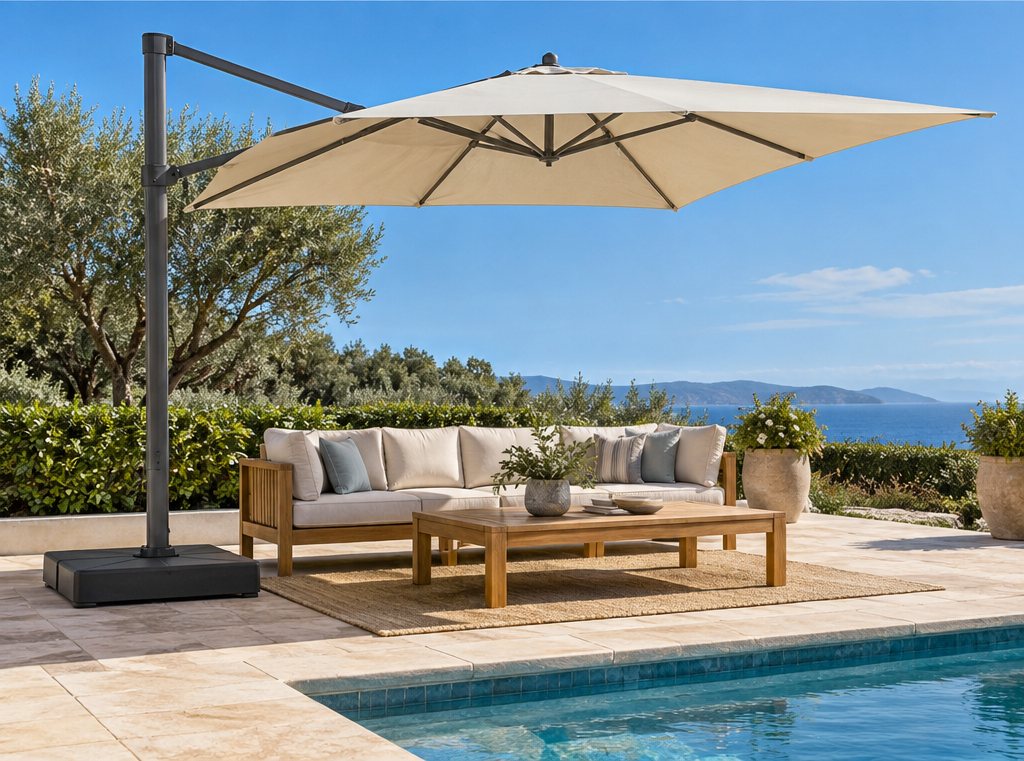
Umbrellas measure by canopy diameter, taken straight across the open canopy from rib tip to rib tip. If you are weighing an offset model, our cantilever umbrella guide goes deeper into arm lengths, rotation and wind safety; this page covers sizing for every type.
What size patio umbrella do I need?
You need a patio umbrella about 4–5 ft wider than your table, which keeps seated shoulders in shade as the sun moves. The chart below is the patio umbrella size guide we use when specifying sets.
| Table size | Seats | Umbrella size | Shade area (approx.) | Base through table | Base freestanding |
|---|---|---|---|---|---|
| 24–30 in (61–76 cm) bistro | 2 | 6–7.5 ft (1.8–2.3 m) round | 28–44 sq ft (2.6–4 m²) | 20–30 lb (9–14 kg) | 35–50 lb (16–23 kg) |
| 36–42 in (91–107 cm) round or square | 2–4 | 7.5–9 ft (2.3–2.7 m) round | 44–64 sq ft (4–6 m²) | 30–40 lb (14–18 kg) | 50–60 lb (23–27 kg) |
| 48 in (122 cm) round | 4 | 9 ft (2.7 m) round | about 64 sq ft (6 m²) | 40–50 lb (18–23 kg) | 60–75 lb (27–34 kg) |
| 54–60 in (137–152 cm) round | 5–6 | 10–11 ft (3–3.4 m) round | 78–95 sq ft (7–9 m²) | 50–60 lb (23–27 kg) | 75–100 lb (34–45 kg) |
| 72–84 in (183–213 cm) rectangle | 6 | 6.5 × 10 ft (2 × 3 m) rectangle or 11 ft round | about 65 sq ft (6 m²) | 50–60 lb (23–27 kg) | 75–100 lb (34–45 kg) |
| 96–108 in (244–274 cm) rectangle | 8–10 | 8 × 11 ft (2.4 × 3.4 m) rectangle or two umbrellas | about 88 sq ft (8 m²) | 60–75 lb (27–34 kg) | 100 lb+ (45 kg+) |
| Lounge seating, no table | 3–6 | 10–13 ft (3–4 m) cantilever | 78–130 sq ft (7–12 m²) | n/a | 150–250 lb+ (68–113 kg+) |
Weights are typical guidance for market umbrellas in sheltered gardens. Exposed rooftops, coastal sites and any umbrella with a heavy acrylic canopy should go one step heavier, and the manufacturer's stated minimum always overrides a chart.
Patio umbrella sizes also shift with orientation. On a west-facing terrace the evening sun comes in low, so the shadow slides off the table long before sunset; go one size up, choose a tilting model, or add a side screen. On a north-facing or partly shaded patio you can often go one size down and save weight on the base. Canopy fabric matters too: solution-dyed acrylic at 240–300 gsm holds color for years, while 160–220 gsm polyester is lighter and cheaper but fades faster.
How heavy should a patio umbrella base be?
A patio umbrella base should weigh at least 10 lb per foot of canopy diameter when the pole passes through a table, and roughly double that when the umbrella stands alone. The table acts as a second anchor point, so it halves the leverage on the base.
Types of umbrella stand base
- Cast iron or concrete: the densest heavy umbrella base, 30–100 lb in a compact footprint. Best under tables.
- Fillable resin: filled with water or sand, 40–80 lb. Sand weighs about 50 percent more than water for the same volume; empty it before freezing weather.
- Steel plate with wheels: a wheeled outdoor umbrella stand makes a 75 lb base movable; lock the wheels before opening.
- Cantilever cross base: a steel frame loaded with four or more stacking plates or sandbags to 150–250 lb or more.
- In-ground sleeve or deck mount: a tube set in concrete or bolted to deck blocking. The most secure outdoor umbrella holder and the hotel standard.
Fit the pole
Patio umbrella sizes and base sizes go together, so measure the pole diameter before buying any umbrella stand base. Residential market poles are usually 1.5 in (38 mm); larger 11–13 ft models often use 1.9–2 in (48–50 mm). Good bases come with step-down rings or a tightening knob so the pole cannot rattle, which is where wobble and cracked table holes start.
Do I need a patio table with an umbrella hole?
A patio table with an umbrella hole is the most stable and space-efficient way to shade a dining set, because the tabletop braces the pole and a lighter base fits underneath. Standard holes are 1.75–2.5 in (44–64 mm) across; check that the hole sits in the exact center and that the table has a lower cross-brace or ring to keep the pole vertical.
Glass and stone tops need a rubber grommet or collar so the pole never touches the edge of the hole. If your outdoor table with umbrella hole is round and at least 42 in (107 cm), a center pole is ideal; for anything without a hole, or for lounge areas, use a freestanding umbrella or a cantilever beside the seating. Buying the full set? Our outdoor dining set guide covers table sizes and the matching umbrella set patio buyers usually want.
When should you choose a rectangular patio umbrella?
Choose a rectangular patio umbrella whenever the table is more than about 1.5 times longer than it is wide, because a round canopy over a long table shades the middle and leaves the end seats in sun. A 6.5 × 10 ft (2 × 3 m) rectangle umbrella suits 72–84 in (183–213 cm) tables; an 8 × 11 ft (2.4 × 3.4 m) one covers 96 in (244 cm) or more.
A rectangular umbrella is also the right shape along a wall, a narrow balcony or a pool edge where a round canopy would hit a railing. For tables over 10 ft (3 m), two matching umbrellas look better and handle wind better than one huge one.
What is the best large umbrella for a pool?
The best pool umbrella is a 7.5–9 ft (2.3–2.7 m) commercial-style market umbrella in a sleeve or heavy base beside each pair of loungers, or a 11–13 ft cantilever arcing over a group. A swimming pool umbrella faces open wind, chlorine and constant handling, so build quality matters more than size.
- Frame: fiberglass ribs flex instead of snapping; powder-coated aluminum poles resist chlorine better than steel.
- Canopy: vented, with a wind valve at the top, in solution-dyed acrylic or marine-grade polyester at UPF 50+.
- Base: in-ground sleeves set flush in the deck are safest and leave no trip hazard around wet feet.
- Height: a big umbrella over loungers can sit lower, around 6.5 ft (2 m) at the edge, since nobody walks under it.
Shoppers searching "large umbrella" or "big umbrella" usually need an 11–13 ft (3.4–4 m) canopy for lounge areas. At that size a cantilever beats a center pole, and the base needs serious weight or a permanent mount.
Are lit patio umbrellas worth it?
A lit patio umbrella is worth it as soft ambient light for a small table, but it is not a replacement for proper outdoor lighting. Most outdoor umbrella with lights designs carry LED strips along each rib or a pole-mounted ring, powered by a solar panel on top or a rechargeable battery, and give a few hundred lumens at most.
Check three things: the battery is replaceable, the LED strips are rated at least IP44 for rain, and the solar panel sits clear of the vent so it does not trap wind. Warm white at 2,700–3,000 K looks far better than cool white. For real task light over a dining table, plan wired fixtures with our lighting calculator.
How do you measure for a replacement umbrella canopy?
Measure a replacement umbrella canopy by rib length and rib count, not by the old canopy's label, because labelled sizes are rounded and frames vary.
- Open the frame without the fabric or with the old canopy loose.
- Count the ribs. Most round umbrellas have 6 or 8; the new canopy must match exactly.
- Measure one rib from the center hub to the tip, in a straight line.
- Measure tip to tip across the frame for the straight diameter; this is usually the advertised size.
- Check the vent and pole top. Single or double vent, and the finial thread size.
- Check the tip pockets. Fabric pockets, grommets or hooks must match your rib ends.
Replacement canopies cost roughly $40–200 for polyester and $150–500 for solution-dyed acrylic; on a sound frame they add five or more seasons.
Mistakes we see with patio umbrella sizes
The mistake we see most often is buying the umbrella for the table rather than for the people sitting at it: a canopy that only just covers the tabletop leaves every chair in sun by mid-afternoon. Close behind it:
- Base too light. A 9 ft umbrella on a 25 lb freestanding base will tip in a modest gust.
- Canopy too low. Edges under 6.5 ft (2 m) catch heads and hold heat.
- Left open overnight. Most broken ribs and tipped tables happen when nobody is watching.
- Dark canopy, small patio. A charcoal 11 ft canopy on a small terrace feels oppressive; go lighter or smaller.
Our verdict: the umbrella we would buy
For a typical four-seat patio, we would buy a 9 ft (2.7 m) round market umbrella with fiberglass ribs and a vented solution-dyed acrylic canopy, set through the table into a 40–50 lb cast base, and close it every evening. For lounge seating, an 11 ft cantilever on a bolted mount. Getting patio umbrella sizes right costs nothing; getting the base wrong costs a table. If a single umbrella is not enough, compare sails and pergola covers in our patio shade ideas guide, and see our outdoor living trends 2027 overview for colors and materials.
Specifying umbrellas for a hotel, pool deck or restaurant terrace? Send counts and table sizes through our outdoor sourcing desk for quotes on canopies, frames and bases.
Free toolLighting CalculatorLumens, fixtures and color temperature for any room.Shop & source the look
Buy it today — or have it made
Retail links are affiliate links: we may earn a commission at no extra cost to you (disclosure). “Get it made” sends the item to our sourcing desk for factory quotes in custom sizes and finishes.
Frequently asked questions
What size umbrella do I need for a 60 inch table?
A 60 in (152 cm) round table needs a 10–11 ft (3–3.4 m) umbrella, which gives about 2 ft of shade beyond the edge for six seated people. Use a base of at least 50–60 lb through the table. If the table is a 60 in rectangle, a 6.5 × 10 ft rectangular canopy shades it more evenly.
How do I know what size umbrella base to buy?
Match the base to both the pole diameter and the canopy size. Measure the pole, usually 1.5 in (38 mm), then allow roughly 10 lb per foot of canopy when the pole passes through a table and about double when it stands alone. Cantilevers need 150–250 lb or a bolted mount.
Is a 9 ft umbrella big enough?
A 9 ft (2.7 m) umbrella is big enough for a 42–48 in (107–122 cm) table and four chairs, which covers most residential dining sets. It shades about 64 sq ft (6 m²). For six seats, lounge areas or west-facing patios with low afternoon sun, step up to 10–11 ft or add a second umbrella.
How are patio umbrellas measured?
Patio umbrellas are measured by canopy diameter, straight across the open frame from rib tip to rib tip. Because the canopy is domed, the fabric arc measures longer than the advertised size. Rectangular umbrellas are given as width by length, for example 6.5 × 10 ft (2 × 3 m).
At what wind speed should you close a patio umbrella?
Close a patio umbrella when wind reaches about 15–20 mph, or earlier if gusts lift the canopy. A heavy base stops the umbrella falling over, but it does not stop ribs bending or the canopy tearing. Close and tie umbrellas every evening and whenever you leave the patio.
Some links may be affiliate links. Regulations and specifications change — always confirm with suppliers and qualified professionals.